This Report Provides In-Depth Analysis of the Security Orchestration Market Report Prepared by P&S Intelligence, Segmented by Component (Solution, Services), Deployment Mode (Cloud, On-Premises), Organization Size (Large Enterprises, Small & Medium Enterprises), End User (Banking, Financial Services, and Insurance, Healthcare, IT & Telecom, Retail & E-Commerce, Manufacturing, Energy & Utilities, Government & Defense, Education), and Geographical Outlook for the Period of 2021 to 2032
Explore the market potential with our data-driven report
Security Orchestration Market Future Outlook
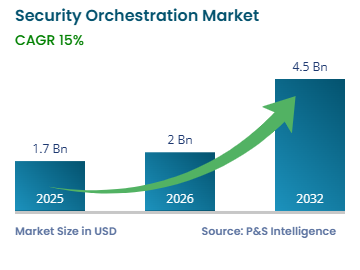
The security orchestration market size was USD 1.7 billion in 2025, and it will grow by 15.0% during 2026–2032 to reach USD 4.5 billion by 2032.
The market is expanding as organizations face complex cybersecurity environments that require faster and more coordinated threat response. Cloud adoption, remote work, connected devices, and hybrid IT infrastructures generate large volumes of alerts that can overwhelm manual investigation processes. Security orchestration, automation, and response (SOAR) platforms address this challenge by connecting security tools, automating repetitive workflows, and coordinating incident response across modern security operations centers (SOCs). This allows analysts to prioritize critical threats while reducing time spent on predictable enrichment, remediation, and documentation tasks.
According to the International Telecommunication Union, 5.5 billion people were using the internet in 2024, representing 68% of the global population. This statistic demonstrates the scale of digital connectivity, the related increase in security orchestration demand is market analysis, as organizations must protect growing numbers of users, applications, devices, and network connections across distributed environments. Stronger incident-management rules, cybersecurity governance requirements, and compliance reporting obligations are also increasing demand for standardized response procedures and automated audit trails.
Key Market Insights
Solution is the larger component, holding a market share of 75.5%, due to rising enterprise demand for integrated threat detection, automation, and incident response capabilities.
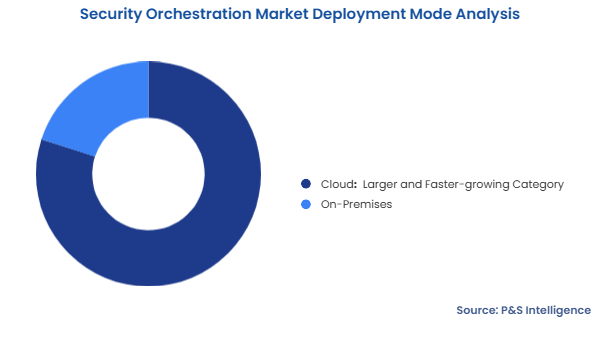
Cloud is the larger and faster-growing category, holding a market share of 80.0% and registering a CAGR of 15.3%, due to increasing adoption of cloud-native applications and demand for scalable security operations.
Large Enterprises are the larger organisation size category, holding a market share of 75.0%, due to complex multi-vendor security environments requiring centralised orchestration and automated security workflows.
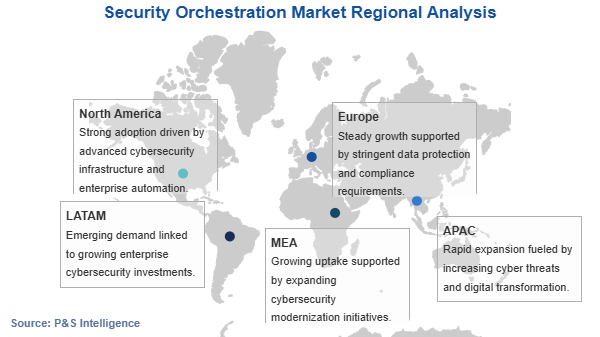
North America holds the largest share of 45.5%, due to high cyber incident volumes, mature security operations infrastructure, and widespread adoption of cybersecurity technologies.
Asia-Pacific is the fastest-growing region, registering a CAGR of 16.5%, due to accelerating digital transformation, expanding cloud adoption, and rising cybersecurity incident volumes across major economies.
Security Orchestration Market Trends and Drivers
AI-Driven and Agentic Security Operations Is a Major Trend
Security orchestration platforms are evolving from rule-based automation tools into AI-driven security operations systems that support faster and more informed decision-making. Organizations increasingly require platforms that can correlate alerts, prioritize threats, recommend response actions, and assist analysts throughout investigations. By automating initial triage, gathering contextual evidence, and identifying high-priority incidents, AI can reduce alert fatigue and help security teams shorten Mean Time to Detect (MTTD) and Mean Time to Respond (MTTR). According to the World Economic Forum, 66% of organizations expected artificial intelligence to have the most significant impact on cybersecurity in 2025. This statistic reflects the growing importance of AI across security operations; the resulting demand for AI-enabled orchestration platforms is market analysis. Vendor innovation also demonstrates this shift.
In 2025, Google Cloud introduced Google Unified Security and AI-powered security agents capable of supporting automated alert triage, investigation, and malware analysis within security operations workflows. These developments are changing how security teams manage investigations, threat prioritization, and incident response. AI-enabled orchestration allows analysts to process larger alert volumes, reduce time spent on repetitive investigations, and focus on complex threats requiring human judgment. As organizations seek faster detection and response, AI capabilities are becoming an important differentiator in orchestration platforms, shaping future investment in intelligent automation and adaptive security operations.
Rising Volume and Complexity of Cyber Threats Drive Market
The rising frequency and complexity of cyber threats are driving demand for security orchestration and automated response solutions. Organizations operate across cloud environments, applications, endpoints, identities, and networks, creating security ecosystems that generate large volumes of alerts requiring rapid investigation. Manual processes often struggle to keep pace with this activity, increasing the need for platforms that automate response actions, coordinate security tools, and standardize incident handling. According to Verizon's 2025 Data Breach Investigations Report, 22,052 real-world security incidents and 12,195 confirmed data breaches were analyzed. Check Point Research also reported that organizations experienced an average of 1,984 cyberattacks per week in Q2 2025.
The growing adoption of Extended Detection and Response (XDR) platforms is further supporting the market, as SOAR capabilities increasingly integrate with broader XDR ecosystems to coordinate alerts and response actions across endpoints, identities, email, cloud workloads, and applications. This combination helps reduce fragmented investigations, improve response consistency, and automate remediation across multiple security layers. As enterprises seek faster containment and lower analyst workloads, integration between SOAR, XDR, SIEM, and threat intelligence platforms is becoming increasingly important for modern security operations.
Complex Integration and Deployment Challenges Restrain Market Growth
Deployment complexity remains a key restraint for the security orchestration market because many organizations operate fragmented security environments built from multiple vendors, legacy infrastructure, and highly customized workflows. Integrating orchestration platforms with older SIEM systems, firewalls, endpoint tools, identity platforms, and proprietary applications can require extensive connector development, API configuration, and workflow redesign. Differences in data formats, vendor architectures, and automation capabilities also create interoperability challenges that limit seamless coordination across existing security tools. According to IBM and Palo Alto Networks research, surveyed organizations managed an average of 83 security solutions from 29 vendors in 2025, highlighting the complexity of modern cybersecurity environments. These barriers can discourage full-scale adoption, particularly among organizations with limited technical resources or deeply embedded legacy systems. Many enterprises therefore use phased implementations to reduce disruption risks, but this can delay broader automation benefits and slow expansion across the entire security environment.
Expansion of Managed Security Operations Creates Market Opportunity
The growing use of outsourced cybersecurity services is creating opportunities for security orchestration providers. Organisations are increasingly relying on managed security service providers and external security operations centres to strengthen monitoring and incident response capabilities without significantly expanding internal teams. Service providers require platforms that can standardise workflows, automate investigations, and manage security activities across multiple customer environments. According to ISC2, the global cybersecurity workforce gap reached 4.8 million professionals in 2024. The shortage of qualified personnel is encouraging organisations to seek external security expertise while increasing demand for automation technologies that improve analyst productivity. Security orchestration platforms help service providers scale operations more efficiently, support larger customer bases, and deliver faster response capabilities. This is encouraging investment in flexible orchestration solutions designed for multi-tenant and distributed security environments.
Solution is the larger category, holding a market share of 75.5%, because organisations prioritise investment in orchestration, automation, and response platforms that centralise security operations and improve incident management efficiency. These platforms coordinate multiple security tools, automate workflows, and strengthen visibility across complex environments. According to Splunk, 59% of respondents reported that adopting a unified platform accelerated incident response in 2025.
Services are the faster-growing category, registering a CAGR of 15.5%, due to increasing demand for specialised expertise required to deploy, integrate, customise, and manage security orchestration environments. Many organisations lack the internal resources needed to optimise automation workflows and maintain complex security ecosystems. As adoption expands across industries, enterprises are relying on consulting, implementation, training, and managed security services to maximise platform effectiveness.
The component analysed in this report are:
Solution (Larger Category)
Services (Faster-growing Category)
Professional Services
Managed Services
Deployment Mode Analysis
Cloud is the larger and faster-growing category, holding a market share of 80.0% and registering a CAGR of 15.3%, as organizations favor scalable deployment, faster implementation, and support for distributed security operations. Cloud-based orchestration platforms reduce infrastructure management needs and simplify integration across hybrid and multi-cloud environments. According to CNCF and SlashData, 15.6 million developers were using cloud-native technologies globally in Q3 2025. The growing adoption of cloud-native applications is increasing the need for centralized security orchestration solutions that can automate threat detection, incident response, and security workflows across complex IT environments.
The deployment mode analysed in this report are:
Cloud (Larger and Faster-growing Category)
On-Premises
Organisation Size Analysis
Large Enterprises are the larger category, holding a market share of 75.0%, because these organizations manage complex digital infrastructures, multiple business units, and geographically distributed operations that generate high security activity. According to the World Economic Forum, 54% of large organizations identified third-party risk management as a major challenge in 2025. This complexity increases demand for orchestration platforms that unify visibility, automate response workflows, and maintain consistent security operations across cloud environments, enterprise applications, external partners, and interconnected business systems.
Small & Medium Enterprises (SMEs) are the faster-growing category, registering a CAGR of 16.1%, as rising cyber threats and limited security staffing increase demand for automation. Cloud-delivered subscription models are making advanced security orchestration more accessible by reducing upfront infrastructure costs, simplifying deployment, and allowing businesses to scale usage according to operational needs.
The organization size analysed in this report are:
Large Enterprises (Larger Category)
Small & Medium Enterprises (SMEs) (Faster-growing Category)
End User Analysis
Banking, Financial Services, and Insurance (BFSI) is the largest category, holding a market share of 25.5%, because financial institutions manage sensitive customer data, real-time transactions, complex payment networks, and strict compliance obligations. Banks and insurers face persistent threats targeting digital platforms, customer accounts, third-party connections, and financial infrastructure. Security orchestration platforms help unify alerts, automate investigations, coordinate response actions, and maintain consistent security controls across distributed environments.
Healthcare is the fastest-growing category, registering a CAGR of 15.8%, as electronic health records, connected medical devices, cloud applications, and digital clinical systems expand the sector’s attack surface. According to Check Point Research, healthcare organizations experienced an average of 1,999 cyberattacks per week in Q2 2024. This statistic demonstrates the scale of cyber threats affecting the sector; the resulting increase in orchestration demand is market analysis.
The end user analysed in this report are:
Banking, Financial Services, and Insurance (BFSI) (Largest Category)
Healthcare (Fastest-growing Category)
IT & Telecom
Retail & E-Commerce
Manufacturing
Energy & Utilities
Government & Defense
Education
Others
Drive strategic growth with comprehensive market analysis
Security Orchestration Market Regional Outlook
North America Security Orchestration Market Analysis
North America holds the largest share, of 45.5%, because organisations across the region have established mature security operations programs and continue to invest heavily in technologies that improve threat detection, incident response, and cybersecurity resilience. Enterprises operate highly complex digital environments spanning cloud platforms, remote work infrastructures, and interconnected business applications, creating strong demand for orchestration and automation capabilities. The region also benefits from the presence of leading cybersecurity vendors, advanced managed security service ecosystems, and extensive adoption of security operations centre practices. Regulatory expectations surrounding data protection and incident management further encourage organisations to implement centralised security workflows.
U.S. Security Orchestration Market Analysis
The United States serves as the core market for security orchestration adoption due to the scale of its cybersecurity ecosystem and the complexity of enterprise security environments. Organisations across finance, healthcare, technology, defence, and critical infrastructure manage large volumes of security alerts and require faster threat response capabilities. According to the Federal Bureau of Investigation's Internet Crime Complaint Centre, 859,532 cybercrime complaints were recorded in 2024. The high volume of cyber incidents is encouraging enterprises to strengthen security operations through automation and orchestration. This demand supports continued investment in platforms that improve visibility, accelerate investigations, and coordinate response activities across diverse security infrastructures.
Canada Security Orchestration Market Analysis
Canada is experiencing strong growth in security orchestration adoption as organisations expand digital operations and strengthen cybersecurity programmes. Enterprises are increasingly investing in automation technologies to improve incident response efficiency while addressing workforce and resource constraints. According to the Communications Security Establishment Canada, the Canadian Centre for Cyber Security responded to 2,561 cybersecurity incidents during 2024–2025. The growing level of cybersecurity activity is encouraging organisations to adopt integrated security operations technologies that can manage threats more effectively. Security orchestration platforms are helping enterprises improve operational consistency, coordinate security tools, and strengthen cyber resilience across distributed digital environments.
Asia-Pacific has the highest CAGR, of 16.5%, because organisations throughout the region are rapidly expanding their digital infrastructure and increasing investments in cybersecurity modernisation. Businesses are adopting cloud services, connected technologies, and digital platforms at a significant pace, creating a growing need for automated security operations. Demand is further supported by rising awareness of cyber risks and efforts to strengthen enterprise security capabilities. China remains the largest country market due to its extensive enterprise technology landscape, large-scale digital economy, and growing focus on cybersecurity governance.
China Security Orchestration Market Analysis
China represents the largest market within Asia-Pacific due to its extensive digital infrastructure, large enterprise technology base, and strengthening cybersecurity requirements. Organizations are investing in advanced security frameworks to protect cloud environments, business applications, industrial systems, and sensitive data. China’s Ministry of Industry and Information Technology introduced a data-security initiative that includes emergency drills covering more than 45,000 companies by 2026. This directly supports the need for coordinated incident handling and stronger security operations. Enterprises are increasingly adopting orchestration platforms to automate workflows, connect multiple security tools, improve visibility, and support faster response across complex digital environments.
India Security Orchestration Market Analysis
India is emerging as the fastest-growing country market as enterprises accelerate digital transformation initiatives and expand cloud-based business operations. Organisations increasingly require security automation to manage growing IT environments and respond to evolving cyber threats without proportionally increasing security staffing. According to the Press Information Bureau of India, the country recorded 22.68 lakh cybersecurity incidents in 2024. The rising scale of cyber threats is encouraging businesses to strengthen security operations and improve response efficiency. Security orchestration platforms support these objectives by automating investigations, coordinating security technologies, and helping organisations manage increasingly complex cybersecurity environments.
Europe Security Orchestration Market Analysis
Europe remains an important market for security orchestration solutions as enterprises modernize security operations to meet stricter cyber resilience, incident reporting, and data protection requirements. Across the European Union, the NIS2 Directive strengthens cybersecurity obligations across 18 critical sectors, while DORA requires financial entities to improve ICT risk management, incident reporting, and operational resilience. GDPR continues to reinforce the need for strong personal-data protection and breach management. These requirements are increasing demand for orchestration platforms that standardize response workflows, automate evidence collection, and improve visibility across distributed environments. The U.K. remains the largest country market due to its mature cybersecurity and financial services sectors, while France is the fastest-growing as cloud adoption, digital modernization, and national cybersecurity initiatives accelerate security operations investment.
The regions and countries analysed in this report are:
North America (Largest Regional Market)
U.S. (Larger Country)
Canada (Faster-Growing Country)
Europe
Germany
U.K. (Largest Country)
France (Fastest-Growing Country)
Italy
Spain
Rest of Europe
Asia-Pacific (Fastest-Growing Regional Market)
China (Largest Country)
India (Fastest-Growing Country)
Japan
South Korea
Australia
Rest of APAC
Latin America
Brazil (Largest Country)
Mexico (Fastest-Growing Country)
Rest of LATAM
Middle East and Africa
Saudi Arabia
U.A.E.
South Africa (Largest Country and Fastest-Growing Country)
Rest of MEA
Security Orchestration Market Share Analysis
The security orchestration market has a fragmented competitive structure, with global cybersecurity companies, security operations specialists, cloud security providers, managed service firms, and automation-focused vendors competing across different deployment environments and industry requirements. Leading vendors maintain advantages through broad platform integration, advanced AI capabilities, established customer relationships, and ecosystem partnerships that connect orchestration tools with SIEM, XDR, endpoint security, cloud platforms, identity systems, and threat intelligence sources. Smaller and specialized providers compete through focused automation workflows, industry-specific expertise, and flexible deployment models. Open APIs and interoperability are becoming important differentiators because enterprises increasingly expect orchestration platforms to connect diverse security technologies without creating additional integration complexity.
Leading Companies in the Security Orchestration Market:
Cisco Systems, Inc.
IBM Corporation
Palo Alto Networks, Inc.
ServiceNow, Inc.
Fortinet, Inc.
Rapid7, Inc.
Exabeam, Inc.
CrowdStrike Holdings, Inc.
D3 Security Management Systems, Inc.
Tines Security Services Limited
Swimlane LLC
Microsoft Corporation
Google LLC
Check Point Software Technologies Ltd.
Tufin Software Technologies Ltd.
Security Orchestration Market News
In June 2026, Cisco Systems, Inc. announced an agentic platform for operating and defending critical IT infrastructure, introducing AI-driven capabilities designed to automate and simplify security and infrastructure operations. The development strengthens Cisco’s security automation and orchestration capabilities by enabling more intelligent threat protection and coordinated security operations across complex IT environments.
In May 2026, Check Point Software Technologies Ltd. launched its Agentic Network Security Orchestration Platform, featuring an autonomous agent architecture that translates business intent into security policies, automates troubleshooting, and streamlines network security operations while maintaining governance and audit controls.
In November 2025, Tufin Software Technologies Ltd. released Tufin Orchestration Suite R25-2, introducing enhanced policy automation for hybrid networks, cloud, and SASE environments. The update added improved topology visibility, automated change design capabilities, and compliance-focused controls to help security teams streamline policy management and governance across complex network infrastructures.
In November 2025, CrowdStrike Holdings, Inc. introduced Charlotte Agentic SOAR as the orchestration layer of its Falcon Agentic Security Platform. The solution connects native, custom-built, and third-party agents to enable real-time agent-to-agent and analyst-to-agent collaboration, helping security teams orchestrate investigations, response actions, and security workflows through AI-driven automation and governance controls.
Frequently Asked Questions About This Report
What does the security orchestration market include for organizations?+
It includes platforms that coordinate security tools, workflows, alerts, evidence, and response actions across security operations centers.
What factors are driving demand in the security orchestration market?+
Growth is driven by tool sprawl, alert volume, incident response pressure, staff shortages, and need for coordinated security processes.
Why are organizations adopting security orchestration solutions across operations?+
Organizations adopt security orchestration to connect tools, standardize response steps, improve collaboration, and reduce manual handoffs.
How do security orchestration solutions improve decision making and efficiency?+
These platforms improve operations by combining automation, case management, enrichment, and playbooks into repeatable response workflows.
What challenges affect adoption of security orchestration solutions today?+
Adoption is affected by disconnected tools, poor playbook design, data inconsistency, process maturity, and trust in automated actions.
Want a report tailored exactly to your business need?
Leading companies across industries trust us to deliver data-driven insights and innovative solutions for their most critical decisions. From data-driven strategies to actionable insights, we empower the decision-makers who shape industries and define the future. From Fortune 500 companies to innovative startups, we are proud to partner with organisations that drive progress in their industries.
Client Testimonials
Working with P&S Intelligence and their team was an absolute pleasure – their awareness of timelines and commitment to value greatly contributed to our project's success. Eagerly anticipating future collaborations.
McKinsey & Company
India
Unmatched Standards
Our insights into the minutest levels of the markets, including the latest trends and competitive landscape, give you all the answers you need to take your business to new heights
Complete Data Security
We take a cautious approach to protecting your personal and confidential information. Trust is the strongest bond that connects us and our clients, and trust we build by complying with all international and domestic data protection and privacy laws