Extended Detection and Response Market Size & Share Analysis - Trends, Drivers, Competitive Landscape, and Forecasts (2026 - 2032)
This Report Provides In-Depth Analysis of the Extended Detection and Response Market Report Prepared by P&S Intelligence, Segmented by Component (Solutions, Services), Deployment Mode (Cloud-based, Hybrid, On-premises), Organization Size (Large Enterprises, Small & Medium Enterprises), End-User (IT & Telecommunications, Healthcare, BFSI, Manufacturing, Retail & E-commerce, Government & Public Sector, Energy & Utilities), Security Function (Endpoint Detection & Response, Identity Threat Detection, Network Detection & Response, Cloud Security Monitoring, Threat Intelligence & Analytics), and Geographical Outlook for the Period of 2021 to 2032
Extended Detection and Response Market Size Estimation
Key Highlights
Study Period
2021 - 2032
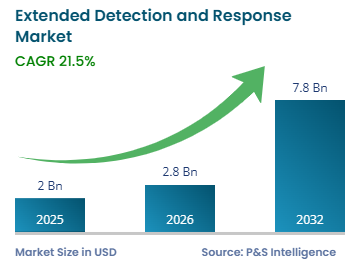
Market Size in 2025
USD 2.0 Billion
Market Size in 2026
USD 2.8 Billion
Market Size by 2032
USD 7.8 Billion
Projected CAGR
21.5%
Largest Region
North America
Fastest-Growing Region
Asia-Pacific
Market Structure
Fragmented
Market Size
Explore the market potential with our data-driven report
Extended Detection and Response Market Overview
The extended detection and response market size was USD 2.0 billion for 2025, and it will grow by 21.5% during 2026-2032, to reach USD 7.8 billion by 2032.
The market is expanding due to the rising frequency and sophistication of cyber threats targeting endpoints, networks, cloud workloads, identities, and applications. Organizations are facing increasing challenges in managing large volumes of security alerts generated by multiple security tools, often resulting in fragmented visibility and slower threat response. Extended detection and response platforms are gaining importance because they consolidate telemetry from different security layers, helping security teams investigate incidents more efficiently and identify attack patterns that may otherwise remain undetected. The growing complexity of hybrid and multi-cloud environments is also increasing demand for centralized threat detection and response capabilities.
According to the Federal Bureau of Investigation, the Internet Crime Complaint Center recorded 859,532 suspected internet crime complaints in 2024. Additionally, reported losses associated with these complaints exceeded USD 16 billion, reflecting the significant financial impact of cybercrime on organizations and individuals. The scale of these incidents highlights the increasing pressure on enterprises to strengthen threat detection, investigation, and response processes across expanding digital environments.
This threat landscape is driving investment in platforms that integrate endpoint, network, cloud, and identity security data into a unified operational view. Security teams are using extended detection and response solutions to improve threat correlation, reduce investigation time, prioritize high-risk incidents, and automate response actions. These capabilities are becoming increasingly important for organizations seeking stronger security operations, improved analyst efficiency, and broader visibility across complex enterprise infrastructures.
Key Market Insights
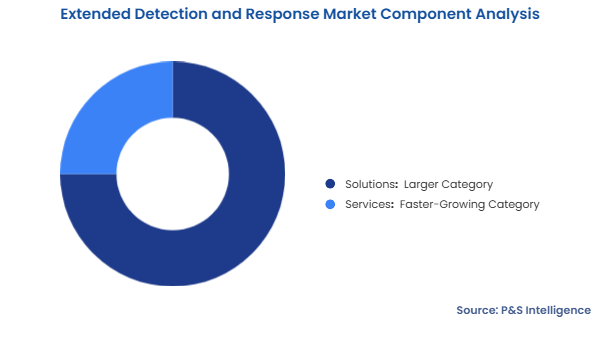
Solutions are the larger segment, holding a market share of 75%, due to strong enterprise preference for integrated, AI-driven security platforms.
Hybrid is the fastest-growing segment, registering a CAGR of approximately 21.9%, driven by the increasing need to secure both cloud and legacy IT environments.
Endpoint Detection & Response is the largest segment, holding a market share of 40%, due to rising endpoint-based cyberattacks targeting devices and users.
North America is the largest region, holding a market share of 40%, due to high cybercrime incidence and strong enterprise cybersecurity investments.
Asia-Pacific is the fastest-growing region, registering a CAGR of approximately 22.4%, driven by rapid digitalisation and expanding enterprise IT infrastructure across emerging economies.
Extended Detection and Response Market Dynamics
AI-Driven Unified Security Platforms Are a Major Trend
The market is shifting toward integrated extended detection and response platforms that unify security visibility across endpoints, networks, cloud workloads, identities, and applications. Organizations are replacing disconnected security tools with platforms that combine telemetry collection, threat correlation, and automated response workflows. This shift is being driven by alert overload, complex hybrid environments, and the need to investigate attacks that move across multiple systems. According to Microsoft Corporation, its 2025 Digital Defense Report stated that Microsoft thwarted USD 4 billion in fraud attempts and blocked about 1.6 million bot-driven or fake account sign-up attempts per hour. International Business Machines Corporation (IBM) also reported that organizations with extensive security AI, and automation identified and contained breaches 108 days faster on average than organizations without AI tools. These capabilities are increasing demand for XDR platforms that improve analyst efficiency, reduce manual triage, and support faster incident response.
Rising Frequency and Complexity of Cyberattacks Drive Market
The market is growing due to the increasing frequency and sophistication of cyberattacks across distributed IT environments. Organizations now face attacks that combine credential theft, phishing, malware, cloud exploitation, and lateral movement across endpoints, networks, and identity systems. Traditional security tools often operate in silos, making it harder for security teams to connect signals and identify the full attack path quickly. According to the Federal Bureau of Investigation's Internet Crime Complaint Center, 1,008,597 suspected internet crime complaints were recorded in 2025, with reported losses reaching USD 20.877 billion. According to the 2025 Cisco Cybersecurity Readiness Index, 86% of business leaders with cybersecurity responsibilities reported at least one AI-related security incident in the past 12 months. This threat complexity is increasing enterprise investment in XDR platforms that improve detection accuracy, prioritize high-risk alerts, and coordinate response actions across interconnected security layers.
Integration Challenges with Existing Security Systems Limit Adoption
One key restraint in the market is the difficulty of integrating extended detection and response platforms with existing security tools and IT infrastructure. Many organizations operate complex security environments built over years of technology investments, where endpoint, network, cloud, identity, and security information and event management systems often function independently. This fragmentation creates visibility gaps, inconsistent data formats, and slower investigation workflows. According to IBM, organizations used an average of 83 different security solutions in 2024, increasing the complexity of managing and integrating cybersecurity systems. Moreover, security teams must correlate alerts across multiple platforms, which increases operational workload and extends deployment timelines. These integration challenges can limit platform efficiency, reduce automation effectiveness, and slow broader adoption across enterprise security operations.
Growing Demand from Mid-Sized Firms and Managed Security Providers Creating New Scope
The market presents strong opportunities driven by increasing demand from mid-sized enterprises and managed security service providers seeking scalable cybersecurity capabilities. Many organizations are expanding cloud usage, supporting remote workforces, and managing larger digital attack surfaces, yet often lack dedicated security personnel and advanced threat detection resources. According to Cisco, around 70% of organizations globally remained in the beginner or formative stages of cybersecurity readiness in 2025, indicating a significant capability gap. Furthermore, many businesses require continuous monitoring, threat hunting, and incident response without building large internal security operations centers. This environment is encouraging vendors to deliver service-based extended detection and response platforms with centralized visibility, automated investigations, and simplified management models that support faster deployment across evolving enterprise environments.
Extended Detection and Response Market Segmentation Analysis
Component Analysis
Solutions are the larger category, holding a market share of 75%, because organizations need unified platforms that connect endpoint, network, cloud, identity, and threat intelligence data. These platforms reduce tool fragmentation by bringing detection, investigation, response automation, and alert prioritization into one workflow. According to the World Economic Forum, nearly two-thirds of organizations expected artificial intelligence to significantly influence cybersecurity strategies in 2025. This is strengthening demand for XDR solutions that improve visibility, automate threat correlation, and support faster response across hybrid and cloud-based security environments.
Services are the faster-growing category, registering a CAGR of approximately 21.7%, as many organizations lack skilled cybersecurity teams to operate XDR platforms, investigate alerts, and manage response workflows. Professional and managed services support deployment, configuration, threat hunting, monitoring, and incident response across complex security environments. This demand is closely linked with SMEs and hybrid deployments, where internal resources are often limited. Service providers help organizations use XDR tools more effectively by tuning alerts, integrating data sources, and maintaining continuous security coverage across endpoints, identities, cloud workloads, and networks.
The components analysed in this report are:
Solutions (Larger Category)
Services (Faster-Growing Category)
Deployment Mode Analysis
Cloud-based is the largest category, holding a market share of 60%, because organizations are shifting security operations toward scalable platforms that protect distributed workloads, remote users, and cloud applications. Cloud-based XDR supports centralized monitoring, automatic updates, and faster deployment across multiple sites without heavy internal infrastructure. This model connects strongly with SMEs and managed security services, where flexible pricing and simplified administration are important. Security teams use cloud-based platforms to collect telemetry from endpoints, networks, identities, and cloud systems, improving investigation speed across expanding digital environments.
Hybrid is the fastest-growing category, as organizations balance legacy infrastructure with expanding cloud environments and distributed workloads. Many enterprises maintain critical applications and sensitive data on-premises while extending operations across public and private cloud platforms. According to IBM, organizations operating at scale derived 2.5 times more value from hybrid multicloud platforms compared with single-provider approaches in 2025. This growing value is encouraging enterprises to strengthen hybrid XDR architectures that provide unified visibility, threat detection, and response across on-premises systems, cloud workloads, and identity layers.
The deployment modes analysed in this report are:
Cloud-based (Largest Category)
Hybrid (Fastest-Growing Category)
On-premises
Organisation Size Analysis
Large Enterprises are the larger category, holding a market share of 80%, because these organizations manage complex IT estates, large data volumes, and multiple security layers across global operations. They require XDR platforms that connect endpoint, identity, network, cloud, and threat intelligence signals to detect coordinated attacks faster. According to the World Economic Forum, nearly 45% of cyber leaders in large organizations identified operational disruption as their primary concern in 2025. This concern is increasing investment in integrated detection and response platforms that support business continuity, incident coordination, and security operations center efficiency.
Small & Medium Enterprises (SMEs) are the faster-growing category, as these businesses expand digital operations, adopt cloud services, and face more credential-based and phishing-related attacks. Many SMEs lack large security teams, making simplified XDR platforms and managed services more attractive. Cloud-based deployment supports this segment by reducing infrastructure requirements and improving access to continuous monitoring. SMEs are investing in solutions that combine alert triage, endpoint protection, identity monitoring, and automated response, allowing smaller teams to strengthen security coverage without building full internal security operations centers.
The organization sizes analysed in this report are:
Large Enterprises (Larger Category)
Small & Medium Enterprises (SMEs) (Faster-Growing Category)
End-User Analysis
IT & Telecommunications is the largest category, holding a market share of 30%, because this sector operates large networks, cloud platforms, identity systems, and customer-facing digital services that require constant security monitoring. Telecom and technology companies handle high traffic volumes, sensitive customer data, and distributed infrastructure, making them frequent targets for ransomware, credential theft, and network intrusion attempts. XDR platforms support this sector by linking endpoint, network, cloud, and identity telemetry. This helps security teams maintain service continuity, detect lateral movement, and respond quickly across highly connected digital environments.
Healthcare is the fastest-growing category, registering a CAGR of approximately 21.0%, as the sector rapidly digitizes patient records, clinical applications, connected medical devices, and healthcare delivery systems. These environments contain sensitive information and require continuous system availability, making them attractive targets for cybercriminals. According to the American Hospital Association, healthcare recorded 444 reported cyberthreat incidents in 2024, including 238 ransomware threats and 206 data breach incidents. This threat environment is increasing investment in XDR platforms that improve visibility, accelerate threat investigation, and strengthen protection across hospital networks, cloud systems, and clinical operations.
The end-users analysed in this report are:
IT & Telecommunications (Largest Category)
Healthcare (Fastest-Growing Category)
BFSI
Manufacturing
Retail & E-commerce
Government & Public Sector
Energy & Utilities
Others
Security Function Analysis
Endpoint Detection & Response is the largest category, because endpoints remain major entry points for malware, credential theft, ransomware, and phishing-led intrusions. Organizations prioritize endpoint visibility to detect suspicious processes, isolate affected devices, and stop attacks before they spread across networks or cloud systems. Microsoft reported that it tracked and mitigated over 600 million cyberattacks daily in 2024, targeting devices and users globally. This attack volume is reinforcing demand for endpoint-focused XDR capabilities that support real-time detection, automated containment, and faster incident investigation.
Identity Threat Detection is the fastest-growing category, registering a CAGR of approximately 21.2%, as attackers increasingly use stolen credentials, session tokens, and privilege abuse to access enterprise systems. Remote work, cloud applications, and hybrid infrastructure have made identity a central security layer within XDR platforms. Organizations are monitoring user behavior, access patterns, impossible travel alerts, and abnormal privilege activity to identify compromised accounts earlier. This function connects closely with cloud-based and hybrid deployments, where identity signals help security teams detect lateral movement and coordinate response across endpoints, applications, and cloud workloads.
The security functions analysed in this report are:
Drive strategic growth with comprehensive market analysis
Extended Detection and Response Market Geographical Analysis
North America Extended Detection and Response Market Analysis
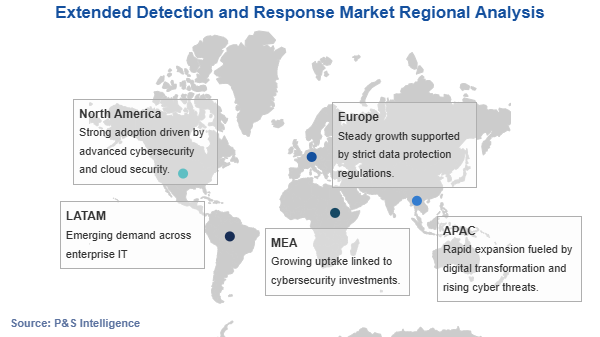
North America holds the largest share, of 40%, because the region has a mature cybersecurity ecosystem supported by advanced security operations centers, high cloud adoption, and significant investment in threat detection technologies. Enterprises manage complex environments that combine cloud workloads, remote users, third-party applications, and legacy infrastructure, creating demand for unified security visibility. Organizations increasingly deploy XDR platforms to correlate alerts across endpoints, networks, identities, and cloud environments. Strong presence of cybersecurity vendors, managed security providers, and technology innovators further accelerates adoption. Regulatory requirements related to data protection, breach disclosure, and cyber risk management are also encouraging continuous investment in monitoring, investigation, and response capabilities across large-scale enterprise environments.
U.S. Extended Detection and Response Market Analysis
The U.S. is the larger regional market, holding a significant share, due to its advanced enterprise IT ecosystem and early adoption of integrated cybersecurity platforms. Organisations invest heavily in solutions that unify threat data across endpoints, networks, and cloud systems to improve visibility. According to the Federal Bureau of Investigation, 859,532 internet crime complaints were recorded in 2024, with losses exceeding $16 billion. This high threat exposure is driving sustained demand for extended detection and response platforms across industries.
Canada Extended Detection and Response Market Analysis
Canada is growing steadily in the market due to increasing focus on strengthening cybersecurity infrastructure and protecting critical sectors. Organisations are adopting modern platforms to enhance visibility across distributed and cloud-based environments. According to Statistics Canada, one in five businesses planned to implement new or additional cybersecurity measures by 2025, particularly in the information and finance sectors. This rising adoption is encouraging demand for scalable and managed security solutions across organisations with limited internal cybersecurity resources.
Asia-Pacific Extended Detection and Response Market Analysis
Asia-Pacific has the highest CAGR, of approximately 22.4%, as organizations across the region rapidly expand digital services, cloud adoption, e-commerce platforms, and connected business operations. Many enterprises are moving beyond traditional security tools and investing in platforms that provide broader threat visibility and centralized response capabilities. Governments are strengthening national cybersecurity programs and encouraging businesses to improve cyber resilience against increasingly sophisticated attacks. The region also contains a large base of small and medium-sized enterprises that are expanding security spending as digital exposure grows. Demand is increasing for cloud-native, scalable, and service-based XDR solutions that help security teams detect threats faster across distributed and fast-changing technology environments.
China Extended Detection and Response Market Analysis
China is witnessing strong adoption of extended detection and response solutions due to the rapid expansion of digital infrastructure and increasing focus on protecting large-scale connected environments. Organizations are managing growing volumes of network traffic, cloud workloads, connected devices, and digital services, creating greater demand for centralized threat detection and response capabilities. According to the Ministry of Industry and Information Technology of the People's Republic of China, the number of 5G base stations reached 4.838 million by the end of 2025. This extensive digital infrastructure is expanding the attack surface across enterprise and public networks, increasing the need for XDR platforms that provide unified visibility, automated threat correlation, and faster incident response across highly interconnected environments.
Europe Extended Detection and Response Market Analysis
Europe shows stable growth driven by strong data privacy requirements, cybersecurity regulations, and structured security governance across industries. Organizations place significant emphasis on compliance, risk management, and continuous monitoring to protect sensitive business and customer data. Many enterprises operate across multiple countries, creating demand for security platforms that support centralized visibility and coordinated response across geographically distributed environments. Companies are investing in XDR solutions that integrate endpoint, network, identity, and cloud security data to strengthen threat detection and investigation processes. While procurement and deployment cycles can be longer due to regulatory reviews and enterprise governance requirements, demand remains consistent for platforms that improve operational visibility, compliance readiness, and incident response effectiveness.
The regions and countries analysed in this report are:
North America (Largest Regional Market)
U.S. (Larger Country)
Canada (Faster-Growing Country)
Europe
Germany (Largest Country)
U.K. (Fastest-Growing Country)
France
Italy
Spain
Rest of Europe
Asia-Pacific (Fastest-Growing Regional Market)
China (Largest Country)
India (Fastest-Growing Country)
Japan
South Korea
Australia
Rest of APAC
Latin America
Brazil (Largest Country)
Mexico (Fastest-Growing Country)
Rest of LATAM
Middle East and Africa
Saudi Arabia (Largest Country)
U.A.E. (Fastest-Growing Country)
South Africa
Rest of MEA
India Extended Detection and Response Market Analysis
India is emerging rapidly in the market due to expanding digital operations and rising exposure to cybersecurity threats across sectors. Organisations are shifting towards integrated platforms to improve visibility and manage risks across cloud and remote environments. According to the Press Information Bureau, cybersecurity incidents increased from 10.29 lakh in 2022 to 22.68 lakh in 2024. This sharp rise in attack volume is encouraging enterprises to adopt advanced detection and response solutions to strengthen security across growing digital ecosystems.
Extended Detection and Response Market Share Analysis
The market is fragmented, with cybersecurity vendors competing across endpoint detection and response (EDR), network detection and response (NDR), cloud workload protection, identity threat detection, email security, and security analytics. Large cybersecurity providers offer integrated XDR platforms that combine telemetry from endpoints, networks, cloud environments, identity systems, and security tools into a unified detection framework. Additionally, specialized vendors focus on areas such as managed XDR, threat intelligence integration, behavioral analytics, and automated incident response. Furthermore, organizations often select XDR solutions based on compatibility with existing SIEM, SOAR, EDR, IAM, and cloud security investments, limiting market concentration. Similarly, cloud-native security companies are introducing AI-driven threat hunting, attack path analysis, and cross-domain correlation capabilities to strengthen their offerings. Moreover, continuous product enhancements, technology partnerships, and platform integrations maintain strong competition across the market, keeping the vendor landscape highly diverse.
Leading Companies in the Extended Detection and Response Market:
Palo Alto Networks Incorporated
Microsoft Corporation
CrowdStrike Holdings Incorporated
Cisco Systems Incorporated
International Business Machines Corporation
Fortinet Incorporated
SentinelOne Incorporated
Trend Micro Incorporated
Broadcom Incorporated
Sophos Limited
Bitdefender S R L
Trellix
Cybereason Incorporated
BlackBerry Limited
Check Point Software Technologies Limited
Extended Detection and Response Market News
In April 2025, SOFTwarfare launched its iDXDR platform at the RSA Conference 2025, integrating identity and access management with extended detection and response into a unified solution. The platform incorporates behavioural analytics and continuous authentication to enhance identity-based threat detection and provide real-time security insights across user environments.
In March 2026, Broadcom Incorporated launched Symantec CBX (Carbon Black XDR), a cloud-based XDR platform that integrates capabilities from Symantec and Carbon Black into a unified solution, enabling visibility and threat detection across endpoints, networks, and data environments.
Frequently Asked Questions About This Report
What is extended detection and response in cybersecurity operations today?+
Extended detection and response unifies security data across endpoints, networks, cloud, email, and identities to detect threats and coordinate faster incident response.
Why are organizations adopting extended detection and response platforms now?+
Organizations adopt these platforms to reduce tool silos, connect alerts across security layers, improve analyst productivity, and respond before attacks spread further.
How does extended detection and response differ from endpoint detection tools?+
Endpoint detection focuses mainly on devices, while extended detection and response connects endpoint, network, cloud, identity, and email signals in one workflow.
Which security layers are usually covered by extended detection and response?+
Most platforms cover endpoints, networks, cloud workloads, identities, email systems, applications, and threat intelligence feeds for broader attack visibility.
How does extended detection and response improve security operations center efficiency?+
It reduces manual alert review by correlating events, prioritizing incidents, supporting automated actions, and giving analysts a clearer attack timeline.
Want a report tailored exactly to your business need?
Leading companies across industries trust us to deliver data-driven insights and innovative solutions for their most critical decisions. From data-driven strategies to actionable insights, we empower the decision-makers who shape industries and define the future. From Fortune 500 companies to innovative startups, we are proud to partner with organisations that drive progress in their industries.
Client Testimonials
Working with P&S Intelligence and their team was an absolute pleasure – their awareness of timelines and commitment to value greatly contributed to our project's success. Eagerly anticipating future collaborations.
McKinsey & Company
India
Unmatched Standards
Our insights into the minutest levels of the markets, including the latest trends and competitive landscape, give you all the answers you need to take your business to new heights
Complete Data Security
We take a cautious approach to protecting your personal and confidential information. Trust is the strongest bond that connects us and our clients, and trust we build by complying with all international and domestic data protection and privacy laws