Saudi Arabia Pediatric Healthcare Market Valuation
Key Highlights
Study Period
2021 - 2032
Market Size in 2025
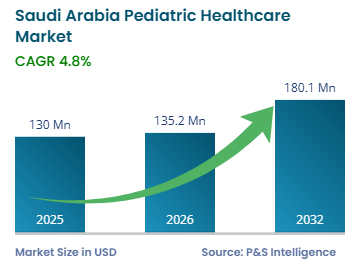
USD 130.0 Million
Market Size in 2026
USD 135.2 Million
Market Size by 2032
USD 180.1 Million
Projected CAGR
4.8%
Largest Province
Al-Riyadh
Fastest-Growing Province
Eastern Province
Market Structure
Semi-Consolidated
Market Size
Explore the market potential with our data-driven report
Saudi Arabia Pediatric Healthcare Market Outlook
The Saudi Arabian pediatric healthcare market size will be an estimated USD 130.0 million for 2025, and it will grow by 4.8% during 2026–2032, to reach USD 180.1 million by 2032.
The major factors responsible for the growth of the market include the youthful population structure with 63% of citizens under 30 years, substantial government investments under Vision 2030, increasing prevalence of chronic pediatric conditions, and rising parental awareness about child health and preventive care.
The transformation of pediatric healthcare infrastructure represents another significant market catalyst. The government's commitment to expanding pediatric infrastructure includes the development of new specialized centers for cancer, cardiology, and pediatric surgery, addressing the growing complexity of childhood health conditions while ensuring comprehensive care availability across the Kingdom.
Additionally, the expansion of insurance coverage, strengthening of referral networks, and increasing private sector participation are improving access to advanced pediatric services. Growing adoption of digital health solutions, including telepediatrics and AI-supported diagnostics, is further enhancing care delivery and enabling earlier intervention for chronic and developmental conditions.
Saudi Arabia Pediatric Healthcare Market Emerging Trends
Digital Health Integration and AI-Powered Pediatric Care Are Key Trends
The integration of artificial intelligence and digital health technologies is fundamentally transforming pediatric healthcare delivery in Saudi Arabia.
Saudi Arabia has positioned itself as a regional leader in digital and AI adoption through the Saudi Data & AI Authority (SDAIA), which drives the National Strategy for Data and AI under Vision 2030.
This investment is yielding tangible results in pediatric care, where AI algorithms are being deployed for early detection of developmental disorders, predictive analytics for identifying at-risk children, and automated screening for conditions like diabetic retinopathy and congenital heart defects.
Telemedicine adoption has accelerated dramatically, with virtual pediatric consultations increasing by over 300% since 2020.
All facilities of the Ministry of National Guard Health Affairs offer integrated telemedicine services, enabling families in remote areas to access subspecialist consultations without travel barriers.
This digital transformation extends beyond basic consultations to include remote monitoring of chronic conditions, where children with diabetes, asthma, or cardiac conditions use connected devices that transmit real-time data to healthcare providers.
The implementation of comprehensive electronic health records across all government healthcare facilities ensures seamless care coordination, with pediatric patients' complete medical histories accessible to authorized providers across the Kingdom, reducing duplicate testing and improving treatment continuity.
The convergence of AI and telemedicine is creating innovative care models particularly suited to Saudi Arabia's geographic challenges and young demographic.
Mobile health applications designed for parents provide AI-powered symptom checkers, vaccination reminders, and developmental milestone tracking, with Arabic language interfaces ensuring broad accessibility.
As 5G network deployment expands across the Kingdom, the potential for real-time remote surgeries, augmented reality training for pediatric specialists, and AI-assisted robotic procedures promises to further revolutionize pediatric healthcare delivery.
Government Healthcare Transformation Under Vision 2030 Is Biggest Driver
Saudi Arabia's Vision 2030 initiative has catalyzed unprecedented transformation in pediatric healthcare delivery systems.
The Health Sector Transformation Program specifically emphasizes preventive care, early intervention, and comprehensive child health services as national priorities.
The kingdom allocated SAR 214 billion to health and social development in 2024, prioritizing new hospital construction, health services expansion, and technological integration.
The privatization strategy under Vision 2030 has opened significant opportunities for public-private partnerships in pediatric healthcare.
The National Center for Privatization & PPP actively promotes private sector participation through legislative enablers designed to enhance investor confidence.
This has resulted in increased private healthcare facility development, with international healthcare providers establishing specialized pediatric centers equipped with advanced diagnostic and therapeutic technologies.
The integration of private sector efficiency with public sector reach ensures broader access to quality pediatric services while maintaining affordability through mandatory health insurance coverage expansion.
Digital health transformation represents a cornerstone of Vision 2030's healthcare strategy.
The SDAIA drives artificial intelligence adoption and strategic data utilization in healthcare delivery.
The implementation of electronic health records across all Ministry of National Guard Health Affairs facilities ensures seamless care coordination and comprehensive patient monitoring throughout childhood.
Saudi Arabia Pediatric Healthcare Market Segmentation Analysis
Service Type Analysis
The therapeutic & surgical services category holds the largest market share, of 35%, in 2025. This leadership position stems from the increasing complexity of pediatric conditions requiring specialized interventions, advancement in minimally invasive surgical techniques, and the establishment of comprehensive pediatric surgical centers across the Kingdom. The Prince Sultan Military Medical City reports a congenital heart defect prevalence of 14.8 per 1,000 births, including 3.2 per 1,000 with severe CHD.
The primary care category will have the highest CAGR, of 5.0%, driven by government emphasis on early intervention strategies and increasing parental awareness about disease prevention. Additionally, the implementation of nationwide screening programs for developmental delays, hearing impairments, and metabolic disorders creates sustained demand for preventive services. The economic benefits of prevention, reducing long-term healthcare costs associated with chronic disease management, further incentivize investment in this rapidly growing segment.
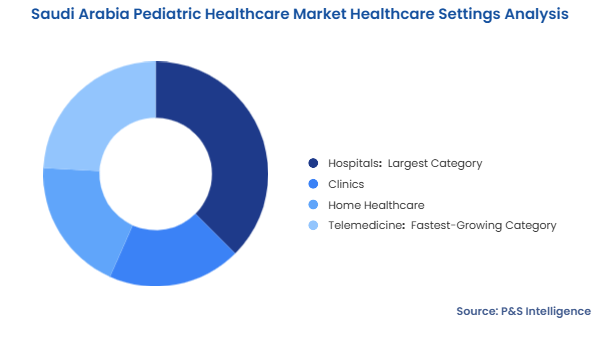
The hospitals category holds the largest market share, of 45%, in 2025, driven by their comprehensive service capabilities, advanced infrastructure, and ability to manage complex pediatric conditions. Private hospitals have particularly expanded their pediatric offerings, with facilities like Saudi German Hospital establishing dedicated Women and Children Specialty Hospitals to capture growing demand from insured populations.
The telemedicine category will have the highest CAGR of 5.1%. The COVID-19 pandemic accelerated digital health adoption, with families experiencing benefits of remote consultations for routine follow-ups, chronic disease management, and specialist access. The integration of artificial intelligence in diagnostic support and treatment planning further enhances telemedicine capabilities.
The healthcare settings analyzed in this report are:
Hospitals (Largest Category)
Public
Private
Clinics
Pediatric
Multi-specialty
Home Healthcare
Telemedicine (Fastest-Growing Category)
Age Group Analysis
The infants category holds the largest market share, of 30%, in 2025, due to intensive vaccination schedules, routine growth and developmental monitoring, and a high incidence of acute respiratory and gastrointestinal infections. These factors collectively drive the greatest volume of pediatric visits and follow-up care.
The school-age category will have the highest CAGR, driven by rising prevalence of chronic pediatric conditions such as asthma and obesity, increased demand for behavioral and developmental assessments, and expanding school-based health programs. Growing parental awareness and the national focus on preventive care further accelerate utilization among this age group, making it the most rapidly expanding segment in the pediatric healthcare market.
The pediatric pulmonology category holds the largest market share, of 20%, in 2025, reflecting the high burden of respiratory conditions among Saudi children. According to ISAAC/GAN surveys, asthma is one of the most common chronic conditions affecting children in Saudi Arabia, with prevalence estimates varying from 10% to over 20% depending on region and age group.
The pediatric mental & behavioral health category will have the highest CAGR during the forecast period. The increasing recognition of neurodevelopmental disorders, rising number of autism spectrum disorder diagnoses, and growing awareness of childhood mental health drive this growth. The establishment of specialized facilities focusing on comprehensive behavioral assessments, therapeutic interventions, and family support programs reflects the healthcare system’s adaptation to emerging needs. Integration of mental health services within primary pediatric care settings further facilitates early identification and intervention.
The clinical subspecialties analyzed in this report are:
Neonatology
Pediatric Cardiology
Pediatric Neurology
Pediatric Pulmonology (Largest Category)
Pediatric Gastroenterology
Pediatric Endocrinology
Pediatric Oncology & Hematology
Pediatric Infectious Diseases
Pediatric Dermatology
Pediatric Mental & Behavioral Health (Fastest-Growing Category)
Pediatric Trauma & Injuries
Genetic & Congenital Disorders
Others
Drive strategic growth with comprehensive market analysis
Saudi Arabia Pediatric Healthcare Market Geographical Analysis
Al-Riyadh Pediatric Healthcare Market Size
Al-Riyadh holds the largest market share, of 35%, in 2025. This supremacy is attributed to the concentration of tertiary pediatric facilities, including King Abdullah Specialist Children's Hospital with 600 beds, King Faisal Specialist Hospital's pediatric departments, and multiple private specialized centers. The capital's role as the administrative and economic hub attracts top medical talent and drives healthcare infrastructure investment, creating a comprehensive pediatric care ecosystem serving both local populations and medical tourism from other provinces.
Riyadh's pediatric healthcare market benefits from the highest per capita healthcare expenditure and insurance coverage penetration in the Kingdom. The presence of major academic medical centers facilitates pediatric subspecialty training programs, ensuring sustainable workforce development. According to government statistics, the province's population density and higher average household income support private healthcare utilization, with families increasingly choosing premium pediatric services. The concentration of corporate headquarters also drives employer-sponsored health insurance coverage, enabling access to advanced pediatric treatments and preventive care programs.
Eastern Province Pediatric Healthcare Market Size
Eastern Province will have the highest CAGR, of 4.9%, driven by rapid industrialization, population growth in cities like Dammam and Khobar, and strategic healthcare infrastructure development. The region's economic prosperity, fueled by the petroleum industry, translates into higher healthcare spending capacity. Recent developments include Johns Hopkins Aramco Healthcare achieving Baby-Friendly Hospital accreditation, the first private facility in the province to receive this designation, demonstrating a commitment to quality maternal and child healthcare standards.
The province's strategic location as a gateway for regional medical collaboration with other GCC countries positions it favorably for healthcare innovation adoption. Investment in specialized pediatric facilities, including plans for dedicated children's hospitals in major cities, addresses historical service gaps. The growing expatriate population, particularly from the Indian subcontinent, creates diverse healthcare needs requiring culturally sensitive pediatric services. Additionally, environmental health concerns related to industrial activities drive demand for specialized respiratory and environmental medicine services for children.
The provinces of the market are as follows:
Al-Riyadh (Largest Province)
Eastern Province (Fastest-Growing Province)
Makkah
Madinah
Qassim
Asir
Tabuk
Ha'il
Northern Borders
Jazan
Najran
Al-Baha
Al-Jouf
Saudi Arabia Pediatric Healthcare Market Share
The market is semi-consolidated, reflecting strong concentration in tertiary and subspecialty services alongside broad fragmentation in primary and outpatient care. A limited group of major providers, including King Faisal Specialist Hospital & Research Centre, King Abdullah Specialist Children’s Hospital, and large government hospital networks, dominates complex pediatric treatments requiring advanced infrastructure and multidisciplinary expertise. At the same time, general pediatric services are dispersed across numerous private clinics, multi-specialty centers, regional hospitals, and emerging digital platforms. As a result, the market reflects a semi-consolidated model, where advanced care is concentrated but general services remain broadly distributed.
Key Saudi Arabia Pediatric Healthcare Companies:
King Faisal Specialist Hospital & Research Centre
King Abdullah Specialist Children's Hospital
King Khalid University Hospital
King Saud Medical City
Prince Sultan Military Medical City
Dr. Sulaiman Al Habib Medical Group
Saudi German Hospitals
International Medical Center
Saad Specialist Hospital
Mouwasat Medical Services
Al Mana General Hospitals
Fakeeh Care Group
Johns Hopkins Aramco Healthcare
King Fahd Medical City
King Salman Armed Forces Hospital
Saudi Arabia Pediatric Healthcare Market News
In April 2025, Saudi Arabia launched 28 healthcare projects worth USD 1.86 billion across Riyadh's health clusters, including a new 500-bed Women's, Maternity, and Children's Hospital at King Saud Medical City.
In February 2025, King Saud University Medical City launched a Pediatric Aerodigestive Clinic at King Khalid University Hospital, representing an innovative multidisciplinary approach to complex conditions involving the upper respiratory and digestive systems in children.
In November 2024, Johns Hopkins Aramco Healthcare in Dhahran, Eastern Province, received the Baby-Friendly Hospital accreditation for adherence to high maternal and pediatric care standards.
Want a report tailored exactly to your business need?
Leading companies across industries trust us to deliver data-driven insights and innovative solutions for their most critical decisions. From data-driven strategies to actionable insights, we empower the decision-makers who shape industries and define the future. From Fortune 500 companies to innovative startups, we are proud to partner with organisations that drive progress in their industries.
Client Testimonials
Working with P&S Intelligence and their team was an absolute pleasure – their awareness of timelines and commitment to value greatly contributed to our project's success. Eagerly anticipating future collaborations.
McKinsey & Company
India
Unmatched Standards
Our insights into the minutest levels of the markets, including the latest trends and competitive landscape, give you all the answers you need to take your business to new heights
Complete Data Security
We take a cautious approach to protecting your personal and confidential information. Trust is the strongest bond that connects us and our clients, and trust we build by complying with all international and domestic data protection and privacy laws