Saudi Arabia Heavy-Duty Truck Market Size & Share Analysis - Trends, Drivers, Competitive Landscape, and Forecasts (2026 - 2032)
This Report Provides In-Depth Analysis of the Saudi Arabia Heavy-Duty Truck Market Report Prepared by P&S Intelligence, Segmented by Gross Vehicle Weight (7.3, 8.8, 11.8, 16, 20, 26, 33, Over 41 Tonnes), Drive Configuration (4x2, 6x2, 6x4, 8x4), Vehicle Type (Tractor Truck, Rigid Truck, Dump Truck), Propulsion (Hybrid and Electric Vehicles, Internal Combustion Engine), End User (Long-Haul Logistics and Distribution, Construction and Mining, Oil and Gas Field Logistics and Support, Waste Management and Municipal Services), Class (Class 5, Class 6, Class 7, Class 8), and Geographical Outlook for the Period of 2019 to 2032
Saudi Arabia Heavy-Duty Truck Market Size Estimation
Key Highlights
Study Period
2019 - 2032
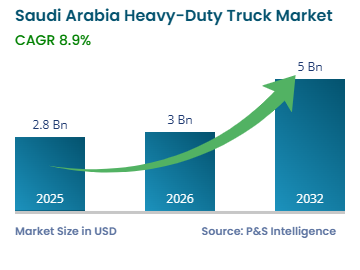
Market Size in 2025
USD 2.8 Billion
Market Size in 2026
USD 3.0 Billion
Market Size by 2032
USD 5.0 Billion
Projected CAGR
8.9%
Largest
Northern and Central
Fastest-Growing
Eastern
Market Structure
Semi-Consolidated
Market Size
Explore the market potential with our data-driven report
Saudi Arabia Heavy-Duty Truck Market Future Outlook
The Saudi Arabia heavy-duty truck market size was USD 2.8 billion for 2025, and it will grow by 8.9% during 2026–2032, to reach USD 5.0 billion by 2032.
This growth is driven by Vision 2030 infrastructure mega-projects and expanding freight, mining, and long-haul logistics activity across the Kingdom. The expansion of mining and mineral-resource development is further increasing demand for heavy-duty trucks used to transport minerals, equipment, and materials, while continued oil and gas support activities are sustaining demand for heavy-duty vehicles across industrial and remote project sites. Saudi Arabia's mining sector has significant long-term potential, with the Ministry of Industry and Mineral Resources estimating the Kingdom's untapped mineral wealth at more than USD 1.3 trillion.
The country's freight and logistics activity provides further evidence of this demand. According to the General Authority for Statistics (GASTAT), road-freight exports through land ports reached 13.4 million tons in 2024, while road-freight imports reached 12.2 million tons, increasing 7.1% from 2023. Overall freight volumes through road ports reached 25.7 million tons during the year. In addition, Saudi Arabia had 23 activated logistics centres covering 34.6 million square meters in 2024, compared with 22 centres in 2023, while the number of licensed commercial warehouses reached 12,234, covering more than 22 million square meters. These developments are strengthening freight-distribution infrastructure and supporting sustained requirements for heavy-duty vehicles across intercity, construction, industrial, and logistics operations.
Key Market Insights
The 11.8-16 tonnes category holds the largest market share, of 30.0%, in 2025, driven by demand from construction, municipal services, regional distribution, and urban freight applications.
The 6x4 category holds the largest market share, of 40.0%, in 2025, and it will have the highest CAGR, of 9.1%, driven by strong demand from construction, mining, and long-haul freight applications.
The internal combustion engine category holds the largest market share, of 80.5%, in 2025, driven by diesel availability, established refueling infrastructure, and suitability for high-payload and long-haul applications.
The Northern and Central region holds the largest market share, of 45.0%, in 2025, driven by Riyadh's concentration of construction projects, government institutions, and logistics infrastructure.
Eastern will have the highest CAGR, of 9.4%, driven by industrial zones, petrochemical clusters, and expanding port and logistics capacity around Dammam and Jubail.
Saudi Arabia Heavy-Duty Truck Market Trends and Drivers
Digital Transformation: Telematics, Connectivity and Predictive Maintenance Are Key Trends
Telematics adoption is reshaping fleet operations across the Kingdom as regulatory requirements converge with operator demand for greater efficiency, safety, and fleet visibility. The Transport General Authority's regulatory framework requires commercial freight operators to use automatic-tracking devices connected to the Authority's platform, enabling monitoring of truck location, speed, weight, driving and rest periods, and vehicle compliance. In July 2024, TGA conducted more than 239,000 inspections of land-transport activities, including 228,058 inspections of transport vehicles, highlighting the increasing scale of regulatory monitoring across
Saudi Arabia's road-transport sector is increasingly adopting telematics and regulatory tracking, while OEMs are integrating connectivity, remote diagnostics, and predictive-maintenance capabilities into new truck offerings, shifting purchasing decisions toward total cost of ownership, vehicle uptime, fuel efficiency, and fleet productivity rather than upfront price alone. As regulatory oversight and digital fleet-management capabilities continue to expand, connected technologies are expected to become increasingly important in new heavy-duty truck procurement across the Kingdom.
Mining-Sector Expansion and Heavy-Haulage Demand Are Biggest Drivers
Saudi Arabia's mining diversification push is a structural driver of demand for heavy-duty haulage vehicles. Vision 2030 identifies mining as the third pillar of Saudi industry and targets the development of the sector as part of the Kingdom's broader economic diversification strategy. In 2025, the Ministry of Industry and Mineral Resources planned to offer more than 50,000 square kilometers of mineral exploration areas, following the launch of competitions for three mineralized belts covering 24,423 square kilometers containing gold, copper, silver, zinc, and nickel.
The expansion of exploration and development activity is increasing requirements for heavy-duty vehicles used to transport minerals, equipment, and materials across mining and industrial supply chains. As exploration projects progress toward development and production, demand is expected to strengthen for high-capacity trucks used in mining, mine-to-processing, and mine-to-port transportation applications through 2030.
Oil-Price Cyclicality and Government-Spending Dependence Are Key Restraints
Fleet procurement remains exposed to fluctuations in government infrastructure spending, which can be influenced by oil-price and oil-revenue conditions. Saudi Arabia's Ministry of Finance reported oil revenues of SAR 149.8 billion in Q1 2025, representing approximately 56.8% of total government revenues of SAR 263.6 billion, compared with SAR 181.9 billion in Q1 2024. This dependence on oil revenues can create uncertainty around the timing and pace of government-funded infrastructure and construction projects, particularly when lower oil revenues place pressure on fiscal balances.
Construction, infrastructure, and municipal projects represent important sources of heavy-duty truck demand, so delays or slower disbursement of project spending can postpone fleet purchases and extend truck replacement cycles. Fluctuations in oil revenues can create short-term volatility in procurement volumes, making oil-price and government-spending dependence a cyclical restraint on market growth.
Fleet Localization and Domestic Assembly under Vision 2030 Are Biggest Opportunities
Vision 2030's localization agenda is opening space for domestic truck assembly to capture a larger share of fleet renewal spending. In September 2023, Zahid Tractor confirmed that Volvo Trucks' new range was being assembled in Saudi Arabia at the Arabian Vehicles & Trucks Industries (AVI) facility in King Abdullah Economic City (KAEC), including Volvo FM and FMX trucks. In 2025, the AVI facility was assembling Volvo Trucks, Renault Trucks, and UD Trucks on a single production line, supporting the localization of heavy-duty commercial-vehicle manufacturing in the Kingdom.
Saudi Arabia's National Industrial Strategy identifies the automotive industry as one of 12 priority sectors and targets 800 investment opportunities valued at approximately SAR 1 trillion by 2030. This opportunity is expected to expand further as Saudi Arabia strengthens domestic commercial-vehicle manufacturing and attracts additional investment in local truck assembly under its Vision 2030 localization agenda.
Saudi Arabia Heavy-Duty Truck Market Segmentation Analysis
Gross Vehicle Weight Analysis
The 11.8-16 tonnes category holds the largest market share, of 30.0%, in 2025, driven by strong demand from urban construction, municipal services, regional distribution, and applications requiring a balance between payload capacity and maneuverability. Saudi Arabia's extensive road infrastructure supports the use of medium-heavy trucks across dispersed construction, distribution, and service activities. The U.S. International Trade Administration reports that Saudi Arabia's transportation network includes approximately 73,000 kilometers of national roads, supporting the movement of goods and equipment across the Kingdom.
The 33-41 tonnes category will have the highest CAGR, of 9.2%, driven by increasing demand from mining, construction, heavy freight, and long-haul transportation activities. Higher-payload trucks can improve transport efficiency where operators prioritize greater payload capacity per trip. The expansion of major infrastructure projects and mining activities is expected to increase demand for higher-capacity heavy-duty trucks, particularly for material transportation, construction logistics, and mine-to-processing or mine-to-port movements.
The gross vehicle weights analyzed in this report are:
7.3–8.8 Tonnes
8.8–11.8 Tonnes
11.8–16 Tonnes (Largest Category)
16–19 Tonnes
20–25 Tonnes
26–32 Tonnes
33–41 Tonnes (Fastest-Growing Category)
Over 41 Tonnes
Drive Configuration Analysis
The 6x4 category holds the largest market share, of 40.0%, in 2025, and it is expected to register the highest CAGR, of 9.1%, during the forecast period, driven by the expansion of construction, mining, logistics, and infrastructure activities across Saudi Arabia, demand for 6x4 heavy-duty trucks is increasing due to their higher traction, stability, and payload capability compared with lower-drive configurations. The configuration is particularly suitable for transporting heavy materials and equipment across construction and mining sites, while also supporting long-distance freight transportation on highways. According to GASTAT, road-freight volumes through Saudi Arabia's road ports reached 25.7 million tons in 2024, including 13.4 million tons of exports and 12.2 million tons of imports, highlighting the scale of road-based freight activity in the Kingdom. The continued development of logistics infrastructure is also supporting demand, with Saudi Arabia having 23 activated logistics centres covering 34.6 million square meters in 2024.
The drive configurations analyzed in this report are:
4x2
6x2
6x4 (Largest and Fastest-Growing Category)
8x4
Others
Vehicle Type Analysis
The rigid truck category holds the largest market share, of 45.5%, in 2025, and it will have the highest CAGR, of 9.0%, driven by rising demand from construction, municipal services, mining, and short-haul distribution activities. Rigid trucks are widely used across the Kingdom because their integrated cab-and-body configuration provides flexibility for applications requiring frequent loading and unloading. Saudi Arabia's Vision 2030 mining strategy targets an increase in the mining sector's GDP contribution from approximately SAR 68 billion to SAR 240 billion by 2030, supporting continued demand for rigid dump and tipper trucks used in mining and material-handling applications.
The vehicle types analyzed in this report are:
Tractor Truck
Rigid Truck (Largest and Fastest-Growing Category)
Dump Truck
Others
Propulsion Analysis
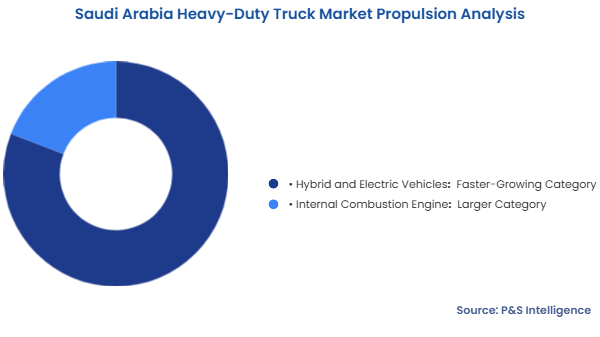
The internal combustion engine category holds the largest market share, of 80.5%, in 2025, driven by the established availability of diesel fuel, extensive refueling infrastructure, and the suitability of diesel powertrains for high-payload, long-distance, and demanding heavy-duty applications. Strong demand from construction, mining, oil and gas, and long-haul freight operations further supports the continued use of diesel-powered trucks across the Kingdom.
The hybrid and electric vehicle category will have the highest CAGR, of 46.8%, driven by the expansion of charging infrastructure and increasing investment in vehicle electrification. The Public Investment Fund states that its EVIQ joint venture is deploying more than 5,000 fast chargers across 1,000 strategic locations nationwide by 2030, supporting the development of Saudi Arabia's electric-vehicle charging ecosystem.
The propulsions analyzed in this report are:
Hybrid and Electric Vehicles (Faster-Growing Category)
Internal Combustion Engine (Larger Category)
End User Analysis
The long-haul logistics and distribution category holds the largest market share, of 40.0%, in 2025, and is expected to register the highest CAGR, of 9.4%, during the forecast period, driven by expanding freight volumes, e-commerce activity, port operations, and improving connectivity between major population centres and industrial zones, demand for heavy-duty trucks is increasing for the transportation of goods over long distances across the Kingdom. Saudi Arabia's General Authority for Statistics reported that the transport, storage, and communication sector grew by 6.0% year-on-year in Q1 2025, supporting continued expansion in logistics and freight transportation activity. In addition, road-freight volumes through Saudi Arabia's road ports reached 25.7 million tons in 2024, including 13.4 million tons of exports and 12.2 million tons of imports, indicating strong demand for road-based freight movement.
The end users analyzed in this report are:
Long-Haul Logistics and Distribution (Largest and Fastest-Growing Category)
Construction and Mining
Oil and Gas Field Logistics and Support
Waste Management and Municipal Services
Others
Class Analysis
The class 6 category holds the largest market share, of 45.0%, in 2025, and it will have the highest CAGR, of 9.2%, driven by strong demand from municipal services, construction-support activities, regional distribution, and urban freight applications. Its combination of payload capacity, maneuverability, and operating flexibility makes Class 6 trucks suitable for a wide range of medium-heavy-duty applications. Saudi Arabia's Ministry of Transport and Logistics Services targets a top-10 position globally in the Logistics Performance Index and sixth place in road infrastructure quality, supporting continued development of road-based logistics and freight activity.
The classes analyzed in this report are:
Class 5
Class 6 (Largest and Fastest-Growing Category)
Class 7
Class 8
Drive strategic growth with comprehensive market analysis
Saudi Arabia Heavy-Duty Truck Market Regional Analysis
Northern and Central Heavy-Duty Truck Market Size
Northern and Central holds the largest market share, of 45.0%, in 2025, anchored by Riyadh's concentration of construction mega-projects, government institutions, and logistics infrastructure. The Ministry of Transport and Logistic Services indicates that the General Plan for Logistics Centers includes 59 logistics centers spanning more than 100 million square meters nationwide, including 12 centers in the Riyadh region, supporting the expansion of freight distribution and logistics activity. Riyadh is also home to the SAL Logistics Zone in Falcon City, Malham, north of the city, covering approximately 1.57 million square meters and designed to strengthen warehousing, distribution, and multimodal logistics capabilities. Major development projects such as Qiddiya and Diriyah further reinforce construction-related heavy-duty truck demand, supporting the region's market leadership as infrastructure and logistics investment continues through the remainder of the decade.
Eastern Heavy-Duty Truck Market Size
Eastern will have the highest CAGR, of 9.4%, driven by industrial zones, petrochemical clusters, and expanding port and logistics capacity around Dammam and Jubail. The Saudi Ports Authority (Mawani) identifies King Abdulaziz Port in Dammam as a major commercial gateway, with ongoing terminal development and capacity expansion strengthening the region's freight-handling and distribution infrastructure. The region also benefits from Ma’aden’s integrated phosphate operations, with the Phosphate 3 mega-project expected to increase production capacity by 50% to 9 million tonnes annually across its Wa’ad Al Shamal and Ras Al Khair hubs. This sustained investment in port and industrial infrastructure, combined with the expansion of Saudi Arabia's mining sector, is supporting demand for heavy-duty trucks used in freight transportation, material movement, construction, and mining-related applications. The region is expected to maintain strong growth as industrial, logistics, and mining investments continue through 2030.
The regions of the market are as follows:
Northern and Central (Largest Region)
Western
Eastern (Fastest-Growing Region)
Southern
Saudi Arabia Heavy-Duty Truck Market Competitive Landscape
The market is semi-consolidated, with a limited group of established international OEMs holding strong positions through extensive dealer networks, local distributors, assembly partnerships, and after-sales service capabilities. Major manufacturers such as Daimler Truck, Volvo Trucks, MAN, Scania, Isuzu, Hino, and UD Trucks compete across construction, logistics, mining, oil and gas, and municipal applications. Established OEMs benefit from long-standing relationships with large fleet operators and government-linked projects, supporting brand loyalty and repeat procurement. At the same time, competition from multiple international manufacturers across different weight classes and applications prevents the market from being fully consolidated. Local assembly initiatives and the presence of regional distributors further broaden the competitive landscape.
Top Companies in the Saudi Arabia Heavy-Duty Truck Market:
Volvo Trucks
Scania AB
MAN Truck & Bus SE
Isuzu Motors Limited
UD Trucks Corporation
Hino Motors, Ltd.
Mitsubishi Fuso Truck and Bus Corporation
SINOTRUK Group
FAW Jiefang Group Co., Ltd.
Dongfeng Commercial Vehicle Co., Ltd.
Daimler Truck AG
Saudi Arabia Heavy-Duty Truck Market Developments
In February 2026, Daimler Truck AG showcased the Mercedes-Benz Arocs 4663 AS 8x8 and Zetros 4051 AS 6x6 at the World Defense Show in Riyadh, highlighting its heavy-duty and defense logistics vehicle portfolio for demanding Middle Eastern operating conditions.
In September 2025, Volvo Trucks, Momentum Logistics (Gulftainer) and Zahid Tractor delivered Saudi-assembled Volvo Trucks, including the FH Aero, manufactured at the AVI facility in King Abdullah Economic City and carrying the Saudi-Made label.
In October 2025, Scania AB, Al Bassami Holding Company and GCC Olayan signed an agreement for the delivery of 800 new Scania trucks in Saudi Arabia, supporting the expansion and modernization of Al Bassami's transportation and logistics fleet.
In April 2025, Isuzu Motors Limited opened its second showroom in Riyadh following the launch of its Jeddah showroom in 2024, expanding access to its truck models and after-sales services across the Kingdom.
Frequently Asked Questions About This Report
What factors are driving the growth of the Saudi Arabia heavy-duty truck market?+
Vision 2030 infrastructure mega-projects, expanding freight and logistics activity, mining-sector development, construction projects, and continued oil and gas support activities are driving market growth.
What are the major trends shaping the Saudi Arabia heavy-duty truck market?+
Telematics, connectivity, predictive maintenance, automatic vehicle tracking, and fleet localization are key trends shaping the Saudi Arabia heavy-duty truck market.
What are the major challenges facing the Saudi Arabia heavy-duty truck market?+
Dependence on oil prices and government spending can create uncertainty around infrastructure projects, fleet procurement, and truck replacement cycles.
How is Vision 2030 impacting the Saudi Arabia heavy-duty truck market?+
Vision 2030 is increasing demand through infrastructure, mining, logistics, and industrial development while supporting domestic truck assembly and fleet localization.
What opportunities exist for heavy-duty truck manufacturers in Saudi Arabia?+
Fleet localization and domestic truck assembly present major opportunities, supported by continued investment in mining, construction, logistics, and industrial development.
Want a report tailored exactly to your business need?
Leading companies across industries trust us to deliver data-driven insights and innovative solutions for their most critical decisions. From data-driven strategies to actionable insights, we empower the decision-makers who shape industries and define the future. From Fortune 500 companies to innovative startups, we are proud to partner with organisations that drive progress in their industries.
Client Testimonials
Working with P&S Intelligence and their team was an absolute pleasure – their awareness of timelines and commitment to value greatly contributed to our project's success. Eagerly anticipating future collaborations.
McKinsey & Company
India
Unmatched Standards
Our insights into the minutest levels of the markets, including the latest trends and competitive landscape, give you all the answers you need to take your business to new heights
Complete Data Security
We take a cautious approach to protecting your personal and confidential information. Trust is the strongest bond that connects us and our clients, and trust we build by complying with all international and domestic data protection and privacy laws