This Report Provides In-Depth Analysis of the Risk Analytics Market Report Prepared by P&S Intelligence, Segmented by Component (Software, Services), Deployment Mode (On-Premises, Cloud), Risk Type (Financial Risk, Operational Risk, Credit Risk, Market Risk, Compliance Risk, Cyber Risk, Third-Party Risk), Organization Size (Large Enterprises, Small and Medium Enterprises), End User (Banking, Financial Services and Insurance, Healthcare, Information Technology and Telecommunications, Retail and E-commerce, Manufacturing, Government and Public Sector), and Geographical Outlook for the Period of 2021 to 2032
Explore the market potential with our data-driven report
Risk Analytics Market Future Outlook
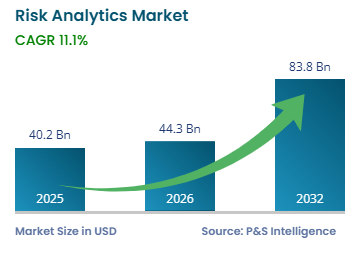
The risk analytics market size was USD 40.2 billion for 2025, and it will grow by 11.1% during 2026-2032, to reach USD 83.8 billion by 2032.
The market is expanding because organisations across industries are operating in increasingly complex digital environments that require continuous monitoring of operational, financial, compliance, and cybersecurity risks. Enterprises are adopting risk analytics platforms to strengthen decision-making, improve operational resilience, support fraud detection and prevention, and identify vulnerabilities before they disrupt business activities. The growing use of cloud computing, connected devices, remote work infrastructure, and AI-driven enterprise applications is generating large volumes of enterprise data that traditional risk management systems cannot efficiently process. According to the International Telecommunication Union, around 6 billion people were using the Internet globally in 2025, highlighting the scale of digital connectivity that is increasing enterprise data exposure and cyber risk across industries. Financial institutions, healthcare providers, manufacturers, retailers, and technology companies are among the major adopters because they manage highly sensitive data, regulated operations, and complex supply chain networks.
The market is also gaining momentum as organisations shift from reactive risk management towards predictive and continuous risk intelligence. Enterprises increasingly require platforms capable of delivering automated reporting, real-time monitoring, and integrated visibility across multiple business functions. Regulatory requirements related to cybersecurity, financial transparency, data privacy, and governance are becoming stricter across several industries, encouraging businesses to modernise compliance monitoring and enterprise risk assessment processes. Rising cyberattacks, fraud incidents, geopolitical disruptions, and supply chain instability are further increasing demand for AI-enabled analytics platforms that support predictive modelling, automated risk scoring, and dynamic threat identification across enterprise environments.
Key Market Insights
Software is the larger component, holding a market share of 75%, due to rising enterprise demand for automated compliance monitoring and fraud analytics platforms.
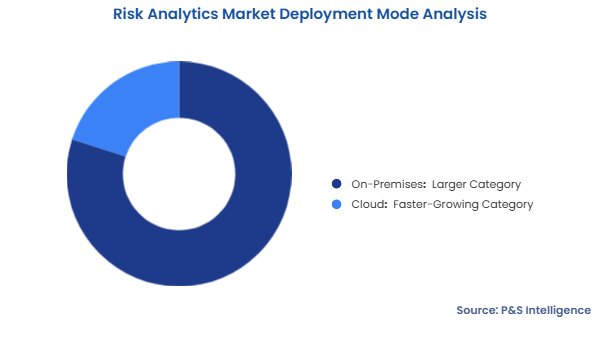
Cloud is the faster-growing deployment mode, registering a CAGR of approximately 11.4%, driven by increasing adoption of scalable remote risk monitoring infrastructure across enterprises.
Financial Risk is the largest risk type, holding a market share of 30%, due to growing regulatory scrutiny and rising digital transaction monitoring requirements.
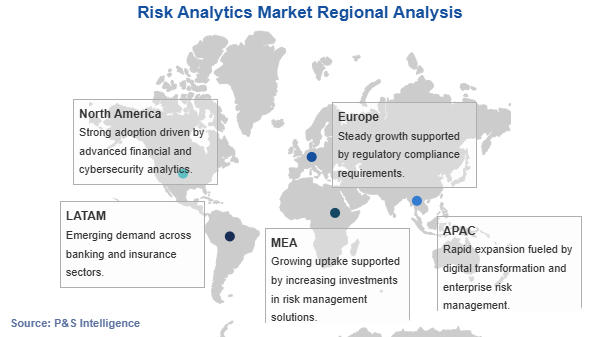
North America holds the largest share of 40%, due to strong enterprise cybersecurity spending and widespread adoption of AI-driven risk analytics platforms.
Asia-Pacific is the fastest-growing region, registering a CAGR of approximately 12.0%, driven by expanding fintech ecosystems and accelerating enterprise digital transformation initiatives.
Risk Analytics Market Trends and Drivers
AI-Powered Predictive and Real-Time Risk Intelligence Platforms Are a Major Trend
Organisations are increasingly shifting from static risk reporting tools towards AI-powered platforms that deliver predictive insights, continuous monitoring, and automated risk scoring in real time. Enterprises now expect risk analytics systems to identify anomalies, simulate operational scenarios, and generate early warnings before financial or operational disruptions escalate. Vendors are therefore integrating generative AI, machine learning, and behavioural analytics into enterprise risk platforms to improve decision-making speed and visibility across complex business environments. According to Microsoft and LinkedIn, 75% of global knowledge workers used generative AI at work in 2024, supporting wider enterprise adoption of AI-enabled analytics tools and automated decision workflows. According to the World Economic Forum, 66% of organisations expected AI to have the most significant impact on cybersecurity in 2025, increasing enterprise demand for predictive monitoring systems capable of identifying emerging cyber and operational risks across interconnected business operations.
Rising Regulatory Compliance and Enterprise Risk Exposure Drive Market
The market is growing steadily because organisations are facing increasing pressure to manage cybersecurity threats, regulatory compliance, financial uncertainty, and operational disruptions more effectively across digital business environments. Enterprises across banking, healthcare, manufacturing, retail, and technology sectors are adopting risk analytics platforms to strengthen audit readiness, improve compliance monitoring, and support faster risk-based decision-making. Growing digital ecosystems, third-party dependencies, and interconnected supply chains are also making hidden operational and compliance risks more difficult to identify through conventional risk management methods. In 2024, 177 countries had at least one regulation on personal data protection, privacy protection, or breach notification in force or in progress, according to the International Telecommunication Union. According to the World Economic Forum, 72% of respondents reported an increase in organisational cyber risks in 2025, increasing enterprise investment in advanced analytics platforms for fraud detection, compliance management, and real-time risk assessment across business operations.
Complex Integration and Data Quality Challenges Limit Market Expansion
Many organisations continue to face difficulties integrating risk analytics platforms with legacy enterprise systems, fragmented databases, and disconnected operational environments. Large enterprises often manage data across multiple business units, cloud environments, and third-party applications, which reduces visibility across enterprise risk workflows and weakens predictive analysis accuracy. Poor data quality, inconsistent reporting structures, and incomplete operational records also limit the effectiveness of AI-based risk assessment models. Organisations in regulated industries additionally face challenges in managing compliance reporting, cross-border data governance, and secure handling of sensitive financial information. According to ISC2, the global cybersecurity workforce gap reached 4.8 million professionals in 2024, increasing implementation challenges for enterprises that require skilled teams to manage advanced analytics platforms, cybersecurity monitoring systems, and AI-driven enterprise risk frameworks.
Expansion of Cloud-Based Risk Analytics across Mid-Sized Enterprises Creates Market Opportunities
The increasing availability of cloud-based and subscription-based risk analytics platforms is creating growth opportunities among mid-sized organisations seeking affordable and scalable enterprise risk management solutions. Businesses are increasingly adopting platforms that support compliance monitoring, fraud detection, cybersecurity assessment, and operational visibility without requiring large internal IT infrastructure. Vendors are therefore introducing simplified deployment models, automated reporting tools, and industry-specific analytics capabilities tailored for financial services, healthcare, manufacturing, and government operations. Emerging markets are also strengthening demand as organisations accelerate digital transformation and modernise enterprise governance frameworks. According to the International Telecommunication Union, 5G networks covered 55% of the world’s population in 2025, supporting wider adoption of connected enterprise systems, cloud-based analytics infrastructure, and real-time operational risk monitoring platforms across distributed business environments.
Risk Analytics Market Segmentation Analysis
Component Analysis
Software is the larger category, holding a market share of 75%, because enterprises increasingly rely on integrated analytics platforms for compliance management, fraud detection, operational monitoring, and financial risk assessment. Large organisations prefer software-based solutions because they provide centralised visibility, automated reporting, predictive analytics, and real-time enterprise risk intelligence across complex operational environments. The growing adoption of AI-enabled enterprise systems and cloud-connected business infrastructure is further strengthening demand for advanced governance and analytics software. In 2023, 68% of organizations worldwide experienced at least one cyberattack, according to the Netwrix 2023 Hybrid Security Trends Report, increasing enterprise investment in software platforms capable of continuous monitoring, automated threat analysis, and integrated compliance management across business operations.
Services is the faster-growing category, because organisations increasingly require external expertise to manage evolving compliance requirements, cybersecurity threats, AI governance, and enterprise risk frameworks. Many companies lack the internal resources needed to deploy, customise, and continuously monitor advanced analytics platforms effectively. As regulatory environments become more complex, enterprises are turning toward consulting, managed analytics, risk assessment, and support services to improve implementation efficiency and operational resilience. Demand is particularly strong among mid-sized organisations adopting cloud-based risk management infrastructure for the first time.
The components analysed in this report are:
Software (Larger Category)
Risk Analytics & Modelling Software
Risk Reporting & Visualization Software
Governance, Risk and Compliance (GRC) Software
Enterprise Risk Management (ERM) Software
Third-Party Risk Management Software
Services (Faster-Growing Category)
Consulting Services
Risk Assessment Services
Managed Risk Analytics Services
Compliance Management Services
Training and Support Services
Deployment Mode Analysis
On-Premises is the larger category, holding a market share of 80%, because highly regulated industries continue to prioritise direct control over sensitive operational, financial, and customer data. Large enterprises in banking, government, healthcare, and defence sectors prefer on-premises deployments to maintain internal security governance, meet strict compliance standards, and support customised enterprise risk workflows. Organisations managing critical infrastructure and confidential information also rely on on-premises systems for greater data visibility and integration flexibility. Long-established enterprise IT environments further contribute to sustained adoption across major industries.
Cloud is the faster-growing category, registering a CAGR of approximately 11.4%, because enterprises are increasingly adopting scalable and remotely accessible risk analytics platforms across distributed business operations. Cloud deployment enables organisations to reduce infrastructure costs, accelerate implementation timelines, and integrate real-time analytics across hybrid work environments and multi-location enterprise systems. Mid-sized enterprises are particularly adopting subscription-based cloud platforms because they simplify compliance monitoring, fraud detection, and cybersecurity risk management without requiring extensive internal IT infrastructure. According to the International Telecommunication Union, 5G networks covered more than half of the global population in 2025, supporting broader deployment of cloud-connected enterprise systems and real-time analytics infrastructure that process operational and risk-related data across digitally connected business environments.
The deployment modes analysed in this report are:
On-Premises (Larger Category)
Cloud (Faster-Growing Category)
Risk Type Analysis
Financial Risk is the largest category, holding a market share of 30%, because banks, insurers, investment firms, and multinational enterprises require continuous monitoring of liquidity exposure, fraud activity, regulatory obligations, and market volatility. Financial institutions increasingly rely on advanced analytics platforms to support transaction monitoring, financial forecasting, and risk-based operational decision-making across highly regulated environments. Growing complexity in global financial systems and rising digital transaction volumes are further strengthening demand for real-time financial risk assessment capabilities. According to the World Economic Forum, cyber-enabled fraud ranked among the top organisational cyber risks in 2025, increasing enterprise demand for analytics systems capable of continuous financial monitoring, anomaly detection, and predictive fraud identification across financial operations.
Operational Risk is the fastest-growing category, as organisations increasingly focus on business continuity, supply chain resilience, workforce disruptions, and internal process vulnerabilities. Enterprises are adopting advanced analytics tools to identify operational inefficiencies, monitor third-party dependencies, and improve incident response capabilities across interconnected business functions. The growing impact of cyber incidents, geopolitical instability, and digital infrastructure failures has heightened the need for proactive operational risk management strategies. Companies are also integrating AI-driven monitoring systems to strengthen visibility across enterprise operations and reduce disruption-related exposure.
The risk types analysed in this report are:
Financial Risk (Largest Category)
Operational Risk (Fastest-Growing Category)
Credit Risk
Market Risk
Compliance Risk
Cyber Risk
Third-Party Risk
Others
Organisation Size Analysis
Large Enterprises is the larger category, due to their extensive operational structures, large-scale data environments, and strict regulatory obligations across multiple business units and geographic regions. These organisations require advanced risk analytics platforms to manage financial exposure, cybersecurity threats, compliance reporting, and third-party risk across complex enterprise ecosystems. Large enterprises also possess stronger financial and technical capabilities to deploy AI-enabled analytics systems, integrate them with existing enterprise software, and maintain dedicated risk management teams. High adoption is particularly visible in banking, healthcare, telecommunications, and government sectors.
Small and Medium Enterprises (SMEs) are the faster-growing category, registering a CAGR of 11.3%, because subscription-based analytics platforms are making enterprise-grade risk management tools more accessible to smaller organisations. SMEs are increasingly adopting risk analytics solutions to improve cybersecurity readiness, fraud prevention, compliance monitoring, and operational visibility without investing heavily in internal IT infrastructure. Expansion of digital payment systems, remote work environments, and cloud-based business applications is also increasing operational and cybersecurity exposure among smaller businesses. Vendors are responding with simplified deployment models and sector-specific analytics platforms designed for SMEs managing limited technical resources. According to the Organisation for Economic Co-operation and Development's 2024 D4SME Survey, 18% of surveyed SMEs had no cybersecurity measures in place, highlighting growing demand for accessible enterprise risk management and cybersecurity monitoring solutions, highlighting growing demand for accessible enterprise risk management and cybersecurity monitoring solutions.
The organization sizes analysed in this report are:
Large Enterprises (Larger Category)
Small and Medium Enterprises (SMEs) (Faster-Growing Category)
End User Analysis
Banking, Financial Services and Insurance (BFSI) is the largest category, because financial institutions operate within highly regulated environments that require continuous monitoring of fraud exposure, compliance obligations, and transaction-related risks. Banks, insurers, and investment firms generate large volumes of sensitive financial data that require advanced analytics for regulatory reporting, financial forecasting, and operational risk assessment. Rising digital banking adoption and increasing anti-money laundering requirements are further strengthening enterprise investment in predictive analytics and governance platforms. In 2025, the World Economic Forum identified financial services among the sectors facing increasing exposure to AI-driven cyber threats and digital fraud activity, increasing adoption of enterprise risk analytics systems that support fraud detection, compliance monitoring, and real-time transaction analysis across financial operations.
Healthcare is the fastest-growing category, registering a CAGR of approximately 11.8%, due to increasing concerns related to patient data security, regulatory compliance, operational continuity, and cyber risk management. Healthcare providers are adopting advanced analytics platforms to monitor vulnerabilities across digital health systems, connected medical devices, insurance processing networks, and third-party service ecosystems. The rapid expansion of electronic health records, telehealth infrastructure, and cloud-connected healthcare applications has increased the need for continuous risk assessment capabilities. Organisations across the sector are also strengthening governance frameworks to address evolving privacy regulations and cybersecurity threats.
The end users analysed in this report are:
Banking, Financial Services and Insurance (BFSI) (Largest Category)
Healthcare (Fastest-Growing Category)
Information Technology and Telecommunications
Retail and E-commerce
Manufacturing
Government and Public Sector
Others
Drive strategic growth with comprehensive market analysis
Risk Analytics Market Regional Outlook
North America Risk Analytics Market Analysis
North America holds the largest share, of 40%, because enterprises across the region have adopted advanced risk management frameworks supported by mature financial systems, strict regulatory oversight, and high enterprise technology spending. Large organisations in banking, insurance, healthcare, and government sectors are heavily investing in AI-enabled analytics platforms to strengthen fraud prevention, cybersecurity monitoring, and regulatory compliance operations. The region also benefits from the strong presence of global analytics providers, cloud infrastructure companies, and cybersecurity firms that continuously introduce integrated enterprise risk solutions. In addition, organisations in North America are increasingly prioritising third-party risk assessment and operational resilience due to rising cyber threats, evolving data privacy regulations, and growing dependence on digital business ecosystems. The rapid integration of generative AI and predictive analytics into enterprise governance strategies is further supporting long-term market expansion across the region.
U.S. Risk Analytics Market Analysis
The United States represents the leading country market due to the strong presence of multinational financial institutions, cybersecurity providers, cloud technology companies, and enterprise software vendors. Organisations across banking, healthcare, defence, and technology sectors are increasingly integrating AI-driven fraud detection, compliance automation, and enterprise risk intelligence platforms into daily operations. Rising ransomware incidents, financial fraud exposure, and regulatory scrutiny are further increasing enterprise investment in advanced analytics systems. In 2024, the Federal Bureau of Investigation recorded 859,532 suspected internet-crime complaints with reported losses exceeding USD 16 billion, strengthening demand for predictive risk monitoring, fraud analytics, and cybersecurity management platforms across highly data-intensive business environments.
Canada Risk Analytics Market Analysis
Canada is experiencing steady growth due to increasing investments in digital banking security, enterprise governance modernisation, and public-sector cybersecurity initiatives. Financial institutions and insurers across the country are deploying analytics platforms to strengthen anti-money laundering compliance, fraud management, and operational risk monitoring capabilities. Organisations are also prioritising cloud-based risk management systems that support hybrid work environments and third-party risk visibility across distributed operations. Government-backed digital transformation programmes and stricter privacy regulations are further encouraging the adoption of enterprise-wide compliance and governance platforms. In 2024, the Canadian Anti-Fraud Centre received 108,878 fraud reports involving more than CAD 638 million in reported losses, increasing enterprise focus on fraud analytics, compliance automation, and cyber risk monitoring systems.
Asia-Pacific Risk Analytics Market Analysis
Asia-Pacific has the highest CAGR, of approximately 12.0%, as enterprises and public institutions across the region are rapidly modernising financial systems, digital infrastructure, and enterprise governance operations. Countries such as China and India are witnessing strong demand for risk analytics platforms due to expanding digital banking ecosystems, rising fintech activity, and increasing cybersecurity concerns. Manufacturing companies, telecom operators, and e-commerce platforms are also adopting analytics-driven risk management tools to improve operational visibility and manage complex supply chain networks. Governments across the region are strengthening cybersecurity regulations, digital compliance frameworks, and financial transparency standards, encouraging wider enterprise adoption of cloud-based analytics solutions. In addition, the growing number of mid-sized enterprises adopting subscription-based and AI-powered risk monitoring platforms is creating strong momentum for market growth across the Asia-Pacific.
China Risk Analytics Market Analysis
China remains a major market because the rapid expansion of digital finance, industrial digitisation, and e-commerce ecosystems is increasing enterprise demand for real-time fraud monitoring and operational risk assessment platforms. Financial institutions and large enterprises are increasingly investing in analytics solutions that strengthen cybersecurity management, transaction monitoring, and regulatory compliance across highly connected digital environments. The country’s large manufacturing sector and interconnected supply chain infrastructure are also increasing the adoption of third-party risk analytics systems across industrial operations. According to the Government of China, digital yuan transactions reached RMB 7 trillion by the end of June 2024, increasing demand for enterprise platforms capable of monitoring high-volume digital transactions, financial fraud exposure, and real-time operational risks across digital finance ecosystems.
India Risk Analytics Market Analysis
India is emerging as one of the fastest-growing country markets because enterprises are rapidly digitising financial services, retail operations, healthcare systems, and public-sector platforms. Expansion of fintech ecosystems, cloud adoption among mid-sized enterprises, and rising digital payment activity are increasing demand for fraud detection, compliance monitoring, and cyber risk analytics platforms. Organisations are also increasing investment in AI-enabled governance systems to strengthen operational transparency and enterprise-wide risk visibility across digital operations. Growing focus on data protection regulations and digital identity infrastructure is further supporting the adoption of scalable cloud-based risk analytics solutions. According to the Press Information Bureau of India, the country processed 18,120.82 crore digital payment transactions by January of FY 2024–25, increasing enterprise demand for real-time transaction monitoring and predictive fraud analytics systems.
Europe Risk Analytics Market Analysis
Europe maintains a stable position in the market due to the region’s strong focus on regulatory compliance, enterprise governance, and data protection standards. Organisations across banking, manufacturing, automotive, healthcare, and energy sectors are increasingly deploying risk analytics solutions to manage operational continuity, cyber resilience, and regulatory reporting requirements. The implementation of strict data privacy regulations and financial governance frameworks has encouraged enterprises to modernise risk assessment and compliance management systems. European companies are also emphasising sustainability risk analysis, supply chain transparency, and ESG-related reporting, creating additional demand for integrated analytics platforms. Furthermore, enterprises across the region are adopting cloud-enabled and AI-supported risk intelligence solutions to improve decision-making efficiency while addressing complex cross-border operational and regulatory challenges.
The regions and countries analysed in this report are:
North America (Largest Regional Market)
U.S. (Larger Country)
Canada (Faster-Growing Country)
Europe
Germany (Largest Country)
U.K.
France (Fastest-Growing Country)
Italy
Spain
Rest of Europe
Asia-Pacific (Fastest-Growing Regional Market)
China (Largest Country)
India (Fastest-Growing Country)
Japan
South Korea
Australia
Rest of APAC
Latin America
Brazil (Largest Country)
Mexico (Fastest-Growing Country)
Rest of LATAM
Middle East and Africa
Saudi Arabia (Fastest-Growing Country)
U.A.E. (Largest Country)
South Africa
Rest of MEA
Risk Analytics Market Share Analysis
The market is moderately fragmented, with global analytics providers, governance, risk and compliance software vendors, cybersecurity specialists, cloud platform companies, and industry-focused risk intelligence providers competing across financial risk, operational risk, third-party risk, fraud analytics, and regulatory compliance applications. Additionally, vendors continue expanding AI-driven predictive analytics, continuous risk monitoring, automated compliance workflows, and cloud-native deployment capabilities to strengthen enterprise offerings. Furthermore, organisations across banking, healthcare, manufacturing, retail, and the public sector increasingly prefer integrated platforms that combine governance, cyber risk, operational resilience, and regulatory reporting within a unified environment. Similarly, technology partnerships, cloud integrations, and targeted acquisitions are supporting broader analytics capabilities and stronger enterprise data intelligence. Regional providers also remain competitive by delivering customised deployment models, managed risk services, and sector-specific compliance expertise aligned with local regulatory requirements and industry operating environments, which continues to support a balanced competitive landscape.
Leading Companies in the Risk Analytics Market:
International Business Machines Corporation
Oracle Corporation
SAP SE
SAS Institute Inc.
Moody's Corporation
Fair Isaac Corporation
Fidelity National Information Services, Inc.
Verisk Analytics, Inc.
MSCI Inc.
BlackRock, Inc.
Aon plc
Experian plc
Wolters Kluwer N.V.
Accenture plc
Capgemini SE
Diligent Corporation
NAVEX Global, Inc.
Risk Analytics Market News
In March 2026, Diligent Corporation launched Third-Party Risk Intel, an agentic due diligence and risk intelligence solution for third-party reviews. The release added entity resolution, ownership identification, screening, risk synthesis, and audit trail creation inside third-party risk workflows, giving compliance, legal, procurement, and risk teams a structured way to assess external-party exposure.
In December 2025, NAVEX Global, Inc. launched NAVEX One Regulatory Change Management, a capability within the NAVEX One platform for tracking, assessing, and documenting regulatory updates. The product connects curated regulatory alerts with workflows for triage, ownership, policy mapping, control linkage, training updates, and audit records, placing regulatory risk analysis inside existing compliance operations.
In October 2025, Wolters Kluwer N.V. launched Enablon Process Hazard Analysis, a cloud-native application for operational risk, process safety, and compliance management across industrial sites. The application links hazard identification, risk assessment, barrier monitoring, bowtie visualization, and action tracking, supporting data-driven risk analysis for sectors such as oil and gas, chemicals, and manufacturing.
Frequently Asked Questions About This Report
What is risk analytics, and why is it important for businesses?+
Risk analytics uses data, statistical models, and predictive techniques to identify, evaluate, and monitor potential risks. It helps organizations improve decision making, strengthen compliance, and reduce unexpected business disruptions.
How does risk analytics improve business decision making across industries?+
Risk analytics provides timely insights into operational, financial, and strategic risks. It allows organizations to prioritize actions, allocate resources efficiently, and make informed business decisions with greater confidence.
Which industries commonly use risk analytics solutions for operational risk management?+
Risk analytics is widely used across banking, insurance, healthcare, manufacturing, retail, energy, telecommunications, and government sectors. It helps identify threats, improve resilience, and support regulatory compliance.
What technologies are commonly used in modern risk analytics platforms today?+
Modern risk analytics platforms combine artificial intelligence, machine learning, predictive analytics, cloud computing, and data visualization. These technologies help detect patterns, assess exposures, and support proactive risk management.
What types of risks can risk analytics help organizations evaluate effectively?+
Risk analytics helps evaluate credit, market, operational, cyber, compliance, liquidity, and supply chain risks. It analyzes historical data, current conditions, and emerging risk indicators to support informed decisions.
Want a report tailored exactly to your business need?
Leading companies across industries trust us to deliver data-driven insights and innovative solutions for their most critical decisions. From data-driven strategies to actionable insights, we empower the decision-makers who shape industries and define the future. From Fortune 500 companies to innovative startups, we are proud to partner with organisations that drive progress in their industries.
Client Testimonials
Working with P&S Intelligence and their team was an absolute pleasure – their awareness of timelines and commitment to value greatly contributed to our project's success. Eagerly anticipating future collaborations.
McKinsey & Company
India
Unmatched Standards
Our insights into the minutest levels of the markets, including the latest trends and competitive landscape, give you all the answers you need to take your business to new heights
Complete Data Security
We take a cautious approach to protecting your personal and confidential information. Trust is the strongest bond that connects us and our clients, and trust we build by complying with all international and domestic data protection and privacy laws