Range Extended Electric Vehicle Market Size & Share Analysis - Trends, Drivers, Competitive Landscape, and Forecasts (2026 - 2032)
This Report Provides In-Depth Analysis of the Range Extended Electric Vehicle Market Report Prepared by P&S Intelligence, Segmented by Range Extender Type (Internal Combustion Engine, Fuel Cell Range Extender), Power Output (Less than 30 kW, 30 kW , Above 100 kW), Vehicle Type (Passenger Vehicles, Commercial Vehicles, Two-Wheelers & Three-Wheelers), Component (Battery Pack, Electric Motor, Generator, Power Converter), End User (Individual Consumers, Fleet-Based Service Providers, Government & Public Sector, Non-Fleet Commercial & Industrial Users), and Geographical Outlook for the Period of 2021 to 2032
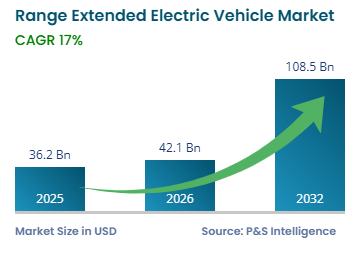
Range Extended Electric Vehicle Market Size Forecast
Key Highlights
Study Period
2021 - 2032
Market Size in 2025
USD 36.2 Billion
Market Size in 2026
USD 42.1 Billion
Market Size by 2032
USD 108.5 Billion
Projected CAGR
17%
Largest Region
Asia-Pacific
Fastest-Growing Region
Asia-Pacific
Market Structure
Semi-Consolidated
Market Size
Explore the market potential with our data-driven report
Range Extended Electric Vehicle Market Analysis
The range extended electric vehicle market size was USD 36.2 billion for 2025, and it will grow by 17.0% during 2026–2032, to reach USD 108.5 billion by 2032.
This growth is supported by the increasing global push toward vehicle electrification, driven by the need for flexible electrified mobility solutions across varying operating conditions. Range-extended electric vehicles bridge this gap by integrating a secondary power source to recharge batteries, thereby extending overall driving range beyond that of standard BEVs. This hybridized architecture is gaining traction in regions where charging networks remain underdeveloped, particularly across emerging economies.
The International Energy Agency reports that global electric car sales exceeded 14 million units in 2023, representing 18% of total vehicle sales, up from 4% in 2020. Additionally, the United Nations projects that urban populations will increase by 2.5 billion by 2050, intensifying demand for flexible and long-range electric mobility solutions.
Key Market Insights
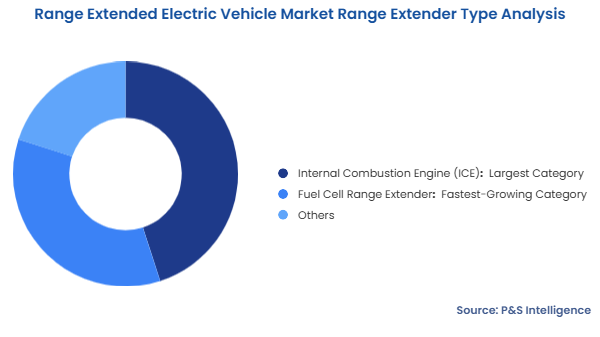
The internal combustion engine category holds the largest market share, of 45%, in 2025, driven by its compatibility with existing fuel infrastructure and mature supply chains.
The above 100 kW category will have the highest CAGR, of approximately 17.7%, driven by the electrification of heavy-duty commercial vehicles.
The commercial vehicles category will have the highest CAGR, of approximately 17.3%, driven by fleet electrification initiatives and logistics sector expansion.
The battery pack category holds the largest market share, of 40%, in 2025, driven by its dominant cost contribution within electrified powertrains.
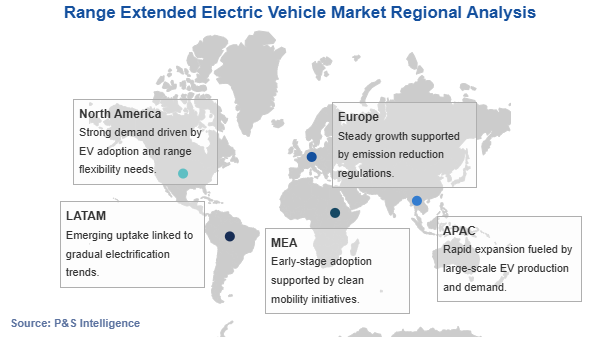
Asia-Pacific holds the largest market share, of 40%, in 2025, and it will have the highest CAGR, of approximately 17.9%, driven by China's mass-market EREV ecosystem and supportive government policies.
Range Extended Electric Vehicle Market Trends and Drivers
Hybridized Electrification Architectures Bridging Infrastructure Gaps Are Key Trends
A major trend shaping the REEV market is the transition toward hybridized electrification platforms that combine battery propulsion with auxiliary energy systems to address infrastructure disparities. Governments continue expanding EV charging networks, but deployment levels vary significantly across regions. According to the International Energy Agency Global EV Outlook, China accounts for over 60% of global public chargers, while regions such as India and Latin America are in early stages of infrastructure expansion. This imbalance has led OEMs to adopt REEV configurations as a practical solution, reducing dependence on fully developed charging networks while maintaining operational flexibility.
Simultaneously, technological integration is advancing toward multi-energy propulsion systems, including advanced range-extending systems integrated within vehicle architectures to enhance operational efficiency and range capability. The European Commission’s Alternative Fuels Infrastructure Regulation (AFIR) sets targets for deploying charging stations at intervals of up to 60 km along major transport corridors by 2030. This evolving infrastructure landscape is accelerating OEM investment in REEV platforms that ensure operational continuity in regions where compliance infrastructure continues to expand.
Expansion of Electrification Mandates and Infrastructure Gaps Are Biggest Drivers
The strongest driver for the REEV market is the rapid expansion of electrification mandates supported by stringent emission reduction targets. Governments worldwide are implementing strict emission reduction policies. The European Union’s CO₂ standards require a 55% reduction in emissions from new cars by 2030, while China’s New Energy Vehicle (NEV) policy mandates increasing EV penetration beyond 40% of total vehicle sales by 2030.
Despite these policies, supporting infrastructure development is expanding across multiple regions. In India, the Ministry of Power reports approximately 12,146 public charging stations installed as of early 2024, compared to over 3 million registered EVs, indicating strong opportunities for infrastructure expansion. REEVs address this constraint by enabling extended driving without reliance on dense charging networks. Additionally, transport accounts for nearly 24% of global CO₂ emissions (IEA), making electrification critical for climate targets. REEVs offer a transitional pathway by combining electric propulsion with extended range capability, supporting gradual infrastructure scaling.
Despite strong performance credentials and regulatory alignment, the elevated purchase price of range extended electric vehicles relative to internal combustion engine equivalents remains a substantial constraint on market expansion beyond early-adopter and premium consumer segments. The International Energy Agency highlights that electric vehicles continue to carry a price premium over comparable internal combustion engine vehicles, which represents an affordability barrier in price-sensitive emerging markets and cost-constrained fleet procurement environments. REEVs incorporate both a full traction battery and a range extender powertrain unit, resulting in higher bill-of-materials costs than either a standard hybrid or a smaller-battery BEV.
In markets where government purchase incentives have been reduced or eliminated, the price gap between REEVs and conventional vehicles widens in consumer perception, slowing adoption among the price-sensitive majority segments that represent the largest volume opportunity. Germany's 2023 withdrawal of BEV subsidies illustrates this dynamic. Battery pack price reductions observed in recent years are narrowing this premium, and current trends suggest continued price convergence through the forecast period. Near-term mass-market penetration nonetheless remains constrained by affordability challenges across several regions.
Commercial Fleet Electrification and Long-Range Mobility Needs Are Biggest Opportunities
A major opportunity for the REEV market lies in commercial fleet electrification, particularly in logistics and public transportation sectors. Fleet operators require vehicles capable of long-distance travel without operational downtime. REEVs provide extended driving range compared to conventional battery electric vehicles, making them suitable for logistics routes and intercity transportation.
Government initiatives are accelerating fleet electrification. In the United States, federal programs supported by the U.S. Department of Energy are investing over USD 7.5 billion in EV infrastructure, while India’s FAME II Scheme allocates INR 10,000 crore (~USD 1.2 billion) to promote electric mobility, including commercial vehicles. These policies are encouraging fleet operators to adopt electrified solutions. Additionally, urban delivery demand is rising significantly, driven by the continued expansion of e-commerce and logistics activity. This growth is increasing demand for vehicles that combine electric efficiency with operational flexibility, positioning REEVs as a viable solution in regions with partial charging infrastructure.
Range Extended Electric Vehicle Market Segmentation Analysis
Range Extender Type Analysis
The internal combustion engine category holds the largest market share, of 45%, in 2025, driven by its compatibility with existing fuel infrastructure and mature supply chains. The U.S. Energy Information Administration reports that petroleum-based fuels account for about 89% of transportation energy consumption in the United States, ensuring widespread accessibility and operational reliability of ICE-based range extenders. Additionally, ICE systems benefit from established manufacturing ecosystems, reducing integration complexity for OEMs and supporting large-scale deployment across passenger and commercial vehicle categories.
The fuel cell range extender category will have the highest CAGR, of approximately 17.5%, driven by national hydrogen strategies and investments in alternative fuel infrastructure. The International Energy Agency reports that the number of hydrogen refueling stations reached approximately 1,000 globally in 2023, with strong expansion targets under the European Hydrogen Strategy and South Korea’s Hydrogen Economy Roadmap. Fuel cell systems provide zero tailpipe emissions and higher efficiency compared to ICE-based generators, positioning them as a next-generation range extension solution in line with long-term decarbonization policies.
The range extender types analyzed in this report are:
Fuel Cell Range Extender (Fastest-Growing Category)
Others
Power Output Analysis
The 30 kW – 100 kW category holds the largest market share, of 60%, in 2025, supported by its optimal balance between energy output and efficiency for passenger vehicles and light commercial applications. This power range aligns with typical urban and intercity driving requirements, minimizing fuel consumption while maintaining extended range capability.
The above 100 kW category will have the highest CAGR, of approximately 17.7%, driven by the electrification of heavy-duty commercial vehicles. The U.S. Department of Energy Vehicle Technologies Office highlights increasing electrification in Class 6–8 trucks, which require higher power outputs for load-bearing and long-haul operations. This is further supported by government-backed freight decarbonization programs targeting emissions reduction in heavy transport sectors.
The power outputs analyzed in this report are:
Less than 30 kW
30 kW – 100 kW (Largest Category)
Above 100 kW (Fastest-Growing Category)
Vehicle Type Analysis
The passenger vehicles category holds the largest market share, of 55%, in 2025, driven by rising consumer demand for long-range electric mobility. Within this segment, SUVs and sedans dominate due to higher battery capacity and consumer preference for extended range vehicles. The International Energy Agency reports that passenger cars accounted for over 90% of global EV sales in 2023, highlighting the strong dominance of this segment in electrified mobility adoption.
The commercial vehicles category will have the highest CAGR, driven by fleet electrification initiatives and logistics sector expansion. Light commercial vehicles are leading adoption due to last-mile delivery demand, while heavy commercial vehicles are gradually integrating REEV systems for long-haul operations.
The vehicle types analyzed in this report are:
Passenger Vehicles (Largest Category)
Sedan
SUV
Hatchback
Others
Commercial Vehicles (Fastest-Growing Category)
Light Commercial Vehicles (LCV)
Medium Commercial Vehicles (MCV)
Heavy Commercial Vehicles (HCV)
Two-Wheelers & Three-Wheelers
Component Analysis
The battery pack category holds the largest market share in 2025, driven by its dominant cost contribution within electrified powertrains. The U.S. Department of Energy reports that battery systems account for 30–40% of total electric vehicle cost, making them the primary revenue component. In REEV architectures, battery packs are critical for enabling electric-only driving modes and reducing fuel consumption, reinforcing their central role in system design.
The power converter category will have the highest CAGR, driven by increasing complexity in energy management systems. Power converters regulate energy flow between battery packs, generators, and electric motors, and their importance is growing with advancements in hybrid control systems. The International Renewable Energy Agency highlights the rising importance of power electronics in improving energy efficiency across electrified transport systems.
The components analyzed in this report are:
Battery Pack (Largest Category)
Electric Motor
Generator
Power Converter (Fastest-Growing Category)
Others
End User Analysis
The individual consumers category holds the largest market share, of 45%, in 2025, due to their need for flexible mobility solutions that can support both daily commuting and extended travel. The ability to operate without full dependence on charging infrastructure makes REEVs highly practical for private ownership.
The fleet-based service providers category will have the highest CAGR, as REEVs enable continuous operations without charging downtime, ensuring high vehicle utilization. Their suitability for mixed-route operations and operational efficiency is driving accelerated adoption in commercial mobility services.
The end users analyzed in this report are:
Individual Consumers (Largest Category)
Fleet-Based Service Providers (Fastest-Growing Category)
Government & Public Sector
Non-Fleet Commercial & Industrial Users
Drive strategic growth with comprehensive market analysis
Range Extended Electric Vehicle Market Geographical Analysis
Asia-Pacific Range Extended Electric Vehicle Market Size
Asia-Pacific holds the largest market share, of 40%, in 2025, and it will have the highest CAGR, of approximately 17.9%, driven by China's mass-market EREV ecosystem and supportive government policies. The region's position is structurally anchored by China's mass-market EREV ecosystem. Strong government policy classifying extended-range electric vehicles as compliant New Energy Vehicles under the country's dual-credit system has created a permissive regulatory foundation. The rapid proliferation of domestically developed range-extended SUVs from Chinese OEMs, including Li Auto, BYD, AITO, Leapmotor, and Geely, has translated that foundation into volume. The International Energy Agency reports that China accounted for around 60% of global electric vehicle sales in 2023. This concentration of EREV supply and demand makes China the structural engine of regional market performance.
Moreover, South Korea is accelerating growth through its national hydrogen strategy, which targets the deployment of approximately 6.2 million fuel cell vehicles by 2040. This target supports the development of hydrogen-based range extender technologies and contributes to broader regional market expansion.
China Range Extended Electric Vehicle Market Size
China is the largest country market globally for range-extended electric vehicles. The rapid adoption of extended-range electric vehicle (EREV) architectures has been the primary structural driver of this position. China's dual-credit regulatory system classifies EREVs as compliant New Energy Vehicles, providing the policy foundation for sustained volume growth, while vehicle purchase incentives and tax exemptions reinforce consumer demand. EV sales in the country reached approximately 8.1 million vehicles in 2023, supported by policy incentives and the expansion of charging infrastructure. The International Energy Agency reports that the share of extended-range electric vehicles (EREVs) in China’s total electric car sales surpassed 10% in 2024, having increased more than fourfold since 2020, reflecting rapidly growing consumer demand for longer-range electrified vehicles.
India Range Extended Electric Vehicle Market Size
India represents one of the fastest-growing country markets within Asia-Pacific for range-extended electric vehicles. The government's FAME II Scheme, allocated INR 10,000 crore, has provided the principal demand-side policy foundation, while state-level EV policies and the expanding domestic EV manufacturing ecosystem reinforce market-level adoption. The Ministry of Heavy Industries has positioned electric mobility as a strategic national priority, with demand incentives, localization initiatives, and infrastructure development programs addressed through dedicated policy instruments.
India's REEV market is in an early but accelerating development stage. Global and Chinese OEMs, including Leapmotor through its partnership with Stellantis, are actively evaluating market entry. The NITI Aayog EV charging infrastructure report indicates that public charging infrastructure is expanding to support increasing EV adoption alongside ongoing expansion initiatives, creating strong demand for range-extended solutions. EV sales in India have witnessed strong growth in recent years, with total registrations surpassing 1.5 million units in 2023. The expanding public and semi-public charging network is progressively reducing range anxiety and supporting electrified mobility adoption.
The regions and countries analysed in this report are:
North America
U.S. (Larger Country)
Canada (Faster-Growing Country)
Europe
Germany (Largest Country)
U.K. (Fastest-Growing Country)
France
Italy
Spain
Rest of Europe
Asia-Pacific (Largest and Fastest-Growing Regional Market)
China (Largest Country)
India (Fastest-Growing Country)
Japan
South Korea
Australia
Rest of APAC
Latin America
Brazil (Largest Country)
Mexico (Fastest-Growing Country)
Rest of LATAM
Middle East and Africa
Saudi Arabia (Fastest-Growing Country)
U.A.E. (Largest Country)
South Africa
Rest of MEA
Range Extended Electric Vehicle Market Competitive Landscape
The market is semi-consolidated, characterized by a mix of global automotive OEMs and emerging EV-focused manufacturers. High capital requirements for R&D, battery integration, and vehicle platform development create strong barriers to entry. Regulatory compliance with emission standards and safety certifications further restrict new entrants. Additionally, supply chain dependencies for battery materials and electronic components increase operational complexity. However, ongoing technological innovation and government incentives are enabling new players to enter selectively, maintaining moderate competitive intensity.
Top Companies in the Range Extended Electric Vehicle Market:
Li Auto Inc.
BYD Company Limited
Leapmotor International B.V.
Stellantis N.V.
BMW Group
Nissan Motor Co., Ltd.
Mazda Motor Corporation
Volkswagen Group
Scout Motors Inc.
Hyundai Motor Company
Geely Auto Group
SERES Group Co., Ltd.
Range Extended Electric Vehicle Market News
In September 2025, Stellantis N.V. continued development of its Ramcharger range-extended electric pickup, reaffirming its strategy to deploy REEV technology across its North American truck portfolio. The move reflects increasing OEM focus on range-extended solutions to address towing capacity and long-range requirements in the pickup segment.
In May 2025, Li Auto Inc. launched the 2025 Smart Refresh Edition of its L-series range-extended electric SUV lineup, including updated L6, L7, L8, and L9 models. The refresh featured upgraded intelligent driving systems, enhanced LiDAR sensing capabilities, and improved active safety functions, reinforcing the company’s competitive positioning in China’s premium REEV SUV segment.
In January 2025, Leapmotor International B.V. unveiled the C10 REEV at the Brussels Motor Show, featuring a 28.4 kWh battery, a 1.5-liter range extender generator, and a combined driving range exceeding 900 km. The launch marked one of the first dedicated REEV entries into the European market through the Leapmotor–Stellantis joint venture, highlighting growing regulatory and consumer acceptance of range-extended architectures.
In April 2025, Mazda Motor Corporation unveiled the MAZDA EZ-60, a new electric SUV developed with Changan Automobile for the Chinese market. The vehicle lineup includes a range-extended electric vehicle (EREV) variant, expanding Mazda’s electrified mobility portfolio in China.
Frequently Asked Questions About This Report
How does the range extender electric vehicle market technology work?+
The technology in the range extender electric vehicle market is based on electric propulsion, where a battery powers the motor and a small onboard generator or engine produces electricity when the battery depletes, extending the vehicle's driving range.
What is the difference between REEV and plug-in hybrid in the range extender electric vehicle market?+
In the range extender electric vehicle market, REEVs rely solely on an electric motor for propulsion while the engine acts only as a generator, whereas plug-in hybrids use both the engine and motor to directly drive the vehicle.
What is the typical driving range in the range extender electric vehicle market?+
Vehicles in the range extender electric vehicle market typically provide 100
Why is the range extender electric vehicle market growing?+
The range extender electric vehicle market is growing due to reduced range anxiety, increasing demand for fuel-efficient mobility, lower emissions, and the ability to support long-distance travel without full dependence on charging infrastructure.
Which region is leading the range extender electric vehicle market?+
The Asia-Pacific region leads the range extender electric vehicle market, supported by strong adoption in countries such as China, favorable government policies, and expanding electric vehicle manufacturing ecosystems.
Want a report tailored exactly to your business need?
Leading companies across industries trust us to deliver data-driven insights and innovative solutions for their most critical decisions. From data-driven strategies to actionable insights, we empower the decision-makers who shape industries and define the future. From Fortune 500 companies to innovative startups, we are proud to partner with organisations that drive progress in their industries.
Client Testimonials
Working with P&S Intelligence and their team was an absolute pleasure – their awareness of timelines and commitment to value greatly contributed to our project's success. Eagerly anticipating future collaborations.
McKinsey & Company
India
Unmatched Standards
Our insights into the minutest levels of the markets, including the latest trends and competitive landscape, give you all the answers you need to take your business to new heights
Complete Data Security
We take a cautious approach to protecting your personal and confidential information. Trust is the strongest bond that connects us and our clients, and trust we build by complying with all international and domestic data protection and privacy laws