This Report Provides In-Depth Analysis of the Quality Management Software Market Report Prepared by P&S Intelligence, Segmented by Solution (Document Control, Audit Management, Complaint Handling, Corrective and Preventive Action, Supplier Quality Management, Change Management, Employee Training, Calibration Management, Quality Inspection Management, Mobile Incident and Event Reporting), Deployment (Cloud, On-Premises), Enterprise Size (Large Enterprises, Small and Medium Enterprises), End User (Manufacturing, Life Sciences, Healthcare, Food and Beverage, IT and Telecommunications, Transportation and Logistics, Aerospace and Defense, Energy and Utilities, Government and Public Sector), and Geographical Outlook for the Period of 2021 to 2032
Explore the market potential with our data-driven report
Quality Management Software Market Future Outlook
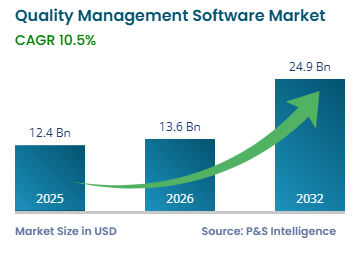
The quality management software market size was USD 12.4 billion for 2025, and it will grow by 10.5% during 2026–2032, to reach USD 24.9 billion by 2032.
The market is driven by the growing adoption of AI-enabled complaint handling, audit management, and document control modules across manufacturing, life sciences, and IT operations. This integration is positioning cloud-native quality management software platforms as central to enterprise compliance and operational risk strategies, while rising regulatory and certification pressure is reinforcing enterprise demand for standardized, digitally managed quality systems. International Organization for Standardization (ISO) data shows that more than 1.47 million ISO 9001 quality management certificates were valid worldwide in 2024. This reflects continued enterprise emphasis on formalized quality management systems. The expanding adoption of ISO 9001 certification supports demand for digital quality management software platforms that facilitate audit trails, non-conformance management, and corrective and preventive action (CAPA) documentation.
Additionally, the enterprise software modernization underpins this trajectory as organizations retire manual and spreadsheet-based quality processes in favor of integrated, analytics-driven platforms. The Organisation for Economic Co-operation and Development (OECD) reports that the ICT sector expanded nearly three times faster than the broader economy across OECD countries between 2013 and 2023, averaging 7.6% growth in 2023 alone, underscoring the pace of enterprise software adoption that includes quality management applications.
Key Market Insights
The document control category holds the largest market share of 25% in 2025 driven by its essential role in managing SOPs, specifications, and controlled records to ensure regulatory compliance across quality processes.
The large enterprises category holds the larger market share of 80% in 2025, driven by complex regulatory requirements, multi-site operations, and higher investments in enterprise-wide QMS solutions.
The life sciences category will have the highest CAGR of approximately 10.8%, driven by stringent regulatory requirements and rising pharmaceutical spending that increase demand for robust quality management solutions.
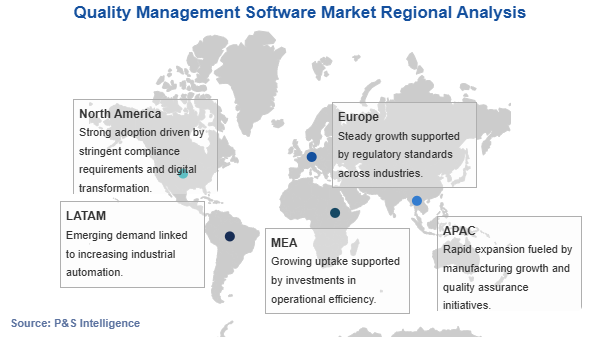
North America holds the largest market share of 40% in 2025, driven by its mature enterprise software ecosystem and stringent regulatory requirements.
Asia-Pacific will have the highest CAGR of approximately 11.4%, driven by rapid manufacturing digitalization in China and expanding IT infrastructure in India.
Quality Management Software Market Trends and Drivers
Artificial Intelligence Integration Is Key Trend
Quality management software is evolving from static, workflow-based documentation systems into predictive, AI-augmented platforms capable of identifying non-conformances, automating root-cause analysis, and generating audit-ready reports with minimal manual intervention. This transformation mirrors the broader enterprise software shift toward embedded artificial intelligence. In 2025, 88% of organizations reported regular AI use in at least one business function. This reflects the mainstream adoption of AI across enterprise operations. This trend is reflected in recent vendor innovation. In April 2026, MetricStream, Inc. introduced an AI-powered update to its GRC platform, embedding governed AI and real-time analytics across enterprise risk management, regulatory compliance, internal audit, and policy and document management modules to accelerate compliance decision-making.
QMS vendors are responding by embedding natural-language querying, automated corrective and preventive action (CAPA) recommendation engines, intelligent document management, and predictive defect-detection models directly into their platforms. As enterprises increasingly prioritize automation, predictive quality management, and faster regulatory compliance, AI-enabled capabilities are becoming a key competitive differentiator in the QMS market. Vendors that embed advanced AI into core quality workflows are expected to strengthen customer retention, accelerate enterprise upgrades, and capture a larger share of new software investments.
Regulatory Harmonization and Compliance Mandates Are Biggest Drivers
Global regulatory authorities are tightening quality documentation, traceability, and compliance requirements across regulated manufacturing industries. This is compelling organizations to replace manual quality processes with auditable digital systems. This shift is evident in the medical device industry. The U.S. Food and Drug Administration's (FDA) Quality Management System Regulation (QMSR) became effective on February 2026. The regulation harmonizes U.S. medical device quality requirements with the internationally recognized ISO 13485:2016 standard, while retaining applicable FDA regulatory requirements, and the FDA confirms that inspections remain mandatory regardless of ISO certification. This requires manufacturers to maintain quality management systems that satisfy both FDA regulatory requirements and ISO 13485-based quality management expectations.
This evolving regulatory landscape is accelerating the adoption of integrated quality management software platforms capable of supporting document control, audit management, traceability, corrective and preventive action (CAPA), and compliance across multiple regulatory frameworks across highly regulated industries.
Integration Complexity and Workforce Skill Gaps Are Key Restraints
Despite strong underlying demand, enterprise-wide QMS deployment is constrained by integration complexity with legacy manufacturing execution systems (MES), ERP platforms, and disparate plant-level data sources, particularly among manufacturers operating multiple facilities with inconsistent technology stacks. This challenge is compounded by a persistent shortage of skilled personnel capable of configuring and administering advanced quality platforms. The National Association of Manufacturers reports that roughly one in four manufacturers report vacancy rates of 5% or higher for open positions, highlighting ongoing workforce shortages that can limit the availability of personnel needed to support enterprise software implementation, system integration, and digital transformation initiatives, including quality management systems.
These barriers tend to extend deployment timelines and increase total cost of ownership, particularly for mid-sized manufacturers lacking dedicated IT resources. Vendors offering low-code configuration tools, pre-built integration connectors, and managed implementation services are better positioned to reduce deployment complexity and help manufacturers accelerate enterprise-wide QMS adoption.
SME Digitalization and Emerging Manufacturing Hubs Are Biggest Opportunities
A share of the global quality management software opportunity remains untapped among small and medium-sized manufacturers, which have historically relied on paper-based or basic spreadsheet quality tracking due to cost and complexity barriers associated with legacy on-premise QMS deployments. The World Bank reports that SMEs represent approximately 90% of businesses worldwide and account for more than half of global employment. This underscores the scale of the underpenetrated market as affordable, subscription-based cloud QMS solutions lower adoption barriers.
This opportunity is pronounced across emerging manufacturing hubs in Southeast Asia, India, and Latin America, where export-oriented SMEs increasingly require internationally recognized quality certifications to participate in global supply chains. Vendors offering modular, scalable, and lower-cost cloud-based QMS solutions are well positioned to expand their customer base by addressing the quality management and regulatory compliance needs of this digitalizing SME segment.
The document control category holds the largest market share of 25% in 2025 driven by its foundational role in nearly every regulated quality process, spanning SOP management, specification control, and controlled record retention, which provides the baseline evidence regulators require of a functioning quality system and sustains document control's leadership position across the market. The complexity of maintaining audit-ready documentation across multi-site, multi-regulator environments has made document control the entry-point module for most QMS implementations particularly in pharmaceutical and medical device manufacturing. The European Medicines Agency's (EMA) GMP inspection data shows that EEA authorities issued 2,110 GMP certificates following inspections in 2024. This volume of documentation-intensive compliance activity is sustaining demand for digital document control systems.
The supplier quality management category will have the highest CAGR of approximately 11.0%. This acceleration reflects intensifying scrutiny of multi-tier supply chains, as manufacturers increasingly require real-time visibility into supplier certifications, incoming inspection data, and non-conformance histories rather than relying on periodic audits alone. UNIDO's International Yearbook of Industrial Statistics indicates that manufactured goods represented nearly four-fifths of total global exports in 2024, underscoring the scale of cross-border supply relationships that require systematized supplier quality oversight.
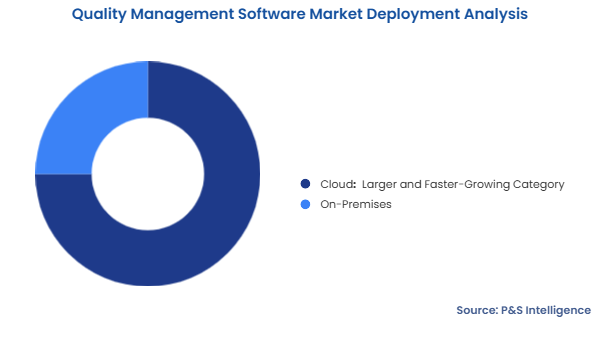
The cloud category holds the largest market share of 75% in 2025, and it will have the highest CAGR, as manufacturers are prioritizing faster deployment, lower upfront capital costs, and easier multi-site rollout. Cloud-based QMS platforms eliminate the server maintenance and version-control burdens associated with legacy on-premise systems while enabling centralized access to quality data across geographically dispersed facilities. According to the International Telecommunication Union's (ITU) Measuring Digital Development report, global internet traffic reached 6 zettabytes in 2024, up from 5.1 zettabytes in 2023. This growth in digital infrastructure is supporting enterprise cloud adoption across the manufacturing sector.
Enterprise-wide digitalization trends are extending beyond large organizations into mid-sized and smaller manufacturers that have traditionally relied on on-premise or manual quality management systems. This trend is reinforcing cloud's dual leadership position across the market. According to Eurostat, 84.67% of large EU enterprises used cloud computing services in 2023. Subscription-based pricing and scalable deployment models are making cloud-based QMS solutions increasingly accessible to enterprises of every size.
The deployments analyzed in this report are:
Cloud (Larger and Faster-Growing Category)
On-Premises
Enterprise Size Analysis
The large enterprises category holds the larger market share in 2025, driven by complex regulatory requirements, multi-site operations, and higher investments in digital transformation. Their extensive manufacturing networks and need for centralized, enterprise-wide QMS solutions further strengthen market leadership. According to Eurostat, 78% of large enterprises in the EU purchased cloud computing services in 2023, compared with 44% of SMEs, reflecting their higher adoption of enterprise digital technologies.
The small and medium enterprises category will have the higher CAGR of approximately 10.7%, driven by declining cloud QMS subscription costs and rising export certification requirements applicable to smaller manufacturers participating in global supply chains. The International Finance Corporation's (IFC) MSME Finance Gap Report estimates a financing gap of approximately USD 5.7 trillion across 119 emerging markets and developing economies. This financing constraint increases the appeal of affordable, subscription-based QMS solutions that reduce upfront investment requirements for SMEs. As modular, cloud-based QMS platforms become more accessible, they are enabling a broader range of smaller manufacturers to digitalize quality management processes and strengthen regulatory compliance.
The enterprise sizes analyzed in this report are:
Large Enterprises (Larger Category)
Small and Medium Enterprises (Faster-Growing Category)
End User Analysis
The manufacturing category holds the largest market share in 2025, driven by the sector's reliance on standardized quality control across production lines. Long-established adoption of quality management methodologies such as Six Sigma and lean manufacturing reinforces this foundation, while ongoing regulatory and customer compliance requirements across automotive, industrial, and consumer goods manufacturing sustain demand for structured quality systems. According to UNIDO, global manufacturing value added reached USD 16.83 trillion in 2024. This vast production base depends on systematic quality management and process standardization to maintain output consistency.
The life sciences category will have the highest CAGR of approximately 10.8%, driven by increasingly stringent regulatory requirements, while sustained growth in pharmaceutical spending is reinforcing the demand for rigorous quality management. Electronic documentation and end-to-end product traceability round out the requirements this growth is placing on manufacturers. According to the Centers for Medicare & Medicaid Services (CMS), U.S. retail prescription drug spending reached USD 467 billion in 2024, an increase of 7.9% from the previous year. This expansion in pharmaceutical production and distribution activity requires digitally managed quality management systems.
The end users analyzed in this report are:
Manufacturing (Largest Category)
Life Sciences (Fastest-Growing Category)
Healthcare
Food and Beverage
IT and Telecommunications
Transportation and Logistics
Aerospace and Defense
Energy and Utilities
Government and Public Sector
Others
Drive strategic growth with comprehensive market analysis
Quality Management Software Market Geographical Outlook
North America Quality Management Software Market Size
North America holds the largest market share of 40% in 2025, supported by a deep, mature enterprise software base. Manufacturing, healthcare, and life sciences organizations across the region face stringent regulatory and quality compliance requirements. Leading QMS vendors including Oracle, MasterControl, and Sparta Systems also maintain their regional headquarters here. The region's extensive manufacturing base continues to generate demand for compliance-focused quality management software across discrete and process industries. U.S. Census Bureau data shows that the U.S. manufacturing sector recorded USD 7.1 trillion in value of shipments in the 2022 Economic Census. This scale of industrial activity supports sustained adoption of quality management software for quality control, regulatory compliance, audit management, and process standardization.
The U.S. is the larger country market for quality management software within North America, driven by a concentration of large manufacturing enterprises that anchors this leadership position. Major QMS vendors headquartered in the country reinforce this advantage. FDA and industry-specific compliance requirements continue to evolve across life sciences, aerospace, and automotive industries. These requirements sustain demand for compliance-focused platforms. According to the U.S. Bureau of Labor Statistics (BLS), manufacturing employment totaled approximately 12.7 million workers in 2025. This reflects the scale of the industrial workforce that continues to support enterprise investment in quality management software for regulatory compliance, operational efficiency, and continuous quality improvement.
Canada Quality Management Software Market Size
Canada is the faster-growing country in the North American Quality Management Software market, supported by ongoing digital transformation across manufacturing, healthcare, food processing, and life sciences industries. Regulatory compliance, quality assurance, and operational efficiency are priorities for organizations across the country. This is encouraging adoption of cloud-based QMS platforms for document control, audit management, corrective and preventive actions (CAPA), and supplier quality management.
According to Statistics Canada, manufacturing sales reached CAD 935.2 billion in 2024. This underscores the scale of Canada's industrial sector, which supports continued investment in enterprise quality management software for process standardization, compliance, and continuous improvement.
Asia-Pacific will have the highest CAGR of approximately 11.4%, driven by rapid manufacturing digitalization in China and expanding IT infrastructure in India. Small and medium-sized enterprises across the region are increasingly adopting affordable cloud-based QMS solutions as manufacturers pursue export-quality certification and strengthen regulatory compliance to meet international standards.
Software Technology Parks of India (STPI), under the Ministry of Electronics and Information Technology, reported that IT and IT-enabled services exports from STPI-registered units crossed INR 9.00 lakh crore in FY 2023–24. This reflects the scale of India's software and digital services ecosystem, which increasingly supports enterprise adoption of quality management software for document control, audit management, regulatory compliance, and process standardization.
China Quality Management Software Market Size
China is the largest country market for quality management software within Asia Pacific, driven by its unmatched manufacturing scale and accelerating industrial digitalization agenda under national policy initiatives. Large-scale smart factory programs and increasingly stringent quality and compliance requirements for export-oriented manufacturing are driving adoption of quality management software across both large enterprises and small and medium-sized businesses. According to the National Bureau of Statistics (NBS) of China, manufacturing accounted for 24.8% of the country's GDP in 2024. China also maintained its position as the world's largest manufacturing nation for the 15th consecutive year. This underscores the scale of the addressable market for enterprise quality management software.
A report released through China's State Council Information Office reported that 89.6% of major industrial enterprises had completed digital retrofitting by December 2025, with adoption rates reaching 94.4% in automotive, 94.2% in shipbuilding, and 93.9% in electronic information manufacturing. This reinforces the accelerating deployment of enterprise-grade quality management software across China's industrial sector.
These regions and countries are analysed:
North America (Largest Regional Market)
U.S. (Larger Country)
Canada (Faster-Growing Country)
Europe
Germany (Largest Country)
U.K. (Fastest-Growing Country)
France
Italy
Spain
Rest of Europe
Asia-Pacific (Fastest-Growing Regional Market)
China (Largest Country)
India (Fastest-Growing Country)
Japan
South Korea
Australia
Rest of APAC
Latin America
Brazil (Largest Country)
Mexico (Fastest-Growing Country)
Rest of LATAM
Middle East & Africa
Saudi Arabia (Largest Country)
South Africa
U.A.E. (Fastest-Growing Country)
Rest of MEA
Quality Management Software Market Share Analysis
The market is fragmented, with numerous global enterprise software providers competing alongside specialized quality management solution vendors serving diverse end-use industries. Leading companies, including SAP SE, Oracle Corporation, Microsoft Corporation, Dassault Systemes SE, MasterControl Inc., Ideagen plc, and Siemens AG, are expanding cloud-based QMS portfolios and integrating AI-driven quality management capabilities into their platforms. Strategic acquisitions and partnerships are strengthening their industry-specific compliance solutions, while cloud-based deployment and artificial intelligence are driving continuous innovation across the competitive landscape. Analytics, mobile accessibility, and integration with enterprise resource planning, manufacturing execution systems, and other business applications are extending this competition into adjacent operational systems.
Vendors increasingly differentiate themselves through industry-specific compliance capabilities and scalable SaaS platforms. Configurable workflows and comprehensive quality management modules, including document control, audit management, corrective and preventive action, supplier quality management, and training management, extend this differentiation across the product suite. Strategic partnerships and acquisitions are expanding company portfolios across the market. Product enhancements are strengthening competitive positioning across regulated and industrial sectors worldwide.
Leading Companies in the Quality Management Software Market:
MasterControl Solutions, Inc.
Veeva Systems Inc.
Hexagon AB
Honeywell International Inc.
Siemens AG
SAP SE
Dassault Systemes SE
Oracle Corporation
Microsoft Corporation
MetricStream, Inc.
ComplianceQuest
Ideagen plc
AssurX, Inc.
Rockwell Automation, Inc.
Intelex Technologies ULC
Quality Management Software Market Developments
In June 2026, Veeva Systems Inc. launched Veeva EHS, a new environmental, health, and safety application within its Quality Cloud suite, with early adopter availability planned for August 2026. The launch extends Veeva's quality platform into safety management by automatically linking safety incidents to quality deviations and retraining workflows.
In April 2026, Hexagon AB launched QUINDOS 2026.1, the latest version of its metrology software, featuring enhanced coordinate measuring machine monitoring, advanced analysis tools, and faster scanning capabilities. The release strengthens Hexagon's quality inspection offering for precision manufacturing environments.
In October 2025, Ideagen plc acquired SafetyStratus, a Texas-based provider of cloud-based environmental, health, and safety software with specialized chemical management capabilities. The acquisition expands Ideagen's EHSQ portfolio to serve university, commercial laboratory, and large enterprise customers requiring precise chemical compliance tracking.
In May 2025, Sparta Systems, Inc., a Honeywell company, introduced AI-assisted recall management software within its TrackWise Digital platform to help life sciences manufacturers reduce the scope and impact of product recalls. The launch strengthens patient safety outcomes by accelerating root-cause identification and corrective action workflows.
In March 2025, MasterControl, Inc. acquired Qualer, a cloud-native computerized maintenance management and calibration software provider, to integrate asset tracking into its quality and manufacturing platform. The acquisition strengthens MasterControl's integrated quality, manufacturing, calibration, and asset management capabilities for life sciences manufacturers.
Frequently Asked Questions About This Report
What factors are driving the growth of the quality management software market?+
Growth is driven by AI integration, stricter regulatory compliance, cloud adoption, and enterprise digital transformation.
How is artificial intelligence transforming quality management software?+
AI automates quality inspections, root-cause analysis, CAPA recommendations, document management, and compliance reporting.
Why are cloud-based quality management software solutions gaining popularity?+
Leading companies across industries trust us to deliver data-driven insights and innovative solutions for their most critical decisions. From data-driven strategies to actionable insights, we empower the decision-makers who shape industries and define the future. From Fortune 500 companies to innovative startups, we are proud to partner with organisations that drive progress in their industries.
Client Testimonials
Working with P&S Intelligence and their team was an absolute pleasure – their awareness of timelines and commitment to value greatly contributed to our project's success. Eagerly anticipating future collaborations.
McKinsey & Company
India
Unmatched Standards
Our insights into the minutest levels of the markets, including the latest trends and competitive landscape, give you all the answers you need to take your business to new heights
Complete Data Security
We take a cautious approach to protecting your personal and confidential information. Trust is the strongest bond that connects us and our clients, and trust we build by complying with all international and domestic data protection and privacy laws