This Report Provides In-Depth Analysis of the Intelligent Document Processing Market Report Prepared by P&S Intelligence, Segmented by Component (Solutions, Services), Deployment Mode (Cloud, On-Premises), Technology (Optical Character Recognition, Natural Language Processing, Machine Learning & Deep Learning, Computer Vision, Generative AI), Organization Size (Large Enterprises, Small & Medium Enterprises), End-user (Banking, financial services, and insurance, Healthcare & Life Sciences, Government & Public Sector, Retail & E-commerce, Manufacturing, Transportation & Logistics, IT & Telecom), and Geographical Outlook for the Period of 2021 to 2032
Explore the market potential with our data-driven report
Intelligent Document Processing Market Overview
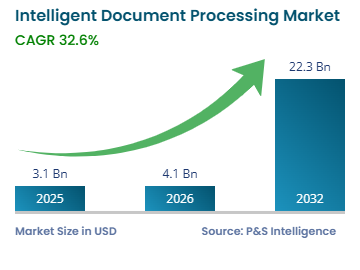
The intelligent document processing market size was USD 3.1 billion in 2025, and it will grow by 32.6% during 2026-2032 to reach USD 22.3 billion by 2032.
The intelligent document processing market is expanding as organizations increasingly replace paper-based and manually managed workflows with digital processes capable of handling large volumes of business information more efficiently. Enterprises process invoices, contracts, claims forms, compliance records, customer documents, and other content that often requires significant manual effort to review and manage. Intelligent document processing solutions are helping address these challenges by combining artificial intelligence, optical character recognition, machine learning, and natural language processing to classify documents, extract information, validate data, and automate workflow routing. The growing emphasis on operational efficiency, workforce productivity, and faster decision-making is encouraging wider adoption of document automation technologies across industries.
The market is also benefiting from broader digital transformation initiatives, expanding cloud adoption, and increasing demand for automated document processing and real-time access to business information. Organizations are managing larger volumes of digital records while seeking to improve compliance, customer experiences, transparency, and process accuracy. According to Eurostat, 20.0% of enterprises in the European Union with 10 or more employees used artificial intelligence technologies in 2025, reflecting the growing adoption of AI-powered business applications that support document classification, data extraction, and workflow automation. The continued expansion of digital business activities continues to increase the creation, exchange, and storage of electronic documents across businesses, government agencies, financial institutions, healthcare providers, and consumer-facing platforms. Growing digital activity is increasing demand for solutions that can process information quickly, reduce manual workloads, improve document accuracy, and support workflow automation across document-intensive operations. Enterprises are therefore investing in advanced document intelligence capabilities that help transform growing volumes of digital content into structured, accessible, and actionable business information.
Key Market Insights
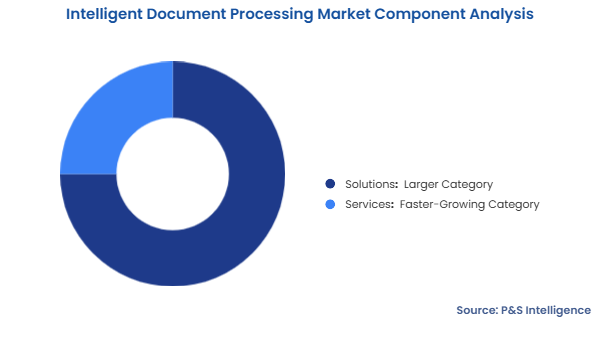
Solutions are the larger component category, holding a market share of 75%, because organizations use these platforms for document capture, classification, extraction, validation, and workflow routing.
Optical Character Recognition is the largest technology category, holding a market share of 35%, because scanned documents and images must be converted into readable text before processing.
Banking, Financial Services, and Insurance is the largest end-user category, holding a market share of 30%, because institutions manage document-heavy workflows for onboarding, compliance reviews, loans, policies, and claims.
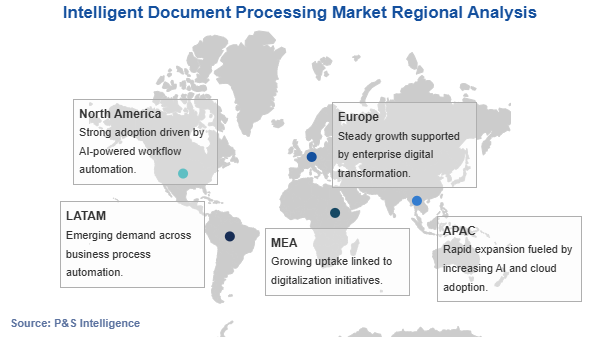
North America holds the largest share of 40%, because enterprises are early adopters of artificial intelligence, workflow automation, and enterprise content management technologies.
Asia-Pacific is the fastest-growing region, registering a CAGR of approximately 33.5%, driven by accelerating digital transformation initiatives, expanding cloud adoption, and growing enterprise automation investments.
Intelligent Document Processing Market Dynamics
Agentic AI and Context-Aware Document Intelligence Is a Major Trend
The intelligent document processing market is evolving from basic document capture and data extraction toward advanced platforms capable of understanding context, interpreting content, and supporting business decisions. Organizations are increasingly adopting solutions that combine generative AI, large language models, and document intelligence capabilities to process contracts, financial records, medical documents, and other complex content with greater flexibility. These technologies reduce dependence on predefined templates and improve the handling of unstructured information across enterprise workflows. According to Stanford University's AI Index 2025, 78% of organizations used AI in 2024, reflecting the rapid integration of AI into enterprise operations and supporting growing demand for intelligent document processing platforms capable of understanding and automating complex document workflows. Growing adoption of generative AI and enterprise AI technologies is increasing demand for intelligent document processing platforms that can automate document understanding, support workflow orchestration, and deliver more accurate information extraction across document-intensive operations.
Rising Need to Eliminate Manual Document Processing Drives Market
The need to process growing volumes of business documents quickly and accurately is a major driver of the intelligent document processing market. Organizations continue to manage invoices, claims, contracts, onboarding forms, and compliance documents that often require significant manual effort and create operational inefficiencies. Intelligent document processing helps automate data extraction, validation, classification, and workflow management, reducing processing times and improving consistency. In addition, the United Nations E-Government Survey 2024 reported improvements in digital government development across all 193 Member States, while the share of people living in countries with low digital government development declined to 22.4%. Expanding digital infrastructure and increasing digital public and business services are generating larger volumes of electronic documents and digital records, encouraging organizations to adopt intelligent document processing solutions that improve efficiency, compliance, and information accessibility across business operations.
Complex Integration and Data Quality Challenges Limit Adoption
A major restraint in the intelligent document processing market is the complexity of integrating document intelligence platforms with existing enterprise systems while maintaining governance, security, and compliance requirements. Organizations often manage documents across legacy applications, cloud environments, and multiple business functions, creating challenges related to data consistency, workflow alignment, and processing accuracy. Variations in document formats, image quality, and content structure can further increase validation requirements and implementation effort. The absence of formal governance frameworks increases concerns around data management, regulatory compliance, and responsible AI usage. These challenges can extend deployment timelines, increase operational complexity, and limit broader adoption of intelligent document processing across highly regulated and document-intensive environments.
Expansion of Intelligent Automation across Mid-Sized Enterprises Creates Market Opportunity
A significant opportunity for the intelligent document processing market is emerging from the growing accessibility of cloud-based automation technologies across organizations with limited technical resources. Businesses are increasingly seeking solutions that can automate document-heavy workflows without requiring extensive infrastructure investments. Advances in artificial intelligence, natural language processing, and workflow automation are expanding the ability of intelligent document processing platforms to handle complex and unstructured content across finance, procurement, human resources, customer onboarding, and compliance functions. According to the OECD, cloud computing adoption among businesses exceeded 50% in 2024, reflecting the growing accessibility of cloud-based digital technologies for enterprises. Expanding digital connectivity is supporting wider adoption of cloud-based business applications and digital workflows, creating favorable conditions for scalable document automation solutions across distributed enterprise environments.
Solutions are the larger category, holding a market share of 75%, because organizations use these platforms to manage capture, classification, extraction, validation, and routing in one workflow. The category also connects strongly with cloud deployment, OCR engines, and industry-specific templates used by banks, insurers, hospitals, and public agencies. According to Eurostat, 53.47% of EU enterprises used ERP, CRM, or BI software in 2025, while 46.45% used ERP software. This widespread adoption of enterprise software creates a strong integration opportunity for IDP solutions, enabling organizations to automate document-driven workflows, reduce manual data entry, and improve workflow control across departments.
Services are the faster category, registering a CAGR of approximately 32.8%, as deployments increasingly require integration, model training, workflow redesign, and post-launch accuracy tuning. Many organizations do not have internal teams that can map document types, prepare exception rules, connect legacy systems, and monitor extraction quality at scale. Demand is rising for consulting, implementation, and managed support as projects move from single-use invoice automation to multi-department programs covering claims, onboarding, contracts, and regulatory files.
The components analysed in this report are:
Solutions (Larger Category)
Services (Faster-Growing Category)
Deployment Mode Analysis
Cloud is the larger and faster-growing category, holding a market share of 80%, because enterprises need document processing that scales across branches, remote teams, scanners, email channels, and customer portals. Cloud deployment supports faster model updates, API integration, usage-based purchasing, and centralized oversight for OCR, extraction, and validation workloads. According to the Organisation for Economic Co-operation and Development (OECD), cloud computing is used by approximately half of businesses with 10 or more employees across OECD countries, reflecting the growing adoption of cloud-based digital technologies. This adoption base supports cloud IDP platforms that handle changing document volumes without significant on-premises infrastructure investments or lengthy system upgrades.
The deployment modes analysed in this report are:
Cloud (Larger and Faster-Growing Category)
On-Premises
Technology Analysis
Optical Character Recognition is the largest category, holding a market share of 35%, because it forms the first technical layer in most intelligent document processing workflows. Scanned papers, PDFs, images, invoices, identity records, claims documents, and healthcare forms must become readable text before classification, extraction, validation, or analytics can work. Microsoft introduced Mistral Document AI with OCR 4 in Microsoft Foundry in 2025, enabling the extraction of text and structured content from PDF documents and other unstructured business files, reinforcing the importance of OCR in intelligent document processing workflows. This highlights the continued importance of OCR as the foundational technology for intelligent document processing, enabling accurate text extraction from unstructured business documents before downstream AI analysis.
Natural Language Processing is the fastest-growing category, due to the rising need for systems that interpret meaning rather than only capture fields. Enterprises are increasingly using natural language processing to analyze contracts, correspondence, claims notes, clinical documents, policy files, and customer communications where key information is embedded in sentences, clauses, or mixed formats. The growth is strengthened by language models that improve entity recognition, document summarization, intent detection, and exception handling, making it valuable for higher-complexity workflows.
The technologies analysed in this report are:
Optical Character Recognition (Largest Category)
Natural Language Processing (Fastest-Growing Category)
Machine Learning & Deep Learning
Computer Vision
Generative AI
Others
Organization Size Analysis
Large Enterprises are the larger category, as large organizations handle document flows across many departments, countries, products, and compliance environments. Their document estates often include loan files, insurance claims, supplier invoices, customer onboarding records, medical documents, and audit trails. These companies have the budgets, IT teams, and governance structures needed for enterprise-wide deployment. They also gain stronger returns from automation because even small improvements in processing speed or accuracy affect very high transaction volumes.
Small and Medium Enterprises are the faster-growing category, registering a CAGR of approximately 33.0%, because cloud delivery and subscription pricing reduce the cost of adopting intelligent document processing. Smaller firms manage invoices, tax records, onboarding files, and customer documents with limited administrative staff, so they need tools that remove repetitive data entry without requiring large IT teams. According to Eurostat, 52.74% of enterprises in the European Union used paid cloud computing services in 2025, reflecting the growing adoption of cloud-based business applications. This growing adoption of cloud computing makes IDP adoption more practical for SMEs by supporting template-based extraction, managed updates, and lower upfront deployment costs.
The organization sizes analysed in this report are:
Large Enterprises (Larger Category)
Small & Medium Enterprises (Faster-Growing Category)
End-User Analysis
Banking, Financial Services, and Insurance is the largest category, holding a market share of 30%, because financial institutions manage document-heavy workflows tied to onboarding, know-your-customer checks, loan files, policy forms, claims records, and compliance reviews. These processes connect directly with OCR, validation, audit trails, and workflow routing because errors can delay approvals or increase regulatory risk. These document-intensive processes create continuous document handling requirements, making IDP valuable for faster verification, cleaner records, and more controlled financial operations.
Healthcare and Life Sciences is the fastest-growing category, as providers, payers, laboratories, and life sciences companies push to reduce administrative friction around clinical and regulatory documentation. The increasing volume of patient records, claims attachments, prior authorization forms, prescriptions, trial documents, and compliance submissions is driving demand for automated document processing to improve operational efficiency. Intelligent document processing helps structure this information for faster review, billing, and record updates. Growth is also supported by digital health programs and pressure to improve staff productivity without compromising data accuracy.
The end-users analysed in this report are:
Banking, financial services, and insurance (Largest Category)
Healthcare & Life Sciences (Fastest-Growing Category)
Government & Public Sector
Retail & E-commerce
Manufacturing
Transportation & Logistics
IT & Telecom
Others
Drive strategic growth with comprehensive market analysis
North America Intelligent Document Processing Market Analysis
North America holds the largest share, of 40%, because enterprises across the region have been early adopters of artificial intelligence, workflow automation, and enterprise content management technologies. Large financial institutions, healthcare networks, government agencies, and insurance providers manage extensive volumes of business-critical documents and continue investing in solutions that improve processing accuracy and regulatory compliance. The region also benefits from a mature software ecosystem, strong cloud infrastructure, and the presence of major technology vendors that actively integrate advanced document intelligence capabilities into enterprise platforms. Organizations increasingly view intelligent document processing as a strategic tool for improving operational efficiency, accelerating customer-facing processes, and strengthening data governance. Continuous investment in digital modernization programs and AI-driven business transformation further supports sustained demand across both private and public sectors.
U.S. Intelligent Document Processing Market Analysis
The U.S. intelligent document processing market benefits from widespread adoption of enterprise software, advanced analytics technologies, and document-intensive operations across financial services, healthcare, government, and large commercial organizations. Businesses are increasingly implementing document automation solutions to improve compliance management, reduce manual workloads, and streamline information processing. The Internal Revenue Service processed 271.4 million tax returns and other forms in 2025. The large volume of tax returns and administrative documents processed across public agencies reflects strong demand for technologies that classify, extract, validate, and manage information efficiently, supporting continued adoption of intelligent document processing solutions.
Canada is experiencing growing adoption of intelligent document processing as organizations modernize administrative workflows and expand digital service delivery capabilities. Financial institutions, healthcare providers, and public-sector agencies are increasingly investing in automation technologies to improve efficiency, accessibility, and information management. The Government of Canada reported that approximately 93% of income tax and benefit returns were filed online in 2025. The continued shift toward digital document submission and processing is increasing demand for solutions that can automate document classification, data extraction, validation, and workflow management while supporting accurate and efficient handling of high-volume records.
Asia-Pacific has the highest CAGR, of approximately 33.5%, because organizations across the region are accelerating digital transformation initiatives while managing rapidly expanding volumes of business and customer documentation. The market benefits from increasing enterprise automation investments, expanding cloud adoption, and growing use of AI technologies across both developed and emerging economies. China, the region’s largest country market, is supported by large-scale digitization efforts, extensive enterprise software deployment, and strong adoption of intelligent automation within financial services, manufacturing, and public-sector operations. India, the fastest-growing country in the region, is experiencing rising demand for document automation as businesses modernize customer onboarding, financial processing, and compliance management functions. India's DigiLocker had issued more than 950 crore digital documents by March 2026, reflecting the rapid expansion of digital document management and paperless service delivery. The combination of expanding digital ecosystems, growing technology investment, and increasing enterprise focus on process efficiency continues to strengthen regional market momentum.
China Intelligent Document Processing Market Analysis
China's intelligent document processing market is supported by large-scale enterprise digitization initiatives, expanding automation adoption, and increasing use of digital business processes across industries. Organizations are deploying document intelligence solutions to manage information generated through manufacturing operations, financial activities, supply chains, and public administration systems. According to the Digital China Development Report (2024), the added value of China's core digital economy industries accounted for approximately 10% of GDP in 2024. The scale of digital activity is increasing the creation and exchange of electronic documents across businesses and government organizations. This environment supports growing demand for technologies that can automate document processing, improve data accessibility, and enhance operational efficiency.
Europe Intelligent Document Processing Market Analysis
Europe maintains a significant position in the intelligent document processing market, supported by strong regulatory requirements and widespread adoption of digital business processes across key industries. Germany, the region’s largest country market, benefits from its extensive manufacturing, financial services, and industrial enterprise base, where document-intensive operations require efficient information management and compliance controls. The U.K., recognized as the fastest-growing country within the region, is witnessing increasing adoption of AI-enabled automation solutions across banking, legal services, insurance, and professional services sectors. European organizations place strong emphasis on data privacy, auditability, and governance, creating favorable conditions for intelligent document processing platforms that support secure and transparent document workflows. Growing interest in AI-driven productivity improvements is further encouraging adoption throughout the region.
The regions and countries analysed in this report are:
The intelligent document processing market is fragmented in nature, with a large number of technology providers competing across document capture, data extraction, workflow automation, artificial intelligence, and industry-specific processing applications. The market includes established enterprise software vendors, cloud platform providers, specialized document intelligence companies, and emerging AI-focused firms, creating a diverse competitive landscape. Vendors differentiate themselves through industry expertise, document understanding capabilities, integration flexibility, and the ability to handle complex unstructured content. Continuous innovation in generative AI, machine learning, and automation is also lowering barriers for new entrants, further increasing competition. Strategic partnerships, platform enhancements, and targeted vertical solutions remain common approaches for expanding market presence. As organizations seek solutions tailored to specific business processes and regulatory requirements, demand continues to support a broad supplier base rather than concentrating market influence among a small group of companies.
Leading Companies in the Intelligent Document Processing Market:
ABBYY Software Ltd.
Open Text Corporation
International Business Machines Corporation
Microsoft Corporation
Hyland Software, Inc.
Tungsten Automation Corporation
Automation Anywhere, Inc.
UiPath, Inc.
Appian Corporation
Adobe Inc.
Oracle Corporation
Rossum Ltd.
LightOn SA
Google LLC
Amazon Web Services, Inc.
Intelligent Document Processing Market News
In June 2026, LightOn SA launched LightOn Console, a sovereign software-as-a-service platform for document AI integration. The platform provides application programming interfaces for document parsing, extraction, search, and analysis, supporting forms, tables, scanned PDFs, and other unstructured documents through a self-service deployment model.
In April 2026, UiPath, Inc. launched Intelligent Xtraction and Processing (IXP) on Google Cloud Marketplace. The solution combines document understanding and communications mining to extract, interpret, and process information from structured and unstructured documents, expanding access to AI-powered document processing capabilities.
In July 2025, OpenText launched Cloud Editions (CE) 25.3, introducing new AI-powered document intelligence and content automation capabilities to improve enterprise document processing and workflow automation.
Frequently Asked Questions About This Report
What does the intelligent document processing market include for organizations?+
It includes software that captures, classifies, extracts, and validates data from invoices, forms, contracts, emails, and scanned business documents.
What factors are driving demand in the intelligent document processing market?+
Growth is driven by high document volumes, automation goals, remote work, compliance needs, and demand for faster back office processing.
Why are organizations adopting intelligent document processing solutions across operations?+
Organizations adopt these tools to reduce manual entry, improve data accuracy, speed approvals, and connect document information with enterprise systems.
How do intelligent document processing solutions improve decision making and efficiency?+
They improve operations by converting unstructured documents into usable data, reducing processing delays, and helping teams handle exceptions more consistently.
What challenges affect adoption of intelligent document processing solutions today?+
Adoption is affected by poor scan quality, varied document formats, language differences, integration needs, and the need for human review.
Want a report tailored exactly to your business need?
Leading companies across industries trust us to deliver data-driven insights and innovative solutions for their most critical decisions. From data-driven strategies to actionable insights, we empower the decision-makers who shape industries and define the future. From Fortune 500 companies to innovative startups, we are proud to partner with organisations that drive progress in their industries.
Client Testimonials
Working with P&S Intelligence and their team was an absolute pleasure – their awareness of timelines and commitment to value greatly contributed to our project's success. Eagerly anticipating future collaborations.
McKinsey & Company
India
Unmatched Standards
Our insights into the minutest levels of the markets, including the latest trends and competitive landscape, give you all the answers you need to take your business to new heights
Complete Data Security
We take a cautious approach to protecting your personal and confidential information. Trust is the strongest bond that connects us and our clients, and trust we build by complying with all international and domestic data protection and privacy laws