Philippines Health Insurance Market Size Forecast
Key Highlights
| Study Period | 2021 - 2032 |
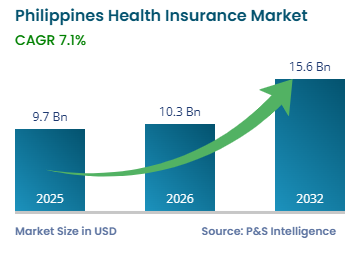
| Market Size in 2025 | USD 9.7 Billion |
| Market Size in 2026 | USD 10.3 Billion |
| Market Size by 2032 | USD 15.6 Billion |
| Projected CAGR | 7.1% |
| Largest Province | Manila Metro (NCR) |
| Fastest-Growing Province | CALABARZON |
| Market Structure | Moderately Fragmented |
Market Size
Explore the market potential with our data-driven report
Philippines Health Insurance Market Key Insights
- Group health insurance accounted for the larger share in 2025, of 75%, driven by mandatory employer contributions to PhilHealth and increasing corporate adoption of supplemental coverage.
- Medical insurance captured the largest share in 2025, of 45%, due to its comprehensive coverage of hospitalization, outpatient treatments, diagnostic procedures, and routine medical care.
- Critical illness insurance is projected to register the fastest growth during 2026–2032, with 7.7% CAGR, driven by rising chronic diseases, higher awareness of treatment costs, and flexible lump-sum benefit offerings.
- Private health insurance providers in the Philippines are experiencing faster growth, with 7.6% CAGR, due to rising demand for supplemental and comprehensive coverage.
- National Capital Region held the largest market share in 2025, of 40%, driven by strong healthcare infrastructure, higher incomes, and well-established insurance distribution networks.
Philippines Health Insurance Market Analysis
The Philippines health insurance market size was USD 9.7 billion in 2025, and it is anticipated to expand at a CAGR of 7.1% during 2026–2032, reaching USD 15.6 billion by 2032. This growth is supported by escalating medical inflation over 12% annually and rapid urbanization driving private coverage demand. Further, the Universal Health Care reforms have expanded the Philippine Health Insurance Corporation's (PhilHealth) membership to over 83 million Filipinos, while creating substantial opportunities for private supplemental insurance. The expansion reflects the growing recognition that public coverage alone cannot address rising healthcare costs, pushing middle-class Filipinos toward HMOs and life-integrated insurance plans.
The market's trajectory is reinforced by the Department of Health's infrastructure expansion, including over 50 Bagong Urgent Care and Ambulatory Service centers established by May 2025. Philippine Statistics Authority data shows that government financing for healthcare reached PHP 643.12 billion in 2024, yet out-of-pocket expenses still accounted for 42.7% of total health expenditures, highlighting persistent coverage gaps that private insurers are positioned to address.
The Insurance Commission reported that Health Maintenance Organizations paid out PHP 36.29 billion in healthcare benefits during H1 2025, representing a 19.63% increase year-over-year, with total HMO revenues reaching PHP 47.03 billion and net income more than doubling to PHP 1.47 billion, confirming strong market momentum despite persistent affordability challenges for lower-income populations.
Philippines Health Insurance Market Trends & Drivers
Private Insurance and Digital Transformation Are Trending
Healthcare expenses in the Philippines have steadily increased, placing pressure on both insurers and policyholders, with medical inflation exceeding 12% annually and creating substantial gaps between PhilHealth's coverage capacity and actual treatment costs. PhilHealth's benefit packages, while expanded, continue to provide limited cost coverage, with the agency covering only approximately 37.5% of average hospital bills according to the 2022 National Demographic and Health Survey.
This systematic underfunding drives private insurance penetration as Filipinos recognize that government coverage alone cannot protect against catastrophic health expenses. The Insurance Commission has encouraged adoption of gender-responsive policies addressing specific health needs such as maternal care, reproductive health, and critical illness coverage to create more nuanced insurance products that align with diverse demographic needs while keeping premiums sustainable.
Technological advancement is transforming insurance accessibility and operational efficiency, with AI-driven claims processing reducing approval times from weeks to hours, insurtech platforms enabling instant policy issuance via mobile wallets, and telemedicine integration expanding service delivery beyond traditional geographic constraints. Digital distribution channels have proven particularly effective in reaching gig economy workers and underserved rural populations who previously lacked convenient access to insurance products, with 82% of Filipinos now utilizing finance apps for cashless payments and insurance purchases according to industry surveys.
Major insurers have launched comprehensive digital platforms—including Manulife's Online platform and mobile app, AIA's integrated health services through MediCard acquisition, and Sun Life's MOVE app with wellness incentives—that simplify customer journeys from product discovery through claims processing. This digital acceleration lowers acquisition costs, enables personalized underwriting, and supports the development of microinsurance and flexible payment models that address affordability barriers, thereby expanding insurance penetration beyond traditional employer-sponsored segments into informal economy and SME markets that represent substantial untapped opportunity.
Universal Health Care Reforms Expanding Market Addressability
The Universal Health Care Act enacted in 2019 fundamentally reshaped the Philippines health insurance landscape by mandating automatic enrollment of all Filipinos in PhilHealth, raising premium contributions to 5% of monthly salary by 2024, and creating explicit recognition that private supplemental insurance plays an essential role in comprehensive coverage. The reform has expanded PhilHealth membership to over 83 million Filipinos while simultaneously highlighting the limitations of public coverage, as benefit packages continue to fall short of actual medical costs in most treatment scenarios.
This policy environment creates sustained demand for private insurance as employers seek comprehensive employee benefits beyond PhilHealth minimums and individuals recognize the need for supplemental protection. The Department of Health announced that over 50 BUCAS centers were operational as of May 2025, serving over 1.3 million patients and bringing essential outpatient and urgent care services closer to underserved communities, reinforcing trust in the public insurance system while simultaneously demonstrating its current limitations.
Employer Demand for Comprehensive Benefits Offers Opportunities in Group Insurance
Group health insurance has gained momentum as a strategic priority for talent management, with employers increasingly recognizing that comprehensive benefits packages are essential for workforce acquisition and retention in competitive labor markets. Small and medium enterprises, which historically provided limited health benefits, are now adopting group policies as bundled options have become more affordable and insurance providers have developed modular plans specifically designed for SME budget constraints.
The shift reflects broader economic development, as rising disposable incomes enable both employers and employees to prioritize health protection alongside traditional compensation elements. Corporate demand for group coverage is particularly strong in urban centers and industrial zones, where labor competition is most intense and employees have greater awareness of benefit package quality as a factor in employment decisions. This trend supports sustained double-digit growth in the group insurance segment, with insurers responding through customized corporate solutions that bundle HMO services with life and critical illness coverage.
Philippines Health Insurance Market Segmentation Analysis
Type Analysis
Group health insurance accounted for the larger share in 2025, of 75%. It is driven by mandatory employer contributions to PhilHealth combined with growing corporate adoption of private supplemental coverage. This reflects established infrastructure for payroll-based premium collection, employer recognition that comprehensive health benefits are essential for talent retention in competitive labor markets, and economies of scale, which enable more favorable pricing for corporate clients compared to individual policies.
Individual health insurance is expected to register the faster growth during 2026–2032, with 7.2% CAGR. The category is propelled by expanding gig economy and informal sector workers who lack employer-sponsored coverage, rising awareness among self-employed professionals of the need for comprehensive health protection, and digital distribution channels that have made individual policy purchase more convenient and affordable. The shift toward individual coverage also reflects changing employment patterns, with more Filipinos working as freelancers, contractors, or entrepreneurs who must secure their own health insurance rather than relying on corporate benefits.
The market segments into the following types:
- Individual (Faster-Growing Category)
- Group (Larger Category)
- Corporate
- Family
- SME
Coverage Analysis
Term insurance dominated coverage types in 2025, with 70%, due to its affordability and alignment with employer-sponsored group coverage structures. Term coverage's market leadership stems from established corporate benefits infrastructure where employers provide health insurance for defined employment periods, lower premium costs compared to lifetime coverage making it accessible to middle-income Filipinos, and traditional insurance purchasing patterns where customers prioritize immediate protection over long-term coverage commitments. Most group health insurance policies operate on term basis, with annual or multi-year coverage periods that align with employment contracts and budget planning cycles.
Lifetime coverage is expected to demonstrate faster growth during 2026–2032, with 7.4%. It is driven by demographic aging creating demand for permanent health protection that extends beyond working years, increasing affluence among upper-middle-class Filipinos willing to invest in comprehensive lifetime benefits, and insurer product innovation offering wealth accumulation features alongside permanent health coverage. Lifetime policies particularly appeal to individuals seeking to lock in coverage before age-related health conditions emerge that could limit future insurability, as well as families desiring multi-generational protection that does not require periodic renewal or risk coverage termination.
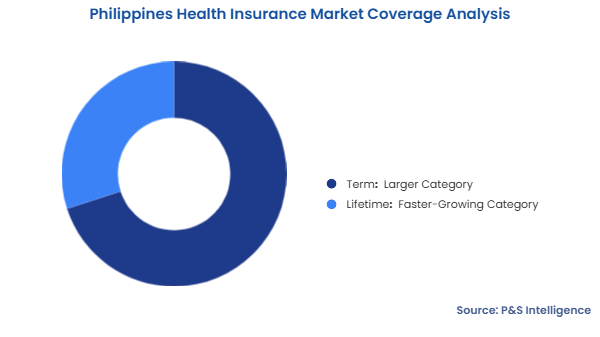
The market segments into the following coverage types:
- Term (Larger Category)
- Lifetime (Faster-Growing Category)
Plan Type Analysis
Medical insurance captured the largest share in 2025, of 45%, due to its comprehensive coverage of hospitalization, outpatient treatments, diagnostic procedures, and routine medical care. Medical insurance dominance stems from universal applicability across all age groups and health conditions, alignment with PhilHealth supplemental coverage requirements where private medical insurance fills gaps in public benefits, and employer preference for comprehensive medical plans as standard employee benefits. The category encompasses both standalone medical policies and medical coverage integrated with HMO service delivery models, providing policyholders with hospital admission authorization, specialist consultations, diagnostic imaging, laboratory tests, and prescription drug benefits.
Critical illness insurance is projected to register the fastest growth during 2026–2032. It is propelled by rising prevalence of non-communicable diseases including cancer, cardiovascular conditions, and diabetes that create substantial financial burden, increasing consumer awareness of the catastrophic costs associated with serious illness requiring intensive treatment, and product innovation offering lump-sum benefit payouts that provide financial flexibility beyond medical expense reimbursement. Critical illness policies appeal particularly to middle-income Filipinos who maintain basic medical coverage but seek additional protection against high-cost disease scenarios that could deplete savings, as benefit amounts can be allocated to treatment costs, income replacement during recovery periods, or family support expenses.
The market segments into the following plan types:
- Medical Insurance (Largest Category)
- Critical Illness Insurance (Fastest-Growing Category)
- Family Floater Health Insurance
- Others
Provider Analysis
The public category holds the larger share, as public provider PhilHealth operates as the universal health insurance program covering over 83 million Filipinos through automatic enrollment mandated by the Universal Health Care Act. It provides baseline coverage for hospitalization, outpatient services, and essential medicines funded through member premium contributions and government subsidies.
PhilHealth enrolls the majority of the population, including formal and informal sector workers, low-income families, and indigents, providing essential inpatient and outpatient benefits. Its government backing ensures wide accessibility, affordability, and regulatory support, making it the largest provider by membership and coverage. Public schemes also benefit from mandatory contributions and government subsidies, creating a stable funding base. This extensive reach and foundational role in the healthcare system secure public insurers’ market dominance despite the rapid growth of private providers.
Private health insurance providers in the Philippines are experiencing faster growth, with 7.6% CAGR, due to rising demand for supplemental and comprehensive coverage. While PhilHealth provides basic universal health benefits, many individuals and companies seek additional protection for specialized care, higher-quality services, and shorter wait times, which private insurers offer through HMOs and commercial plans. Increasing urbanization, rising incomes, employer-sponsored benefits, and emergence of digital health platforms, telemedicine, and flexible plans are driving adoption of private coverage.
Private providers offer diverse health insurance products ranging from HMO prepaid healthcare plans to life insurance-integrated health coverage, with competitive advantage in service delivery speed, provider network breadth, and product customization capabilities. Private insurers' market strength reflects their ability to offer premium coverage, established distribution networks through agents, bancassurance partnerships, and digital platforms, and operational flexibility enabling rapid product innovation responding to evolving customer needs. Many have invested heavily in healthcare infrastructure including owned clinics, extensive hospital partnerships, and telemedicine capabilities that create competitive differentiation.
The market segments into the following providers:
- Public (Larger Category)
- Private (Faster-Growing Category)
Network Analysis
Health maintenance organizations (HMOs) commanded the largest share in 2025, of 45%, operating prepaid healthcare delivery systems where members access medical services through designated provider networks in exchange for regular premium payments. They operate a comprehensive service delivery model combining insurance coverage with direct healthcare provision through owned clinics, contracted hospitals, and employed or affiliated physicians, creating integrated care coordination that manages costs while ensuring service availability. Maxicare and MediCard maintain extensive networks of partner hospitals, clinics, and accredited physicians, providing members with accessible primary care, specialist consultations, diagnostic services, and hospital care.
HMOs lead due to employers’ preference for turnkey healthcare solutions to simplify benefits administration, member appreciation for coordinated care reducing the complexity of navigating healthcare systems, and operational efficiency enabling competitive pricing through volume-based provider contracts and utilization management.
Exclusive provider organizations (EPOs) will demonstrate the highest CAGR during 2026–2032, of 7.3%, as they offer cost-savings through tightly managed care coordination and favorable provider reimbursement arrangements. EPO appeal is driven by employers’ pursuit of cost containment strategies, development of narrow network products by insurers to reduce premium costs, while maintaining service quality through carefully selected high-performing providers, and members’ willingness to accept network limitations in exchange for premium affordability.
The market segments into the following network types:
- Health Maintenance Organization (HMO) (Largest Category)
- Exclusive Provider Organization (EPO) (Fastest-Growing Category)
- Preferred Provider Organization (PPO)
- Point of Sale (PoS)
Age Analysis
Adults commanded the largest market share in 2025, reflecting this demographic's dual role as primary income earners who can afford premium payments and active workforce participants requiring health protection to maintain productivity. Adults face diverse health needs ranging from preventive care to treatment of chronic conditions developed through lifestyle factors, creating sustained demand for comprehensive coverage that extends beyond PhilHealth's basic benefits. The category benefits from employer-sponsored group insurance as well as individual purchasing power, and includes both healthy individuals seeking preventive coverage and those managing existing health conditions.
Senior citizens are expected to demonstrate the fastest growth during 2026–2032, as seniors are projected to comprise 10% of Filipinos by 2032. Among them, the increasing prevalence of chronic conditions requiring ongoing medical management and rising healthcare expenses drive the market. PhilHealth automatically covers senior citizens through special provisions under Republic Act 10645, yet this public coverage remains insufficient for the comprehensive care that aging populations require. This encourages private insurers to offer specialized senior plans addressing critical illnesses, hospitalization, and homecare.
The market segments into the following age groups:
- Adult (Largest Category)
- Senior Citizens (Fastest-Growing Category)
- Minors
Distribution Channel Analysis
Direct sales captured the largest share, in 2025, encompassing both digital platforms and company-employed sales representatives who provide face-to-face consultation. The channel's dominance reflects insurers' strategic investments in proprietary distribution capabilities, including mobile apps, online portals, and self-service platforms that enable customers to research products, obtain quotes, and complete purchases without intermediary involvement. Direct digital channels prove particularly effective for younger, tech-savvy consumers, who prefer convenient online transactions and are comfortable navigating insurance product features independently. Contrarily, direct sales representatives remain essential for more-complex corporate accounts and individual customers requiring personalized guidance.
Brokers/agents are expected to register the fastest growth during 2026–2032. The category is driven by their ability to provide personalized coverage recommendations across multiple insurance providers, trust among clients who value expert guidance on complex insurance decisions, and effectiveness in reaching informal economy workers and small businesses, which benefit from customized policy assembly. Agents play an important role in explaining the interplay between PhilHealth coverage and private supplemental insurance, helping customers understand gaps in public benefits and identify appropriate private coverage to address specific protection needs.
The market segments into the following distribution channels:
- Direct Sales (Largest Category)
- Brokers/Agents (Fastest-Growing Category)
- Banks
- Others
Drive strategic growth with comprehensive market analysis
Philippines Health Insurance Market Geographical Analysis
Manila Metro (NCR) Market Size
National Capital Region held the largest market share in 2025, of 40%, sustained by concentrated healthcare infrastructure including over 100 accredited hospitals and specialist clinics, substantially higher disposable incomes enabling premium payments for comprehensive private coverage, and mature insurance distribution networks with extensive agent presence and digital platform adoption. Metro Manila's economic centrality attracts major employers who provide group health benefits, while urban professionals and middle-class families demonstrate greater insurance awareness and willingness to purchase supplemental coverage beyond PhilHealth's basic benefits. The region benefits from established HMO networks, including Maxicare's over 1,000 partner hospitals and MediCard's 26 owned clinics concentrated in key cities.
CALABARZON Market Growth
CALABARZON represents the fastest-growing region during 2026–2032, with 7.5% CAGR, propelled by rapid industrialization creating substantial employment in manufacturing and logistics sectors, population migration from Metro Manila as housing and living costs become prohibitive in the capital, and expanding middle-class demographics as economic development raises incomes. The region's growth corridor status attracts both multinational corporations and domestic enterprises establishing operations in Cavite, Laguna, Batangas, Rizal, and Quezon. This creates a strong demand for employer-sponsored group insurance. Infrastructure development, including improved transportation connectivity to Metro Manila and expansion of commercial real estate further, supports health insurance penetration as the region transitions from primarily agricultural to industrial and services-oriented economy.
The regions analyzed in this report include:
- Manila Metro (NCR) (Largest Region)
- CALABARZON (Fastest-Growing Region)
- Central Visayas
- Central Luzon
- Davao
- Rest of Philippines
Philippines Health Insurance Market Share
The Philippines health insurance market demonstrates moderate fragmentation, with public and private sectors coexisting in distinct yet complementary roles. PhilHealth operates as the universal public insurer covering over 83 million Filipinos through mandatory enrollment, providing baseline coverage that remains insufficient for comprehensive healthcare needs, thereby creating sustained demand for private supplemental insurance. The private sector includes both HMOs offering prepaid healthcare plans with direct service delivery and life insurance companies providing health coverage as riders or integrated products.
Market structure reflects low entry barriers for new insurers, diverse customer segments ranging from large corporate clients to individual retail customers, and regional variations in healthcare infrastructure that enable multiple distribution strategies and competitive approaches. The competitive landscape reflects strategic diversity, with established players leveraging distribution scale and brand recognition while newer entrants pursue technology-enabled differentiation and specialized segment targeting.
Major Players in the Philippines Health Insurance Market:
- Philippine Health Insurance Corporation (PhilHealth)
- Sun Life Financial Inc.
- AIA Philippines
- Prudential plc
- Maxicare HealthCare Corporation
- MediCard Philippines Inc.
- FWD Life Insurance Corporation
- Manulife Philippines
Philippines Health Insurance Market News
- In April 2025, Sun Life Philippines announced paying over PHP 6 billion in claims, maturities, and other benefits to customers in 2024, bringing total benefits paid over the past five years to more than PHP 32 billion.
- In March 2025, Sun Life Philippines launched Sun Life OFW Health Protect, a specialized insurance plan for overseas Filipino workers providing coverage up to age 100 for prevention, diagnosis, treatment, and rehabilitation.
- In January 2024, Manulife Philippines partnered with Forticare Health Systems International Inc. to become the exclusive underwriter of group life insurance bundled with Forticare's HMO products. The collaboration enables Forticare customers to access additional benefits including basic life insurance coverage, total and permanent disability, critical illness riders, hospital income, terminal illness, and family assistance, enhancing the value proposition of employer-sponsored health benefits.
- In March 2023, AIA Philippines completed its acquisition of MediCard Philippines Inc. The acquisition integrates MediCard's extensive HMO network spanning 1,000 partner hospitals and clinics with AIA's life insurance capabilities.