This Report Provides In-Depth Analysis of the Philippines Clinical Laboratory Testing Services Market Report Prepared by P&S Intelligence, Segmented by Test Type (Clinical Chemistry, Human & Tumor Genetics, Medical Microbiology & Cytology, Hematology, Immunology, Cytology, Genetics, Drugs of Abuse), Service Provider (Hospital-Based Laboratories, Independent & Reference Laboratories, Standalone Laboratories, Clinic-Based Laboratories), Service Type (Routine Testing Services, Esoteric Services, Anatomic Pathology Services), and Geographical Outlook for the Period of 2021 to 2032
Clinical chemistry testing accounted for the largest share in 2025, of 25%, and it is expected to demonstrate the fastest growth during 2026–2032, at 6.0% CAGR.
Independent and reference laboratories are expected to register the fastest growth during 2026–2032, at 5.9% CAGR.
Metro Manila (NCR) accounts for the largest market share, of 40%.
CALABARZON represents the fastest-growing market, at 6.1% CAGR.
Philippines Clinical Laboratory Testing Services Market Future Outlook
The Universal Health Care Act has restructured the Philippine healthcare financing landscape by automatically enrolling all Filipinos in the National Health Insurance Program administered by PhilHealth. This broadens access to diagnostic laboratory services through expanded benefit packages that eliminate financial barriers for routine and essential testing. The Philippine Department of Health indicates that as of January 2024, the country operates more than 40,000 health facilities, including 1,351 hospitals and extensive networks of rural health units and barangay health stations. These places are increasingly integrating clinical laboratory capabilities to support primary care delivery.
Its Konsulta primary care benefit package covers 18 laboratory and diagnostic tests including complete blood count, urinalysis, fasting blood sugar, lipid profile, and creatinine testing without patient co-payment. This policy framework transforms laboratory testing from discretionary expenditure to accessible preventive healthcare, accelerating utilization among previously underserved populations who historically delayed diagnostic testing due to cost constraints, while PhilHealth's expanding benefit packages for specialized conditions including diabetes management, cardiovascular disease monitoring, and cancer screening create additional service volume across both routine and specialized testing categories.
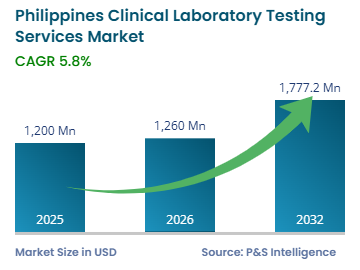
The Philippines clinical laboratory testing services market size was USD 1,200.0 million in 2025, and it is anticipated to expand at a CAGR of 5.8% during 2026–2032, reaching USD 1,777.2 million by 2032.
This growth is supported by the increasing prevalence of chronic diseases, expanding health insurance coverage under the Universal Health Care Act, and advancing laboratory automation technologies across hospital-based and independent laboratory facilities. The rising burden of noncommunicable diseases is accelerating demand for diagnostic testing services throughout the Philippines. The World Health Organization reports that noncommunicable diseases account for 68% of all deaths in the country, with cardiovascular diseases, diabetes, and cancer representing the leading contributors to this health burden, driving sustained utilization of clinical chemistry testing, hematology panels, and specialized diagnostic procedureThe Universal Health Care Act has restructured the Philippine healthcare financing landscape by automatically enrolling all Filipinos in the National Health Insurance Program administered by PhilHealth. This broadens access to diagnostic laboratory services through expanded benefit packages that eliminate financial barriers for routine and essential testing. The Philippine Department of Health indicates that as of January 2024, the country operates more than 40,000 health facilities, including 1,351 hospitals and extensive networks of rural health units and barangay health stations. These places are increasingly integrating clinical laboratory capabilities to support primary care delivery.
Automation and Digital Transformation Are Major Market Trends
Laboratory automation technologies and digital health systems are transforming clinical testing workflows across Philippine healthcare facilities, enabling higher throughput, reduced error rates, and improved operational efficiency. Automated sample processing, result interpretation algorithms, and laboratory information management systems allow facilities to handle increasing test volumes while maintaining quality standards despite persistent technical workforce constraints. The Philippine Department of Information and Communications Technology reports that as of 2024, over 70% of government services are now available online, reflecting broader digital transformation momentum extending into healthcare delivery and laboratory service digitization.
The integration of artificial intelligence for diagnostic support, particularly in medical imaging analysis and pattern recognition in laboratory results. This represents an emerging capability that several tertiary hospitals, including The Medical City, have begun deploying to augment clinician decision-making. As healthcare facilities progressively adopt electronic health records and laboratory information systems, interoperability becomes critical for enabling seamless data exchange between clinical laboratories, primary care providers, and hospital departments. This makes digital infrastructure investments strategic priorities for both independent laboratories and hospital-based facilities seeking competitive differentiation.
The escalating burden of noncommunicable diseases combined with expanded health insurance coverage under the Universal Health Care Act creates sustained demand growth for clinical laboratory testing services throughout the Philippines. The World Health Organization analysis demonstrates that noncommunicable diseases account for 68% of all deaths in the Philippines, with cardiovascular diseases, diabetes, cancer, and chronic respiratory conditions driving continuous requirements for diagnostic monitoring, disease screening, and treatment response assessment.
The World Health Organization indicates that individuals in the Philippines aged between 30 and 70 years face a significant risk of mortality due to non-communicable diseases. This risk stands at 24.5%, which is considerably higher than the average of 15.6% observed in other regions. This situation poses a challenge for the healthcare system, as it must cater to a large population, yet it struggles to do so effectively, particularly in rural areas where medical professionals are scarce.
The Philippines experiences a high prevalence of heart disease, cancer, diabetes, and lung disease, which are classified as non-communicable diseases. Ischemic heart disease and other cardiovascular conditions are the leading causes of death, followed by cancer and cerebrovascular disease. It is estimated that more than four million adults in the Philippines are affected by diabetes.
Additionally, a significant number of Filipinos are afflicted with chronic kidney disease (CKD). The growing population of older adults in the Philippines, projected to surpass 15 million by 2030, will further increase the demand for electronic health record (EHR) systems to address the complexities involved in managing older adults with multiple chronic conditions.
Government initiatives to strengthen healthcare delivery in provinces and geographically isolated areas create substantial market expansion potential for clinical laboratory testing service providers capable of establishing presence beyond Metro Manila concentration. The Philippine Department of Health's deployment of Bagong Pilipinas mobile clinics equipped with laboratory testing capabilities, establishment of Bagong Urgent Care and Ambulatory Services Centers across 42 locations nationwide, and systematic strengthening of rural health units represent deliberate strategies to reduce geographic healthcare disparities that historically limited diagnostic service accessibility in provincial areas.
CALABARZON region had 4,415 health facilities as of January 2024 compared, while Metro Manila had 2,784, yet clinical laboratory market penetration remains disproportionately lower relative to facility count, indicating underserved demand. Independent laboratory chains’ expansion into Cebu, Davao, and provincial capitals can capture growing middle-class populations seeking quality diagnostic services locally rather than traveling to Metro Manila for specialized testing.
While, partnerships with local government units implementing Universal Health Care mandates enable laboratory providers to secure PhilHealth contracts for population-based primary care laboratory services. Telemedicine integration and result delivery digitization further reduce geographic constraints by allowing provincial laboratories to access specialist consultation support from Metro Manila pathologists and clinical experts for complex case interpretation, enhancing diagnostic capabilities in decentralized locations.
Clinical chemistry testing accounted for the largest share of Philippines clinical laboratory testing services market in 2025, of 25%, and it is expected to demonstrate the fastest growth during 2026–2032, at 6.0% CAGR. It is driven by the extensive range of biochemical tests required for chronic disease monitoring including diabetes management through fasting blood sugar and HbA1c testing, cardiovascular disease screening via lipid profiles and cardiac biomarkers, kidney function assessment through creatinine and blood urea nitrogen measurements, and liver function evaluation using enzyme panels. The Philippine Department of Science and Technology supports expanded diagnostic capabilities through its Digital and Frontier Technologies for Health Programme, which funds locally developed laboratory innovations and promotes adoption of advanced testing platforms in priority communities to strengthen clinical chemistry service delivery across the archipelago. Clinical chemistry is fundamental in primary care disease screening under the PhilHealth Konsulta program, which mandates comprehensive metabolic panels for preventive healthcare, alongside specialist requirements for detailed biochemical monitoring in diabetes complications, cardiovascular risk stratification, and oncology treatment response assessment, positioning chemistry testing as the highest-volume laboratory service category across both hospital-based and independent laboratory networks.
The market segments into the following test types:
Clinical Chemistry (Largest and Fastest-Growing Category)
Human & Tumor Genetics
Medical Microbiology & Cytology
Hematology
Immunology
Cytology
Genetics
Drugs of Abuse
Others
Service Provider Analysis
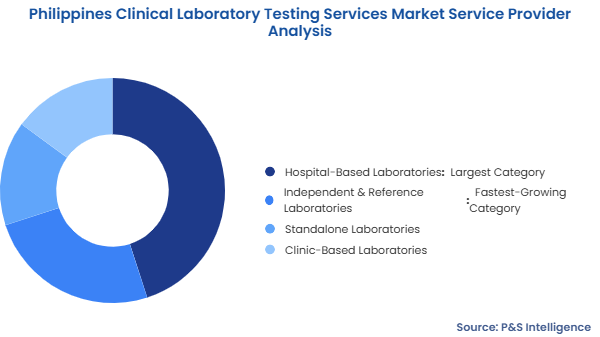
Hospital-based laboratories held the largest market share in 2025, of 45%. This is due to integrated access to inpatients, presence of pathologists for complex test interpretation and multidisciplinary consultation, and availability of esoteric procedures. Preferential patient referral patterns from specialist physicians practicing within hospital systems who direct diagnostic workload toward affiliated laboratories also drives this category.
Independent and reference laboratories are expected to register the fastest growth during 2026–2032, at 5.9% CAGR. This is fueled by strategic geographic expansion into provincial markets underserved by hospital infrastructure, extended operating hours, competitive pricing for direct-pay patients seeking routine testing without insurance, and establishment of collection centers to reduce access barriers. Independent laboratories capitalize on convenience-focused service models, including online appointment scheduling, home sample collection services, and rapid digital result delivery. They appeal to health-conscious consumers seeking routine wellness testing separate from hospital-based medical encounters.
The market segments into the following service providers:
Routine testing services accounted for the largest market share in 2025, of 60%, and they are projected to experience the fastest expansion during 2026–2032. Routine testing includes complete blood count panels for anemia and infection, basic metabolic panels assessing electrolyte balance and kidney function, urinalysis for urinary tract infections and diabetes complications, and lipid profiles for cardiovascular risk evaluation. They collectively represent the highest-volume laboratory procedures performed across all healthcare settings.
The category benefits from standardization enabling automation and economies of scale that reduce per-test costs, while maintaining quality standards. Alongside, government health programs mandating routine screening for noncommunicable diseases drive continuous testing volumes for diabetes monitoring, hypertension evaluation, and chronic kidney disease surveillance across public health facilities and private laboratory networks.
The market segments into the following service types:
Routine Testing Services (Largest and Fastest-Growing Category)
Esoteric Services
Anatomic Pathology Services
Drive strategic growth with comprehensive market analysis
Metro Manila (NCR) Clinical Laboratory Testing Service Market Size
Metro Manila (NCR) accounts for the largest market share, of 40%. It is the primary healthcare hub with the highest concentration of tertiary hospitals, independent reference laboratories, and specialized diagnostic facilities serving both local populations and referral cases from neighboring regions. The region's dominance stems from high healthcare infrastructure investment and presence of specialized testing capabilities for advanced diagnostics, including molecular testing and genetic analysis, which remain unavailable in most provincial settings. Moreover, this region is home to major medical centers, including The Medical City, Makati Medical Center, and St. Luke's Medical Center.
CALABARZON Clinical Laboratory Testing Service Market Growth
CALABARZON region represents the fastest-growing market, at 6.1% CAGR, driven by rapid urbanization, infrastructure development, and rising demand for occupational health testing. Healthcare infrastructure expansion to serve growing populations in Cavite, Laguna, Batangas, Rizal, and Quezon provinces also drives the market. As of January 2024, the Philippine Department of Health reports that CALABARZON operates 4,415 health facilities, demonstrating the region's expanding healthcare capacity and laboratory service requirements.
The Philippines clinical laboratory testing services market is moderately fragmented, characterized by the existence of hospital-based laboratories, independent diagnostic chains, and international laboratory service providers operating through local partnerships or direct presence. This reflects the diversity of service requirements across routine clinical chemistry testing, specialized molecular diagnostics, reference laboratory services, and occupational health testing. Hospital-based laboratories maintain structural advantages through integrated access to inpatient populations and specialty physician networks. While, independent laboratories compete through convenient geographic locations, extended operating hours, competitive pricing for direct-pay customers, and streamlined sample collection networks across multiple barangays and municipalities.
Major players differentiate through service portfolios, geographic coverage, and accreditation status with PhilHealth and international quality certification bodies. Market evolution shows gradual consolidation potential as larger players pursue acquisition strategies to expand geographic presence and achieve economies of scale in equipment procurement and quality management systems, though regulatory requirements for laboratory licensing and PhilHealth accreditation maintain moderate barriers protecting incumbent facility investments.
Top Companies in Philippines Clinical Laboratory Testing Services Market:
Hi-Precision Diagnostics
Healthway Medical
The Medical City
Makati Medical Center
St. Luke's Medical Center
Aventus Medical Care Inc.
Medi Linx Laboratory Inc.
Quest Diagnostics Incorporated
Laboratory Corporation of America Holdings (LabCorp)
January 2025, the Philippine Health Insurance Corporation implemented the Outpatient Emergency Care Benefit, covering laboratory tests, imaging, and routine blood work for emergency department patients at accredited hospitals through PhilHealth Circular 2024-0033. The benefit package eliminates financial barriers for diagnostic testing in emergency settings, expanding laboratory service utilization for acute care patients who do not require hospital admission.
December 2025, Hi-Precision Diagnostics received PNS ISO 15189:2022 accreditation from the Philippine Accreditation Bureau. Valid through December 2030, it confirms compliance with international quality management standards for medical laboratories. The certification strengthens the company's competitive positioning for PhilHealth contracts and corporate health screening programs requiring accredited laboratory providers.
December 2024, the Philippine Health Insurance Corporation expanded its Ischemic Heart Disease-Acute Myocardial Infarction benefit package to include comprehensive laboratory and diagnostic testing support for cardiac care. It increased coverage for percutaneous coronary intervention to PHP 524,000 and establishing cardiac rehabilitation services.
January 2025, PhilHealth implemented a 50% case rate adjustment across approximately 9,000 benefit packages covering diverse medical conditions and procedures, increasing reimbursement rates to reflect rising healthcare costs. The upward rate adjustment improves laboratory service profitability for providers serving PhilHealth members and reduces out-of-pocket expenses, which previously deterred diagnostic testing utilization.
December 2024, PhilHealth expanded peritoneal dialysis Z Benefits coverage for both adult and pediatric patients to include laboratory monitoring, exit site infection prevention, and peritonitis care at 51 accredited providers nationwide. The expanded benefit package increases recurring laboratory testing volumes for dialysis patient monitoring and creates stable revenue streams for laboratories serving chronic kidney disease populations.
Frequently Asked Questions About This Report
What was Philippines clinical laboratory testing service market size in 2025?+
In 2025, the clinical laboratory testing service market in Philippines size was USD 1,200.0 million.
Which test type has largest Philippines clinical laboratory testing service industry share?+
Clinical chemistry has the largest Philippines clinical laboratory testing service industry share, of 25%.
Which region has largest Philippines clinical laboratory testing service market share?+
Metro Manila (NCR) is the largest clinical laboratory testing service market in Philippines, with 40% share.
What are the key Philippines clinical laboratory testing service industry drivers?+
The Philippines clinical laboratory testing service industry is driven by increasing prevalence of chronic diseases, expanding health insurance coverage under the Universal Health Care Act, and advancing laboratory automation technologies across hospital-based and independent laboratory facilities.
What is the Philippines clinical laboratory testing service market nature?+
The clinical laboratory testing service market in Philippines is moderately fragmented.
Want a report tailored exactly to your business need?
Leading companies across industries trust us to deliver data-driven insights and innovative solutions for their most critical decisions. From data-driven strategies to actionable insights, we empower the decision-makers who shape industries and define the future. From Fortune 500 companies to innovative startups, we are proud to partner with organisations that drive progress in their industries.
Client Testimonials
Working with P&S Intelligence and their team was an absolute pleasure – their awareness of timelines and commitment to value greatly contributed to our project's success. Eagerly anticipating future collaborations.
McKinsey & Company
India
Unmatched Standards
Our insights into the minutest levels of the markets, including the latest trends and competitive landscape, give you all the answers you need to take your business to new heights
Complete Data Security
We take a cautious approach to protecting your personal and confidential information. Trust is the strongest bond that connects us and our clients, and trust we build by complying with all international and domestic data protection and privacy laws