This Report Provides In-Depth Analysis of the Personalized Nutrition Market Report Prepared by P&S Intelligence, Segmented by Product Type (Active Measurement, Standard Measurement), Application (Standard Supplements, Disease-Based, Sports Nutrition), End Use (Direct-to-Consumer, Wellness & Fitness Centers, Hospitals & Clinics, Institutions), Form (Tablets, Capsules, Powder, Liquid), and Geographical Outlook for the Period of 2019 to 2032
Explore the market potential with our data-driven report
Personalized Nutrition Market Overview
The personalized nutrition market was valued at USD 15 billion in 2024 and is projected to reach USD 43.5 billion by 2032, growing at a CAGR of 14.4% during 2025–2032. The market's robust expansion reflects the growing consumer shift toward individualized health solutions and the integration of advanced technologies in nutrition planning.
Personalized nutrition represents a fundamental departure from traditional one-size-fits-all dietary approaches by leveraging individual genetic profiles, lifestyle patterns, and biomarker data to create customized dietary recommendations. This approach addresses the unique metabolic, genetic, and environmental factors that influence how individuals respond to different nutrients and foods.
The market growth is primarily driven by the rising prevalence of chronic diseases and the increasing consumer awareness about preventive healthcare. According to the Centers for Disease Control and Prevention, about 1 in 10 Americans has diabetes, with 89.8% of adults with diagnosed diabetes being overweight or having obesity. Additionally, the World Health Organization reports that higher-than-optimal BMI caused an estimated 3.7 million deaths from noncommunicable diseases in 2021, highlighting the critical need for personalized dietary interventions.
Personalized Nutrition Market Dynamics
Technological Advancement in Digital Health Solutions Is Key Trend
The integration of artificial intelligence, machine learning, and advanced diagnostic tools is transforming personalized nutrition accessibility and effectiveness. Digital health platforms now utilize sophisticated algorithms to analyze genetic data, biomarkers, and lifestyle patterns to generate highly specific dietary recommendations.
The proliferation of smartphone technology and health-tracking applications has democratized access to personalized nutrition services. According to market data, over 26 million people in the U.S. have already taken DNA tests, indicating widespread consumer acceptance of genetic-based health insights.
Wearable devices and continuous health monitoring systems provide real-time data on metabolic responses, enabling dynamic adjustment of nutritional recommendations. Companies are increasingly incorporating AI-driven platforms that can process vast amounts of health data to deliver actionable insights, making personalized nutrition more precise and responsive to individual needs.
Rising Prevalence of Chronic Diseases Is Fueling Market Growth
The increasing burden of lifestyle-related chronic diseases serves as a primary catalyst for personalized nutrition market expansion. According to the Peterson-KFF Health System Tracker, obesity affects 42% of the U.S. population as of 2022, making it the most-prevalent chronic illness. The National Center for Health Statistics reports that the prevalence of total diabetes increased significantly from 9.7% in 1999–2000 to 15.8% in 2021–2023 among adults.
The interconnected nature of these conditions creates substantial demand for targeted nutritional interventions. Research published in PMC indicates that cardiovascular disease accounts for 68% of all diabetic deaths, emphasizing the critical role of personalized dietary management in disease prevention and management.
Personalized nutrition offers precision-based solutions that address individual risk factors through DNA analysis, metabolic profiling, and lifestyle assessment. This approach enables healthcare providers and consumers to implement targeted interventions that can significantly reduce disease progression and improve health outcomes.
High Cost of Personalized Nutrition Services and Products Is Key Restraint
The high cost of personalized nutrition services and products remains one of the most critical restraints for the market. Personalized nutrition typically involves individualized dietary assessments, genomic testing, microbiome analysis, wearable integration, and AI-driven recommendations. The cost of such comprehensive programs is significantly higher compared to conventional nutrition plans or over-the-counter supplements. This cost barrier excludes a large portion of the population, particularly those from middle- and low-income backgrounds, limiting the addressable market size.
One major factor contributing to the high cost is the inclusion of genetic and microbiome testing, which are core components of many personalized nutrition offerings. These tests alone can cost up to USD 300 or more per person, not including the cost of analysis or follow-up plans. When bundled into a service model with recurring fees for consultations, AI-based analysis, and customized supplement formulations, the overall monthly cost may reach USD 100–USD 500 or more, making it unaffordable for the majority of consumers. Even in high-income countries, insurance rarely covers such services, further increasing the financial burden on individuals.
In addition, personalized nutrition often requires premium-grade dietary supplements or meal kits, which are specially formulated to match an individual’s nutritional profile. These products are typically more expensive than standard options, due to the inclusion of niche ingredients or precise dosage customization. For example, a consumer receiving personalized vitamin blends may pay two to three times more than for generic multivitamins available at retail stores. The customization adds not just formulation complexity but also operational costs related to fulfillment and packaging.
Growing Consumer Health Consciousness Offers Opportunity
Consumer behavior has shifted significantly toward proactive health management and preventive care approaches. This transformation is driven by increased health awareness, higher disposable incomes, and greater access to health information through digital platforms.
The trend of preventive healthcare is particularly pronounced among millennials and Generation Z consumers who prioritize wellness and are willing to invest in personalized health solutions. These demographics are driving demand for genetic testing, microbiome analysis, and customized supplement programs that align with their health goals and lifestyle preferences.
The COVID-19 pandemic further accelerated this trend, with consumers placing increased emphasis on immune system support and overall health optimization. This has led to sustained growth in demand for personalized nutrition solutions that address specific health concerns and support long-term wellness objectives.
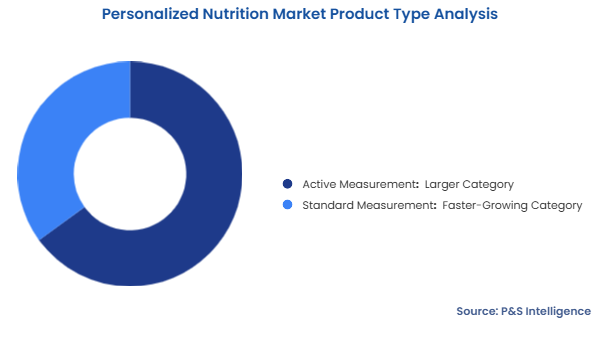
The active measurement category held approximately 65% market share in 2024 and is expected to maintain its dominant position throughout the forecast period. Active measurement encompasses genetic testing kits, biomarker analysis, microbiome testing, and digital health assessment tools that provide detailed insights into individual nutritional needs and metabolic responses.
This category's growth is driven by increasing consumer awareness about the value of data-driven nutrition decisions and the growing accessibility of genetic testing technologies. The declining costs of genome sequencing and expanding availability of direct-to-consumer testing options have made active measurement tools more attractive to health-conscious consumers seeking personalized insights.
Standard measurement is expected to grow at the fastest CAGR of 14.8%, during the forecast period, supported by the development of simplified assessment tools and questionnaire-based platforms that offer personalized recommendations without requiring extensive testing. This category appeals to cost-sensitive consumers and those seeking entry-level personalized nutrition solutions.
These product types are covered:
Active Measurement (Larger Category)
Genetic Testing Kits
Biomarker Analysis
Microbiome Testing
Wearable Device Integration
Standard Measurement (Faster-Growing Category)
Lifestyle Questionnaires
Basic Health Assessments
Simplified Profiling Tools
Application Analysis
The standard supplements category accounted for approximately 45% market share in 2024, reflecting the widespread consumer preference for personalized vitamin and mineral formulations that address general health maintenance and nutritional gaps. This category's dominance stems from the established supplement market infrastructure and consumer familiarity with nutritional products.
Disease-based applications represent the fastest-growing category, with an expected CAGR of 15.1% during 2025–2032, driven by the increasing integration of personalized nutrition into clinical care and disease management protocols. Healthcare providers are increasingly recognizing the value of tailored nutritional interventions for managing conditions such as diabetes, cardiovascular disease, and metabolic disorders.
The growing body of scientific evidence supporting the role of personalized nutrition in disease prevention and management is attracting investment from pharmaceutical companies and healthcare organizations, further accelerating growth in this category.
These applications are covered:
Standard Supplements (Largest Category)
Personalized Vitamins
Customized Minerals
Targeted Nutritional Support
Disease-Based (Fastest-Growing Category)
Diabetes Management
Cardiovascular Health
Metabolic Disorders
Sports Nutrition
Performance Optimization
Recovery Enhancement
Athletic-specific Formulations
End Use Analysis
The direct-to-consumer category held approximately 65% market share in 2024, reflecting the growing consumer preference for accessible, convenient personalized nutrition services that can be accessed through digital platforms and delivered directly to homes. This category's growth is supported by the expansion of e-commerce infrastructure and increasing consumer comfort with online health services. The U.S. International Trade Administration anticipates global B2C online sales to value USD 5.5 trillion by 2027.
Wellness and fitness centers represent the fastest-growing end-use category with an expected CAGR of 14.6% during the forecast period. This growth is driven by the integration of personalized nutrition services into comprehensive wellness programs and the increasing demand for holistic health solutions that combine fitness, nutrition, and lifestyle coaching.
The partnership between fitness centers and personalized nutrition providers is creating new service models that appeal to health-conscious consumers seeking integrated wellness solutions.
Capsules dominated the form category with approximately 65% market share in 2024, reflecting consumer preferences for convenient, precise dosing and familiar delivery methods. The capsule format offers advantages in terms of ingredient stability, customization flexibility, and consumer acceptance.
Powder formulations are expected to grow at the highest CAGR, of 14.8%, during the forecast period, driven by the versatility of powder-based products for creating highly customized blends and the growing popularity of meal replacement and functional food applications.
These forms are covered:
Tablets
Extended-release Formulations
Chewable Options
Targeted Delivery
Capsules (Largest Category)
Vegetarian Options
Controlled Release
Multi-ingredient Blends
Powder (Fastest-Growing Category)
Custom Blends
Functional Foods
Beverage Applications
Liquid
Ready-to-consume
Concentrated Formulas
Enhanced Absorption
Others
Gummies
Soft Gels
Functional Foods
Drive strategic growth with comprehensive market analysis
Personalized Nutrition Market Regional Outlook
North America Personalized Nutrition Market Size
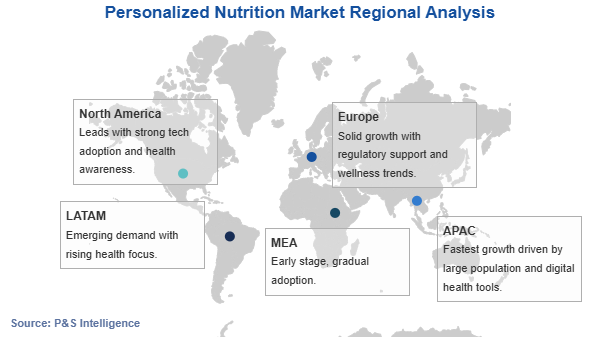
North America held the largest market share, of approximately 45%, in 2024 and is expected to maintain its leading position throughout the forecast period. The region's dominance is attributed to high consumer health awareness, advanced healthcare infrastructure, widespread adoption of digital health technologies, and strong presence of leading market players.
The U.S. drives regional growth with its mature market for health and wellness products, high disposable incomes, and favorable regulatory environment for personalized nutrition services.
Consumer acceptance of genetic testing and preventive healthcare approaches is particularly strong in North America, with companies like 23andMe and Ancestry DNA establishing large consumer databases that support personalized nutrition applications. The region's advanced digital health infrastructure and high smartphone penetration rates facilitate the delivery of personalized nutrition services through mobile platforms and telehealth solutions.
The presence of major technology companies and significant venture capital investment in health technology startups further supports market growth in North America, creating an ecosystem conducive to innovation in personalized nutrition solutions.
Asia-Pacific Personalized Nutrition Market Growth
Asia-Pacific is expected to exhibit the fastest growth rate with a CAGR of 15.2% during 2025–2032, driven by the rapid economic development, increasing health consciousness, rising disposable incomes, and growing prevalence of lifestyle-related diseases across the region.
The region's large population base and increasing urbanization create substantial market opportunities for personalized nutrition providers. Countries like China, India, and Japan are experiencing significant growth in consumer demand for health and wellness products, supported by expanding middle-class populations and changing lifestyle patterns.
Government initiatives promoting preventive healthcare and digital health adoption are supporting market growth across the region. The increasing penetration of smartphones and internet connectivity is enabling broader access to personalized nutrition services, particularly in emerging markets where traditional healthcare infrastructure may be limited.
Based on geography, the market has the following categories:
North America (Largest-Regional Market)
U.S.
Canada
Europe
Germany
U.K.
France
Italy
Spain
Rest of Europe
Asia-Pacific (Fastest-Growing Regional Market)
Japan
China
India
South Korea
Australia
Rest of APAC
Latin America
Brazil
Mexico
Rest of LATAM
Middle East and Africa
Saudi Arabia
South Africa
U.A.E.
Rest of MEA
Personalized Nutrition Market Share
The personalized nutrition market exhibits a fragmented competitive landscape characterized by the presence of numerous players ranging from established pharmaceutical and nutrition companies to innovative technology startups. The market fragmentation stems from diverse entry points, including dietary supplements, genetic testing, digital health platforms, and clinical nutrition services.
The top 10 players collectively account for approximately 35% of the total market share, indicating significant opportunities for emerging companies and new entrants to establish market presence through innovation and specialized offerings. The fragmented nature of the market reflects the diverse technological approaches and business models being employed to deliver personalized nutrition solutions.
Market fragmentation is further driven by the specialization of companies in different aspects of the personalized nutrition value chain. Some companies focus on genetic testing and data analysis, while others specialize in supplement manufacturing, digital platforms, or clinical applications. This creates opportunities for strategic partnerships and vertical integration initiatives.
Leading companies are investing heavily in research and development to advance their technological capabilities and expand their service offerings. The competitive landscape is characterized by rapid innovation cycles, with companies continuously developing new testing methodologies, analytical algorithms, and delivery mechanisms to differentiate their products and services.
Strategic activities in the market include mergers and acquisitions aimed at consolidating technological capabilities and expanding geographic reach. Companies are also forming partnerships with healthcare providers, fitness centers, and digital health platforms to create integrated service offerings that appeal to consumers seeking comprehensive wellness solutions.
Key Personalized Nutrition Companies:
BASF SE
Koninklijke DSM N.V.
Herbalife Nutrition Ltd.
Amway Corp.
Prenetics Limited
Nutrigenomix Inc.
Viome Life Sciences Inc.
Habit LLC
Atlas Biomed Group Limited
InsideTracker
DNAfit
Rootine
Personalized Nutrition Market News
In December 2024, Wisp Inc. announced a partnership with Nourish to provide personalized nutrition counseling for patients using GLP-1 medications, expanding access to specialized dietary support for individuals managing diabetes and weight loss.
In November 2024, Persona Nutrition launched its white-labeling service designed to support emerging and established businesses entering the personalized nutrition industry, enabling broader market participation through turnkey solutions.
In November 2024, Recharge announced that personalized nutrition company Gainful has migrated its subscription business to the Recharge platform, offering thousands of customers enhanced personalized nutrition solutions through improved service delivery.
In October 2024, Oura revealed plans to acquire Sparta Science, a data company specializing in health and performance information collection and analysis, strengthening Oura's capabilities in personalized health insights.
In August 2024, Mealogic announced plans to power personalized nutrition through custom meal delivery services, introducing a turnkey platform that brings together healthy, chef-crafted meals from various brands for consumers.
In April 2024, Vitamyna launched its personalized pack builder feature to address the increasing need for customized nutrition and wellness products, allowing consumers to create custom daily vitamin packs according to their specific requirements.
In January 2024, Mayo Clinic announced a partnership with Hologram Sciences to develop a Precision Nutrition Platform, merging Mayo Clinic's clinical protocols with Hologram's personalized nutrition infrastructure to enable proactive health interventions.
Want a report tailored exactly to your business need?
Leading companies across industries trust us to deliver data-driven insights and innovative solutions for their most critical decisions. From data-driven strategies to actionable insights, we empower the decision-makers who shape industries and define the future. From Fortune 500 companies to innovative startups, we are proud to partner with organisations that drive progress in their industries.
Client Testimonials
Working with P&S Intelligence and their team was an absolute pleasure – their awareness of timelines and commitment to value greatly contributed to our project's success. Eagerly anticipating future collaborations.
McKinsey & Company
India
Unmatched Standards
Our insights into the minutest levels of the markets, including the latest trends and competitive landscape, give you all the answers you need to take your business to new heights
Complete Data Security
We take a cautious approach to protecting your personal and confidential information. Trust is the strongest bond that connects us and our clients, and trust we build by complying with all international and domestic data protection and privacy laws