North America Wiring Devices Market Size Estimation
Key Highlights
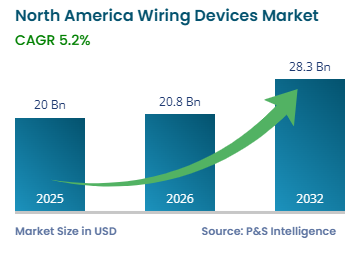
| Study Period | 2021 - 2032 |
| Market Size in 2025 | USD 20.0 Billion |
| Market Size in 2026 | USD 20.8 Billion |
| Market Size by 2032 | USD 28.3 Billion |
| Projected CAGR | 5.2% |
| Largest Region | U.S. |
| Fastest-Growing Region | U.S. |
| Market Structure | Semi-Consolidated |
Market Size
Explore the market potential with our data-driven report
North America Wiring Devices Market Key Insight
- The current carrying category holds the larger market share, of 80%, in 2025, driven by its essential role in power distribution across residential, commercial, and industrial systems.
- The non-current carrying category will have the higher CAGR, of 6.0%, supported by increasing adoption of smart enclosures and protective components in advanced electrical systems.
- The receptacles category holds the largest market share, of 35%, in 2025, due to their widespread use across all building types.
- The electric switches category will have the highest CAGR, of 4.1%, driven by the transition toward smart and connected switching solutions.
- The United States holds the largest market share, of 85%, in 2025, and will also have the highest CAGR, of 5.1%, supported by strong construction activity and technological adoption.
North America Wiring Devices Market Future Outlook
The North America wiring devices market size was USD 20.0 billion in 2025, and it will grow by 5.2% during 2026–2032, to reach USD 28.3 billion by 2032. This growth is supported by sustained residential construction activity, increasing renovation spending, and the modernization of low-voltage electrical systems and wiring device installations across commercial and industrial buildings. The U.S. Census Bureau reports that residential construction spending in the United States reached USD 917.9 billion in 2024, representing a 5.9% increase over the prior year, reinforcing sustained demand for wiring devices in new builds and renovation projects. The expansion of smart buildings, energy-efficient lighting systems, and connected electrical devices is further strengthening demand for advanced wiring devices such as switches, receptacles, and dimmers.
The rising adoption of smart home technologies and building automation systems is transforming traditional wiring devices into intelligent, connected components integrated with IoT ecosystems. Additionally, regulatory emphasis on electrical safety, energy efficiency, and building code compliance is encouraging the replacement of legacy wiring devices and low-voltage electrical components with advanced wiring solutions.
North America Wiring Devices Market Dynamics
Smart and IoT-Integrated Wiring Devices Are Key Trends
A defining trend reshaping the North America wiring devices market is the rapid evolution of traditional electrical components into smart, IoT-integrated devices capable of remote monitoring, automation, and energy management. Modern wiring devices, including switches, dimmers, and receptacles, are increasingly equipped with wireless connectivity, voice control compatibility, and integration with home automation platforms. The U.S. Census Bureau indicates that approximately 132.7 million housing units in the United States were occupied in 2024, highlighting the scale of residential energy demand supporting the adoption of connected wiring devices.
This trend is reinforced by recent developments such as Schneider Electric’s introduction of Matter protocol compatibility to its Square D X Series connected wiring devices in August 2024, improving cross-platform integration, alongside Legrand’s launch of the Wattstopper i3 platform in May 2025, delivering AI-powered building management and lighting control solutions tailored for commercial buildings and data centers. Manufacturers are focusing on developing interoperable solutions that seamlessly integrate with broader building management systems, supporting centralized control of lighting and electrical circuits through connected wiring devices. The Consumer Technology Association highlights the continued growth of smart home device adoption across North America, reinforcing demand for connected wiring devices.
Robust Residential Construction and Renovation Activity Are Biggest Drivers
Robust residential construction and renovation activity represents the most consequential external force driving market growth. New housing developments, coupled with rising renovation and remodeling projects, are generating strong demand for wiring devices across North America. Homeowners are increasingly investing in electrical upgrades, including modern switches, receptacles, and dimmers, to enhance safety, energy efficiency, and aesthetic appeal.
The National Fire Protection Association National Electrical Code (NEC) mandates GFCI-protected receptacle installations in kitchens and bathrooms, reinforcing replacement demand driven by renovation activity. The National Association of Home Builders reports sustained growth in home construction and remodeling expenditures, reflecting strong underlying demand. Additionally, aging housing stock across the U.S. and Canada is necessitating electrical system upgrades, further supporting market expansion. This demand environment is further supported by investments in low-voltage electrification and wiring device manufacturing ecosystems, such as ABB’s USD 120 million U.S. facility expansion and Siemens’ USD 285 million investment in U.S. manufacturing for low-voltage electrical products supporting wiring devices and related electrical infrastructure.
High Raw Material and Input Costs Are Key Restraints
High raw material and input costs represent a significant constraint on market growth. Wiring devices rely heavily on materials such as copper, plastics, and metals, whose prices are subject to volatility due to global supply chain disruptions and commodity market fluctuations. Rising costs of raw materials increase manufacturing expenses, leading to higher product prices and reduced profit margins for manufacturers.
Additionally, logistics challenges and supply chain constraints have increased procurement costs and lead times, impacting production schedules. Copper and aluminum price volatility directly impacts cost structures, as both metals serve as primary conductive materials in wiring devices, increasing exposure to commodity fluctuations. Manufacturers are responding by optimizing supply chains, adopting alternative materials, and implementing cost-control strategies. The impact is particularly significant for small and mid-sized manufacturers that lack large-scale procurement advantages and hedging capabilities. Furthermore, increasing copper demand from electric vehicles, renewable energy systems, and data center infrastructure is intensifying competition for supply, sustaining long-term input cost pressure.
Rising Smart Home and Commercial Automation Adoption Are Biggest Opportunities
The increasing adoption of smart home technologies and commercial automation systems presents a significant growth opportunity for the wiring devices market. Smart buildings require advanced wiring devices capable of supporting connected systems, automation, and energy management solutions. The integration of lighting controls, occupancy sensors, and programmable switches is becoming standard in modern residential and commercial spaces.
The U.S. Department of Energy emphasizes the role of advanced wiring devices and electrical systems in improving energy efficiency and reducing building energy consumption. As demand for intelligent building solutions increases, wiring device manufacturers have significant opportunities to expand their product portfolios. Manufacturers developing devices with embedded energy monitoring, occupancy sensing, and interoperability features can capture premium pricing, aligned with U.S. Green Building Council LEED and ENERGY STAR certification requirements. Additionally, integration with demand response and load management programs is further expanding growth opportunities. Partnership-led ecosystem expansion is accelerating adoption. For instance, in February 2026, Leviton integrated its My Leviton platform with Sonos audio systems, enabling synchronized lighting and audio control through smart scene management. This integration expands the residential automation experience beyond device-level control into coordinated ambient environments.
North America Wiring Devices Market Segmentation Analysis
Type Analysis
The current carrying category holds the larger market share, of 80%, in 2025, driven by its fundamental role in enabling electrical current flow across residential, commercial, and industrial systems. Components such as switches, receptacles, and connectors are essential for power distribution, making them indispensable across all end-use applications. The high installation volume across new construction and retrofit projects reinforces the dominance of this category.
The non-current carrying category will have the higher CAGR, of approximately 6.0% during the forecast period, driven by increasing demand for protective enclosures, mounting systems, and safety components used in advanced electrical installations. As building codes and safety standards evolve, the adoption of non-current carrying components is increasing to enhance system reliability and user safety.
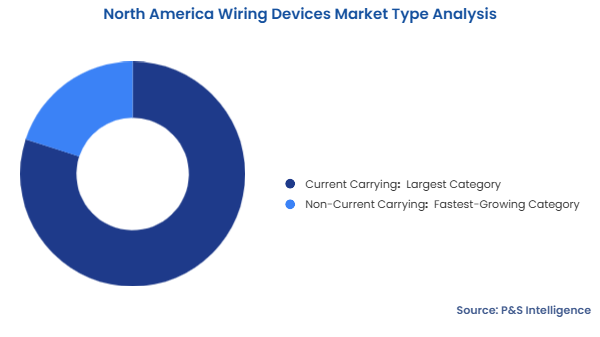
The types analyzed in this report are:
- Current Carrying (Largest Category)
- Non-Current Carrying (Fastest-Growing Category)
Product Analysis
The receptacles category holds the largest market share, of 35%, in 2025, due to their universal application across residential, commercial, and industrial buildings. The high installation density per unit across new construction and renovation projects further reinforces volume demand and market dominance. Additionally, increasing adoption of code-compliant receptacles, including GFCI, AFCI, and USB-integrated variants, is further supporting demand growth.
The electric switches category will have the highest CAGR, of approximately 4.1%, during the forecast period, driven by increasing adoption of smart switches and connected lighting control systems. These devices offer enhanced functionality, including remote operation, automation, and energy monitoring, aligning with the growing trend of smart homes and intelligent buildings. The transition from mechanical to IoT-enabled switches is increasing the average selling price and technical value of switch products.
The products analyzed in this report are:
- Receptacles (Largest Category)
- Electric Switches (Fastest-Growing Category)
- Light Dimmers
- Lamp Holders
- Metal Contacts
- Others
Application Analysis
The commercial category holds the largest market share, of 65%, driven by extensive deployment of wiring devices across office buildings, retail spaces, healthcare facilities, and educational institutions. Commercial installations typically require higher device counts per square foot compared to residential applications, reinforcing demand intensity in this segment. The demand is further strengthened by advanced building technologies, including AI-powered lighting and control systems such as Legrand’s Wattstopper platform, which are increasingly deployed in offices, healthcare facilities, and data centers to improve energy efficiency and operational control.
The residential category will have the highest CAGR, of approximately 4.7%, during the forecast period driven by rising housing construction, renovation activities, and increasing adoption of smart home technologies. Homeowners are investing in modern electrical systems to improve energy efficiency and safety. The residential segment is increasingly transitioning from a volume-driven to a value-driven growth trajectory, supported by the adoption of smart and energy-efficient wiring devices.
The applications analyzed in this report are:
- Commercial (Largest Category)
- Residential (Fastest-Growing Category)
- Industrial
Drive strategic growth with comprehensive market analysis
North America Wiring Devices Market Geographical Analysis
United States Wiring Devices Market Size
The United States holds the largest market share, of 85%, in 2025, and will also have the highest CAGR, of 5.1%, supported by strong residential construction activity, high adoption of smart home technologies, and continuous infrastructure upgrades. Additionally, capacity expansion initiatives such as Schneider Electric’s USD 700 million U.S. investment program, Eaton’s expanded production facility in Texas, and ABB’s ongoing manufacturing expansion are strengthening domestic production capabilities and supporting long-term market growth.
The U.S. Census Bureau reports steady growth in construction spending and housing starts, reinforcing demand for wiring devices across new and existing buildings. Additionally, increasing adoption of building automation systems is driving demand for advanced wiring solutions in both residential and commercial sectors. Ongoing updates to the National Fire Protection Association National Electrical Code (NEC) continue to drive the adoption of code-compliant and advanced wiring devices.
Canada Wiring Devices Market Size
Canada represents a steady-growth market, supported by residential construction, infrastructure development, and increasing adoption of energy-efficient building solutions. Government initiatives promoting sustainable construction are further supporting demand for modern wiring devices across the country.
The federal government's infrastructure commitments are stimulating demand for advanced electrical components, with Statistics Canada reporting that total building construction investment rose 5.8% to CAD 253.8 billion in 2024, with the non-residential sector expanding 1.1% to CAD 51.7 billion. The Government of Canada's CAD 6 billion Canada Housing Infrastructure Fund (CHIF), active in 2024–2025, is supporting infrastructure development linked to new housing supply. Cities such as Toronto, Vancouver, Calgary, and Montreal are focal points of high-rise residential and mixed-use development, dense construction typologies that require higher wiring device counts per structure than low-rise formats. Canada's progressive adoption of smart building standards and energy efficiency codes is elevating the technical specification of wiring devices deployed in new and retrofit installations, creating incremental value per unit sold.
The countries of the market are as follows:
- United States (Larger and Faster-Growing Market)
- Canada
North America Wiring Devices Market Share
The market is consolidated, shaped by high entry barriers including capital-intensive manufacturing requirements, well-established contractor and distributor networks, and strict compliance standards under UL Solutions and the National Fire Protection Association National Electrical Code (NEC). These factors reinforce the dominance of major wiring device manufacturers such as Leviton Manufacturing Co. Inc. and Legrand, alongside other multinational players. However, the market is not dominated by a single entity, as several global companies collectively maintain significant market share while competing across residential, commercial, and industrial segments. The presence of regional and specialized manufacturers further prevents full consolidation, resulting in a semi-consolidated competitive landscape.
Top Companies in the North America Wiring Devices Market:
- Schneider Electric SE
- ABB Ltd.
- Legrand Holding SA
- Panasonic Holdings Corporation
- Emerson Electric Co.
- Eaton Corporation plc
- Littelfuse Inc.
- Leviton Manufacturing Co. Inc.
- Honeywell International Inc.
- TE Connectivity Ltd.
- IPEX Inc.
- Molex LLC
North America Wiring Devices Market News
- In February 2026, Leviton Manufacturing Co. Inc. announced a partnership with Ardd + Winter to expand the reach of its Visioneering and Certolux lighting solutions in the southeastern U.S., targeting specialized environments such as healthcare and cleanrooms.
- In October 2025, Legrand Holding SA announced the acquisition of Avtron Power Solutions in the U.S. to strengthen its presence in power quality and critical power infrastructure across North America, enhancing solutions that support electrical reliability in commercial and industrial applications.
- In September 2023, Schneider Electric SE inaugurated a 160,000-square-foot manufacturing facility in El Paso, Texas, as part of its U.S. investment strategy to support electrical equipment production and energy infrastructure development.