This Report Provides In-Depth Analysis of the Non-Dispersive Infrared Market Report Prepared by P&S Intelligence, Segmented by Gas Type (Carbon Dioxide, Hydrocarbons, Refrigent Gases, Sulphur Hexafluoride, Carbon Monoxide, Ethylene, Anesthetic gases, Acetylene, Volatile Organic Compounds), Application (HVAC, Monitoring, Detection and Analysis), Vertical Analysis (Automotive & Transportation, Chemicals, Oil & Gas, Medical, Industrial & Manufacturing, Environmental, Food Processing and Storage), and Geographical Outlook for the Period of 2019 to 2032
Explore the market potential with our data-driven report
Non-Dispersive Infrared Market Outlook
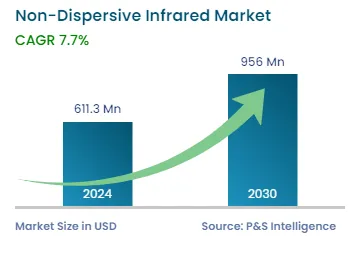
The non-dispersive infrared market size was USD 611.3 million in 2024, and it will grow by 7.7% during 2025–2032, reaching USD 1094.2 million by 2032. The growth can be primarily ascribed to the rising demand for sensors in critical industries and the increasing focus on carbon dioxide detection in the food processing and storage industry.
NDIR instruments are suitable for the detection of toxic gases in chemical industries, which aids in minimizing leakage, as well as ensuring the safety of the workplace and workers. Over the years, regulatory agencies have made their guidelines for workplace safety more stringent, which, in turn, is expected to boost the demand for NDIR analyzers.
In the modified atmospheric packaging technique utilized in the food & beverage industry, many gases are used, including nitrogen, oxygen, and carbon dioxide, and to detect them, NDIR sensors are used. These instruments have a long life and high accuracy, allowing for longer transport times and minimization of the wastage of food.
Accurate levels of carbon dioxide help in enhancing the shelf life of vegetables and fruits and also aid in improving storage quality. Similarly, nitrogen is used in the case of dried foods in order to regulate humidity, hence improving their shelf life and preserving their consistency.
Besides food storage and processing, NDIR analyzers are used in medical facilities for the detection of airborne poisons, which can cause serious health issues.
Non-Dispersive Infrared Market Emerging Trends
Technological Advancements Are a Key Trend
The development of smaller, compact NDIR sensor, and portable devices, such as smart home systems, enabled by miniaturization is a major trend.
CO2 monitor for personal use, gas detector for industrial workers. and small sensors for smart home devices are a few examples of advanced non-dispersive infrared sensors.
They play a key role in gas concentration detection, environmental monitoring, medical diagnostics, and industrial measurements, by enhancing sensitivity, accuracy, and reliability.
For instance, medical gas analysis and enhanced detection of low-level toxic gases in industrial settings improve worker safety.
Real-time monitoring for data collection, remote diagnostics, and predictive maintenance has become possible due to enhanced IoT connectivity.
The adoption of AI and ML improves analytical procedures, optimizes operations, and elevates safety measures.
Initiatives to reduce particulate matter pollution across India propel the demand for improved air quality monitoring systems that are sensitive to CO2, methane, and other gases.
These initiatives are promoted and implemented under the National Clean Air Programme (NCAP), launched in 2019.
Increasing Focus on Occupational Safety Is Major Growth Driver
As per the International Labour Organization, around 3 million people are killed each year at work due to diseases and injuries.
The safety of workers holds importance in almost all industries. In the mining, chemicals, fertilizers, and oil & gas sectors, in particular, hazardous working environments prevail.
During the refining and extraction of oil & gas and the processing of chemicals, various toxic gases, including sulfur hexafluoride, carbon monoxide, and hydrocarbons, are generated.
They have major health repercussions if inhaled in large amounts, including death in extreme cases.
Moreover, high concentrations of flammable gases can lead to fires and explosions.
Hence, governments across the world are implementing safety directives and regulations for the wellbeing of workers across industries.
In the U.S., for instance, regulatory agencies, such as the National Institute for Occupational Safety and Health (NIOSH) and the Occupational Safety and Health Administration (OSHA), conduct research and make recommendations for the prevention of occupational injuries. According to the Occupational Safety and Health (OSH) Act, employers have to ensure a safe workplace.
Moreover, specifically for the mining industry, the act recommends the usage of regulation-compliant respiratory protective devices and compulsory health hazard evaluations.
Therefore, non-dispersive infrared sensors are used to easily detect toxic fumes in various industries.
The technology helps in the minimization of hazardous smoke leaks, thus enhancing worker and workplace safety.
Therefore, the increasing focus of regulatory agencies on workplace safety is expected to fuel the demand for NDIR analyzers and modules.
Non-Dispersive Infrared Market Segmentation and Category Analysis
Gas Type Analysis
The carbon dioxide category held the largest market share, of 35%, in 2024. This is because of its multiple uses of CO2 monitoring equipment in HVAC, automotive, indoor air quality, greenhouse, industrial safety, and medical applications.
The accuracy provided by NDIR in measuring CO2 levels is significant in monitoring combustion processes, assessing lung function during medical procedures, and measuring indoor air quality. For carbon dioxide measurement, it offers long-term stability, which is another advantage of the technology driving the market growth.
The volatile organic compounds category will grow at the highest CAGR, of 8.2%, during the forecast period. This is because exposure to such compounds can lead to irritation, difficulty in concentrating, fatigue, and vision and memory problems. Therefore, these instruments are used to measure the quality of the air and concentration of many VOCs that can cause health problems, including ketones and amines.
The HVAC category held the largest market share, of 30%, IN 2024. This is because of the need to detect carbon dioxide levels for better control of ventilation and compliance with green building standards. HVAC systems with NDIR sensors optimize their performance and reduce energy consumption. Additionally, with strict rules and rising awareness of the environmental impact of CO2 emissions drive the demand for accurate and reliable sensing technologies.
The detection and analysis category will grow at the highest CAGR, of 7.8%, during the forecast period, because of the improvements in portable and real-time gas analyzers. Many hazardous incidents are prevented via accurate gas detection in industries with NDIR analyzers.
The applications analyzed here are:
HVAC (Largest Category)
Monitoring
Air quality monitoring
Capnography
Refrigerant Monitoring
Fruit Ripening Monitoring
Detection and analysis (Fastest-Growing Category)
Hazardous Gas Detection
Flame Detection
Alcohol Detection
Blood Gas Analysis
Vertical Analysis
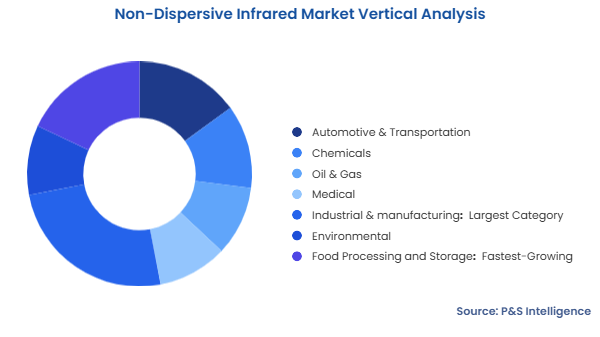
The industrial & manufacturing category held the largest market share, of 25%, in 2024. This is because of the increasing global focus on workforce safety, strict environmental rules, and the adoption of industry 4.0 technologies. In smart factories, real-time control, leak detection, and maintenance are facilitated by the NDIR technology. As per the World Resources Institute, industries are the third-largest polluter in the world, with a share of 6.5% in global direct emissions.
The verticals analyzed here are:
Automotive & Transportation
Chemicals
Oil & Gas
Medical
Industrial & manufacturing (Largest Category)
Environmental
Food Processing and Storage (Fastest-Growing Category)
Drive strategic growth with comprehensive market analysis
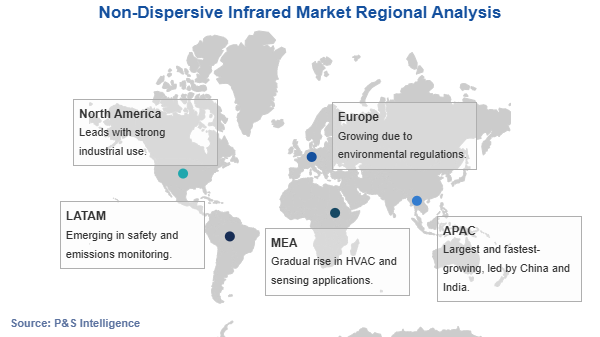
APAC held the largest market share, of 30%, in 2024, owing to the increasing number of small and medium-sized manufacturers, coupled with the rising investments in the development of IoT-based NDIR analyzers.
In APAC, China holds the leading position, and it will grow with a CAGR of around 8.6%, attributed to the expanding automotive & transportation sector in the country. Many automobile manufacturers have started focusing on integrating such sensors for monitoring cabin air quality.
Europe will grow at the highest CAGR, of 8.8%, during the forecast period. This is due to the implementation of stringent regulations on the emission of greenhouse gases and the rising focus on monitoring the concentration of toxic gases. In November 2022, the EU presented Euro 7 emission standards to deliver effective air quality improvements.
The regions analyzed in this report are:
North America
U.S. (Largest Category)
Canada (Fastest-Growing Category)
Europe (Fastest-Growing Regional Market)
Germany (Largest Category)
U.K. (Fastest-Growing Category)
France
Italy
Russia
Rest of Europe
Asia-Pacific (Largest Regional Market)
Japan
China (Largest Category)
India (Fastest-Growing Category)
South Korea
Australia
Rest of APAC
Latin America
Brazil (Largest Category)
Mexico (Fastest-Growing Category)
Rest of LATAM
Middle East and Africa
U.A.E
Saudi Arabia (Largest Category)
South Africa (Fastest-Growing Category)
Rest of MEA
Non-Dispersive Infrared Market Share Analysis
The market is fragmented because it consists of a wide variety of small and large players, such as Honeywell International Inc., Amphenol Corporation, Senseair AB, Emerson Electric Co., ABB Ltd., Yokogawa Electric Corporation, and Figaro Engineering. This is because of the improvements in sensor design, miniaturization, accuracy, and integration with IoT technologies. They allow both new and existing companies to develop specialized and more-competitive solutions.
Key Non-Dispersive Infrared Companies:
Honeywell International Inc.
N.E.T. Srl
NevadaNano
S+S Regeltechnik Gmbh
MIPEX TECHNOLOGY
Senseair AB
Emerson Electric Co.
Acal Bfi group
Yokogawa Electric Corporation
Amphenol
Non-Dispersive Infrared Market News
In June 2025, Teledyne Technologies Incorporated announced a partnership with Industrial Detection Solutions to expand its operations in the Middle East. Under the partnership, the companies will set up a 699-square-meter manufacturing factory in Dammam to manufacture high-precision sensors for toxic and combustible gas detection at oil & gas facilities, such as onshore and offshore oilfields, refineries, LNG/CNG plants, and petrochemical factories.
In February 2025, Mouser Electronics Inc. announced that it will begin distributing the RRH47000 CO2 sensor module from Renesas Electronics Corporation.
In December 2024, Alphasense, a subsidiary of Ametek Inc., launched a new LED NDIR CO2 sensor with indium aluminum antimonide.
In August 2024, Asahi Kasei Corporation launched the Sunlight R290 gas sensor for compliance with European PFAS and F-gas regulations.
In February 2024, Yokogawa Electric corporation acquired Adept Fluidyne Pvt. Ltd.’s manufacturing facility in India for improved magnetic flowmeters.
In November 2023, Amphenol acquired the CMR Group from LBO France, to expand its sensor offerings for challenging environments with extreme temperatures.
Want a report tailored exactly to your business need?
Leading companies across industries trust us to deliver data-driven insights and innovative solutions for their most critical decisions. From data-driven strategies to actionable insights, we empower the decision-makers who shape industries and define the future. From Fortune 500 companies to innovative startups, we are proud to partner with organisations that drive progress in their industries.
Client Testimonials
Working with P&S Intelligence and their team was an absolute pleasure – their awareness of timelines and commitment to value greatly contributed to our project's success. Eagerly anticipating future collaborations.
McKinsey & Company
India
Unmatched Standards
Our insights into the minutest levels of the markets, including the latest trends and competitive landscape, give you all the answers you need to take your business to new heights
Complete Data Security
We take a cautious approach to protecting your personal and confidential information. Trust is the strongest bond that connects us and our clients, and trust we build by complying with all international and domestic data protection and privacy laws