Neoantigen Cancer Vaccine Market Size & Share Analysis - Key Trends, Future Opportunities, Growth Strategies, and Forecasts (2025 - 2032)
This Report Provides In-Depth Analysis of the Neoantigen Cancer Vaccine Market Report Prepared by P&S Intelligence, Segmented by Product Type (Personalized, Off-the-Shelf), Type (Nucleic Acid, Peptide, Dendritic-Cell-Based), Therapeutic Specialty (Lung Cancer, Urinary System Cancer, Melanoma, Liver Cancer, Head and Neck Cancer, Blood and Bone Marrow Cancer), End User (Hospitals & Clinics, Cancer Research Institutes, Specialty Cancer Centers, Academic & Research Institutions), and Geographical Outlook for the Period of 2019 to 2032
Explore the market potential with our data-driven report
Neoantigen Cancer Vaccine Market Outlook
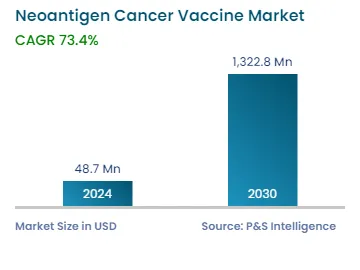
The neoantigen cancer vaccine market size was USD 48.7 million in 2024, which is predicted to reach USD 3952.7 million by 2032, growing at a CAGR of 73.4% during 2025–2032.
The remarkable growth trajectory of this market is primarily driven by the convergence of technological advancements in genomic sequencing, rising cancer incidence globally, and the paradigm shift toward personalized medicine in oncology. Neoantigen vaccines represent a revolutionary approach in cancer immunotherapy, targeting tumor-specific mutations unique to individual patients and demonstrating unprecedented potential in clinical trials for melanoma, lung cancer, and pancreatic cancers.
The accelerating adoption of precision oncology approaches has positioned neoantigen vaccines at the forefront of next-generation cancer therapeutics. According to the World Health Organization, there were an estimated 20 million new cancer cases and 9.7 million deaths globally in 2022, with projections indicating a 77% increase in cancer burden by 2050. This escalating disease burden, combined with the limitations of conventional therapies, has intensified the focus on personalized immunotherapies that can precisely target each patient's unique tumor profile. The success of mRNA technology platforms during the COVID-19 pandemic has further catalyzed development in this space, with companies leveraging similar platforms to rapidly manufacture personalized cancer vaccines within 4-8 weeks of tumor sampling.
Neoantigen Cancer Vaccine Market Trends & Drivers
Advancement in Genomic Technologies and AI Integration Are a Key Trend
Genomic sequencing technologies, such as next-generation sequencing (NGS) and whole-genome sequencing (WGS), have become faster, more accurate, and more cost-effective, enabling broader adoption in clinical and research settings.
AI algorithms can analyze vast genomic datasets rapidly, identifying complex patterns, mutations, and biomarkers that may be missed by traditional analytical methods.
The integration of AI with genomic platforms allows for real-time interpretation of sequencing results, reducing turnaround time for diagnosis and treatment planning.
Machine learning models improve predictive accuracy for disease risk, treatment response, and patient outcomes based on genomic data.
AI-driven automation streamlines genomic workflows, from sample preparation to data analysis, minimizing human error and increasing efficiency.
Personalized medicine benefits significantly from the combination of genomics and AI, enabling the development of tailored therapies based on an individual’s genetic profile.
Pharmaceutical and biotech companies use AI-enhanced genomic insights for faster drug discovery, target identification, and clinical trial optimization.
Expanding Clinical Pipeline and Positive Trial Results Driving Market Growth
Biopharmaceutical companies are increasing the number of drug candidates, diagnostic tools, or therapeutic devices under development, to target more diseases and patient segments.
As of 2023, there are over 300 cancer vaccines currently in various stages of development across the global R&D pipeline, being evaluated by more than 250 companies.
A larger pipeline indicates a stronger potential for future product launches, which can expand market reach and revenue opportunities.
The successful progress of products through clinical trial phases (I, II, and III) demonstrates safety, efficacy, and regulatory compliance, boosting investor and stakeholder confidence.
Positive trial results accelerate regulatory approvals and pave the way for faster commercialization of innovative treatments or technologies.
Favorable clinical data often attract partnerships, licensing deals, and funding from pharmaceutical companies, biotech firms, and venture capital investors.
A growing portfolio supported by strong trial outcomes enhances competitive positioning in the market, as companies can address unmet medical needs more effectively.
These advancements also drive adoption rates among healthcare providers and patients, further fueling overall market growth.
Neoantigen Cancer Vaccine Market Emerging Trends
Product Type Analysis
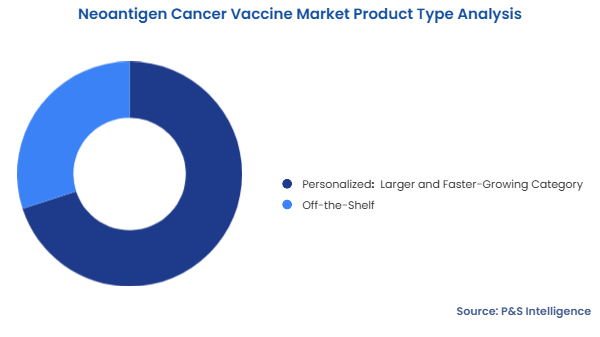
The personalized category dominated the market in 2024 with a 70% market share and it is expected to grow at the highest CAGR during the forecast period, driven by their superior specificity and ability to target patient-specific tumor mutations. These vaccines utilize advanced sequencing technologies to identify unique neoantigens present in individual tumors, enabling the creation of truly personalized therapeutic interventions. The dominance of this category reflects the growing understanding that cancer is a highly heterogeneous disease requiring individualized treatment approaches, with each patient's tumor harboring a unique constellation of mutations that can serve as therapeutic targets. As per studies, the global spending on precision medicine will reach almost USD 740 billion by 2030.
The types analyzed here are:
Personalized (Larger and Faster-Growing Category)
Off-the-Shelf
Type Analysis
The nucleic acid vaccines category held the dominant position in 2024, accounting for 55% market share, with RNA-based vaccines emerging as the preferred platform due to their rapid manufacturing capabilities and strong immunogenicity profiles. The success of mRNA technology during the COVID-19 pandemic has accelerated its adoption in cancer vaccine development, with multiple candidates demonstrating robust T-cell responses in clinical trials. RNA vaccines offer several advantages, including self-adjuvanting properties, transient expression that reduces the risk of genomic integration, and the ability to encode multiple neoantigens in a single construct.
The dendritic-cell-based vaccines category is expected to grow at the highest CAGR during the forecast period, driven by the advances in ex vivo cell manipulation techniques and improved understanding of dendritic cell biology. These vaccines leverage the professional antigen-presenting capabilities of dendritic cells to initiate powerful anti-tumor immune responses. Recent innovations in dendritic cell loading strategies, including the use of neoantigen-pulsed exosomes and enhanced maturation protocols, have improved vaccine potency and clinical outcomes. The combination of dendritic cell vaccines with checkpoint inhibitors has shown synergistic effects, further driving interest in this therapeutic approach.
These types are included in the market:
Nucleic Acid (Largest Category)
DNA
RNA
Peptide
Dendritic-Cell-Based (Fastest-Growing Category)
Therapeutic Specialty Analysis
The lung cancer category commanded the largest market share in 2024, of 30%, driven by the high mutational burden typically found in lung tumors and the substantial unmet medical need in this patient population. As per the IARC, in 2022, lung cancer accounted for around 2.48 million new diagnoses and caused approximately 1.82 million deaths worldwide, making it the most diagnosed cancer and the leading cause of cancer mortality.
Non-small cell lung cancer, which accounts for approximately 85% of all lung cancer cases, presents numerous targetable neoantigens due to tobacco-associated mutagenesis and other environmental factors.
The integration of neoantigen vaccines with standard-of-care treatments, including checkpoint inhibitors and targeted therapies, has shown promising results in extending progression-free survival and overall survival in advanced lung cancer patients.
The blood & bone marrow cancer category is set to exhibit the highest CAGR, during the forecast period, fueled by breakthrough results in hematological malignancies and the unique immunological characteristics of these cancers. In 2022, there were an estimated 487,000 new cases of leukemia, 553,000 of non-Hodgkin lymphoma, and 188,000 of multiple myeloma globally.
The success of CAR-T cell therapies in blood cancers has paved the way for neoantigen vaccine adoption, with several trials demonstrating the ability to induce measurable residual disease negativity in patients with acute myeloid leukemia and multiple myeloma. The accessibility of tumor samples through liquid biopsies and the presence of well-characterized driver mutations make blood cancers particularly amenable to neoantigen-based approaches.
The therapeutic specialties covered include:
Lung Cancer (Largest Category)
Urinary System Cancer
Melanoma
Liver Cancer
Head & Neck Cancer
Blood & Bone Marrow Cancer (Fastest-Growing Category)
Others
End User Analysis
The hospitals & clinics category dominated the market in 2024 with a 45% share, as these facilities serve as primary centers for cancer diagnosis, treatment administration, and patient monitoring throughout the vaccination process. Major cancer centers have established specialized immunotherapy units equipped with the infrastructure necessary for personalized vaccine production, including on-site sequencing capabilities and GMP-compliant manufacturing facilities. The concentration of multidisciplinary oncology teams in hospital settings facilitates the complex coordination required for neoantigen vaccine therapy, from initial biopsy and sequencing to vaccine administration and immune monitoring.
The cancer research institutes category is projected to grow at the highest CAGR, of approx. 73.5%, during the forecast period, driven by increasing collaborations between academic institutions and industry partners in developing next-generation vaccine platforms. These institutes play a crucial role in conducting early-phase clinical trials, validating novel neoantigen identification algorithms, and advancing fundamental understanding of tumor immunology. The establishment of specialized translational research centers focused on cancer vaccines, supported by both public funding and private investment, has accelerated the pace of innovation in this field.
The end users in the market include:
Hospitals & Clinics (Largest Category)
Cancer Research Institutes (Fastest-Growing Category)
Specialty Cancer Centers
Academic & Research Institutions
Drive strategic growth with comprehensive market analysis
Neoantigen Cancer Vaccine Market Regional Growth Dynamics
North America Neoantigen Cancer Vaccine Market Size
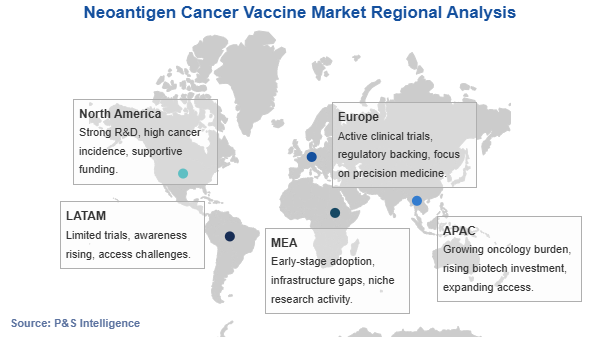
North America dominated the global neoantigen cancer vaccine market in 2024, accounting for a 45% market share, positioning itself as the epicenter of innovation in personalized cancer immunotherapy. The region's leadership stems from its robust biotechnology ecosystem, substantial venture capital investment exceeding USD 5 billion annually in oncology therapeutics, and a regulatory framework that supports expedited development pathways for breakthrough therapies. The presence of numerous clinical-stage biotechnology firms has created a competitive landscape that drives continuous innovation in vaccine platform technologies and manufacturing processes.
U.S. Neoantigen Cancer Vaccine Market Size
The U.S. FDA's proactive approach to personalized medicine, evidenced by the establishment of specific guidance for therapeutic cancer vaccines and multiple breakthrough therapy designations for neoantigen vaccines, has accelerated clinical development timelines. According to the National Cancer Institute, the U.S. recorded over 2 million new cancer cases in 2024, creating substantial demand for innovative treatment approaches. The concentration of world-class cancer centers, including Memorial Sloan Kettering, MD Anderson, and Dana-Farber, provides an ideal environment for conducting complex clinical trials requiring sophisticated infrastructure for tumor sequencing, vaccine manufacturing, and immune monitoring. Furthermore, favorable reimbursement policies and increasing insurance coverage for personalized therapies have improved patient access to these innovative treatments.
Asia-Pacific Neoantigen Cancer Vaccine Market Forecast
The Asia-Pacific region is projected to witness the highest CAGR, of approx. 74.0%, during the forecast period, driven by the rapidly expanding healthcare infrastructure, increasing cancer incidence, and growing government support for precision medicine initiatives. The region's vast population of over 4.6 billion people, combined with rising cancer rates particularly in China, Japan, and India, presents an enormous addressable market for personalized cancer therapies. Strategic investments by both domestic and international companies in establishing manufacturing facilities and research centers across the region are building the foundation for sustainable market growth.
China Neoantigen Cancer Vaccine Market Size
China's commitment to biotechnology innovation, exemplified by its inclusion of precision medicine in national strategic plans and investment of over USD 10 billion in genomics and immunotherapy research, positions it as a future leader in neoantigen vaccine development.
Japan Neoantigen Cancer Vaccine Market Size
Japan's advanced healthcare system and regulatory framework supporting regenerative medicine and cell therapy provide an enabling environment for clinical trials and early adoption of personalized vaccines. The establishment of regional clinical trial networks and harmonization of regulatory standards through initiatives like the APEC Harmonization Center are facilitating multi-country studies and accelerating product approvals across Asian markets.
Europe Neoantigen Cancer Vaccine Market Share
Europe captured a 30% market share in 2024, with Germany, the U.K., and Switzerland serving as primary hubs for neoantigen vaccine research and development. The region benefits from strong academic-industry collaborations, exemplified by partnerships between universities and biotechnology companies that have produced several clinical-stage vaccine candidates. The European Medicines Agency's PRIME designation program and adaptive pathways approach have facilitated accelerated development of personalized cancer vaccines, while the Horizon Europe research program has allocated substantial funding for cancer immunotherapy projects.
Germany Neoantigen Cancer Vaccine Market Size
Germany has emerged as a particular strength in mRNA vaccine technology, with BioNTech's headquarters in Mainz serving as a global center for personalized cancer vaccine development. The country's robust biotechnology sector, supported by government initiatives like the National Decade Against Cancer, has fostered innovation in vaccine manufacturing and delivery technologies.
U.K. Neoantigen Cancer Vaccine Market Size
The U.K.'s genomics capabilities, anchored by initiatives such as the 100,000 Genomes Project and Genomics England, provide essential infrastructure for neoantigen identification and patient stratification, positioning the country as a leader in precision oncology research.
The regions and countries analyzed in this report are:
North America (Largest Regional Market)
U.S. (Larger Country Market)
Canada (Faster-Growing Country Market)
Europe
Germany (Largest Country Market)
U.K. (Fastest-Growing Country Market)
France
Italy
Spain
Rest of Europe
Asia-Pacific (Fastest-Growing Regional Market)
Japan
China (Largest Country Market)
India (Fastest-Growing Country Market)
South Korea
Australia
Rest of APAC
Latin America
Brazil (Largest Country Market)
Mexico (Fastest-Growing Country Market)
Rest of LATAM
Middle East and Africa
Saudi Arabia (Largest Country Market)
South Africa
U.A.E. (Fastest-Growing Country Market)
Rest of MEA
Neoantigen Cancer Vaccine Market Share
The global neoantigen cancer vaccine market is characterized by a relatively consolidated structure, with a small group of developers holding significant influence due to the complexity and cost of bringing personalized cancer vaccines to market. High barriers to entry arise from the need for advanced genomic sequencing capabilities, bioinformatics expertise, and GMP-compliant manufacturing infrastructure. Competition is strong between established biotechnology developers and emerging firms, with strategic collaborations playing a central role in accessing complementary technologies and accelerating clinical progress.
Market leaders have maintained their positions by developing robust vaccine platform technologies, advancing extensive clinical pipelines, and forming alliances that facilitate late-stage development and commercialization. Innovation in vaccine design, optimization of manufacturing processes, and integration with combination therapy strategies are ongoing focus areas. The adoption of artificial intelligence and machine learning in neoantigen prediction and selection is enabling more precise and efficient vaccine development workflows, from target identification through clinical evaluation.
Key Neoantigen Cancer Vaccine Companies:
Moderna Inc.
F. Hoffmann-La Roche Ltd.
AstraZeneca plc
Agenus Inc.
OSE Immunotherapeutics
Advaxis Inc.
Medigene AG
Neon Therapeutics
Genocea Biosciences
Immunovative Therapies Ltd.
Gritstone bio
CureVac AG
Neoantigen Cancer Vaccine Market News
In September 2024, OSE Immunotherapeutics launched the ARTEMIA Phase III clinical trial for Tedopi (OSE‑2101), an off-the-shelf neoepitope-based cancer vaccine. This international study focuses on HLA‑A2 positive patients with metastatic non-small cell lung cancer (NSCLC) who have developed secondary resistance to immune checkpoint inhibitors.
In April 2024, Transgene S.A. and NEC Corporation presented Phase I clinical data demonstrating that TG4050 induced robust T-cell immune responses and led to 100% disease-free survival after a median of 18.6 months in head & neck cancer patients. Further updates published in November 2024 confirmed that all treated patients remained disease-free at a median 24.1 months of follow-up.
In April 2024, Gritstone bio Inc. reported the preliminary results of its Phase 2/3 study of the personalized neoantigen vaccine GRANITE in front-line metastatic MSS-CRC. The vaccine showed favorable progression-free survival trends (HR 0.82 overall; 0.52 in high-risk patients), with long-term ctDNA data supporting sustained clinical benefit.
In October 2023, BioNTech SE initiated the first patient dosing in the Phase 2 trial of autogene cevumeran for resected pancreatic ductal adenocarcinoma, marking a significant milestone in addressing one of the most challenging cancer types with personalized immunotherapy.
In February 2023, Moderna Inc. and Merck & Co. Inc. announced that their personalized cancer vaccine mRNA-4157/V940, in combination with Keytruda, has received the FDA Breakthrough Therapy Designation for the adjuvant treatment of high-risk melanoma, following positive Phase 2b trial results showing a 44% reduction in recurrence risk.
Want a report tailored exactly to your business need?
Leading companies across industries trust us to deliver data-driven insights and innovative solutions for their most critical decisions. From data-driven strategies to actionable insights, we empower the decision-makers who shape industries and define the future. From Fortune 500 companies to innovative startups, we are proud to partner with organisations that drive progress in their industries.
Client Testimonials
Working with P&S Intelligence and their team was an absolute pleasure – their awareness of timelines and commitment to value greatly contributed to our project's success. Eagerly anticipating future collaborations.
McKinsey & Company
India
Unmatched Standards
Our insights into the minutest levels of the markets, including the latest trends and competitive landscape, give you all the answers you need to take your business to new heights
Complete Data Security
We take a cautious approach to protecting your personal and confidential information. Trust is the strongest bond that connects us and our clients, and trust we build by complying with all international and domestic data protection and privacy laws