Medical Disposables Market Size & Share Analysis - Trends, Drivers, Competitive Landscape, and Forecasts (2026 - 2032)
This Report Provides In-Depth Analysis of the Medical Disposables Market Report Prepared by P&S Intelligence, Segmented by Type (Glucose Monitoring Strips, Blood Collection Consumables, Diagnostic Catheters, Dialysis Consumables, Radiology Consumables, Infusion Products, Smart Syringes, Prefilled Syringes, Intubation & Ventilation Supplies, Hypodermic Products, Sterilization Consumables, Nonwoven Medical Supplies, Incontinence Products, Surgical Nonwoven Products, Wound Care Consumables, Infection Management Products, Exudate Management Products, Negative Pressure Wound Therapy Devices), Application (Cardiovascular, Cerebrovascular, Ophthalmology, Gynecology, Urology, Orthopedics), End User (Hospitals, Clinics/Physician Offices, Assisted Living Centers & Nursing Homes, Ambulatory Surgery Centers, Research Institutes), and Geographical Outlook for the Period of 2021 to 2032
Explore the market potential with our data-driven report
Medical Disposables Market Overview
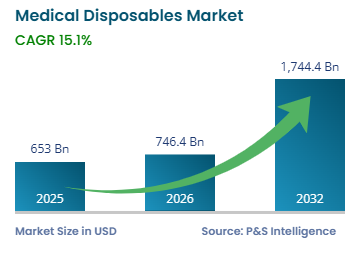
The medical disposables market size was USD 653.0 billion for 2025, and it will grow by 15.1% during 2026–2032, to reach USD 1,744.4 billion by 2032.
The market is driven by the increasing volume of diagnostic, surgical, therapeutic, and routine healthcare procedures worldwide, creating recurring demand for single-use products such as syringes, blood collection consumables, catheters, infusion products, and nonwoven medical supplies. The expansion of hospitals, ambulatory care centers, diagnostic laboratories, and home healthcare services is further increasing the consumption of disposable medical products. Rising healthcare expenditure and the growing emphasis on infection prevention are also encouraging the use of single-use products over reusable alternatives. According to the World Health Organization (WHO) Global Health Expenditure Database, global health spending reached approximately USD 10.6 trillion in 2023, reflecting the continued expansion of healthcare expenditure worldwide.
The market is further driven by the growing prevalence of chronic diseases, an aging population, increasing surgical and diagnostic procedures, and the expansion of healthcare infrastructure in emerging economies. Demand is also supported by stricter infection-control practices and the need to minimize healthcare-associated infections, particularly in hospitals and other clinical settings. In addition, increasing access to healthcare and the expansion of universal health coverage are creating a broader patient base requiring disposable medical products.
Key Market Insights
The wound care consumables category holds the largest market share, of 25%, in 2025, supported by recurring dressing changes and ongoing treatment of chronic wounds.
The cardiovascular category holds the largest market share, of 35%, in 2025, supported by the high global burden of cardiovascular diseases and demand for related medical consumables.
The urology category will have the highest CAGR, of approximately 15.5%, driven by the rising burden of urological conditions, minimally invasive procedures, and demand for disposable products.
North America holds the largest market share, of 40%, in 2025, driven by the rising prevalence of urological conditions and demand for minimally invasive procedures and disposable products.
Asia-Pacific will have the highest CAGR, of approximately 16.0%, driven by expanding healthcare infrastructure and rising demand for single-use medical products.
Medical Disposables Market Trends and Drivers
Shift Toward Smart and Advanced Single-Use Medical Disposables Is a Key Trend
A key trend in the medical disposables market is the increasing adoption of smart and advanced single-use products, driven by the need for greater patient safety, medication accuracy, infection prevention, and workflow efficiency. Manufacturers are increasingly integrating technologies such as sensors, electronic monitoring, safety mechanisms, and connectivity into conventional disposable products, particularly syringes, infusion devices, blood collection products, and diagnostic consumables. This trend is also supported by the growing emphasis on reducing medication errors and needlestick injuries, while healthcare providers seek products that can improve clinical outcomes without significantly increasing procedural complexity.
The trend is further supported by the expanding use of connected healthcare technologies and the growing burden of healthcare-associated infections. According to WHO, approximately 1 in 10 patients are affected by healthcare-associated infections during the provision of care, highlighting the importance of infection-prevention measures and appropriate use of single-use medical products. In addition, WHO estimates that around 16 billion injections are administered worldwide each year, creating substantial demand for safe, single-use injection and related disposable products.
Rising Prevalence of Chronic Diseases Is The Biggest Driver
A major driver of the medical disposables market is the rising prevalence of chronic diseases, including diabetes, cardiovascular diseases, cancer, and kidney disorders. These diseases often require repeated diagnosis, monitoring, medication administration, and long-term treatment, rather than a one-time medical intervention. As the number of patients requiring ongoing care increases, healthcare providers consume larger quantities of disposable products such as syringes, glucose monitoring strips, blood collection consumables, infusion products, catheters, and dialysis consumables. Therefore, the growing chronic disease burden directly increases the frequency and volume of medical procedures, creating recurring demand for disposable medical products.
This driver is particularly important because chronic disease patients typically require healthcare services over extended periods, resulting in continued consumption of medical disposables. According to WHO, noncommunicable diseases (NCDs) account for approximately 41 million deaths globally each year, representing around 74% of all deaths worldwide. The substantial and continuing burden of chronic diseases increases demand for disease monitoring, diagnostic testing, drug delivery, and supportive treatments, thereby supporting sustained growth of the medical disposables market.
Environmental Impact and Medical Waste Are Key Restraints
A key restraint for the medical disposables market is the environmental impact associated with the widespread use of single-use medical products. Infection management products, including gloves, masks, gowns, and related products, are discarded after use, generating significant volumes of medical waste. Many of these products are plastic-based and may be contaminated with biological materials, making their recycling and disposal more complex. As healthcare providers and governments increasingly focus on reducing plastic waste and improving environmental sustainability, pressure is growing to reduce reliance on conventional single-use products where clinically appropriate.
This environmental concern can restrain market growth by increasing waste-management requirements and encouraging healthcare facilities to consider reusable, recyclable, biodegradable, or lower-waste alternatives. Manufacturers may also face additional costs to redesign products, adopt sustainable materials, and comply with increasingly stringent environmental requirements. Therefore, while single-use products remain essential for infection control and patient safety, the environmental burden associated with their disposal can limit the growth of conventional medical disposables.
Expansion of Home Healthcare and Community-Based Care Is The Biggest Opportunity
A key opportunity for the medical disposables market is the rapid expansion of home healthcare and community-based care, as healthcare systems increasingly seek to provide treatment and long-term disease management outside hospitals. This shift is particularly important for older adults and patients with chronic conditions who require regular monitoring, medication administration, wound care, infusion therapy, catheterization, and other recurring interventions. These services rely on convenient, sterile, and easy-to-use single-use products, creating opportunities for manufacturers to expand the use of medical disposables beyond traditional hospitals and clinics.
The opportunity is further strengthened by the growing elderly population, which is increasing the need for long-term and home-based healthcare services. According to WHO, 1.1 billion people worldwide were aged 60 years or older in 2023, and this number is projected to reach 1.4 billion by 2030. This expanding population is expected to increase demand for continuous healthcare, monitoring, and supportive services outside hospitals. Therefore, manufacturers can capitalize on this opportunity by developing portable, user-friendly, prefilled, safety-engineered, and home-use disposable products, allowing them to reach a broader patient base and capture growing demand from decentralized healthcare.
Medical Disposables Market Segmentation Analysis
Type Analysis
The wound care consumables category holds the largest market share, of 25%, in 2025, supported by the recurring nature of wound management, as chronic wounds often require repeated dressing changes and ongoing treatment over extended periods. This creates continuous demand for dressings, bandages, wound cleansers, gauze, and other wound-care consumables. The underlying patient population is also expanding due to the rising prevalence of diabetes, vascular conditions, and other diseases associated with chronic wounds. Peer-reviewed research published in Advances in Wound Care estimates that chronic wounds affect approximately 10.5 million U.S. Medicare beneficiaries, highlighting the substantial patient base requiring ongoing wound-care products.
The negative pressure wound therapy devices category will have the highest CAGR, supported by increasing adoption of NPWT for complex wounds, surgical wounds, and post-operative wound management. The expanding use of NPWT across a broader range of wound-care applications is increasing demand for associated devices and consumables. Greater awareness of advanced wound-management techniques and the need to improve healing outcomes are also supporting adoption, creating opportunities for manufacturers to expand NPWT product offerings.
The cardiovascular category holds the largest market share in 2025, supported by the substantial global burden of cardiovascular diseases, which drives demand for diagnostic, interventional, surgical, and post-procedure medical consumables. Cardiovascular procedures commonly require multiple disposable products, including catheters, guidewires, sheaths, drapes, syringes, and closure materials, resulting in recurring consumption across healthcare facilities. The American Heart Association's 2026 heart disease and stroke statistics update reports approximately 19.41 million global cardiovascular disease deaths and 612.06 million people living with CVD in 2021.
The urology category will have the highest CAGR, of approximately 15.5%, supported by the increasing burden of urological conditions, rising demand for minimally invasive procedures, and growing adoption of disposable products used in stone management, prostate procedures, urinary drainage, and continence care. The increasing prevalence of conditions such as benign prostatic hyperplasia (BPH) is expanding the patient population requiring diagnosis and treatment, supporting demand for urological medical disposables.
The applications analyzed in this report are:
Cardiovascular (Largest Category)
Cerebrovascular
Ophthalmology
Gynecology
Urology (Fastest-Growing Category)
Orthopedics
Others
End User Analysis
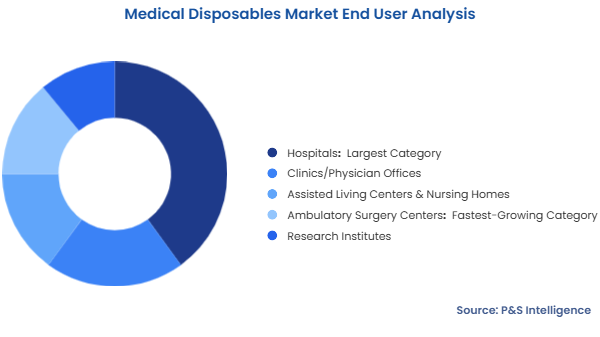
The hospitals category holds the largest market share, of 40%, in 2025, supported by the high volume and complexity of procedures performed in inpatient and emergency settings, which require substantial consumption of sterile single-use products. Hospitals use a broad range of medical disposables, including syringes, gloves, surgical drapes, catheters, infusion products, wound-care supplies, and blood collection consumables across diagnosis, treatment, surgery, and routine patient care. The American Hospital Association reported 6,093 hospitals operating in the U.S. in 2026, highlighting the large healthcare-facility base supporting demand for medical disposables.
The ambulatory surgery centers category will have the highest CAGR, supported by the increasing migration of eligible procedures from inpatient hospitals to outpatient settings, as healthcare providers and payers seek to reduce costs while maintaining access to surgical care. The shift toward minimally invasive procedures and outpatient treatment also increases demand for procedure-specific single-use products. According to the Centers for Medicare & Medicaid Services (CMS), its CY 2026 payment policies apply to approximately 6,000 Medicare-participating ASCs, with ASC payment rates increasing by 2.6%.
The end users analyzed in this report are:
Hospitals (Largest Category)
Clinics/Physician Offices
Assisted Living Centers & Nursing Homes
Ambulatory Surgery Centers (Fastest-Growing Category)
Research Institutes
Drive strategic growth with comprehensive market analysis
Medical Disposables Market Geographical Analysis
North America Medical Disposables Market Size
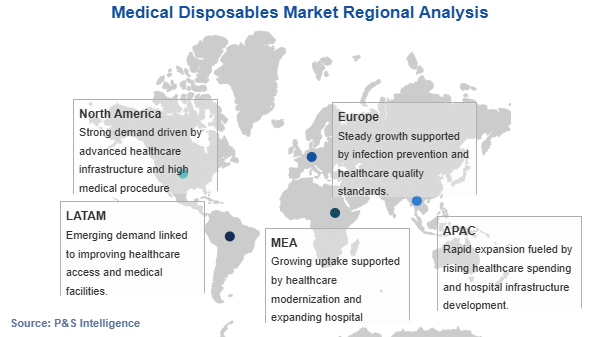
North America holds the largest market share, of 40%, in 2025, supported by its well-developed healthcare infrastructure, high volume of surgical and diagnostic procedures, strong adoption of single-use medical products, and stringent infection-prevention practices across hospitals and healthcare facilities. The presence of large hospital networks, established medical supply chains, and advanced healthcare systems further supports consistent demand for disposable products such as syringes, catheters, infusion products, blood collection consumables, and surgical supplies. CDC surveillance data reported declines in several healthcare-associated infections between 2023 and 2024, including a 9% reduction in central line-associated bloodstream infections and a 10% reduction in catheter-associated urinary tract infections. These infection-prevention efforts support continued reliance on sterile and single-use medical products in clinical settings.
U.S. Medical Disposables Market Size
The U.S. is the largest country market in North America, supported by the migration of surgical and other procedures from inpatient hospitals to outpatient and ambulatory surgical center (ASC) settings. As more procedures are performed in these settings, demand increases for procedure-specific consumables, including syringes, surgical supplies, wound-care products, catheters, infusion products, and other single-use medical products. The expansion of outpatient care therefore creates additional consumption opportunities for medical disposable manufacturers across the U.S. healthcare system.
This shift is reinforced by recent Medicare policy changes. For CY 2026, CMS removed 271 codes from the Inpatient-Only List and added these codes to the Ambulatory Surgical Center Covered Procedures List (ASC CPL), supporting the migration of certain procedures toward outpatient settings. This policy expands the range of procedures that can be performed and reimbursed in outpatient settings when clinically appropriate, supporting the continued migration of procedures toward ASCs and strengthening demand for medical disposables used in ambulatory procedures.
Asia-Pacific Medical Disposables Market Size
Asia-Pacific will have the highest CAGR, of approximately 16.0%, supported by the expansion of hospitals, diagnostic centers, and healthcare facilities into tier-two cities and semi-urban areas, improving access to diagnostic and treatment services and increasing consumption of single-use medical products. Rising healthcare coverage and increasing treatment volumes are further supporting demand for syringes, blood collection consumables, infusion products, catheters, dialysis consumables, and other disposable products. In addition, the presence of large-scale medical-device manufacturing bases in countries such as China, India, Malaysia, and Vietnam supports local supply and improves the availability and affordability of medical disposables.
India's Ministry of Health and Family Welfare reports that approximately 2.2 lakh new end-stage renal disease patients are added annually, generating demand for around 3.4 crore dialysis sessions each year. This growing dialysis requirement supports demand for dialysis-related disposables, including dialyzers, blood tubing sets, fistula needles, catheters, and other single-use consumables. The increasing burden of chronic kidney disease and expansion of dialysis infrastructure therefore represents an important source of demand for the medical disposables market across Asia Pacific.
China Medical Disposables Market Size
China is the largest country market in Asia Pacific, driven by the country's large healthcare system and high volume of medical services, which create substantial recurring demand for single-use products, including syringes, catheters, blood collection products, infusion supplies, and other medical consumables. The expansion and modernization of healthcare facilities, together with government initiatives to improve healthcare accessibility and control medical costs, are also influencing procurement practices and encouraging manufacturers to compete on product quality, cost efficiency, and supply capabilities.
According to China's National Bureau of Statistics, medical institutions recorded 10.11 billion medical visits and 0.31 billion hospital discharges in 2024, supported by approximately 10.37 million hospital beds nationwide. This high volume of healthcare activity generates recurring requirements for disposable products across diagnosis, treatment, surgery, hospitalization, and routine patient care. Consequently, the scale of China's healthcare system provides a substantial demand base for medical disposables and supports continued market growth.
The regions and countries analyzed in this report are:
North America (Largest Regional Market)
U.S. (Larger Country)
Canada (Faster-Growing Country)
Europe
Germany (Largest Country)
U.K. (Fastest-Growing Country)
France
Italy
Spain
Rest of Europe
Asia-Pacific (Fastest-Growing Regional Market)
China (Largest Country)
India (Fastest-Growing Country)
Japan
South Korea
Australia
Rest of APAC
Latin America
Brazil (Largest Country)
Mexico (Fastest-Growing Country)
Rest of LATAM
Middle East & Africa
Saudi Arabia (Largest Country)
South Africa
U.A.E. (Fastest-Growing Country)
Rest of MEA
Medical Disposables Market Share Analysis
The market is fragmented because it includes a large number of global, regional, and local manufacturers competing across a broad range of product categories. The market covers diverse products such as syringes, gloves, catheters, blood collection consumables, infusion products, wound-care supplies, dialysis consumables, and sterilization products, with different companies specializing in specific segments. While major players such as BD, Cardinal Health, B. Braun, Terumo, and Stryker have strong positions in particular product categories, no single company dominates the overall market. In addition, regional manufacturers compete effectively by offering cost-efficient products and serving local healthcare systems and distribution networks. Differences in regulatory requirements, healthcare infrastructure, purchasing preferences, and product demand across countries further support the presence of numerous regional suppliers.
Top Companies in the Medical Disposables Market:
Medtronic plc
Becton, Dickinson and Company
B. Braun SE
Terumo Corporation
Cardinal Health, Inc.
Boston Scientific Corporation
Smith & Nephew plc
Nipro Corporation
Fresenius SE & Co. KGaA
Stryker Corporation
Owens & Minor, Inc.
Ansell Limited
Molnlycke Health Care AB
ConvaTec Group PLC
Solventum Corporation
Medical Disposables Market Developments
In June 2026, Molnlycke Health Care AB confirmed a combined investment of approximately EUR 40 million at its Mikkeli, Finland, and Oldham, U.K., sites to expand wound-care manufacturing capacity and strengthen supply-chain resilience.
In May 2026, Smith & Nephew plc launched the RENASYS EDGE negative pressure wound therapy system at the European Wound Management Association congress in Bremen, Germany, extending its portfolio of portable NPWT solutions.
In May 2026, ConvaTec Group PLC unveiled Aquacel ConvaFiber at EWMA 2026 in Bremen, Germany, ahead of scale-up later in the year, alongside 13 accepted clinical abstracts.
In February 2026, Becton, Dickinson and Company completed the spin-off of its Biosciences & Diagnostic Solutions business and its merger with Waters Corporation, receiving USD 4 billion in cash proceeds and issuing shareholders 0.135 Waters shares per BD share. The transaction further focuses BD on its remaining medical technology businesses.
In December 2025, Solventum Corporation completed its acquisition of Acera Surgical for USD 725 million in cash plus up to USD 125 million in milestone payments, adding the Restrata electrospun synthetic tissue matrix platform and approximately USD 90 million in 2025 sales. The deal extends Solventum's advanced wound care franchise into regenerative acute-care matrices.
Frequently Asked Questions About This Report
What is driving the growth of the medical disposables market?+
Growth is driven by rising surgical and diagnostic procedures, increasing adoption of single-use products, infection-control requirements, and expanding healthcare infrastructure.
How is the growing adoption of single-use medical products affecting demand?+
Single-use products are increasingly preferred because they reduce cross-contamination risks, minimize sterilization requirements, and improve convenience and infection control across healthcare settings.
How are infection prevention and control requirements influencing the market?+
Stricter infection-control practices are increasing the use of sterile disposable products such as syringes, catheters, surgical supplies, gloves, and wound-care products, supporting recurring demand.
What are the major challenges facing the medical disposables market?+
Key challenges include the environmental impact of single-use products, rising medical waste, disposal requirements, and pressure to develop more sustainable disposable products.
How is the increasing number of surgical procedures affecting demand for medical disposables?+
Rising surgical volumes are increasing consumption of syringes, blood-collection products, surgical nonwovens, wound-care products, catheters, infusion products, and other procedure-related disposables.
Want a report tailored exactly to your business need?
Leading companies across industries trust us to deliver data-driven insights and innovative solutions for their most critical decisions. From data-driven strategies to actionable insights, we empower the decision-makers who shape industries and define the future. From Fortune 500 companies to innovative startups, we are proud to partner with organisations that drive progress in their industries.
Client Testimonials
Working with P&S Intelligence and their team was an absolute pleasure – their awareness of timelines and commitment to value greatly contributed to our project's success. Eagerly anticipating future collaborations.
McKinsey & Company
India
Unmatched Standards
Our insights into the minutest levels of the markets, including the latest trends and competitive landscape, give you all the answers you need to take your business to new heights
Complete Data Security
We take a cautious approach to protecting your personal and confidential information. Trust is the strongest bond that connects us and our clients, and trust we build by complying with all international and domestic data protection and privacy laws