MEA Smart Transformer Market Future Outlook
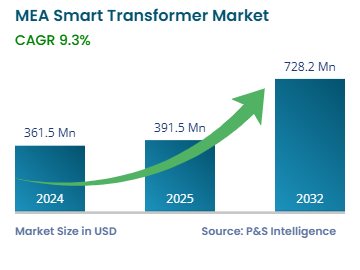
The MEA smart transformer market size was USD 361.5 million in 2024, and it will grow by 9.3% during 2025-2032, to reach USD 728.2 million by 2032.
The market growth is primarily driven by rapid infrastructure modernization across the Gulf Cooperation Council countries, increasing investments in smart grid technologies, and the region's ambitious renewable energy integration targets aligned with various national vision programs. These transformers offer real-time monitoring capabilities, voltage regulation, and bidirectional power flow management, making them essential for accommodating the increasing penetration of distributed energy resources, which further contributes to market growth.
As of 2024, the Middle East and Africa (MEA) region consumed approximately 3,000 Terawatt-hours (TWh) of electricity annually, according to the International Energy Agency (IEA). This consumption is driven by a population exceeding 1.5 billion, with urbanization averaging 62% region-wide. Rapid industrial growth, particularly in the Gulf states, has significantly boosted energy demand. The United Nations reports that urban populations in countries like Saudi Arabia and the UAE surpass 80%, while Sub-Saharan Africa experiences rising electrification rates. Continued infrastructure development, energy-intensive industries, and improved access are key contributors to the region’s growing electricity consumption, making energy security a central policy focus.
This region is witnessing unprecedented transformation in its power infrastructure, with smart transformers emerging as critical components for grid modernization initiatives. These smart transformers feature advanced monitoring, communication, and control systems, which help companies manage the electricity supply more effectively, minimize energy losses, and better integrate solar and wind power into the grid.
The growing emphasis on sustainable energy solutions is particularly prominent in Gulf countries, where national transformation programs such as Saudi Vision 2030 and UAE Energy Strategy 2050 are driving substantial investments in smart grid infrastructure. Furthermore, the region's extreme climatic conditions, characterized by high temperatures and sandstorms, are pushing utilities to adopt smart transformers with enhanced monitoring capabilities to predict maintenance needs and prevent unexpected failures, thereby ensuring grid reliability and reducing operational costs.