This Report Provides In-Depth Analysis of the Managed Detection & Response Market Report Prepared by P&S Intelligence, Segmented by Service (Threat Detection, Incident Response/Termination, Threat Monitoring), Security (Cloud, Endpoint, Network), Deployment (Cloud, On-Premises), Organization Size (Large Enterprises, SMEs), End-User (IT & ITeS, Healthcare, BFSI, Government, Energy & Utilities, Manufacturing, Retail), and Geographical Outlook for the Period of 2021 to 2032
Explore the market potential with our data-driven report
Managed Detection and Response Market Key Insights
Threat Monitoring is the largest category with 55% share, providing essential 24/7 visibility for organizations lacking internal security teams.
Cloud security holds the largest share at 60%, as businesses need unified dashboards to track risks across remote environments.
IT & ITeS leads end-use adoption with 30% share, relying on continuous monitoring to secure shared platforms and client data.
Asia-Pacific is the fastest-growing region with 21.5% CAGR, driven by companies formalizing security measures to combat fraud and supplier attacks.
North America remains the largest market with 40% share, supported by strict breach reporting regulations and insurer mandates for active monitoring.
Managed Detection and Response Market Overview
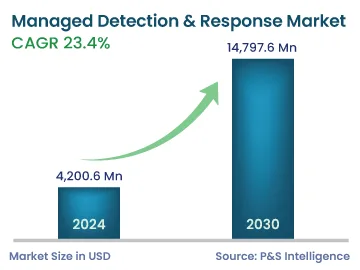
The managed detection & response market size was USD 5.1 billion for 2025, and it will grow by 21.4% during 2026-2032, to reach USD 19.8 billion by 2032.
The market is growing as companies are increasingly being targeted for cyberattacks, which are not possible to prevent with basic security tools. Cybercriminals use a variety of techniques, including ransomware and phishing, to bypass traditional firewalls and antivirus solutions. The transition to the cloud and work-from-home has changed many companies today, which also creates additional pathways for hackers to take advantage of. Most companies are struggling to recruit enough qualified cybersecurity professionals to monitor the threat environment around the clock.
Companies now face severe penalties for not demonstrating proper protection of customer data under GDPR, HIPAA, and other regulations. MDR services provide businesses with security experts and detection equipment to monitor 24/7, quickly identifies threats, and stops attacks from causing damage. According to the Federal Bureau of Investigation, reported cybercrime losses reached USD 16.6 billion in 2024, reflecting a 33% increase over 2023, highlighting the growing financial impact of cyberattacks on organizations.
Shift to Always-On Managed Detection and Response Is Major Trend
Enterprises are shifting from tool-based security to always-on managed detection and response services. MDR providers are combining endpoint, cloud, identity, and network monitoring into a single service. Customers prefer a single alert view rather than multiple dashboards. Providers are also introducing quicker response actions, not just alerts, so that incidents are contained without lengthy handoffs. More deals nowadays include threat hunting and response playbooks with guidance. Around 50% of organizations were projected to use managed detection and response services by 2025. This reflects the shift from tool-based security toward unified, always-on detection and response models.
Rising Impact of Real-World Cyber Incidents on Day-to-Day Business Drives Market
The market is expanding as cyber incidents impact daily business operations, beyond IT systems only. Cyberattacks delay payments, disrupt deliveries, and make core app access impossible. Quite a few companies are unable to bounce back quickly without external help. Security teams of small companies feel the pain most times. Besides, insurers and partners also demand evidence that security breaches are promptly addressed. This compels companies to go for MDR services over setting up everything in-house. Human-operated ransomware activity increased 2.75 times year over year in 2024, while global password-based attacks exceeded 600 million per day in 2024, increasing the need for external managed detection and response services.
Threat monitoring is the largest category, holding a market share of 55%, as the majority of companies first require continuous internal visibility of their system operations. A large number of businesses do not have a team to monitor the alerts around the clock. Managed service providers address this gap by operating security tools, filtering noise, and identifying real risks. It is suitable for both large and medium-sized enterprises. Constant monitoring also helps to fulfil the requirements of audits and internal reporting. More than 600 million identity attacks were observed daily in 2024, with nearly 99% being password-based, creating high alert volumes that require continuous monitoring to identify real threats.
Incident response/termination is the fastest-growing category, registering a CAGR of 21.6%, as most companies that get attacked want assistance only when some damage is done. Attacks are speedy, and any delay in response leads to greater losses. During such attacks, teams remain stunned and are unable to do the right things in time. MDR providers isolate infected systems, stop threats, and work with the customer to complete the recovery process. Legal teams and insurers also figure out the management of the situation clearly.
This leads to additional purchases of response services after they have experienced downtime or a breach of their data. The average breakout time between initial access and lateral movement dropped to 62 minutes in 2024, increasing the need for rapid managed response capabilities to contain active intrusions.
Cloud is the largest category, holding a market share of 60%, since more business tools nowadays operate remotely from company offices. Data, applications, and user access are hosted on common platforms, which gives rise to novel risk paths, which internal teams have difficulty tracking. MDR tools that are designed for cloud systems can monitor activity across users, apps, and access points. Companies want one dashboard rather than several scattered tools. Besides, cloud setups are also dynamic, thus increasing the number of blind spots. Cloud intrusions increased by 75% between 2023 and 2024, driven by the misuse of valid credentials, raising the need for advanced detection beyond standard activity logging.
Endpoint is the fastest-growing category, registering a CAGR of 21.8%, as work devices have spread all over the world. The use of laptops, mobiles, and remote logins increases security vulnerabilities. A lot of companies still cannot manage updates and alerts across all their devices. MDR services conduct surveillance of device behavior and intervene when device behavior signals an anomaly. Teams that have remote employees and practice mixed device policies highly value this assistance. With the continuation of hybrid work, endpoints are frequently unprotected. That fact is the main reason for the rapid increase in the demand for endpoint-focused MDR solutions. About 90% of successful cyberattacks and 70% of data breaches originated from compromised endpoint devices in 2024, increasing the importance of managed endpoint monitoring.
The security types analyzed in this report are:
Cloud (Largest Category)
Endpoint (Fastest-Growing Category)
Network
Deployment Analysis
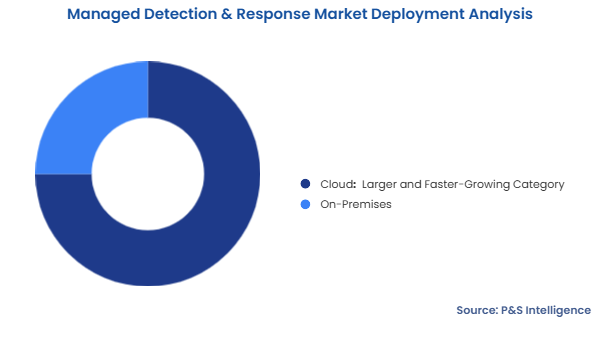
Cloud is the larger category, holding a market share of 75%, and it has the higher CAGR. This is since customers desire a quick setup without too much physical hardware work. Scaling cloud delivery becomes simpler when teams increase in size or change locations. Besides, security patches go out more quickly in hosted systems. Businesses generally prefer services that operate across multiple locations without one-time installations.
Cloud MDR is compatible with remote teams and shared IT models. With the growing advent of security tools online, MDR buyers are taking the same route for pace and agility. Nearly 99% of organizations experienced at least one attack targeting AI systems in cloud environments in 2024, expanding the attack surface, and increasing demand for cloud-native detection and response.
The deployment modes analyzed in this report are:
Cloud (Larger and Faster-Growing Category)
On-Premises
Organization Size Analysis
Large enterprises is the larger category, holding a market share of 70%, as they are subject to larger attack surfaces. Big companies operate numerous systems, users, and vendors. These factors make manual security very challenging to control. MDR aids in centralizing alerts across teams and locations. Besides, large companies have the finances for continuous protection. They come across greater public and legal risks from attacks. The average cost of a data breach in the United States reached USD 9.36 million in 2024, driven largely by detection and escalation costs, reinforcing the need for centralized managed response in large enterprises.
SMEs are the faster-growing category, since small companies generally do not have security staff and in-house monitoring teams. MDR provides them with access to advanced tools and security experts without the need for building everything from scratch. Today, attacks are more frequently targeted at small businesses. Downtime affects them more severely; hence, owners desire simple ways to lessen the risk. As the threats extend to smaller businesses, MDR become a sensible entry point to professional security. According to the Department for Science, Innovation and Technology, around 70% of medium-sized businesses experienced a cybersecurity breach or attack in 2024.
The organization sizes analyzed in this report are:
Large Enterprises (Larger Category)
SMEs (Faster-Growing Category)
End User Analysis
IT & ITeS is the largest category, as these companies run digital systems for many clients. So, a single breach can result in the loss of multiple customers, which increases the risks both legally and in terms of trust. Their services rely on uptime and data access. Security monitoring via MDR supports the surveillance of shared platforms as well as client-facing systems. Besides, integrating with other systems constantly exposes these firms to new threats. The IT sector accounted for 24% of nation-state cyberattacks globally in 2024, increasing the need for continuous monitoring across interconnected service environments.
Healthcare is the fastest-growing category, registering a CAGR of 21.7%, due to the increased attacks on clinical systems as well as patient data. Further, a lot of hospitals have outdated systems that are difficult to secure. Doctors and other medical professionals are focused on providing patient care and not on cyber risks. MDR providers help monitor the networks without slowing the daily work. Security incidents can disrupt the delivery of care, compelling healthcare authorities to look for managed support. The healthcare sector experienced a 47% year-over-year increase in cyberattacks in 2024, driven largely by ransomware targeting legacy systems and sensitive patient data.
The end users analyzed in this report are:
IT & ITeS (Largest Category)
Healthcare (Fastest-Growing Category)
BFSI
Government
Energy & Utilities
Manufacturing
Retail
Others
Drive strategic growth with comprehensive market analysis
Managed Detection & Response Market Regional Outlook
North America Managed Detection and Response Market Analysis
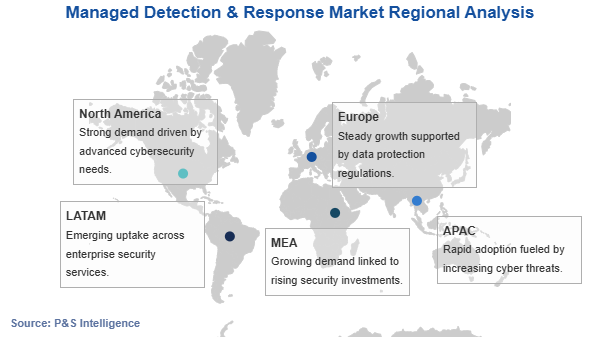
North America holds the largest share of the market, of 40%, as companies here are among the earliest and most frequent buyers of security as a service. Already, many firms have tough breach reporting obligations, which is a major reason behind their outsourcing of teams that can identify and deal with incidents rapidly. Cyber insurance is a factor in shaping buying behavior. Before issuing or renewing coverage, insurers require proof of monitoring and response; thus, MDR becomes a part of risk management, not merely an IT spend.
U.S. Managed Detection and Response Market Analysis
The U.S. is leading as sectors like finance, healthcare, and energy are heavily regulated and, therefore, face stringent legal and reporting obligations following a data breach. According to the U.S. Department of Health and Human Services, 739 large healthcare data breaches affecting 500 or more individuals were reported in 2024. This strengthens the need for continuous detection and response to meet disclosure requirements.
Canada Managed Detection and Response Market Analysis
Canada's growth is largely contributed to by mid-sized and large companies using MDR as a way of ensuring compliance with privacy and cybersecurity regulations. Since many organizations do not have in-house expertise, managed teams are contracted to watch over the network, respond quickly to incidents, and keep up with the compliance standards. According to Statistics Canada, businesses spent CAD 1.2 billion recovering from cyber security incidents in 2023, nearly double earlier spending levels, driving increased outsourcing of managed security services.
Asia-Pacific Managed Detection and Response Market Analysis
Asia-Pacific is experiencing the highest CAGR, of 21.5%, simply because a lot of companies in that region are formalizing their security measures for the first time. Business groups transcend borders, which consequently increases their vulnerability to fraud, credential abuse, and supplier attacks. Local IT teams are small in number, so companies depend on managed response services to manage incidents outside office hours. Some markets are running modern cloud infrastructures, while others are still relying on local data centers and third-party IT vendors.
China Managed Detection and Response Market Analysis
China is the leader because large industrial and tech companies there have multiple sites and really complicated IT environments. MDR providers can detect threats at the same time in different factories, offices, and cloud platforms. According to the Ministry of Industry and Information Technology, more than 17,000 industrial connectivity projects were active across major industrial categories in 2024, reflecting large-scale connected environments requiring multi-site threat monitoring.
India Managed Detection and Response Market Analysis
India is expanding rapidly as the IT, telecom and service sectors become subject to audits, client demand for security, and regulatory compliance. Managed response teams are increasingly being deployed for 24/7 monitoring, alert analysis, and incident response. According to the National Computer Emergency Response Authority, over 1.59 million cybersecurity incidents were recorded in 2023, accelerating the adoption of continuous managed monitoring and response services.
Europe Managed Detection and Response Market Analysis
Europe has a major share of the market, also showing steady growth, due to strict privacy regulations and the high requirements for reporting incidents. Companies need to provide evidence of how attacks are identified, dealt with, and recorded. This gives a strong nudge to managed response services that have the capability of keeping logs and case records readily accessible for audits. One MDR partner enables the company to maintain a consistent response to issues regardless of the geographical location. The area is also home to a lot of legacy systems in banks, utilities, and public services, which are difficult to secure just with tools. MDR firms continuously monitor these environments and direct responses whenever alerts are raised.
Germany Managed Detection and Response Market Analysis
Germany leads in manufacturing, energy, and financial companies that run complex hybrid IT environments. Enterprises use MDR experts to monitor their critical systems 24/7 and respond to any threats that may come from various locations. This lowers the operational risk for companies that still have legacy infrastructures and helps in compliance with regional and national cybersecurity regulations. According to the Federal Office for Information Security, more than 72,000 cyber incidents were reported in 2024, marking a 21% increase and intensifying demand for managed security services.
U.K. Managed Detection and Response Market Analysis
The U.K. is a rapidly growing market as financial, retail, and public sector institutions progressively rely more on MDR for their incident management. Managed teams enable businesses to comply with the tightest reporting requirements and have uninterrupted monitoring of their distributed and hybrid IT infrastructures. According to the Department for Science, Innovation and Technology, 74% of large businesses and 91% of universities experienced cybersecurity breaches or attacks in 2025.
The regions and countries analyzed in this report are:
The managed detection and response market is fragmented. Several vendors run their businesses simultaneously, and no single company controls the market. Large security firms compete with focused MDR providers and regional service players. Each group meets different buyer needs, budgets, and risk levels. A few vendors combine MDR with other security tools. Others offer MDR as a standalone service. Buyers often choose a mixture of providers based on the region or the use case. This keeps the share distributed among many names.
New companies also come with niche skills, like cloud, only or endpoint-only services. Changing providers is possible when the service quality is low. This pressure prevents any one company from getting too far ahead. The outcome is a packed market with a lot of players, the competition taking place regularly, and the clients steadily moving from one vendor to another.
Key Players in the Managed Detection & Response Market:
CrowdStrike, Inc.
Secureworks, Inc.
Arctic Wolf Networks
Palo Alto Networks, Inc.
Rapid7, Inc.
WithSecure Ltd.
Atos SE
Accenture plc
Tata Consultancy Services Limited
Sophos Ltd.
Cynet Ltd.
Red Canary, Inc.
Field Effect Security, Inc.
Bitdefender
Alert Logic, Inc.
Managed Detection & Response Market News
In January 2026, CyberMaxx completed its purchase of Corvid Cyberdefense, adding Corvid’s email security work and MDR-related analytics into its security operations.
In December 2025, Cyderes finished buying Lucidum and brought Lucidum’s security data system into its MDR, identity security, and exposure management work.
In November 2025, Coalition Inc. closed a deal to take over automated MDR provider Wirespeed and folded Wirespeed’s detection and response system into its cyber risk services.
In May 2025, Rapid7 launched a managed detection and response service for large companies, built to support complex IT setups across different environments.
In April 2025, WatchGuard Technologies released WatchGuard Total MDR, a managed detection and response service for service providers and partners to run threat monitoring and response for customers.
Frequently Asked Questions About This Report
Why are businesses shifting from traditional security tools to MDR services?+
Enterprises prefer MDR because it replaces fragmented tools with a unified always-on service that combines endpoint, cloud, and network monitoring.
What are the primary benefits of using managed detection and response?+
MDR provides 24/7 expert monitoring to quickly identify threats and stop attacks, which is critical for companies lacking internal security staff.
How does managed detection and response help with regulatory compliance requirements?+
MDR services ensure companies avoid severe penalties by demonstrating proper protection of customer data as required by GDPR, HIPAA, and insurance mandates.
Why is endpoint security the fastest-growing segment in the MDR market?+
Growth is driven by the global spread of remote work devices, as laptops and mobiles create new vulnerabilities that require constant monitoring.
What is the difference between threat monitoring and incident response services?+
Threat monitoring offers continuous visibility to find risks, while incident response focuses on isolating systems and stopping threats after an attack occurs.
Want a report tailored exactly to your business need?
Leading companies across industries trust us to deliver data-driven insights and innovative solutions for their most critical decisions. From data-driven strategies to actionable insights, we empower the decision-makers who shape industries and define the future. From Fortune 500 companies to innovative startups, we are proud to partner with organisations that drive progress in their industries.
Client Testimonials
Working with P&S Intelligence and their team was an absolute pleasure – their awareness of timelines and commitment to value greatly contributed to our project's success. Eagerly anticipating future collaborations.
McKinsey & Company
India
Unmatched Standards
Our insights into the minutest levels of the markets, including the latest trends and competitive landscape, give you all the answers you need to take your business to new heights
Complete Data Security
We take a cautious approach to protecting your personal and confidential information. Trust is the strongest bond that connects us and our clients, and trust we build by complying with all international and domestic data protection and privacy laws