This Report Provides In-Depth Analysis of the Industrial Edge Computing Market Report Prepared by P&S Intelligence, Segmented by Component (Hardware, Software, Services), Deployment (On-Premises, Cloud-Based, Hybrid), Application (Real-Time Monitoring, Machine Vision, Predictive Maintenance, Quality Inspection, Process Optimisation, Remote Equipment Control, Digital Twin, Industrial Automation), Organization Size (Large Enterprises, SMEs), End User (Manufacturing, Transportation and Logistics, Oil and Gas, Energy and Utilities, Mining and Metals, Automotive, Pharmaceuticals, Food and Beverage, Aerospace and Defense), and Geographical Outlook for the Period of 2021 to 2032
Explore the market potential with our data-driven report
Industrial Edge Computing Market Future Outlook
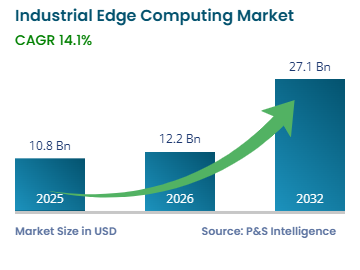
The industrial edge computing market size was USD 10.8 billion for 2025, and it will grow by 14.1% during 2026–2032, to reach USD 27.1 billion by 2032.
The market is driven by the escalating volumes of machine-generated telemetry on factory floors. Latency-sensitive workloads increasingly need processing at the point of creation rather than in distant cloud data centers. According to the International Federation of Robotics (IFR), approximately 542,000 industrial robots were installed worldwide in 2023. Connected industrial automation systems continue to expand, generating large volumes of real-time operational data, while manufacturers, energy operators, and logistics providers are embedding millions of sensors across production assets, making edge nodes a foundational layer of industrial infrastructure for real-time filtering, analytics, and deterministic control.
The market sits at the convergence of Industry 4.0 modernization, private 5G connectivity, and industrial artificial intelligence. Ruggedized gateways, industrial servers, and containerized software platforms now enable predictive maintenance, machine vision inspection, and autonomous control loops directly beside programmable logic controllers. This local processing reduces unplanned downtime and safeguards intellectual property through local data custody. Data-sovereignty requirements and evolving cybersecurity regulations are pushing deployment beyond flagship pilots, while the growing availability of subscription-based managed edge platforms extends adoption into mid-sized brownfield facilities. The U.S. Bureau of Economic Analysis reported that private goods-producing industries expanded by 3.4% in 2024. This sustained investment across manufacturing and industrial sectors accompanies increasing edge computing adoption for operational efficiency, automation, and real-time decision-making.
Key Market Insights
The hardware category holds the largest market share, of 60%, in 2025, driven by demand for ruggedized edge infrastructure for real-time industrial operations.
The cloud-based category will have the highest CAGR, of approximately 14.3%, driven by demand for scalable and cost-efficient edge infrastructure management.
The manufacturing category holds the largest market share, of 25%, in 2025, driven by high automation and operational data generation.
North America holds the largest market share, of 40%, in 2025, driven by early private 5G adoption, advanced manufacturing, and industrial digitalization.
Asia-Pacific will have the highest CAGR, of approximately 15.0%, driven by greenfield manufacturing, expanding 5G deployment, and growing industrial IoT adoption.
Industrial Edge Computing Market Dynamics
Industrial AI and Containerized Software Are Key Trends
The industrial edge is shifting from fixed-function hardware toward software-defined, containerized architectures that decouple workloads from proprietary equipment. Manufacturers increasingly deploy analytics microservices, machine vision models, and digital-twin instances on the same ruggedized nodes that host control logic, then redeploy them across plants through centralized registries. This convergence of operational technology and cloud-native tooling allows factories to update edge applications without replacing underlying hardware infrastructure. Deployment cycles compress from months to weeks. According to the World Economic Forum, the Global Lighthouse Network expanded to 201 leading production facilities and value chains in 2025, reflecting accelerating adoption of advanced digital manufacturing technologies that increasingly rely on industrial edge computing for real-time analytics, artificial intelligence, and automation. Industrial technology providers are also reinforcing this transition.
In August 2025, NVIDIA announced the general availability of its Blackwell-powered Jetson AGX Thor platform, designed to accelerate robotics, machine vision, and physical AI workloads across manufacturing and logistics, supporting the shift toward localized AI inference within industrial environments. As artificial intelligence migrates from centralized data centers toward inference at the node, containerized edge stacks are becoming the default deployment model. These stacks embed intelligence directly within production environments and blur the boundary between device and application.
Latency-Sensitive Automation and Private 5G Are Biggest Drivers
Escalating demand for deterministic, low-latency control is a primary force accelerating industrial edge deployment. Autonomous mobile robots, machine vision inspection, and closed-loop process control require sub-10-millisecond response times that centralized cloud architectures cannot consistently deliver. This latency gap compels enterprises to process data at the point of generation. Private 5G networks amplify this driver by providing the bandwidth, reliability, and device density that factory-floor automation demands. Strategic technology partnerships are also reinforcing this transition. In June 2025, Siemens and NVIDIA expanded their collaboration to integrate NVIDIA AI and accelerated computing with the Siemens Xcelerator platform, enabling AI-powered industrial automation, edge AI deployment, and real-time manufacturing applications across factory environments.
As manufacturers pair private wireless infrastructure with on-site compute, edge nodes become essential for processing high-volume sensor telemetry into real-time operational insights and deterministic control decisions. This driver is expected to intensify as 5G-TSN convergence matures, enabling single-network coverage for both motion-control loops and cloud backhaul across increasingly automated facilities.
Cybersecurity Exposure and Regulatory Complexity Are Key Restraints
Expanding attack surfaces and tightening compliance requirements present friction to industrial edge adoption. Distributing compute across hundreds of edge nodes, many operating in remote or physically uncontrolled settings, multiplies vulnerability points, exposing operational technology environments to cyberattacks, tampering, and firmware exploitation. Integrating these nodes with legacy control systems and existing cloud infrastructure demands sophisticated orchestration that many organizations struggle to execute, while edge environments also require consistent security policy enforcement, patch management, identity management, and vulnerability monitoring across large fleets of geographically distributed devices.
Regulatory obligations compound this challenge. The European Union's Cyber Resilience Act mandates built-in cybersecurity requirements and long-term vulnerability support for connected products, increasing compliance burdens for industrial edge deployments across European markets. A persistent shortage of engineers proficient in both industrial protocols and cybersecurity further extends project timelines and inflates implementation and consulting costs. Behavioral analytics, zero-trust frameworks, and secure-by-design architectures are emerging to mitigate these risks. Cybersecurity and integration complexity nonetheless remain barriers to widespread industrial edge computing adoption, particularly among small and mid-sized facilities with limited IT resources.
Managed Edge-as-a-Service Models Are Biggest Opportunity
The emergence of subscription-based, managed edge platforms is creating untapped potential among small and mid-sized manufacturers historically priced out of edge deployment. Ruggedized servers, hardened switches, and environmental enclosures impose steep capital costs that have traditionally constrained SME adoption. Managed Edge-as-a-Service converts these capital expenditures into predictable operating expenses by bundling orchestration, security patching, fleet management, and 24/7 monitoring into recurring subscription models aligned with mid-market budgets, lowering technical barriers by removing the need for in-house specialists with expertise in industrial protocols and cloud-native platforms. In May 2025, Red Hat introduced Red Hat Edge Manager, providing centralized fleet management, end-to-end security, and simplified lifecycle management for thousands of distributed edge devices from a single console, making enterprise-grade edge operations more accessible to organizations with limited IT resources.
As turnkey offerings mature and system integrators package standardized deployments, brownfield facilities modernizing legacy production lines represent an expanding addressable market. This opportunity is expected to broaden further as vendors continue extending consumption-based pricing models and pre-validated industry solutions to resource-constrained manufacturers across diverse industrial sectors.
The hardware category holds the largest market share, of 60%, in 2025. This dominance is driven by demand for ruggedized gateways, industrial servers, AI accelerators, and edge appliances for real-time industrial operations. Deterministic performance for real-time industrial workloads depends on purpose-built computing platforms deployed close to programmable logic controllers and other control systems, making hardware the primary spending category. According to Ericsson, total cellular IoT connections are projected to reach approximately 4.5 billion by the end of 2025. This expansion of connected devices increases demand for ruggedized edge hardware to process data locally across industrial IoT environments.
The software category will have the highest CAGR, of approximately 14.4%, driven by containerized orchestration platforms that decouple workloads from proprietary hardware and enable subscription-based deployment models. Growing adoption of AI model management, digital twin applications, edge analytics, and centralized fleet management is positioning software as the fastest-growing component by enabling enterprises to deploy, monitor, and update applications across distributed industrial environments more efficiently. Rising adoption of cloud-native architectures, Kubernetes-based orchestration, and edge AI platforms supports this growth by allowing manufacturers to scale industrial edge deployments with greater flexibility, interoperability, and operational efficiency.
The components analyzed in this report are:
Hardware (Largest Category)
Software (Fastest-Growing Category)
Services
Deployment Analysis
The on-premises category holds the largest market share, of 65%, in 2025, driven by industrial operating requirements. Real-time control loops demand sub-10-millisecond latency, sensitive operational data requires local processing for security and regulatory compliance, and mission-critical systems cannot depend on continuous internet connectivity. Processing data directly on the factory floor delivers deterministic performance, strengthens operational resilience, and supports data sovereignty requirements. These advantages make on-premises deployment the preferred model for safety-critical industrial applications.
The cloud-based category will have the highest CAGR, driven by demand for scalable and cost-efficient edge infrastructure management. Enterprises are increasingly adopting cloud-native orchestration platforms to centrally deploy, monitor, secure, and update edge applications while avoiding fragmented edge management environments. In 2025, Hewlett Packard Enterprise expanded its Aruba Networking and GreenLake cloud portfolios with enhanced zero-trust networking capabilities and private cloud operations designed for distributed enterprise and edge environments, supporting secure and centralized management of edge infrastructure. Growing adoption of hybrid edge-cloud architectures, software-defined edge platforms, and AI-enabled analytics is accelerating cloud-based deployment by improving scalability, operational flexibility, and centralized lifecycle management across geographically dispersed industrial environments.
The deployments analyzed in this report are:
On-Premises (Largest Category)
Cloud-Based (Fastest-Growing Category)
Hybrid
Application Analysis
The real-time monitoring category holds the largest market share, of 25%, in 2025, supported by its role as the foundational use case for industrial edge deployment, enabling continuous monitoring of equipment performance, process parameters, and asset health that generates the immediate operational visibility manufacturers prioritize, allowing rapid intervention before disruptions escalate. Its broad applicability across virtually every industrial vertical sustains this leadership, as edge nodes apply real-time filtering and analytics within facility walls to eliminate cloud-backhaul bottlenecks. Real-time monitoring provides continuous operational visibility, accelerates fault detection, and supports immediate decision-making, making it the most widely adopted industrial edge computing application across manufacturing, energy, transportation, and other process industries.
The machine vision category will have the highest CAGR, of approximately 14.8%, driven by AI-powered inspection systems that detect product defects and quality deviations in real time directly on factory floors. By processing images locally rather than relying on cloud-based inspection, edge-enabled machine vision minimizes network latency, speeding quality assurance, reducing scrap rates, and limiting production interruptions. Growing adoption of AI-driven quality inspection, robotics, and automated manufacturing is accelerating deployment by helping manufacturers improve production accuracy, operational efficiency, and overall product quality.
The applications analyzed in this report are:
Real-Time Monitoring (Largest Category)
Machine Vision (Fastest-Growing Category)
Predictive Maintenance
Quality Inspection
Process Optimisation
Remote Equipment Control
Digital Twin
Industrial Automation
Others
Organization Size Analysis
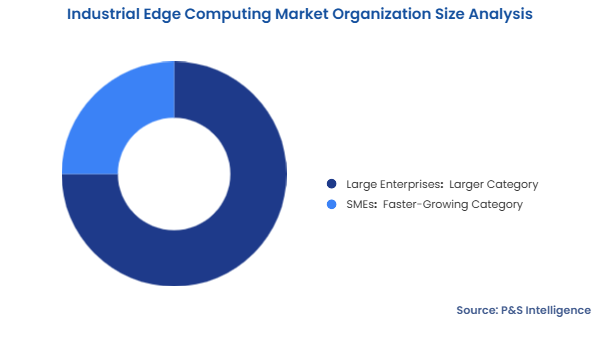
The large enterprises category holds the largest market share, of 75%, in 2025, driven by capital availability, complex multi-site operations, and established digital transformation programs. These organizations operate globally distributed facilities that require real-time processing, enhanced cybersecurity, and seamless connectivity across production environments, while their financial capacity, existing hybrid-cloud environments, dedicated engineering teams, and long-term digitalization strategies enable large-scale deployment and accelerate adoption of advanced edge computing infrastructure across manufacturing operations.
The SMEs category will have the highest CAGR, driven by Managed Edge-as-a-Service models that reduce upfront infrastructure investments by shifting capital expenditure to predictable operating costs. Subscription-based deployment models, simplified edge management, and cloud-native orchestration are making industrial edge computing increasingly accessible to manufacturers with limited IT resources. In November 2025, Siemens introduced the SMB Production Optimization Starter Pack, integrating Industrial Edge Management Cloud and Industrial Edge Virtual Device solutions to help small and medium-sized manufacturers accelerate digital transformation and production optimization.
The organization sizes analyzed in this report are:
Large Enterprises (Larger Category)
SMEs (Faster-Growing Category)
End User Analysis
The manufacturing category holds the largest market share, in 2025, driven by high automation and operational data generation. Digital twin applications, predictive maintenance, machine vision inspection, and industrial robotics are most extensively deployed within manufacturing, where industrial edge computing enables real-time analytics, reduces unplanned downtime, improves overall equipment effectiveness, and enhances production efficiency. According to the United Nations Industrial Development Organization (UNIDO), global manufacturing output increased by 0.70% quarter over quarter in Q3 2025, reflecting continued expansion in industrial production and reinforcing demand for advanced digital manufacturing technologies, while the widespread adoption of Industry 4.0 technologies and industrial automation continues to reinforce manufacturing's position as the leading end-user segment.
The transportation and logistics category will have the highest CAGR, of approximately 14.6%, driven by demand for real-time fleet monitoring, warehouse automation, and edge-enabled routing across geographically dispersed operations. Autonomous mobile robots, private 5G-connected facilities, and latency-sensitive tracking applications are accelerating adoption, as localized processing enables faster operational decision-making, improved supply chain visibility, and uninterrupted operations even in low-connectivity environments.
The end users analyzed in this report are:
Manufacturing (Largest Category)
Transportation and Logistics (Fastest-Growing Category)
Oil and Gas
Energy and Utilities
Mining and Metals
Automotive
Pharmaceuticals
Food and Beverage
Aerospace and Defense
Others
Drive strategic growth with comprehensive market analysis
Industrial Edge Computing Market Regional Outlook
North America Industrial Edge Computing Market Size
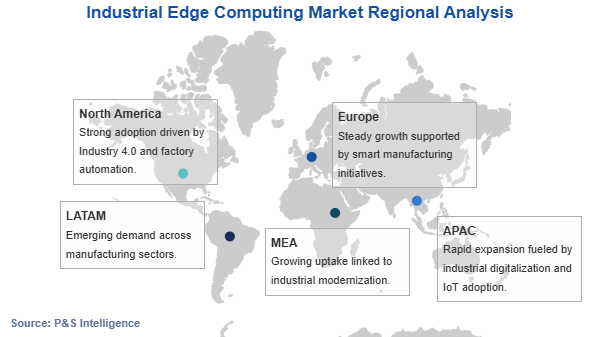
North America holds the largest market share, of 40%, in 2025, driven by early private 5G adoption, advanced manufacturing, and industrial digitalization. The region's deep hyperscaler presence enables factories to extend cloud-native toolchains onto production floors, while multinational operators validate open architectures blending legacy control systems with containerized microservices.
Additionally, the momentum is now shifting from flagship pilots toward mid-sized plants modernizing brownfield lines, extending the market beyond early adopters. Federal advanced-manufacturing initiatives and reshoring incentives are expected to sustain North America's lead, while the United States dominates regional revenue. According to the International Federation of Robotics (IFR), manufacturers in the United States installed 34,200 industrial robots in 2024. These installations accounted for 68% of all industrial robot installations across the Americas, accelerating the deployment of connected production environments that increasingly rely on edge computing for real-time analytics, machine vision, and deterministic control.
Asia-Pacific will have the highest CAGR, of approximately 15.0%, driven by greenfield industrial development, expanding 5G deployment, and growing industrial IoT adoption. National industrial strategies, including China's Made in China 2025 and Japan's Society 5.0 vision, continue to accelerate investment in intelligent manufacturing, industrial AI, and digital transformation. Industrial expansion provides a powerful tailwind. According to the National Bureau of Statistics of China (NBS), the value added of industrial enterprises above designated size increased by 5.8% in 2024, while high-tech manufacturing grew by 8.9%, reflecting the rapid expansion of advanced manufacturing sectors that increasingly require industrial edge computing for real-time analytics, intelligent automation, and low-latency operational control.
The region's extensive base of new and rapidly modernizing manufacturing facilities enables edge computing to be integrated during plant design, reducing the need for costly retrofits that often constrain adoption in more mature industrial markets. The region's manufacturing scale positions Asia Pacific as the global hub for industrial edge innovation, backed by government digitalization initiatives and a growing base of domestic edge technology providers. This trajectory is expected to strengthen throughout the forecast period as investment in automotive, semiconductor, electronics, and other high-value manufacturing industries continues to expand.
India Industrial Edge Computing Market Size
India is the fastest-growing country market in Asia Pacific, driven by expanding manufacturing investment, national digitalization initiatives, and rising automation across greenfield industrial facilities. Government-backed programs promoting domestic manufacturing and smart-factory adoption are accelerating deployment of edge infrastructure, particularly as electronics, automotive, and pharmaceutical producers modernize operations.
India's growing base of IoT-connected assets and improving 5G connectivity create strong demand for localized, low-latency processing. According to the Ministry of Electronics and Information Technology (MeitY), the Modified Electronics Manufacturing Clusters (EMC 2.0) Scheme has approved 11 Electronics Manufacturing Cluster projects and two Common Facility Centre projects across 10 states, with projected investments of INR 1,46,846 crore. These projects strengthen India's electronics manufacturing ecosystem and accelerate demand for industrial edge computing infrastructure, supporting broader adoption across automotive, semiconductor, electronics, pharmaceuticals, and other high-value manufacturing industries. Favorable industrial policies and a growing engineering talent pool position the country as a key long-term growth engine for the Asia Pacific market.
Europe Industrial Edge Computing Market Size
Europe represents a mature yet expanding industrial edge computing market, driven by a deep manufacturing base and stringent data sovereignty requirements, while coordinated digital transformation initiatives such as Horizon Europe and the EU Data Act sustain demand. Manufacturers across the automotive, machinery, chemicals, and industrial equipment sectors increasingly deploy edge computing to support real-time analytics, AI-enabled automation, predictive maintenance, and secure local data processing while complying with GDPR requirements. The region's emphasis on open, interoperable architectures continues to accelerate adoption of cloud-native and Kubernetes-based edge platforms across industrial facilities.
Germany remains the largest country market, driven by its extensive manufacturing sector. According to the German Federal Statistical Office (Destatis), manufacturing accounted for 19.9% of Germany's gross value added in 2024, compared with the EU average of 15.9%, reinforcing the country's leadership in industrial digitalization. France is the fastest-growing country market. Industrial modernization initiatives and rising investment in smart manufacturing position Europe for long-term growth, even as legacy production facilities modernize gradually.
The regions and countries analysed in this report are:
North America (Largest Regional Market)
U.S. (Larger and Faster-Growing Country)
Canada
Europe
Germany (Largest Country)
U.K.
France (Fastest-Growing Country)
Italy
Spain
Rest of Europe
Asia-Pacific (Fastest-Growing Regional Market)
China (Largest Country)
India (Fastest-Growing Country)
Japan
South Korea
Australia
Rest of APAC
Latin America
Brazil (Largest and Fastest-Growing Country)
Mexico
Rest of LATAM
Middle East and Africa
Saudi Arabia (Largest Country)
U.A.E. (Fastest-Growing Country)
South Africa
Rest of MEA
Industrial Edge Computing Market Share Analysis
The market is fragmented because no single vendor offers a complete portfolio spanning industrial hardware, edge software, cloud orchestration, networking, cybersecurity, and systems integration. The market consists of industrial automation providers, hyperscale cloud companies, enterprise IT vendors, networking specialists, and industrial computing manufacturers, each bringing distinct technological strengths and serving a different layer of the edge ecosystem. Key participants, including Siemens AG, Schneider Electric SE, ABB Ltd., Amazon Web Services, Inc., Microsoft Corporation, Cisco Systems, Inc., and Hewlett Packard Enterprise Development LP, compete by leveraging their expertise across automation, cloud computing, networking, and industrial infrastructure. The complexity of integrating operational technology (OT) with information technology (IT), together with diverse industry-specific requirements, enables specialized vendors to maintain competitive positions across manufacturing, energy, logistics, and process industries. Enterprises increasingly prefer open, interoperable, and Kubernetes-native edge platforms over proprietary ecosystems, encouraging multi-vendor deployments, strategic collaborations, and greater solution interoperability across industrial environments.
Leading Companies in the Industrial Edge Computing Market:
Siemens AG
Schneider Electric SE
ABB Ltd.
Rockwell Automation, Inc.
Honeywell Technologies Inc.
Cisco Systems, Inc.
Dell Technologies Inc.
Hewlett Packard Enterprise Development LP
Advantech Co., Ltd.
Emerson Electric Co.
GE Vernova Inc.
Huawei Technologies Co., Ltd.
Amazon Web Services, Inc.
Intel Corporation
Microsoft Corporation
Industrial Edge Computing Market News
In February 2026, Schneider Electric SE launched EcoStruxure Foxboro Software Defined Automation (SDA), the industry's first open, software-defined distributed control system (DCS), enabling flexible, cybersecure modernization of industrial automation.
In July 2025, Advantech Co., Ltd. launched the AMAX IoT Control Platform, a software-defined, PC-based platform integrating PLC, HMI, and IoT functions to simplify industrial automation and edge computing deployments.
In May 2025, Hewlett Packard Enterprise Development LP expanded its NVIDIA AI Computing by HPE portfolio, enhancing HPE Private Cloud AI and introducing NVIDIA-powered AI servers for edge and enterprise computing workloads.
In April 2025, Rockwell Automation, Inc. and Amazon Web Services, Inc. announced a collaboration to accelerate manufacturing digital transformation, expanding Rockwell's FactoryTalk Hub, DataMosaix industrial DataOps, and Fiix CMMS onto AWS Marketplace. The partnership advances edge-to-cloud connectivity and AI-driven insights across life sciences, automotive, and consumer-goods manufacturing.
Frequently Asked Questions About This Report
What does the industrial edge computing market include for organizations?+
It includes computing systems placed near machines, sensors, and industrial processes to process data close to operations.
What factors are driving demand in the industrial edge computing market?+
Demand is driven by factory automation, low latency needs, connected equipment, predictive maintenance, and limited reliance on distant clouds.
Why are organizations adopting industrial edge computing solutions across operations?+
Industrial firms adopt edge computing to analyze machine data faster, support local control, and keep operations running during connectivity issues.
How do industrial edge computing solutions improve decision making and efficiency?+
These solutions improve operations by enabling quick decisions, reducing data transfer, supporting safety systems, and improving equipment visibility.
What are the major challenges affecting the growth of the industrial edge computing market?+
Adoption is challenged by cybersecurity risks, interoperability issues, legacy system integration, remote management complexity, and rugged hardware requirements.
Want a report tailored exactly to your business need?
Leading companies across industries trust us to deliver data-driven insights and innovative solutions for their most critical decisions. From data-driven strategies to actionable insights, we empower the decision-makers who shape industries and define the future. From Fortune 500 companies to innovative startups, we are proud to partner with organisations that drive progress in their industries.
Client Testimonials
Working with P&S Intelligence and their team was an absolute pleasure – their awareness of timelines and commitment to value greatly contributed to our project's success. Eagerly anticipating future collaborations.
McKinsey & Company
India
Unmatched Standards
Our insights into the minutest levels of the markets, including the latest trends and competitive landscape, give you all the answers you need to take your business to new heights
Complete Data Security
We take a cautious approach to protecting your personal and confidential information. Trust is the strongest bond that connects us and our clients, and trust we build by complying with all international and domestic data protection and privacy laws