Edge AI Market Size & Share Analysis - Trends, Drivers, Competitive Landscape, and Forecasts (2026 - 2032)
This Report Provides In-Depth Analysis of the Edge AI Market Report Prepared by P&S Intelligence, Segmented by Component (Hardware, Software, Services), Function (Training, Inference), Application (Video Surveillance, Remote Monitoring, Predictive Maintenance), End Use (Manufacturing, Consumer Electronics, Healthcare, BFSI, Government, Retail & E-Commerce, Telecommunications, Transportation & Logistics), and Geographical Outlook for the Period of 2021 to 2032
Explore the market potential with our data-driven report
Edge AI Market Future Outlook
Edge AI Market Key Insights
The hardware category accounted for the largest share, of 60%, in 2025.
The training category has the higher CAGR, of 25.6%, during 2026–2032.
The video surveillance category commanded the largest share, of 35%, in 2025.
The manufacturing category has the highest CAGR, of 25.9%, during 2026–2032.
North America held the largest share, of 45%, in 2025.
Asia-Pacific is projected to register the highest CAGR, of 26.5%, through 2032.
Edge AI Market Future Outlook
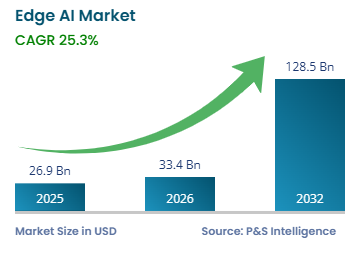
The global edge AI market stood at USD 26.9 billion in 2025 and is projected to reach approximately USD 128.5 billion by 2032, expanding at a compound annual growth rate of 25.3% over 2026–2032.
The accelerating deployment of IoT-connected devices is broadening the addressable base for edge AI hardware and software. Rapid advances in low-power AI processors and neural network acceleration units have made real-time, low-latency inference commercially viable across video surveillance, predictive maintenance, and computer vision applications. By moving computation from centralized cloud infrastructure to the point of data generation, edge AI enables time-critical decision-making, reduces bandwidth dependency, and strengthens data privacy. The ability to compute within a smartphone, surveillance camera, edge server, or industrial robot makes it a foundational layer of next-generation digital infrastructure.
The proliferation of 5G networks has materially strengthened the market's deployment trajectory. Enterprise and service provider investments in hardware, software, and managed services are driving edge computing adoption across sectors. According to the International Telecommunication Union (ITU), edge AI technologies are increasingly critical for managing urban infrastructure and enabling real-time public safety analytics across global smart city projects.
Edge AI Market Emerging Trends & Growth Drivers
On-Device AI Model Optimization Is Major Trend
A decisive shift in AI model architecture and deployment philosophy is reshaping how intelligence is embedded within edge devices. Historically, AI workloads were designed for data center-scale compute and were ill-suited to the power, memory, and thermal constraints of edge hardware. The emergence of model compression techniques including quantization, pruning, and knowledge distillation, alongside purpose-built neural processing units (NPUs) and AI accelerators, has fundamentally changed this calculus. Manufacturers including Qualcomm, Apple, and NVIDIA have embedded dedicated AI silicon into edge hardware spanning smartphones, automotive systems, and industrial controllers, enabling complex inference workloads to execute efficiently without cloud dependency.
This trend is compressing the performance gap between edge and cloud inference, expanding the range of applications viable at the edge to include computer vision, speech and NLP, and real-time predictive analytics. 5G combined with edge AI is enabling new categories of smart city and industrial automation applications that were not previously feasible. As model efficiency continues improving, edge AI will progressively displace cloud AI in latency-sensitive, data-privacy-critical, and bandwidth-constrained deployment scenarios.
IoT Proliferation and Real-Time Processing Demands Drive Market
The exponential expansion of IoT-connected devices has fundamentally altered the computational requirements of enterprise and consumer technology infrastructure. Connected endpoints now span manufacturing floors, transportation networks, healthcare monitoring systems, and smart city infrastructure, and the volume of data generated at the network periphery has outpaced the bandwidth and latency tolerance of centralized cloud processing models. Edge AI resolves this constraint by executing AI inference locally on the device or a nearby server enabling sub-millisecond decision cycles that cloud-dependent architectures cannot deliver.
As 5G network deployment extends high-bandwidth, low-latency connectivity to previously underserved geographies and industrial environments, the viable surface for edge AI deployment expands correspondingly. Projections indicate that global edge computing AI chip shipments will reach 1.6 billion units by 2026, reinforcing sustained hardware demand. Autonomous systems, industrial robotics, and connected vehicle deployments are creating new categories of latency-sensitive workloads that structurally require localized AI inference, and this driver is expected to intensify through the forecast period.
Deployment in Underconnected Industrial Environments Offers Opportunities
A substantial addressable expansion exists in industrial and operational environments where persistent, high-quality internet connectivity cannot be guaranteed. Remote mining operations, offshore energy platforms, agricultural deployments, and manufacturing facilities in emerging economies generate continuous streams of sensor, visual, and operational data requiring real-time analysis for safety monitoring, equipment diagnostics, and quality assurance. Cloud-based AI remains infeasible in these environments due to unreliable or cost-prohibitive connectivity.
Edge AI systems operating in standalone or intermittently connected modes directly address this gap, enabling full AI functionality without cloud dependency. The manufacturing, government, and utilities sectors in APAC host substantial underconnected operational infrastructure. As edge AI hardware becomes more energy-efficient and cost-competitive, deployment economics improve for resource-constrained industrial environments in Latin America, MEA, and South and Southeast Asia, where operational connectivity limitations have historically prevented cloud AI adoption. The global IoT in manufacturing market stood at USD 87.9 billion in 2024 and is projected to reach USD 194.9 billion by 2030.
High Infrastructure Costs and Integration Complexity Constrain Market Growth
The high upfront capital requirements associated with deploying edge AI infrastructure represent a barrier to adoption, particularly among small and medium-sized enterprises and organizations in emerging markets. Cloud-based AI operates on a pay-as-you-go model requiring minimal initial investment. Edge AI deployment, by contrast, demands procurement of purpose-built hardware alongside expenditure on system integration, software configuration, and workforce training. AI-optimized processors, edge servers, and ruggedized endpoint devices each carry substantial unit costs, and their combined procurement creates adoption friction that delays deployment timelines and narrows the addressable market in cost-sensitive segments.
NIST highlights integration complexity as a key implementation challenge for AI systems at the edge, noting that deploying AI across heterogeneous device environments requires technical expertise that many organizations lack internally. Ongoing operational costs including hardware maintenance, model retraining, and security patching across distributed edge nodes compound the total cost of ownership beyond initial deployment. Declining semiconductor prices and the emergence of managed edge AI service models are gradually lowering these barriers, though cost and complexity constraints will continue limiting adoption among resource-constrained organizations.
Edge AI Market Segmentation Analysis
Component Analysis
The hardware category accounted for the largest share, of 60%, in the global edge AI market in 2025. Purpose-built physical infrastructure at the point of data generation is a fundamental requirement of edge AI deployment. Unlike software, which operates on existing devices, hardware creates the compute substrate upon which edge AI execution depends. Smartphones embedding NPUs, surveillance cameras with onboard inference chips, industrial robots, edge servers, and automotive systems with dedicated AI processors each represent high-unit-cost procurement categories, and concentrated demand from consumer electronics, automotive, and industrial manufacturing end-uses sustains hardware's dominant position.
The software category is expected to register the highest CAGR, during 2026–2032. Enterprise demand for AI model deployment frameworks, edge-native analytics platforms, and hardware-agnostic runtime environments that decouple intelligence from specific device configurations is driving this trajectory. As model compression and on-device optimization mature, software becomes the primary competitive differentiator for edge AI solution providers. This growth is further supported by the increasing adoption of AI across public-sector operations, with over 1,200 AI use cases identified across U.S. federal agencies by the U.S. Government Accountability Office, highlighting the growing need for scalable AI deployment and management software platforms.
The market segments into the following components:
Hardware (Largest Category)
Smartphones
Surveillance Cameras
Robots
Wearables
Edge Servers
Smart Speakers
Automotive Systems
Smart Mirrors
Others
Software (Fastest-Growing Category)
By Type
Standalone
Integrated
By Deployment
Cloud
On-Premises
Services
Professional
Consulting
Deployment and Integration
Support and Maintenance
Managed
Function Analysis
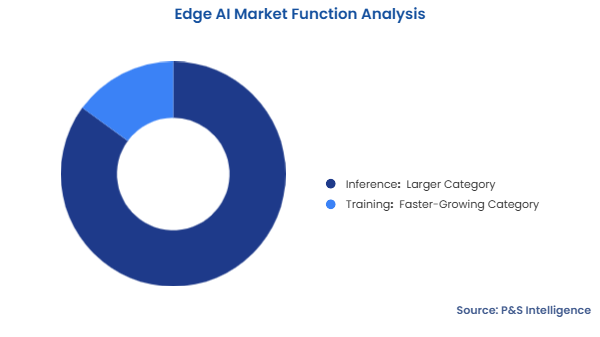
The inference category held the larger share, of 85%, in the global edge AI market in 2025. Inference—the real-time application of trained AI models to new data at the device level represents the operational core of edge AI, encompassing video analytics, voice recognition, object detection, and predictive diagnostics executing continuously on deployed devices.
Unlike training, which is compute-intensive and typically performed centrally or in the cloud, inference must occur with minimal latency at the edge to deliver value in time-sensitive applications. The volume of inference workloads scales directly with the number of deployed edge devices, and as IoT endpoint proliferation accelerates, inference demand grows proportionally.
The training category is expected to register the higher CAGR, during 2026–2032. Federated learning architectures and advances in on-device training capabilities enable AI models to update and adapt locally using real-world operational data without transmitting sensitive information to central servers. Distributed AI training at the edge is an emerging priority for privacy-preserving AI deployments in healthcare, defense, and financial services applications globally.
The market segments into the following functions:
Inference (Larger Category)
Training (Faster-Growing Category)
Application Analysis
The video surveillance category commanded the largest share, of 35%, in the global edge AI market in 2025. Pervasive deployment of AI-enabled cameras across public safety, retail loss prevention, industrial monitoring, and smart city infrastructure underpins this position. Edge AI enables surveillance systems to perform real-time object detection, facial analysis, anomaly identification, and behavioral analytics locally on the camera itself, eliminating the latency and bandwidth costs of cloud-dependent video streaming at scale. Hundreds of millions of connected cameras deployed globally create a structurally large installed base for edge AI inference workloads. The global video surveillance market stood at USD 58.5 billion in 2024 and is projected to reach USD 99.7 billion by 2030.
The computer vision category is anticipated to register the highest CAGR, during 2026–2032. Expanding adoption across manufacturing quality control, autonomous systems, medical imaging, and retail analytics is driving this trajectory, as these applications require real-time image and object recognition beyond traditional surveillance use cases.
The market segments into the following applications:
Video Surveillance (Largest Category)
Remote Monitoring
Predictive Maintenance
Computer Vision (Fastest-Growing Category)
Speech & NLP
Others
End Use Analysis
The consumer electronics category accounted for the largest share, of 25%, in the global edge AI market in 2025. A massive installed base of AI-enabled smartphones, smart speakers, and wearables embedding NPUs to execute voice recognition, personalized recommendations, real-time image processing, and health monitoring locally on device underpins this position. The scale of consumer device shipments generates structurally high volumes of edge AI hardware and software deployment. Global smartphone shipments exceed 1.2 billion units annually. Consumer electronics manufacturers have invested substantially in proprietary AI silicon, with Apple's Neural Engine, Qualcomm's Snapdragon AI cores, and Google's Tensor chips embedding dedicated inference accelerators across successive device generations.
The manufacturing category is projected to register the highest CAGR, during 2026–2032. Industry 4.0 adoption is mandating real-time monitoring, predictive maintenance, and autonomous quality inspection on factory floors where cloud connectivity constraints and latency requirements make edge AI the only viable deployment architecture. The global industrial control and factory automation market stood at USD 166.1 billion in 2024 and is projected to reach USD 339.5 billion by 2032, with Asia-Pacific the largest and fastest-growing region.
The market segments into the following end uses:
Consumer Electronics (Largest Category)
Manufacturing (Fastest-Growing Category)
Healthcare
BFSI
Government
Retail & E-Commerce
Telecommunications
Transportation & Logistics
Others
Drive strategic growth with comprehensive market analysis
Edge AI Market Geographical Analysis
North America Edge AI Market Outlook
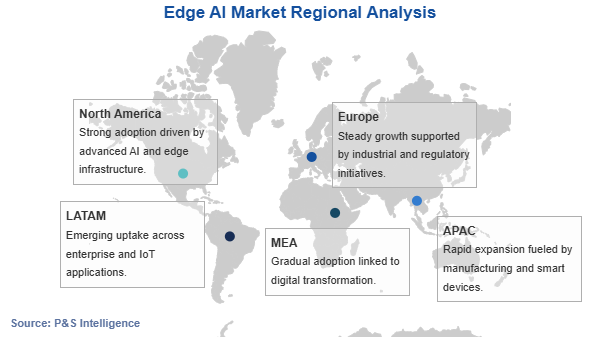
North America held the largest share, of 45%, in the global edge AI market in 2025. Early technology adoption, mature cloud-edge integration ecosystems, and a dense concentration of edge AI developers and semiconductor innovators collectively underpin this position. Continued semiconductor investment, expanding 5G-edge integration across telecom verticals, and growing federal demand for localized AI inference in defense and public safety applications are sustaining market momentum.
The Department of Commerce has announced USD 33.0787 billion in grant awards and up to USD 7.15 billion in loans to companies across semiconductor projects. The U.S. Department of Commerce has announced funding under the CHIPS Program. Enterprises across healthcare, defense, manufacturing, and smart infrastructure have accelerated adoption of edge AI platforms where cloud connectivity cannot be guaranteed in mission-critical environments.
U.S. Edge AI Market Growth
The U.S. is the largest country market within North America. A deeply embedded technology ecosystem encompassing leading semiconductor manufacturers and cloud-edge platform providers gives the market the infrastructure and developer reach to accelerate commercial deployment. NVIDIA, Intel, Qualcomm, AMD, Microsoft, Google, and AWS are all headquartered in the U.S., concentrating the dominant share of global edge AI hardware and platform development within a single national market.
Federal AI adoption across government agencies and private enterprise investment in IoT and industrial automation are driving edge AI deployment across transportation, healthcare, and manufacturing. 5G network expansion has broadened the viable deployment surface for edge inference workloads at scale. The U.S. recorded approximately 259 million 5G-enabled devices in 2024. Sustained R&D investment and growing adoption of edge AI in autonomous systems and smart city infrastructure are reinforcing this trajectory.
Europe Edge AI Market Analysis
Europe's edge AI market is shaped by a strong regulatory environment and significant public research funding. The European Union's EU AI Act has established transparency and safety requirements for AI systems deployed at the edge, standardizing compliance obligations across member state deployments. Germany's industrial base deploys edge AI for real-time quality control, predictive maintenance, and Industry 4.0 automation across its manufacturing sector. The U.K. is recording adoption in fintech, healthcare AI, and smart infrastructure.
European manufacturers and automotive OEMs are integrating edge AI hardware into embedded systems across automotive and industrial robotics applications. Sustained automotive and industrial sector demand in Germany, France, and Italy provides the structural foundation for continued market expansion through the forecast period.
Asia-Pacific Edge AI Market Forecast
Asia-Pacific is projected to register the highest CAGR, of 26.5%, through 2032. Government-mandated IoT programs, aggressive 5G infrastructure rollouts, and large-scale industrial digitization across China, India, Japan, and South Korea are driving this trajectory. Central government mandates for AI integration in smart factories, logistics hubs, and smart city infrastructure are accelerating China's market formation. A domestic AI chip manufacturing ecosystem enables cost-competitive edge hardware deployment at scale.
India's Smart City Mission, Digital India program, and rapid expansion of 5G-enabled edge analytics deployments are propelling adoption across the subcontinent. As China's industrial AI mandates scale and India's digital infrastructure investments yield accelerating commercial deployment, Asia-Pacific is consolidating its position as the most strategically important growth region for edge AI.
China Edge AI Market Scenario
The push toward smart manufacturing is a primary growth driver in China's edge AI market, where edge AI enables real-time monitoring, predictive maintenance, and automation across production lines. Widespread 5G deployment is accelerating adoption by supporting low-latency data processing for autonomous systems and smart city applications. The rapid growth of IoT devices across industries and urban environments is increasing demand for on-device intelligence. Rising concerns around data privacy and sovereignty are encouraging localized data processing over cloud dependence, reinforcing edge AI's structural role in China's technology landscape.
India Edge AI Market Trends
India is the fastest-growing country market within Asia-Pacific for edge AI. Government-backed digitization programs, rapid 5G network rollout, and growing demand for real-time analytics in manufacturing, agriculture, public safety, and financial services are converging to drive adoption. The Smart City Mission and Digital India Program are deploying IoT-connected systems across transportation, lighting, and urban infrastructure that require localized AI processing. The National Strategy for Artificial Intelligence supports enterprise adoption by providing policy frameworks that reduce regulatory uncertainty for edge AI deployments. As 5G coverage expands into Tier 2 and Tier 3 cities, new deployment surfaces for edge inference are opening across rural connectivity, digital payments, and precision agriculture.
The regions and countries analyzed in this report include:
North America (Largest Region)
U.S. (Largest Country Market)
Canada (Fastest-Growing Country Market)
Europe
Germany (Largest Country Market)
U.K.
France (Fastest-Growing Country Market)
Italy
Spain
Rest of Europe
Asia-Pacific (Fastest-Growing Region)
China (Largest Country Market)
India (Fastest-Growing Country Market)
Japan
South Korea
Australia
Rest of APAC
Latin America
Brazil (Largest Country Market)
Mexico (Fastest-Growing Country Market)
Rest of LATAM
Middle East & Africa
Saudi Arabia
South Africa (Fastest-Growing Country Market)
U.A.E. (Largest Country Market)
Rest of MEA
Edge AI Market Share Analysis
The global edge AI market exhibits a moderately fragmented competitive structure, with large diversified technology platforms coexisting alongside a growing cohort of specialized hardware and software providers. The market spans hardware silicon, software frameworks, managed services, and end-use-specific applications, creating distinct competitive arenas within the broader market rather than a single consolidated landscape.
The diversity of hardware form factors, deployment environments, and application requirements across industries prevents any single player from commanding dominant share across all dimensions. Consumer electronics, healthcare, manufacturing, and BFSI each carry distinct operational requirements that preclude uniform platform dominance. Entry barriers remain elevated in hardware, where chip design, fabrication relationships, and power efficiency expertise require sustained R&D investment, but are comparatively lower in software and services layers. Lower software entry barriers enable continuous new entrant activity and sustain fragmentation at the overall market level.
Competitive intensity is expected to increase as model efficiency improvements reduce hardware differentiation advantages and software and services emerge as the primary battleground for competitive positioning. Leading players are actively expanding their stack coverage through partnerships and acquisitions to defend positions across hardware, software, and managed service layers.
Key Players in the Edge AI Market:
NVIDIA Corporation
Intel Corporation
Qualcomm Incorporated
Microsoft Corporation
Alphabet Inc.
Amazon.com Inc.
Apple Inc.
International Business Machines Corporation
Huawei Technologies Co. Ltd.
Advanced Micro Devices Inc.
Hailo Technologies Ltd.
Synaptics Incorporated
Samsung Electronics Co. Ltd.
Arm Holdings plc
MediaTek Inc.
Micron Technology Inc.
Cisco Systems Inc.
Dell Technologies Inc.
Hewlett Packard Enterprise Company
Tata Consultancy Services Limited
Infosys Limited
HCL Technologies Limited
Tech Mahindra Limited
STMicroelectronics N.V.
NXP Semiconductors N.V.
Infineon Technologies AG
Analog Devices Inc.
Texas Instruments Incorporated
Renesas Electronics Corporation
Microchip Technology Incorporated
onsemi
Edge AI Market News & Updates
In October 2025, Qualcomm Technologies Inc. acquired Arduino, an open-source hardware and software platform with over 33 million registered developers. The acquisition integrates Arduino with Qualcomm's earlier acquisitions of Edge Impulse and Foundries.io, assembling a full-stack edge AI platform spanning silicon, software development, and community ecosystem targeting IoT and industrial deployment at scale.
In August 2025, NVIDIA Corporation released the Jetson AGX Thor, its next-generation edge AI computing module featuring a Blackwell GPU capable of 2,070 FP4 TFLOPS and 128 GiB memory. The module delivers approximately 7.5 times greater computing performance and 3.5 times the energy efficiency of the prior Jetson AGX Orin generation, targeting robotics, autonomous systems, and industrial edge AI deployments.
In March 2025, Qualcomm Technologies Inc. acquired Edge Impulse Inc., an edge AI development platform with over 250,000 developers enabling low-code machine learning model building and deployment across IoT and embedded devices. The acquisition expanded Qualcomm's Dragonwing edge portfolio into software tooling and developer ecosystem capabilities to accelerate enterprise edge AI adoption.
In March 2025, IBM and NVIDIA Corporation expanded their collaboration to accelerate enterprise AI deployment by integrating NVIDIA AI infrastructure with IBM’s watsonx platform, enabling hybrid cloud and on-premises AI solutions with enhanced data management, performance, and governance capabilities.
In February 2025, Arm Holdings plc introduced the Armv9 Edge AI Platform, featuring the Cortex-A320 processor delivering 10 times faster machine learning performance and the Ethos-U85 NPU achieving up to 4 TOPs at 1 GHz. The platform targets energy-efficient AI inference across IoT devices, wearables, and connected industrial endpoints.
In December 2024, NVIDIA Corporation announced the Jetson Orin Nano Super, an upgraded edge AI module delivering higher AI performance at a reduced developer kit price of USD 249. The lower price point reduces the cost barrier for developers deploying generative AI models on small edge devices across robotics, smart cameras, and industrial automation applications.
Frequently Asked Questions About This Report
What will be the edge AI market 2032 size?+
In 2032, the market for edge AI will value USD 128.5 billion.
Which component leads the edge AI industry?+
Hardware dominates the edge AI industry with 60% revenue.
Which is the largest region in the edge AI market?+
North America is the largest market for edge AI, with 45% share.
What are the key edge AI industry drivers?+
The global edge AI industry is driven by rapid proliferation of IoT devices, growing demand for real-time data processing with low latency, increasing adoption of smart manufacturing and automation, expansion of 5G networks, and rising concerns around data privacy that favor on-device intelligence over cloud-based processing.
What is the edge AI market nature?+
The market for edge AI is moderately fragmented.
Want a report tailored exactly to your business need?
Leading companies across industries trust us to deliver data-driven insights and innovative solutions for their most critical decisions. From data-driven strategies to actionable insights, we empower the decision-makers who shape industries and define the future. From Fortune 500 companies to innovative startups, we are proud to partner with organisations that drive progress in their industries.
Client Testimonials
Working with P&S Intelligence and their team was an absolute pleasure – their awareness of timelines and commitment to value greatly contributed to our project's success. Eagerly anticipating future collaborations.
McKinsey & Company
India
Unmatched Standards
Our insights into the minutest levels of the markets, including the latest trends and competitive landscape, give you all the answers you need to take your business to new heights
Complete Data Security
We take a cautious approach to protecting your personal and confidential information. Trust is the strongest bond that connects us and our clients, and trust we build by complying with all international and domestic data protection and privacy laws