Medical Equipment Maintenance Market Outlook (2027 - 2033)
This Report Provides In-Depth Analysis of the Medical Equipment Maintenance Market Report Prepared by P&S Intelligence, Segmented by Equipment type (Diagnostic imaging equipment, Patient monitoring and life support equipment, Surgical equipment, Electromedical and laboratory equipment, Other equipment), Service provider (Original equipment manufacturers, Independent service organizations, In-house maintenance), and Geographical Outlook for the Period of 2022 to 2033
Explore the market potential with our data-driven report
Medical Equipment Maintenance Market Outlook
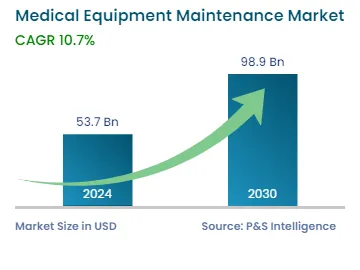
The global medical equipment maintenance market is valued at USD 65.81 billion in 2026 and is projected to reach USD 72.85 billion in 2027. The market is projected to reach USD 134.06 billion by 2033, growing at a CAGR of 10.70% during 2027-2033. Hospitals and clinical engineering departments are directing a growing share of their capital and operating budgets toward keeping imaging systems, monitors, and life support devices certified and running, rather than risking downtime on equipment that costs millions of dollars to replace.
Hospitals renewing MRI and CT service contracts represent one of the largest recurring spend categories in the medical equipment maintenance market, since a comprehensive scanner agreement commands a premium annual fee and comes bundled with guaranteed uptime. The Joint Commission's Environment of Care Standard EC.02.04.03 requires accredited U.S. hospitals to document on-time completion of scheduled preventive maintenance for applicable life support devices, a mandate that converts routine servicing into a compliance obligation rather than a discretionary purchase. This regulatory pressure, combined with aging imaging fleets, keeps multi-year service contracts the preferred purchasing format over one-off repairs.
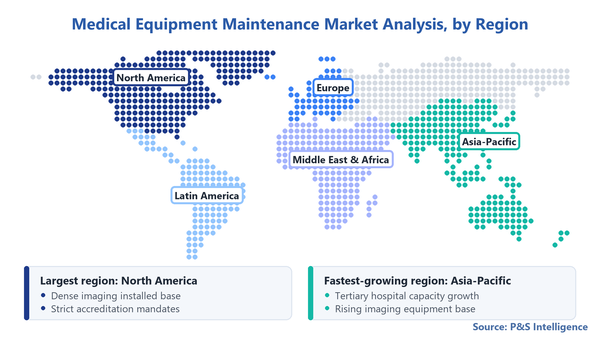
North America accounted for 39.5% of the medical equipment maintenance market in 2026, led by the United States and its dense installed base of diagnostic imaging equipment and strict accreditation requirements. Asia-Pacific is on track to outpace every other region, expanding at 12.60% CAGR during 2027-2033, as China and India expand tertiary hospital capacity and bring thousands of newly installed CT and MRI systems under formal maintenance contracts.
Key market insights
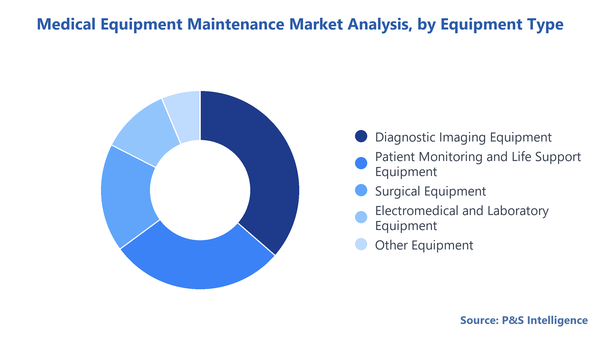
By equipment type, diagnostic imaging equipment held 36.4% in 2026, while patient monitoring and life support equipment is projected to grow at an 11.50% CAGR during 2027-2033. By service provider, original equipment manufacturers held 62.5% in 2026, while independent service organizations are projected to grow at a 12.20% CAGR during 2027-2033. By geography, North America held 39.5% in 2026, while Asia-Pacific is projected to grow at a 12.60% CAGR during 2027-2033.
Medical Equipment Maintenance Market Growth Drivers & Challenges
Connected monitoring platforms are reshaping how service contracts are priced
Imaging and monitoring vendors are moving from fixed annual service fees toward usage-linked contracts tied to telemetry data streamed off the equipment itself. Remote diagnostics let a technician diagnose a fault before a hospital engineer notices a problem, so OEMs are bundling predictive alerts into contracts that previously only covered scheduled visits. GE HealthCare markets its OnWatch predictive remote service and Siemens Healthineers runs its Guardian Program on this same logic, and both platforms are positioned to support a shift toward usage-linked pricing alongside the conventional flat labor-and-parts fee.
This shift raises the entry cost for independent service organizations that lack telemetry access to OEM equipment, since a hospital comparing a predictive OEM contract against a conventional ISO quote increasingly weighs avoided downtime, not just price per visit. Hospitals that adopt connected monitoring are also generating the usage data that lets vendors justify multi-year renewals instead of competitive rebids, favoring incumbents with the deepest installed base of connected devices.
Mandatory preventive maintenance compliance is driving contract-based purchasing
Accreditation bodies tie hospital certification to documented, on-time preventive maintenance on life support and diagnostic equipment, turning servicing from a discretionary expense into a condition of operating. The Joint Commission's Environment of Care Standard EC.02.04.03 requires accredited U.S. hospitals to complete 100% of scheduled preventive maintenance activities on applicable life support equipment, including ventilators, defibrillators, and anesthesia machines, according to The Joint Commission.
Hospitals with serious, unresolved maintenance deficiencies risk jeopardizing their accreditation or certification status through the applicable enforcement process, so clinical engineering departments favor annual contracts with guaranteed response times over ad hoc repair calls. This dynamic benefits OEMs and large independent service organizations able to document compliance across thousands of devices, while smaller in-house teams increasingly outsource the paperwork burden alongside the repair work itself.
Right to Repair momentum is opening a lower-cost service channel
Hospitals facing materially higher OEM specialist labor rates than independent technicians charge are pushing lawmakers to widen access to diagnostic software and calibration tools long restricted to OEMs. OEM software diagnostic lockouts and restricted access to calibration tools raise hospital maintenance costs relative to an open-access alternative, a gap wide enough to have drawn bipartisan Congressional support for medical device Right to Repair legislation.
Wider legal access to OEM diagnostic keys would let independent service organizations bid on contracts currently closed to them, expanding the addressable market for ISOs beyond equipment types where generic parts already suffice. Hospital systems with large multi-vendor fleets stand to gain the most negotiating leverage once that access opens, since they can split contracts across OEM and independent providers equipment by equipment.
Certified biomedical technician shortages are constraining service capacity
Growth in the installed base of diagnostic imaging and life support equipment is outpacing the supply of certified biomedical equipment technicians able to service it, lengthening the wait for routine calibration and non-emergency repairs. Hospitals in markets with the tightest technician supply are increasingly forced to prioritize life-critical devices over diagnostic and laboratory equipment when response capacity runs short.
This constraint raises the premium OEMs and large ISOs can charge for guaranteed response times, since a contract with a firm service-level agreement becomes more valuable as the alternative, unscheduled repair queue, grows longer. Service organizations that invest in technician training pipelines are better positioned to win multi-year contracts in capacity-constrained markets, while smaller providers risk losing renewals to vendors that can staff a dedicated response team.
Hospital systems facing the longest technician wait times are also starting to write minimum staffing levels directly into renewal contracts, shifting part of the workforce risk from the buyer onto the service provider, a term that was rarely requested when technician supply was more plentiful. This shift in contract terms is most pronounced among health systems with the largest, most geographically dispersed equipment fleets, where a single missed service window can delay repairs across several facilities at once.
Segmentation Analysis
By equipment type
Diagnostic imaging equipment held 36.4% of the medical equipment maintenance market in 2026. MRI, CT, PET, and ultrasound systems carry the highest per-unit service contract value of any equipment class, since a comprehensive scanner agreement commands a premium annual fee and guaranteed uptime; a high-field MRI scanner's agreement additionally covers cryogen monitoring and coil replacement that other imaging modalities do not require. Hospitals budget for these contracts as a near-fixed operating cost because unplanned imaging downtime directly delays diagnosis and billable procedure volume, and a multi-day outage on a facility's only MRI scanner can force the rescheduling of a full day or more of scans.
The high capital cost of replacing a scanner outright, often running into the millions of dollars, also makes a comprehensive multi-year service contract cheaper over the equipment's working life than piecemeal repairs, which keeps renewal the default choice over a competitive rebid. Hospital finance teams increasingly treat this renewal decision as routine rather than negotiable, locking in multi-year terms well before the prior agreement expires, since reopening the contract to competitive bids risks a coverage gap at the exact moment the equipment is most likely to need a certified technician.
Patient monitoring and life support equipment is on track to outpace every other category, expanding at an 11.50% CAGR during 2027-2033. Ventilators, infusion pumps, and bedside monitors are proliferating across intensive care and step-down units, and accreditation rules requiring documented preventive maintenance on life-critical devices push nearly every unit onto a formal service contract rather than ad hoc repair.
Hospitals expanding critical-care capacity add proportionally more monitoring devices than imaging systems, pulling this category's service base up faster than the market overall. The unit count involved, often dozens of monitors and pumps per intensive care unit, means even a modest per-device fee compounds into a sizeable recurring contract across a hospital's full critical-care footprint, giving providers that can service high device counts efficiently a cost advantage over those billing visit by visit.
Copyright P&S Intelligence. Reuse requires attribution under CC BY 4.0.
By service provider
Original equipment manufacturers held 62.5% of the market in 2026. OEMs may restrict access to certain proprietary diagnostic software and genuine replacement parts, which keeps hospitals that want full-coverage, guaranteed-uptime contracts tied to the equipment manufacturer even where independent alternatives exist. This proprietary access also lets OEMs bundle calibration, software patching, and cybersecurity updates into one renewal rather than separate purchase orders.
Hospitals weighing the cost of a denied warranty claim against a modestly higher OEM premium often conclude that staying with the manufacturer is the lower-risk choice for their newest, highest-value imaging systems. This calculation tends to favor OEMs most heavily in the first years after a scanner's installation, when warranty terms are still in force and switching providers can, depending on the specific contract, void some or all of the remaining coverage.
Independent service organizations are on track to outgrow every other category, advancing at a 12.20% CAGR during 2027-2033. Hospitals managing multi-vendor fleets increasingly consolidate servicing with ISOs that can cover equipment from several manufacturers under one contract at hourly rates well below OEM specialist labor.
Growing legislative support for expanded diagnostic tool access is widening the equipment types ISOs can service without voiding a warranty. Hospital systems that already shifted older, off-warranty imaging equipment to ISOs are now testing the same providers on newer systems as OEM contracts come up for renewal, a pattern that could gradually erode the warranty-period advantage OEMs currently hold across the equipment categories where ISOs have built a credible service track record. Procurement teams at large hospital systems increasingly treat this track record, not brand recognition, as the deciding factor on a multi-vendor service rebid.
The following segments are analyzed in this report.
Equipment type
Diagnostic imaging equipment
Patient monitoring and life support equipment
Surgical equipment
Electromedical and laboratory equipment
Other equipment
Service provider
Original equipment manufacturers
Independent service organizations
In-house maintenance
Regional Analysis
North America medical equipment maintenance market outlook
North America accounted for 39.5% of market share in 2026. The region's dense installed base of advanced imaging systems, built up over decades of capital investment, requires continuous recalibration and software patching to stay within manufacturer-level FDA quality system obligations and hospital-level accreditation requirements alike, and The Joint Commission's accreditation standard makes documented preventive maintenance a condition of hospital certification rather than an optional expense. This accreditation link reinforces hospitals' preference for guaranteed-uptime service contracts over discretionary repair spending, and large health systems increasingly centralize this purchasing decision at the corporate level rather than leaving it to individual facilities.
The United States anchors the region as its largest market, accounting for the bulk of regional revenue in 2026 on the strength of its large base of Joint Commission-accredited hospitals maintaining imaging and life support equipment under formal preventive maintenance programs. Canada's provincial health systems add a smaller but steady base of publicly funded hospital maintenance contracts, with procurement cycles that track provincial capital budgets more closely than private-sector demand.
This position is likely to hold through the forecast period as replacement imaging equipment entering service carries its own multi-year service agreement, keeping the contract base self-renewing even as unit growth moderates. Hospitals consolidating into larger health systems are increasingly centralizing procurement of these contracts, which favors vendors able to service a multi-site fleet under one master agreement.
Asia-Pacific medical equipment maintenance market growth
Asia-Pacific is on track to outpace every other region, expanding at 12.60% CAGR during 2027-2033. Tertiary hospital construction across China and India is adding diagnostic imaging and life support equipment faster than any other region, and national health authorities are formalizing calibration and quality control requirements that push newly installed equipment onto contract-based maintenance rather than informal repair arrangements.
China, the region's fastest-growing market, is bringing a growing share of its tertiary hospital imaging fleet under standardized calibration and quality-control protocols enforced by the National Health Commission of China. Rising hospital accreditation standards elsewhere in the region, including in India and South Korea, are extending similar formal servicing requirements to a broader base of newly commissioned equipment.
Growth is expected to stay installed-base-led rather than replacement-led through 2033, since much of the region's imaging fleet remains within its initial warranty-to-contract transition window. Service providers that establish local technician networks early are better positioned to capture these first-generation contracts before hospitals default to in-house maintenance for cost reasons.
Copyright P&S Intelligence. Reuse requires attribution under CC BY 4.0.
Europe market analysis
Europe contributes a steady, mature share of the global market, underpinned by national health systems that budget equipment servicing as a recurring line item rather than a discretionary cost. Germany, France, and the United Kingdom carry the region's largest hospital imaging fleets, and EU medical device regulation keeps calibration and safety documentation requirements broadly aligned across member states, supporting standardized multi-country service contracts for hospital groups operating across borders.
Public hospital budget cycles in several European markets have also tightened capital spending on new equipment, which extends the service life of existing imaging and monitoring systems and, in turn, lengthens the maintenance contracts written around them. Older fleets require more frequent calibration visits to stay within regulatory tolerance than recently installed systems, which keeps per-unit service revenue rising even as unit replacement slows across the region's public hospital networks.
Latin America market analysis
Latin America trails the leading regions but keeps pace with the broader market's expansion, supported by Brazil and Mexico's growing private hospital networks investing in diagnostic imaging capacity. Public health system budget constraints in several countries push a larger share of maintenance spending toward private facilities able to commit to multi-year service contracts.
Brazil's expanding private hospital sector is a notable contributor to regional demand, as newly installed imaging equipment in private facilities is more likely to carry a formal OEM service agreement than equipment in public hospitals operating under tighter budgets. This gap widens the addressable contract base for OEMs and ISOs alike as private capacity keeps expanding faster than the public system's capital spending on comparable equipment.
Middle East and Africa market analysis
Middle East and Africa holds the smallest regional share but is building a steady base of demand as Gulf states invest in new hospital capacity tied to national healthcare expansion programs. Saudi Arabia and the United Arab Emirates are the region's most active markets for new imaging and life support equipment, and their hospitals increasingly specify multi-year OEM service contracts at the point of equipment purchase rather than negotiating maintenance separately.
Public and private hospital expansion across the Gulf is expected to keep this region's growth tied closely to new facility openings rather than to replacement of aging equipment, a different mechanism from the installed-base-driven demand seen in more mature regions. This favors OEMs able to bundle a service contract into the original equipment purchase order before a facility even opens its doors, since a newly commissioned hospital has no incumbent service relationship for an independent provider to displace.
The following geographies are analyzed in this report.
North America
United States
Canada
Asia-Pacific
China
India
Japan
South Korea
Australia
Rest of Asia-Pacific
Europe
Germany
France
United Kingdom
Italy
Spain
Netherlands
Switzerland
Rest of Europe
Latin America
Brazil
Mexico
Colombia
Argentina
Rest of Latin America
Middle East and Africa
Saudi Arabia
United Arab Emirates
South Africa
Egypt
Rest of Middle East and Africa
Medical Equipment Maintenance Market Competition Analysis
The medical equipment maintenance market is OEM-led at the service layer, with equipment manufacturers' proprietary access to diagnostic software and certified parts keeping a handful of global players in control of the bulk of contract revenue on their own installed base. This structure is stable in the near term, since hospitals rarely switch an imaging scanner's service provider mid-contract, but it is gradually opening at the margins as Right to Repair legislation widens independent service organizations' access to OEM diagnostic tools.
GE HealthCare Technologies Inc. and Siemens Healthineers AG compete primarily on predictive remote monitoring, running their respective OnWatch and Guardian Program platforms across large multi-site hospital fleets. Koninklijke Philips N.V. and Canon Medical Systems Corporation differentiate through multi-vendor service agreements that let a hospital cover competing brands of imaging equipment under one contract. Independent service organizations such as TRIMEDX Holdings, LLC and Agiliti, Inc. compete on lower hourly labor rates and clinical asset management across thousands of facilities, a model Thomas H. Lee Partners backed with its 2024 acquisition of Agiliti.
Hospitals managing mixed equipment fleets increasingly weigh OEM guaranteed-uptime contracts against independent multi-vendor coverage on a device-by-device basis, which keeps both groups competing for the same renewal cycles rather than operating in separate markets. Larger health systems are starting to split a single multi-site fleet across both provider types rather than awarding it all to one vendor, a practice that forces OEMs and ISOs to compete directly on service-level terms within the same hospital system rather than on separate, non-overlapping equipment lists.
Major Medical Equipment Maintenance Service Providers:
GE HealthCare Technologies Inc.
Siemens Healthineers AG
Koninklijke Philips N.V.
Canon Medical Systems Corporation
Stryker Corporation
Medtronic plc
Agiliti, Inc.
TRIMEDX Holdings, LLC
B. Braun Melsungen AG
Drägerwerk AG & Co. KGaA
Medical Equipment Maintenance Market News & Developments
August 2026, Transcat, Inc. acquired Southeastern Biomedical Associates, Inc. for USD 12.8 million in cash, adding calibration and repair capacity across the southeastern United States. The deal extends Transcat's biomedical calibration footprint into a region where hospital system consolidation is concentrating service contracts with fewer providers.
June 2026, TRIMEDX Holdings, LLC announced a new clinical asset management partnership with OSF HealthCare, to be managed through OSF's Pointcore Inc. subsidiary. The agreement shifts multi-site biomedical equipment servicing from an in-house model to a dedicated outsourced provider, a transition increasingly common among multi-hospital health systems.
May 2026, Canon Medical Systems Corporation and Elekta AB agreed that Elekta will take over servicing of Elekta-made radiotherapy systems previously maintained by Canon Medical, effective July 1, 2026, while Canon Medical continues to handle sales. The handover illustrates OEMs narrowing their service scope to equipment they manufacture as multi-vendor service demands grow more specialized.
April 2026, Radon Medical Imaging, a private equity-backed independent service organization, acquired Majestic Medical Solutions, a Baton Rouge, Louisiana-based imaging equipment service provider. The deal consolidates regional ISO capacity as larger independent providers roll up smaller local servicers to compete for multi-site hospital contracts.
February 2026, Agiliti, Inc. was awarded a Defense Health Agency delivery order worth up to USD 3.3 million for medical equipment maintenance services. The award extends Agiliti's clinical engineering relationship with the U.S. military health system, a customer base with stringent uptime and documentation requirements similar to civilian hospital accreditation standards.
Last Updated: November 2026
Frequently Asked Questions About This Report
What is the medical equipment maintenance market size?+
The global medical equipment maintenance market is valued at USD 65.81 billion in 2026 and is projected to reach USD 72.85 billion in 2027.
What equipment type dominates the medical equipment maintenance market?+
By equipment type, diagnostic imaging equipment held 36.4% in 2026, while patient monitoring and life support equipment is projected to grow at an 11.50% CAGR during 2027-2033.
Who are the leading service providers in the medical equipment maintenance market?+
By service provider, original equipment manufacturers held 62.5% in 2026, while independent service organizations are projected to grow at a 12.20% CAGR during 2027-2033.
Which region leads the medical equipment maintenance market?+
By geography, North America held 39.5% in 2026, while Asia-Pacific is projected to grow at a 12.60% CAGR during 2027-2033.
Why are hospitals pushing for medical device right to repair legislation?+
Hospitals facing materially higher OEM specialist labor rates than independent technicians charge are pushing lawmakers to widen access to diagnostic software and calibration tools long restricted to OEMs.
What is widening the range of equipment independent service organizations can legally service?+
Growing legislative support for expanded diagnostic tool access is widening the equipment types ISOs can service without voiding a warranty.
Want a report tailored exactly to your business need?
Leading companies across industries trust us to deliver data-driven insights and innovative solutions for their most critical decisions. From data-driven strategies to actionable insights, we empower the decision-makers who shape industries and define the future. From Fortune 500 companies to innovative startups, we are proud to partner with organisations that drive progress in their industries.
Client Testimonials
Working with P&S Intelligence and their team was an absolute pleasure – their awareness of timelines and commitment to value greatly contributed to our project's success. Eagerly anticipating future collaborations.
McKinsey & Company
India
Unmatched Standards
Our insights into the minutest levels of the markets, including the latest trends and competitive landscape, give you all the answers you need to take your business to new heights
Complete Data Security
We take a cautious approach to protecting your personal and confidential information. Trust is the strongest bond that connects us and our clients, and trust we build by complying with all international and domestic data protection and privacy laws