This Report Provides In-Depth Analysis of the India Semiconductor Manufacturing Equipment Market Report Prepared by P&S Intelligence, Segmented by Back-End (Lithography, Water surface conditioning equipment, Deposition, Wafer Cleaning, Etching, Assembly and Packaging, Dicing, Metrology, Bonding, Wafer Testing/IC Testing), Product Type (Memory, Logic Components, Microprocessor, Analog Components, Optoelectronic Components, Discrete Components), Dimension (2D, 2.5D, 3D), End User (OSAT, IDM, Foundry), and Geographical Outlook for the Period of 2019 to 2032
India Semiconductor Manufacturing Equipment Market Revenue Insights
Key Highlights
Study Period
2019 - 2032
Market Size in 2025
USD 2.6 Billion
Market Size in 2026
USD 2.8 Billion
Market Size by 2032
USD 4.9 Billion
Projected CAGR
9.4%
Largest State
Gujarat
Fastest-Growing State
Karnataka
Market Structure
Consolidated
Market Size
Explore the market potential with our data-driven report
India Semiconductor Manufacturing Equipment Market Future Outlook
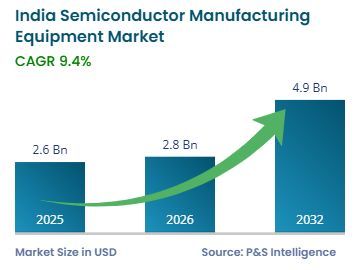
The Indian semiconductor manufacturing equipment market values USD 2.6 billion in 2025, and it is projected to grow at a CAGR of 9.4% during 2026–2032, to reach USD 4.9 billion by 2032. The major factors responsible for the growth of the market include government initiatives under the India Semiconductor Mission, rising domestic demand for electronics manufacturing, increasing investments in semiconductor fabrication facilities, and the emergence of India as a global hub for assembly, testing, marking, and packaging (ATMP) operations.
The expansion is also being catalyzed by strategic partnerships between domestic companies and global technology leaders to establish their production facilities in the country. Tata Electronics started exporting semiconductor chip samples from its Bengaluru R&D center to partners in Japan, the US, and Europe, signifying the country's growing capabilities in semiconductor technology. The market is further bolstered by the rising adoption of electric vehicles, IoT devices, and 5G infrastructure rollout, which collectively drive demand for advanced semiconductor manufacturing capabilities.
The India Semiconductor Mission offers concentrated aid towards the growth and expansion of the country's semiconductor and display manufacturing ecosystem. With multiple semiconductor projects already approved and more under evaluation, India is positioned to become a significant player in the global semiconductor equipment market, particularly in back-end equipment, for which OSAT and ATMP facilities are rapidly being established.
India Semiconductor Manufacturing Equipment Market Trends & Drivers
Rising Demand for Electronics Manufacturing and Emerging Technologies Drives Market
The burgeoning electronics manufacturing sector and adoption of emerging technologies constitute another significant driver for semiconductor equipment demand in India.
The rapid digitalization across sectors, coupled with the government's Digital India initiative, has created substantial demand for semiconductor components, thereby driving the need for advanced manufacturing equipment.
The government's PLI Scheme, pressed into existence for the promotion of local manufacturing of semiconductors, has been a major impetus.
The automotive sector's transition towards electric vehicles is particularly significant, with semiconductor content per vehicle expected to increase from USD 600 in 2024 to USD 1,200 by 2030.
Additionally, India completed nationwide 5G coverage across 779 districts by October 2024, commissioning more than 460,000 base stations, further amplifying the need for semiconductor manufacturing capabilities.
Strategic Focus on OSAT and Advanced Packaging Creates Equipment Opportunities
India's strategic positioning in the outsourced semiconductor assembly and test (OSAT) category is emerging as a major trend driving equipment demand.
The estimated value of the Indian OSAT market is USD 1.7 billion by 2025, which is expanding at a CAGR of 8.5% from 2026 to 2032, to reach USD 3.0 billion by 2032.
HCL-Foxconn OSAT will provide assembly, packaging, and testing to a whole array of customers, like a foundry model, thus enhancing supply chain resiliency for multiple players in India and globally.
Multiple companies, including Micron Technology, HCL-Foxconn, CG Power-Renesas, and Kaynes Technology, have announced OSAT/ATMP facilities in India, creating substantial demand for back-end semiconductor equipment.
Micron will ramp up capacity gradually over time in line with global demand trends, with their Sanand facility expected to be operational by late 2025.
The focus on advanced packaging technologies, including 2.5D and 3D IC packaging, is particularly noteworthy.
These advanced packaging techniques are essential for AI chips, high-performance computing, and 5G applications, areas where India aims to establish expertise.
The country's emphasis on building OSAT capabilities before full-scale fabrication represents a pragmatic approach to entering the global semiconductor value chain.
India Semiconductor Manufacturing Equipment Market Segmentation Analysis
Equipment Type Analysis
The front-end equipment category holds the larger share in the Indian semiconductor manufacturing equipment market in 2025, of 60%, and it is expected to maintain dominance through 2032. This is primarily due to the establishment of India's first semiconductor foundry by Tata Electronics in Gujarat and increasing investments in wafer fabrication capabilities.
The back-end equipment category is witnessing the higher CAGR, of 9.6%, during the forecast period, driven by the rapid establishment of OSAT and ATMP facilities across India. Tata Electronics is building an advanced ATMP plant in Assam with a focus on modern packaging technologies like flip-chip​. Assembly and packaging equipment, including die bonding, wire bonding, and advanced packaging tools for 2.5D/3D integration, are in high demand. Testing equipment, particularly for wafer-level and final IC testing, is essential for ensuring quality in the growing OSAT sector.
The equipment types covered include:
Front-End (Larger Category)
Lithography
EUV
DUV
Water surface conditioning equipment
Etching
Chemical Mechanical Planarization (CMP)
Deposition
Atomic Layer Deposition (ALD)
Chemical Vapor Deposition (CVD)
Wafer Cleaning
Single Wafer Cleaning System
Scrubber System
Single Wafer Cryokinetic Cleaning System
Batch Spray Cleaning System
Others
Etching
Plasma Etch System
Gas Chemical Etch System
Back-End (Faster-Growing Category)
Assembly and Packaging
Dicing
Metrology
Bonding
Wafer Testing/IC Testing
Others
Product Type Analysis
The memory category dominates the market in 2025 with 35% share, driven by Micron Technology's ATMP facility in Gujarat, focused on DRAM and NAND products. Micron's assembly plant and CG Power's OSAT venture with Renesas expand the local outsourcing landscape, allowing fabless startups to access domestic backend capacity. Memory devices require specialized equipment for high-density packaging and testing, particularly for high-bandwidth memory, which is used in AI accelerators. The category benefits from growing data center deployments and the increasing memory requirements in smartphones and automotive applications.
Logic components represent the fastest-growing category, as India focuses on developing capabilities in processor design and manufacturing for applications ranging from consumer electronics to industrial IoT. The emphasis on developing indigenous processors and microcontrollers for strategic applications drives demand for advanced manufacturing equipment capable of producing complex logic devices.
These product types are included:
Memory (Largest Category)
Logic Components (Fastest-Growing Category)
Microprocessor
Analog Components
Optoelectronic Components
Discrete Components
Others
Dimension Analysis
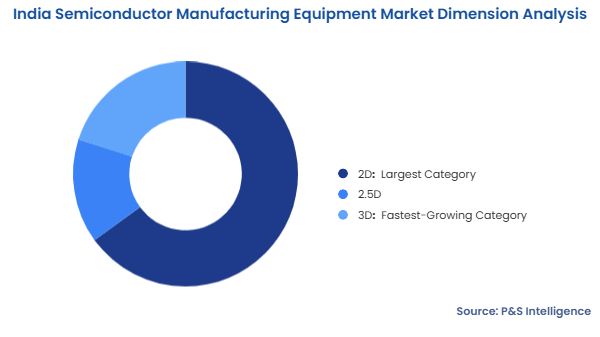
The 2D category held the largest market share, of 65% in 2025, as most current manufacturing in India focuses on conventional planar semiconductor technologies suitable for mature node production. 2D semiconductor technology dominates India’s semiconductor manufacturing equipment market because the country’s initial fabrication and ATMP/OSAT investments are focused on mature nodes and planar architectures, which rely heavily on established 2D processes. The upcoming 28 nm fab and multiple packaging units prioritize cost-effective, high-volume production suited to automotive, industrial, and consumer applications. Since 3D integration and advanced nodes require far more complex, expensive tooling, 2D technology remains the most practical, scalable, and widely adopted platform in India’s current semiconductor ecosystem.
The 3D category has the highest CAGR, of 9.7%, through 2032. 3D IC packaging techniques are used to combine various chips into one package, essential for advanced applications in AI, high-performance computing, and 5G infrastructure. Indian OSAT facilities are increasingly investing in equipment capable of handling advanced packaging dimensions, recognizing this as a key differentiator in the global market. 3D semiconductor technology is growing fastest as India expands into advanced packaging, chip stacking, and heterogeneous integration, driven by rising demand for high-performance computing, AI, 5G, and energy-efficient architectures.
The dimensions studied include:
2D (Largest Category)
2.5D
3D (Fastest-Growing Category)
End User Analysis
The foundry category dominates applications in 2025 market share, driven by major fab projects, including Tata Electronics' facility in Gujarat. Semiconductor fabrication plants are the largest end-users of equipment because they require the widest range and highest value tools—lithography, deposition, etching, CMP, metrology, and clean-room systems—making fabs the most capital-intensive part of the semiconductor chain. India’s investment push, led by projects like the Tata–PSMC fab, further concentrates equipment demand in this segment. Fabs also need continual technology upgrades and capacity expansion, creating sustained, large-scale demand unmatched by ATMP/OSAT or design units.
OSAT is the fastest-growing end-use segment in India’s semiconductor manufacturing equipment market because rising ATMP/OSAT investments—such as Micron’s Sanand facility and CG Power–Renesas initiatives—are sharply increasing demand for advanced test handlers, probe stations, and inspection systems. As India expands packaging, assembly, and mature-node chip production, ensuring yield, reliability, and export-grade quality becomes critical. This drives accelerated adoption of automated optical inspection (AOI), electrical testing, and reliability-validation equipment across new and expanding semiconductor lines.
These end uses have been considered:
Foundry (Largest Category)
IDM
OSAT (Fastest-Growing Category)
Drive strategic growth with comprehensive market analysis
India Semiconductor Manufacturing Equipment Market Regional Outlook
Gujarat Semiconductor Equipment Market Size
Gujarat holds the largest share in India's semiconductor manufacturing equipment market in 2025, of 35% This dominance is attributed to major semiconductor projects, including Micron Technology's USD 2.75-billion ATMP facility in Sanand and Tata Electronics' semiconductor foundry in Dholera. The state offers substantial incentives, including a 75% subsidy on the purchase of the first 200 acres of land and an additional 50% capital subsidy to companies. The semiconductor projects will be supplied water at INR 12 per cubic meter for the initial five years, with a subsequent annual increment of 10% for the following five years. Gujarat's well-developed industrial infrastructure, proximity to ports, and reliable power supply make it the preferred destination for semiconductor equipment installations, particularly for front-end wafer fabrication and advanced packaging equipment.
Karnataka Semiconductor Equipment Market Outlook
Karnataka is experiencing the fastest growth in semiconductor equipment demand, with a CAGR of 9.5%, during 2026–2032, driven by its strong R&D ecosystem and concentration of global semiconductor design centers. Karnataka was the first Indian state to introduce a semiconductor policy in 2010 and a dedicated ESDM policy in 2013. The state hosts over 100 fabless chip design houses and more than 400 multinational corporations operating global R&D centers, accounting for 50% of India's share in electronic product companies. In June 2023, Applied Materials committed USD 400 million for a Collaborative Engineering Center in Karnataka focusing on equipment design and prototyping. Bengaluru's ecosystem particularly drives demand for advanced testing equipment, metrology systems, and design verification tools, complementing the manufacturing equipment requirements.
These states are covered:
Gujarat (Largest State Market)
Karnataka (Fastest-Growing State Market)
Tamil Nadu
Maharashtra
Telangana
Andhra Pradesh
Uttar Pradesh
Assam
Rest of India
India Semiconductor Manufacturing Equipment Market Share
The Indian semiconductor manufacturing equipment market exhibits a moderately consolidated structure, characterized by the presence of major international players establishing local partnerships and service centers to capitalize on India's growing semiconductor ambitions. Applied Materials Inc., ASML, Tokyo Electron Limited, Lam Research Corporation, and KLA Corporation lead with robust growth strategies and innovative service offerings. These companies dominate through their technological superiority, comprehensive product portfolios spanning front-end and back-end equipment, and strong customer relationships with Indian semiconductor manufacturers.
The competitive landscape is evolving with increased localization efforts and partnerships. Global leaders are establishing service centers, training facilities, and collaborative engineering centers in India to support the growing customer base. Lam Research has announced significant investments in Karnataka for semiconductor infrastructure development, including fabrication equipment training and precision component manufacturing. Tokyo Electron and KLA Corporation have also strengthened their presence through technical support centers and customer engagement programs. The market is witnessing the emergence of specialized equipment suppliers focusing on niche applications like advanced packaging and compound semiconductors, though they currently hold a smaller market share.
Key India Semiconductor Manufacturing Equipment Companies:
Applied Materials Inc.
ASML Holding N.V.
Tokyo Electron Limited
Lam Research Corporation
KLA Corporation
Screen Holdings Co. Ltd.
Advantest Corporation
Teradyne Inc.
Hitachi High-Tech Corporation
ASM International N.V.
Nikon Corporation
Canon Inc.
India Semiconductor Manufacturing Equipment Market News
In November 2024, Lam Research announced an investment exceeding INR 8,000 crore in Karnataka to enhance India's semiconductor infrastructure, focusing on local supply chain development, fabrication equipment training, and precision component manufacturing.
In September 2024, the Indian government approved Kaynes Technology's INR 3,307-crore ATMP unit in Gujarat with a daily production capacity of 6.3 million chips, alongside Kaynes SemiCon's INR 5,000-crore investment for an OSAT plant in Sanand.
In August 2024, Gujarat-based Suchi Semicon announced the inauguration of its OSAT facility in Surat.
In July 2024, AMD partnered with SINE at IIT Bombay to provide grants to startups developing energy-efficient spiking neural network chips.
In May 2024, Tata Electronics commenced exporting semiconductor chip samples from its Bengaluru R&D center to partners in Japan, the US, and Europe.
In February 2024, HCL Technologies expanded its collaboration with Intel Foundry to co-develop customized silicon solutions for manufacturers and OEMs.
In December 2023, Canon announced plans to establish lithography equipment facilities in India.
Want a report tailored exactly to your business need?
Leading companies across industries trust us to deliver data-driven insights and innovative solutions for their most critical decisions. From data-driven strategies to actionable insights, we empower the decision-makers who shape industries and define the future. From Fortune 500 companies to innovative startups, we are proud to partner with organisations that drive progress in their industries.
Client Testimonials
Working with P&S Intelligence and their team was an absolute pleasure – their awareness of timelines and commitment to value greatly contributed to our project's success. Eagerly anticipating future collaborations.
McKinsey & Company
India
Unmatched Standards
Our insights into the minutest levels of the markets, including the latest trends and competitive landscape, give you all the answers you need to take your business to new heights
Complete Data Security
We take a cautious approach to protecting your personal and confidential information. Trust is the strongest bond that connects us and our clients, and trust we build by complying with all international and domestic data protection and privacy laws