India Outsourced Semiconductor Assembly and Testing Market Size & Share Analysis - Trends, Drivers, Competitive Landscape, and Forecasts (2026 - 2032)
This Report Provides In-Depth Analysis of the India Outsourced Semiconductor Assembly and Testing Market Report Prepared by P&S Intelligence, Segmented by Turnkey Solutions (Die Preparation & Sawing, Wire Bonding, Flip Chip Assembly, Encapsulation & Molding, Wafer Testing, Final Testing, Burn-in & Reliability Testing, System Level Testing), Packaging Type (Advanced Packaging, Traditional Packaging), Technology Node (?28 nm, 16/14 nm, 10/7 nm, 5 nm and below, End Use), Consumer Electronics (Automotive, Telecommunications & Data Centers, Manufacturing, Medical Devices & Healthcare, Aerospace & Defense), and Geographical Outlook for the Period of 2019 to 2032
India Outsourced Semiconductor Assembly and Testing Market Revenue Insights
Key Highlights
Study Period
2019 - 2032
Market Size in 2025
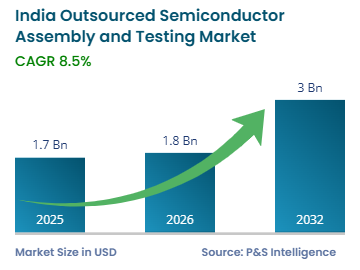
USD 1.7 Billion
Market Size in 2026
USD 1.8 Billion
Market Size by 2032
USD 3.0 Billion
Projected CAGR
8.5%
Largest State
Gujarat
Fastest-Growing State
Assam
Market Structure
Consolidated
Market Size
Explore the market potential with our data-driven report
India Outsourced Semiconductor Assembly and Testing Market Overview
The Indian outsourced semiconductor assembly and testing (OSAT) market value is estimated at USD 1.7 billion in 2025, and it is projected to grow at a CAGR of 8.5% during 2026–2032, to reach USD 3.0 billion by 2032. The market's robust growth trajectory is underpinned by the government's ambitious India Semiconductor Mission with its USD 10 billion (INR 76,000 crore) outlay, unprecedented domestic demand for semiconductors driven by the electronics manufacturing boom, and strategic global supply chain diversification initiatives that position India as an emerging alternative to traditional OSAT hubs in East Asia.
India's semiconductor market transformation has gained remarkable momentum, with the country projected to more than double its semiconductor consumption from USD 45–50 billion in 2024–2025 to USD 100–110 billion by 2030, according to industry estimates. This surge in domestic demand creates a compelling case for local OSAT capabilities, as the nation transitions from being primarily a consumer to becoming a critical node in the global semiconductor value chain. The OSAT sector serves as a vital bridge between semiconductor fabrication and end-product manufacturing, providing essential assembly, packaging, and testing services that enable India's burgeoning electronics ecosystem encompassing smartphones, automotive electronics, consumer devices, and industrial applications.
India Outsourced Semiconductor Assembly and Testing Market Emerging Trends
Advanced Packaging Technologies Are Trending
The market is witnessing a paradigm shift toward advanced packaging technologies, with Indian OSAT facilities investing in system-in-package (SiP), 2.5D/3D IC packaging, fan-out wafer level packaging (FOWLP), and flip-chip technologies.
These advanced packaging solutions are critical for emerging applications in artificial intelligence, 5G communications, edge computing, and high-performance automotive electronics.
Here traditional packaging approaches cannot meet the demanding requirements for miniaturization, thermal management, and electrical performance.
Leading OSAT projects are incorporating cutting-edge technologies from inception. Tata Electronics' Assam facility will employ the flip-chip and integrated system-in-package (ISIP) technologies.
In October 2025, Kaynes Semicon demonstrated capabilities in multi-chip module (MCM) packaging with its first commercial shipment to U.S.-based Alpha & Omega Semiconductor.
This technological sophistication enables Indian OSAT providers to serve high-value segments and compete effectively with established players in Taiwan, China, and Southeast Asia.
Explosive Growth in Domestic Electronics Manufacturing Drives OSAT Demand
According to the IBEF, India's smartphone production reached USD 49.55 billion in FY24 and establishing the country as the world's second-largest mobile phone manufacturer after China.
The transformation from 78% import dependence in 2014 to 97% self-sufficiency reflects the success of the Make in India initiative.
Major manufacturers, such as Apple, Samsung, and Xiaomi, are establishing extensive production facilities across the country.
The revenue of the automotive electronics market is forecasted to increase to USD 615.3 billion by 2030, representing another significant growth driver, with India's electric vehicle market continuing to boom.
The government's ambitious target of 30% EV penetration by 2030 necessitates substantial semiconductor content, as modern EVs require 20–30% more semiconductor components than conventional vehicles.
This automotive transformation, combined with the proliferation of IoT devices, 5G infrastructure deployment, and industrial automation, creates sustained demand for OSAT services across diverse application segments.
Government’s PLI Scheme Offers Opportunities
The Production Linked Incentive (PLI) scheme for semiconductors, announced in December 2021 with an allocation of INR 76,000 crore, represents the government's largest industrial commitment to any sector, signifying semiconductors' foundational importance to India's economic future.
Under the Modified Scheme for setting up Semiconductor ATMP/OSAT facilities, the government extends fiscal support of up to 30% of capital expenditure to approved units, dramatically improving project economics and attracting both domestic and international investments.
The scheme has already catalyzed multiple high-profile OSAT projects across India.
Major approvals include Tata Electronics' INR 27,000 crore facility in Assam, expected to produce 48 million chips daily; Kaynes Semicon's INR 3,307 crore unit in Gujarat with a 6.3-million-chip-per-day capacity; and CG Power's INR 7,600-crore joint venture targeting 15 million units daily production.
These projects collectively represent over INR 40,000 crore in committed investments, with the potential to create approximately 50,000 direct jobs and position India among the top global OSAT destinations by the decade's end.
India Outsourced Semiconductor Assembly and Testing Market Segmentation Analysis
Service Type Analysis
The assembly category holds the largest share in the India OSAT market in 2025, of 55%, driven by the extensive demand from consumer electronics manufacturers and the rapid expansion of smartphone assembly operations. Assembly services encompass die attachment, wire bonding, flip chip assembly, and encapsulation processes that are fundamental to semiconductor packaging. The category benefits from India's established electronics manufacturing ecosystem, skilled workforce availability, and cost-competitive operations that attract both domestic and international clients seeking to diversify their supply chains away from traditional Asian hubs.
Testing services will witness the highest CAGR, during the forecast period, fueled by increasing complexity of semiconductor designs, stringent quality requirements from automotive and industrial applications, and the growing emphasis on reliability testing for mission-critical applications. The proliferation of 5G devices, automotive ADAS systems, and AI-enabled products demands sophisticated testing capabilities including wafer probe testing, final testing, burn-in, and system-level testing. Indian OSAT providers are investing heavily in automated test equipment (ATE) and developing specialized testing protocols to capture this high-margin segment.
These service types are covered:
Assembly Services (Larger Category)
Die Preparation & Sawing
Wire Bonding
Flip Chip Assembly
Encapsulation & Molding
Testing Services (Faster-Growing Category)
Wafer Testing
Final Testing
Burn-in & Reliability Testing
System Level Testing
Turnkey Solutions
Packaging Type Analysis
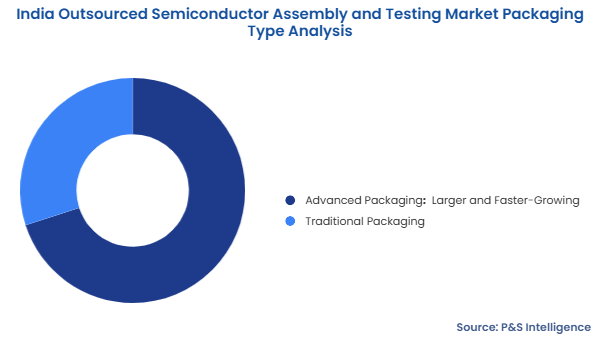
Advanced packaging dominates the market in 2025 with 70% share, reflecting the industry's transition toward sophisticated packaging solutions that enable higher performance, reduced form factors, and improved thermal management. The category encompasses system-in-package (SiP), 2.5D/3D IC packaging, FOWLP, and WLCSP technologies that are essential for smartphones, high-performance computing, and automotive applications. India's new OSAT facilities are being designed with advanced packaging capabilities from inception, positioning the country to capture value-added manufacturing opportunities in emerging technology segments.
These packaging types are covered:
Advanced Packaging (Larger and Faster-Growing Category)
System-in-Package (SiP)
2.5D/3D IC Packaging
Fan-Out Wafer Level Packaging
Wafer Level Chip Scale Package
Traditional Packaging
Ball Grid Array (BGA)
Quad Flat Package (QFP)
Chip Scale Package (CSP)
Lead Frame Based Packaging
Technology Node Analysis
The ≥28 nm node dominates the India OSAT market in 2025 with 40% share, serving the vast majority of automotive microcontrollers, power management ICs, and analog devices. This category benefits from mature manufacturing processes, lower capital requirements, and strong demand from India's automotive and industrial sectors where cutting-edge nodes are not required.
The 10/7 nm category is witnessing the highest growth rate, during the forecast period, albeit from a smaller base. This growth is driven by the assembly and testing requirements for advanced processors used in smartphones, AI accelerators, and high-performance computing applications.
The technology nodes covered include:
≥28 nm (Largest Category)
16/14 nm
10/7 nm (Fastest-Growing Category)
5 nm and below
End Use Analysis
Consumer electronics commanded the largest market share, of 30%, in 2025, supported by India's position as a global smartphone assembly hub and rising domestic consumption. The segment benefits from high-volume production requirements and rapid product cycles that favor outsourced assembly and testing models. India's electronics manufacturing sector, bolstered by production-linked incentive schemes, continues to drive substantial demand for OSAT services.
The automotive segment is experiencing the fastest growth, during 2026–2032, propelled by the electric vehicle revolution and increasing semiconductor content per vehicle. The government's FAME-India scheme and focus on EV adoption create sustained demand for automotive-grade semiconductor assembly and testing services, particularly for power electronics and battery management systems. The Indian electric car market recorded a sale of 19,778 units in 2023, and it is projected to reach 430,603 units by the year 2030.
The end uses covered include:
Consumer Electronics (Largest Category)
Automotive (Fastest-Growing Category)
Telecommunications & Data Centers
Manufacturing
Medical Devices & Healthcare
Aerospace & Defense
Others
Drive strategic growth with comprehensive market analysis
India Outsourced Semiconductor Assembly and Testing Market Geographical Analysis
Gujarat OSAT Market Outlook
Gujarat has emerged as the epicenter of India's semiconductor ecosystem, accounting for 40% OSAT market share in 2025, with investments exceeding INR 15,000 crore in approved OSAT projects. The state's Dholera Special Investment Region and Sanand industrial clusters anchor this growth, hosting Kaynes Semicon's INR 3,307 crore facility, CG Power-Renesas' INR 7,600 crore joint venture, and complementing Micron's USD 2.75 billion assembly plant that represents India's first major international OSAT investment.
Gujarat's semiconductor policy offers compelling incentives, including up to 75% land acquisition subsidies, ready-built utility corridors, and dedicated semiconductor-grade water infrastructure, which significantly reduce project implementation timelines. The state government's proactive approach in creating specialized industrial zones with proximity to Kandla port for chemical imports and finished goods exports provides logistical advantages. The concentration of multiple semiconductor projects creates a synergistic ecosystem attracting specialty gas suppliers, photomask manufacturers, and equipment vendors, establishing Gujarat as India's undisputed semiconductor manufacturing hub.
Assam OSAT Market Growth
Assam represents the fastest-growing regional OSAT market, with a projected CAGR of approx. 9.0% during 2026–2032, anchored by Tata Electronics' transformative INR 27,000-crore investment in Morigaon district. This facility, set to become operational by mid-2025, will be India's largest OSAT operation with a capacity of 48 million chips daily, employing approximately 15,000 people directly and creating 11,000-13,000 indirect jobs, fundamentally altering Northeast India's industrial landscape.
The strategic selection of Assam offers unique advantages including access to renewable hydropower enabling carbon-neutral operations, proximity to Southeast Asian markets, and strong state government support with dedicated infrastructure development. The facility's focus on advanced packaging technologies for automotive, telecommunications, and consumer electronics positions Assam as a critical node in India's semiconductor value chain, while catalyzing ancillary industries and technical education institutions in the region.
These states are covered:
Gujarat (Largest State Market)
Karnataka
Tamil Nadu
Assam (Fastest-Growing State Market)
Uttar Pradesh
Maharashtra
Rest of India
India Outsourced Semiconductor Assembly and Testing Market Share
The India OSAT market exhibits a moderately consolidated structure. The competitive landscape characterized by a mix of domestic conglomerates partnering with international technology leaders and new entrants backed by substantial government support. The competitive landscape is rapidly evolving as established Indian industrial houses like Tata Group, CG Power, and HCL leverage their manufacturing expertise and capital resources to enter the semiconductor domain through strategic partnerships with global OSAT technology providers from Taiwan, Japan, and Thailand.
International technology transfer forms the cornerstone of competitive strategies, with companies like Tata Electronics partnering with Taiwan's Powerchip Semiconductor Manufacturing Corporation, CG Power collaborating with Japan's Renesas Electronics and Thailand's Stars Microelectronics, and HCL joining forces with Foxconn. These partnerships ensure access to proven technologies, operational expertise, and established customer relationships while enabling Indian partners to rapidly develop domestic capabilities. The competitive intensity is expected to increase as new facilities achieve operational status, with differentiation based on technology sophistication, quality certifications, and ability to serve demanding automotive and telecommunications segments.
Key India Outsourced Semiconductor Assembly and Testing Companies:
Kaynes Technology India Limited
CG Power and Industrial Solutions Limited
Tata Electronics Private Limited
HCL Technologies Limited
Hon Hai Precision Industry Co. Ltd. (Foxconn)
Micron Technology Inc.
Advanced System-in-Package Technologies
SenseSemi Technologies Pvt. Ltd.
Larsen & Toubro Limited
Continental Device India Limited
3D Glass Solutions Inc.
Vedanta Limited
India Outsourced Semiconductor Assembly and Testing Market News
In October 2025, Kaynes Semicon shipped India's first commercially packaged multi-chip module with complex 17-die intelligent power modules for automotive applications, from its Sanand OSAT facility to the U.S.-based Alpha & Omega Semiconductor.
In September 2024, Government approved Kaynes Semicon's INR 3,307 crore OSAT facility in Gujarat with a capacity of 6.3 million chips per day, becoming the fifth major semiconductor project under the India Semiconductor Mission.
In March 2024, the Indian prime minister laid foundation stones for three semiconductor projects worth INR 1.25 lakh crore including Tata's facilities in Gujarat and Assam, signaling India's commitment to becoming a global semiconductor manufacturing hub.
In February 2024, Cabinet approved semiconductor projects by Tata Electronics in Dholera and Morigaon, and CG Power's joint venture in Sanand, with combined investments exceeding INR 35,000 crore.
In January 2024, HCL Group and Foxconn announced joint venture to establish OSAT facility near Noida with an investment of approximately INR 3,700 crore, bringing semiconductor manufacturing to North India.
Want a report tailored exactly to your business need?
Leading companies across industries trust us to deliver data-driven insights and innovative solutions for their most critical decisions. From data-driven strategies to actionable insights, we empower the decision-makers who shape industries and define the future. From Fortune 500 companies to innovative startups, we are proud to partner with organisations that drive progress in their industries.
Client Testimonials
Working with P&S Intelligence and their team was an absolute pleasure – their awareness of timelines and commitment to value greatly contributed to our project's success. Eagerly anticipating future collaborations.
McKinsey & Company
India
Unmatched Standards
Our insights into the minutest levels of the markets, including the latest trends and competitive landscape, give you all the answers you need to take your business to new heights
Complete Data Security
We take a cautious approach to protecting your personal and confidential information. Trust is the strongest bond that connects us and our clients, and trust we build by complying with all international and domestic data protection and privacy laws