India Micro-Electro-Mechanical Systems (MEMS) Sensors Market Size & Opportunities Analysis - Growth Strategies, Competitiveness, and Forecasts (2026 - 2032)
This Report Provides In-Depth Analysis of the India MEMS Sensors Market Report Prepared by P&S Intelligence, Segmented by RF MEMS, Technology (Surface Micromachining, Bulk Micromachining, LIGA, CMOS MEMS, NEMS), Application (Consumer Electronics, Automotive, Industrial, Healthcare & Medical Devices, Aerospace & Defense, Telecommunications), and Geographical Outlook for the Period of 2019 to 2032
Explore the market potential with our data-driven report
India MEMS Sensors Market Outlook
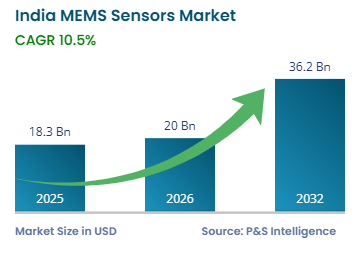
The Indian MEMS sensors market value is estimated at USD 18.3 billion in 2025, and it is projected to grow at a CAGR of 10.5% during 2026–2032, to reach USD 36.2 billion by 2032. The primary growth catalysts include rapid automotive electronics adoption, expanding Internet of Things ecosystem deployment, surging consumer electronics penetration, government initiatives promoting smart manufacturing, and healthcare sector digitalisation driving demand across diverse applications and industries.
India's MEMS sensor ecosystem is experiencing transformative growth through multiple technology convergence trends and localization initiatives. In November 2024, ISRO made a move towards creating made-in-India car sensors, minimizing dependence on imports, signalling strong government commitment to building domestic capabilities in critical sensor technologies. The market evolution reflects India's strategic transition from being predominantly import-dependent to emerging as both a significant consumption market and manufacturing hub for advanced sensor technologies serving global value chains.
The proliferation of connected devices and smart applications creates exponential demand growth across sectors. Additionally, with advanced driver assistance systems (ADAS) penetration in India growing, the automotive sector emerges as a critical growth driver. The convergence of consumer electronics proliferation, automotive safety mandates, industrial automation, and healthcare digitalization establishes multiple sustained growth trajectories ensuring market expansion across diverse end-use segments.
India MEMS Sensors Market Emerging Trends
Automotive Safety Regulations and Vehicle Electrification Are Key Trends
Government mandates for vehicle safety features represent the strongest catalyst for MEMS sensor market expansion.
Rising safety concerns in the automotive industry are primarily driving the MEMS accelerometer market, as low-g accelerators have become increasingly popular for applications such as airbags.
Each modern vehicle requires 50–100 MEMS sensors for various safety, comfort, and performance functions.
ADAS-equipped vehicles require an additional 15–20 sensors for electronic stability control, tire pressure monitoring, blind spot detection, and collision avoidance systems.
The automotive transformation extends significantly beyond safety features to encompass vehicle electrification and connected car technologies.
As per the India Brand Equity Foundation, India recorded sales of 1.97 million units, compared to 1.75 million units in FY24, increasing 16.9%, propelling the demand for specialized MEMS sensors.
Electric vehicles require additional sensor arrays for battery management systems monitoring cell temperatures and voltages, thermal management ensuring optimal operating conditions, regenerative braking control, and electric motor management.
This electrification trend creates incremental demand layers beyond traditional automotive applications, establishing sustained growth trajectories as India targets 30% EV penetration by 2030.
Industrial IoT Deployment and Smart Manufacturing Revolution Drive Market
Industrial automation and smart manufacturing initiatives create large-scale enterprise demand for MEMS sensors.
Manufacturing facilities deploy thousands of MEMS sensors for comprehensive operational monitoring.
Applications span predictive maintenance reducing unplanned downtimes, process optimization improving efficiency, quality control ensuring product consistency, and environmental monitoring for regulatory compliance.
Manufacturing firms in India are rapidly automating their operations to improve productivity and efficiency.
Government programs including Make in India, Production-Linked Incentive schemes, and Smart Cities Mission, accelerate industrial sensor deployment across manufacturing sectors.
The integration of artificial intelligence and machine learning with sensor networks enables advanced analytics, creating additional value propositions for industrial MEMS adoption.
Manufacturing plants increasingly implement sensor-based digital twins for virtual process optimization, further expanding addressable markets.
Difficulties in Local Semiconductor Production Hamper Market Growth
India’s semiconductor ambitions are constrained by severe reliance on imported materials and technology, coupled with capital-intensive infrastructure and a deep talent gap.
Over 90% of the essential semiconductor inputs—such as high-purity chemicals, specialty gases, and wafers—are imported.
Building fabs requires enormous capital (several billion dollars) for precision-grade cleanrooms, continuous ultra-pure water, and Class-1 environments.
Meanwhile, India faces a shortfall of 250,000–300,000 specialized semiconductor professionals by 2027, especially in advanced fabrication, packaging, and microfabrication.
This combination of high capex, import dependence, and limited human capital makes scaling indigenous compound-semiconductor production highly challenging.
Healthcare, Smart Manufacturing, and Consumer Wearables Sectors Offer Opportunities
Healthcare sector digital transformation and wearable device proliferation create rapidly expanding MEMS sensor applications.
In August 2024, the Institute of Advanced Study in Science and Technology (IASST) created a smartphone-based fluorescence sensor to detect L-dopa levels in Parkinson's patients, demonstrating India's advancing capabilities in specialized medical MEMS applications.
Telemedicine expansion, accelerated by pandemic experiences, remote patient monitoring for chronic disease management, fitness tracking becoming mainstream consumer behaviour, and medical-grade wearables for continuous health monitoring, creates diverse market opportunities.
The growth of industrial automation, robotics, and smart manufacturing in India offers a powerful opportunity for MEMS and compound-semiconductor sensors.
As factories modernize under Industry 4.0 paradigms, demand surges for high-precision sensors (inertial, environmental, pressure) to enable machine vision, predictive maintenance, and real-time monitoring.
The India Semiconductor Mission (ISM) supports this shift by offering up to 50% fiscal support for sensor manufacturing capacity.
At the same time, the PLI scheme incentivizes electronics manufacturing, helping build local sensor-ecosystem infrastructure.
Moreover, multi-state industrial parks and smart manufacturing hubs (including SEZs) are being developed, combining robotics, AI, and semiconductors to drive automation.
These collective initiatives create a favourable climate for domestic MEMS sensor makers to scale alongside India’s industrial transformation.
India MEMS Sensors Market Segmentation Analysis
Type Analysis
Pressure sensors dominate the Indian MEMS sensor market in 2025 with 30% share, driven by critical applications across automotive, industrial, and medical sectors. The segment benefits from mandatory tire pressure monitoring system requirements in vehicles, expanding industrial process control applications in manufacturing plants, and growing medical device applications including ventilators and blood pressure monitors. Automotive applications alone consume millions of pressure sensors annually for engine management, emission control, and safety systems.
Inertial sensors are demonstrating the fastest growth, during 2026–2032. The expansion of IoT devices is driving the development of the inertial sensor segment. These sensors enable critical functions in smartphones for screen orientation and image stabilization, gaming controllers for motion detection, drones for navigation and stability, industrial robotics for precision control, and automotive safety systems for rollover detection and electronic stability control.
Types covered in the market include:
Pressure (Largest Category)
Inertial (Fastest-Growing Category)
Audio
Environmental
Optical
Flow
RF MEMS
Others
Technology Analysis
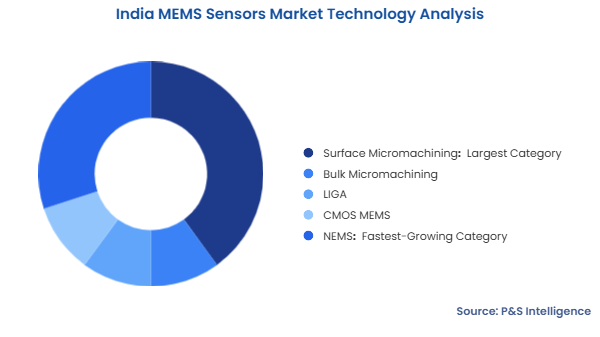
Surface micromachining technology have captured 40% market share in 2025, benefiting from mature manufacturing processes, cost-effectiveness for high-volume production, and compatibility with standard semiconductor fabrication. The technology dominates consumer electronics and automotive segments where integration density and cost optimization are critical. Surface micromachining enables production of accelerometers, gyroscopes, and microphones at scales required for smartphone and automotive markets.
The NEMS category is projected to have the highest growth rate, as next-generation applications emerge. The technology's superior sensitivity, reduced power consumption, and miniaturization capabilities position it ideally for biomedical sensing applications, ultra-low power IoT devices, and advanced environmental monitoring systems.
Technologies covered include:
Surface Micromachining (Largest Category)
Bulk Micromachining
LIGA
CMOS MEMS
NEMS (Fastest-Growing Category)
Application Analysis
Consumer electronics hold the largest share, of 35%, in 2025, leveraging India's position as one of the world's largest smartphone markets. Each smartphone incorporates 10–15 MEMS sensors for various functions including motion detection, audio capture, environmental sensing, and user interface control. The category benefits from rapid technology adoption, continuous device upgrade cycles, and expanding product categories including wearables, hearables, and gaming devices.
Automotive applications will exhibit the highest growth rate, during the forecast period, driven by dual trends of safety system proliferation and vehicle electrification. Modern vehicles require extensive sensor arrays for airbag deployment, stability control, navigation, climate control, and engine management, with electric vehicles adding incremental requirements for battery and thermal management systems. The Indian electric car market recorded a sale of 19,778 units in 2023, and it is projected to reach 430,603 units by the year 2030.
Applications covered include:
Consumer Electronics (Largest Category)
Automotive (Fastest-Growing Category)
Industrial
Healthcare & Medical Devices
Aerospace & Defence
Telecommunications
Others
Drive strategic growth with comprehensive market analysis
India MEMS Sensors Market Geographical Analysis
Karnataka MEMS Sensor Market Size
Karnataka commands the largest state market share, of 40% in 2025, establishing dominance through Bengaluru's comprehensive technology ecosystem. The state hosts over 200 R&D centres developing MEMS applications, supported by abundant skilled engineering talent from premier institutions and established semiconductor design infrastructure. Karnataka's thriving IoT startup ecosystem, smart city initiatives, and presence of global technology companies create natural demand synergies. Bengaluru's position as India's Silicon Valley attracts continuous investments in sensor technology development and applications.
Tamil Nadu MEMS Sensor Market Growth
Tamil Nadu is exhibiting the fastest growth, at approx. 11.5% CAGR, during 2026–2032, emerging as a critical manufacturing and consumption hub. Chennai's automotive manufacturing cluster, producing over 1.5 million vehicles annually and hosting global OEMs and tier-1 suppliers, drives substantial automotive sensor demand. The state's aggressive electronics manufacturing expansion under PLI schemes attracts sensor assembly and testing operations, creating integrated supply chains from components to finished products.
States covered in the market include:
Karnataka (Largest State Market)
Tamil Nadu (Fastest-Growing State Market)
Maharashtra
Gujarat
Uttar Pradesh
Haryana
Rest of India
India MEMS Sensors Market Share
The Indian MEMS sensor market exhibits a consolidated structure with global technology leaders dominating high-value segments while domestic players focus on distribution, system integration, and application development. International companies hold sway through direct operations and strategic partnerships, leveraging technological expertise, established manufacturing capabilities, and global supply chain networks.
Competition intensifies in commodity sensor segments with significant price pressures from Chinese suppliers, while differentiation occurs through application-specific solutions, local technical support, and customization capabilities. Companies pursue aggressive localization strategies through assembly operations, technology partnerships, and design centres, responding to government incentives promoting domestic manufacturing and customer preferences for local suppliers. The emphasis on Make in India and Atmanirbhar Bharat creates opportunities for joint ventures, technology transfer arrangements, and capability building partnerships.
Market entry barriers include high capital requirements for fabrication facilities, extensive intellectual property portfolios held by established players, lengthy qualification processes particularly for automotive and medical applications, and need for continuous R&D investments to maintain competitiveness.
Key India MEMS Sensors Companies:
Robert Bosch GmbH
STMicroelectronics N.V.
Analog Devices Inc.
Honeywell International Inc.
TDK Corporation
Infineon Technologies AG
Texas Instruments Inc.
Murata Manufacturing Co. Ltd.
NXP Semiconductors N.V.
Sensata Technologies Inc.
Omron Corporation
Qualcomm Incorporated
Sony Group Corporation
Micron Technology Inc.
Panasonic Holdings Corporation
Broadcom Inc.
TE Connectivity Ltd.
Vishay Intertechnology Inc.
India MEMS Sensors Market News
In January 2025, the Ministry of Electronics and Information Technology (MeitY) launched a Centre of Excellence for Intelligent IoT Sensors and an India Innovation Centre for Graphene, aiming to drive innovation and support industry growth in advanced sensor technologies.
In November 2024, Indian Space Research Organisation (ISRO) announced comprehensive development program for indigenous automotive sensors targeting import substitution and supporting domestic vehicle manufacturers with cost-effective solutions for safety and performance applications.
In August 2024, Institute of Advanced Study in Science and Technology developed innovative smartphone-based MEMS fluorescence sensor for Parkinson's disease monitoring, advancing India's capabilities in medical MEMS applications.
In May 2024, STMicroelectronics NV introduced comprehensive MEMS Studio development platform for sensor evaluation and prototyping, supporting Indian designers with localized tools and technical support infrastructure.
In March 2024, the Indian government extended Production-Linked Incentive scheme to MEMS sensors under electronic components category, offering substantial capital expenditure incentives for domestic manufacturing and assembly operations.
Want a report tailored exactly to your business need?
Leading companies across industries trust us to deliver data-driven insights and innovative solutions for their most critical decisions. From data-driven strategies to actionable insights, we empower the decision-makers who shape industries and define the future. From Fortune 500 companies to innovative startups, we are proud to partner with organisations that drive progress in their industries.
Client Testimonials
Working with P&S Intelligence and their team was an absolute pleasure – their awareness of timelines and commitment to value greatly contributed to our project's success. Eagerly anticipating future collaborations.
McKinsey & Company
India
Unmatched Standards
Our insights into the minutest levels of the markets, including the latest trends and competitive landscape, give you all the answers you need to take your business to new heights
Complete Data Security
We take a cautious approach to protecting your personal and confidential information. Trust is the strongest bond that connects us and our clients, and trust we build by complying with all international and domestic data protection and privacy laws