India Integrated Circuit Market Size & Share Analysis - Trends, Drivers, Competitive Landscape, and Forecasts (2026 - 2032)
This Report Provides In-Depth Analysis of the India Integrated Circuit Market Report Prepared by P&S Intelligence, Segmented by Mixed-Signal ICs, Application (Consumer Electronics, Automotive, IT & Telecommunications, Industrial Electronics & Automation, Healthcare & Medical Devices, Aerospace & Defense), and Geographical Outlook for the Period of 2019 to 2032
Explore the market potential with our data-driven report
India Integrated Circuit Market Overview
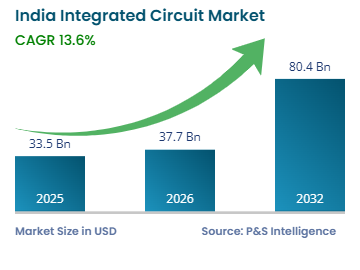
The Indian integrated circuit market value is USD 33.5 billion in 2025, and it is projected to grow at a CAGR of 13.6% during 2026–2032, reaching USD 80.4 billion by 2032. The market growth is driven by surging consumer electronics demand, rapid 5G infrastructure expansion, and government initiatives promoting domestic semiconductor manufacturing under the Production Linked Incentive scheme.
The escalating smartphone penetration across India is a significant catalyst for IC demand. As per the Press Information Bureau, smartphone penetration in India reached 85.5% of the households in 2024, with three out of four smartphones shipped being 5G capable. This widespread adoption of 5G-enabled devices requires advanced ICs for enhanced processing power, connectivity, and energy efficiency. The consumer electronics segment, particularly smartphones and tablets, continues to drive substantial IC consumption as manufacturers integrate more sophisticated features including artificial intelligence capabilities, advanced cameras, and high-resolution displays.
As per the Press Information Bureau, India has seen the fastest rollout of 5G services in the world, with 4,62,084 BTS deployed across 779 districts, as of December 2024. This aggressive 5G rollout by Reliance Jio and Bharti Airtel has created enormous demand for RF ICs, power management ICs, and baseband processors essential for network infrastructure. The telecommunications sector transformation from 4G to 5G technology necessitates upgraded semiconductor components across base stations, network equipment, and end-user devices, significantly expanding the IC market opportunity.
India Integrated Circuit Market Growth Factors
Rising IoT Device and Smart Home Solution Adoption Is Major Trend
The proliferation of internet of things devices and smart home technologies across India is creating substantial demand for microcontrollers, connectivity ICs, and sensor ICs.
The growing middle-class population with higher disposable incomes is increasingly adopting smart appliances, wearable devices, and connected home automation systems.
These IoT applications require low-power, cost-effective ICs with wireless connectivity capabilities including Wi-Fi, Bluetooth, and Zigbee.
The Digital India initiative launched by the government is accelerating digital transformation across industries, promoting IoT adoption in sectors including manufacturing, agriculture, healthcare, and smart cities.
IoT device deployments necessitate specialized ICs designed for edge computing, enabling data processing at the device level rather than relying solely on cloud infrastructure.
The demand for system-on-chip solutions integrating multiple functions onto single chips is increasing as manufacturers seek compact, energy-efficient designs for portable IoT devices.
Furthermore, the rollout of 5G networks provides the high-speed, low-latency connectivity required for massive IoT deployments, creating additional opportunities for IC manufacturers supplying components for IoT infrastructure and end devices.
The rapid development of smart cities is one of the major drivers of the demand for IoT and smart home solutions in the country.
The Press Information Bureau says that by November 15, 2024, under the Smart Cities Mission (SCM), work orders had been issued for 8,066 projects, totaling INR 1,64,669 crore.
Of these, 7,352 projects, which represents 91% of the total, amounting to INR 1,47,366 crore, had been completed, according to data provided by 100 Smart Cities.
Expanding Electric Vehicle Market Driving Automotive IC Demand
As per the India Brand Equity Foundation, India recorded sales of 1.97 million units, compared to 1.75 million units in FY24, increasing 16.9%, propelling the demand for specialized MEMS sensors.
The automotive sector's electrification is significantly increasing semiconductor content per vehicle, with the average semiconductor bill-of-materials value per car projected to reach USD 1,200 by 2030, as per NITI Aayog.
Electric vehicles require substantially more ICs compared to traditional internal combustion engine vehicles, including power management ICs for battery systems, microcontrollers for vehicle control units, sensor ICs for advanced driver assistance systems, and logic ICs for infotainment systems.
The government's target to achieve 30% EV sales penetration by 2030 will create sustained demand for automotive-grade ICs.
Additionally, the adoption of Level-2 driver-assistance features and the shift toward zonal vehicle architectures requiring centralized domain controllers are driving demand for high-performance microprocessors and memory ICs in the automotive industry.
Government Schemes Offer Opportunities for Domestic Manufacturing
The Indian government launched the Production Linked Incentive scheme in December 2021 with an outlay of INR 76,000 crore to boost semiconductor and display manufacturing capabilities.
The scheme offers up to 50% financial support for capital expenditures, making India an attractive destination for global semiconductor players.
As of March 2025, the PLI scheme attracted INR 1.61 lakh crore in investments, generated INR 14 lakh crore in production, and created 1.15 million jobs across 764 approved applications.
This government initiative is reducing India's import dependency for ICs and fostering a robust domestic semiconductor ecosystem.
The India Semiconductor Mission established under this program acts as the nodal agency for implementing semiconductor development schemes, providing technical support and facilitating partnerships between domestic companies and global technology leaders.
In June 2023, Micron Technology Inc. announced investments of at USD 825 million to construct semiconductor assembly and test facilities in Gujarat.
Tata Group has also committed to establishing fabrication units, marking significant progress in building indigenous IC manufacturing capacity.
India Integrated Circuit Market Segmentation Analysis
Product Type Analysis
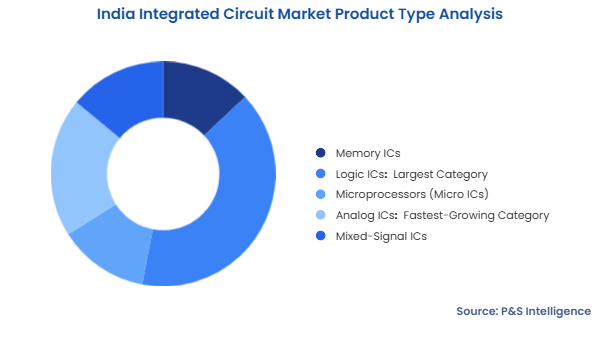
Logic ICs hold the largest share in the Indian integrated circuit market in 2025, of 40%, and they are expected to maintain their dominant position through 2032. Logic ICs are essential components in virtually all electronic devices, performing critical digital processing functions in smartphones, computers, telecommunications equipment, and consumer electronics.
The widespread adoption of 5G technology and increasing smartphone penetration drive substantial logic IC consumption, as these devices require advanced application processors and baseband processors for handling complex computational tasks and network connectivity. The growing demand for artificial intelligence and machine learning capabilities in consumer devices further amplifies logic IC requirements, as AI processing necessitates specialized neural processing units and tensor processing units integrated within application-specific integrated circuits.
Analog ICs represent the fastest-growing category during the forecast period. Analog ICs are indispensable for power management, signal conditioning, and sensor interfacing across diverse applications including automotive electronics, industrial automation, and telecommunications infrastructure. The electric vehicle market expansion is a primary growth driver for analog ICs, as battery management systems, motor control units, and charging infrastructure require sophisticated power management ICs and operational amplifiers.
The 5G infrastructure deployment across India necessitates RF analog ICs, power amplifiers, and mixed-signal ICs for base station equipment. Furthermore, the proliferation of IoT devices and wearables creates sustained demand for low-power analog ICs optimized for battery-operated applications, including voltage regulators, data converters, and sensor interface ICs.
These product types are covered:
Memory ICs
Logic ICs (Largest Category)
Microprocessors (Micro ICs)
Analog ICs (Fastest-Growing Category)
Mixed-Signal ICs
Application Analysis
Consumer electronics hold the largest share, of 35%, in the Indian integrated circuit market in 2025, driven by robust demand for smartphones, tablets, laptops, and smart televisions. Mobile phone production accounts for 52% of India's consumer electronics manufacturing, with smartphone shipments reaching 153 million units in 2024. The consumer electronics segment benefits from continuous technology upgrades, with consumers increasingly demanding 5G connectivity, enhanced camera capabilities, artificial intelligence features, and superior display quality, all of which require advanced ICs.
The premiumization trend in smartphones drives the demand for high-performance processors, increased memory capacity, and sophisticated sensor arrays. Additionally, the growing adoption of smart wearables, wireless earbuds, and smart home devices expands IC consumption across the broader consumer electronics ecosystem.
Automotive represents the fastest-growing application, during 2026–2032. The automotive industry's rapid electrification and the integration of advanced driver assistance systems are dramatically increasing semiconductor content per vehicle. The Indian electric car market recorded a sale of 19,778 units in 2023, and it is projected to reach 430,603 units by the year 2030. Each electric vehicle contains significantly more ICs than conventional vehicles, including battery management system controllers, electric motor control units, onboard charging ICs, and thermal management system controllers. Furthermore, the implementation of safety features, connectivity solutions, and autonomous driving capabilities requires microcontrollers, sensor ICs, radar ICs, and vision processing units. The government's push toward vehicle electrification combined with stringent emission norms is accelerating IC adoption across the automotive sector.
These applications are covered:
Consumer Electronics (Largest Category)
Automotive (Fastest-Growing Category)
IT & Telecommunications
Industrial Electronics & Automation
Healthcare & Medical Devices
Aerospace & Defense
Others
Drive strategic growth with comprehensive market analysis
India Integrated Circuit Market Geographical Analysis
Karnataka India IC Market Size
Karnataka holds the largest market share, of 40%, in the Indian integrated circuit market in 2025, with Bengaluru serving as the country's primary semiconductor design and electronics manufacturing hub. Often referred to as India's Silicon Valley, Karnataka hosts numerous multinational semiconductor companies, research institutions, and startups driving innovation in IC design and development. The state is home to over 400 global research and development centers, including facilities operated by Intel, Texas Instruments, Qualcomm, Analog Devices, and STMicroelectronics, employing thousands of semiconductor design engineers.
Karnataka's established electronics manufacturing ecosystem, skilled engineering talent pool, and supportive state government policies including single-window clearances and infrastructure support make it the preferred destination for semiconductor companies. The state government's Electronics System Design and Manufacturing policy offers incentives for investment, research and development, and skill development initiatives. The presence of premier educational institutions including the Indian Institute of Science and numerous engineering colleges ensures continuous supply of qualified semiconductor professionals. Additionally, Karnataka's mature supply chain ecosystem, comprising component suppliers, assembly service providers, and testing facilities, provides comprehensive support for IC manufacturers and fabless design companies.
Tamil Nadu Indian integrated circuit market Outlook
Tamil Nadu is projected to be the fastest-growing state in the Indian IC market, at a CAGR of approx. 14.5% during 2026–2032, driven by substantial investments in semiconductor manufacturing and aggressive government promotion of electronics production. The state government announced a USD 2 billion investment by VinFast for an electric vehicle project in Thoothukudi, creating substantial demand for automotive ICs. Tamil Nadu unveiled the Automotive Future roadmap in 2025 to position the state as a global EV innovation hub, including mobility innovation funds for research and development in battery chemistry and advanced EV technologies.
The establishment of dedicated research and development zones in Chennai and Coimbatore will accelerate semiconductor innovation activities. Tamil Nadu offers competitive advantages including established automotive manufacturing clusters, robust port infrastructure facilitating component imports and finished goods exports, and relatively lower operational costs compared to other major states. Major electronics manufacturers including Foxconn, Samsung, and numerous automotive component suppliers operate manufacturing facilities in Tamil Nadu, creating strong demand for ICs across consumer electronics and automotive applications. The state's Electronics Hardware Manufacturing Policy provides capital subsidies, interest subsidies, and quality certification reimbursements to encourage local IC production and consumption.
These states are covered:
Karnataka (Largest State Market)
Tamil Nadu (Fastest-Growing State Market)
Maharashtra
Telangana
Gujarat
Uttar Pradesh
Rest of India
India Integrated Circuit Market Share
The Indian integrated circuit market exhibits a fragmented competitive landscape characterized by the presence of numerous global semiconductor giants alongside emerging domestic players. The market fragmentation stems from diverse application requirements, varied product categories, and different technology nodes serving distinct end-user segments. Global multinational companies dominate the high-performance IC segment, leveraging advanced fabrication technologies and extensive research and development capabilities, while domestic companies focus on design services, assembly, testing, and niche applications catering to local market requirements.
This fragmented market structure reflects the diversity of IC applications across consumer electronics, automotive, telecommunications, industrial, and emerging sectors, each requiring specialized semiconductor solutions with varying performance characteristics, power consumption profiles, and cost considerations.
Key competitive strategies observed in the market include strategic partnerships between global technology leaders and Indian companies for technology transfer and local manufacturing, investments in research and development facilities to develop India-specific IC solutions optimized for local requirements, and mergers and acquisitions to expand product portfolios and market reach. In August 2024, L&T Semiconductor Technologies partnered with C-DAC to develop Make-in-India integrated circuits and system-on-chip solutions for automotive, industrial, and energy sectors, strengthening domestic semiconductor capabilities. Global companies are establishing collaborative engineering centers in India to leverage the country's skilled engineering workforce while domestic companies are focusing on design-led manufacturing and fabless business models to compete effectively without heavy capital investments required for fabrication facilities.
The market presents substantial opportunities for companies specializing in automotive-grade ICs, power management solutions for renewable energy applications, and IoT-optimized low-power ICs targeting India's expanding connected device ecosystem. The government's emphasis on Atmanirbhar Bharat initiatives and production-linked incentives is attracting both domestic and foreign investments, gradually reducing India's import dependency and establishing the country as an integral part of the global semiconductor supply chain.
Key India Integrated Circuit Companies:
Intel Corporation
Qualcomm Incorporated
Texas Instruments Incorporated
Samsung Electronics Co. Ltd.
Analog Devices Inc.
STMicroelectronics N.V.
NXP Semiconductors N.V.
Infineon Technologies AG
Broadcom Inc.
MediaTek Inc.
Advanced Micro Devices Inc.
NVIDIA Corporation
Micron Technology Inc.
ON Semiconductor Corporation
Renesas Electronics Corporation
Microchip Technology Inc.
Realtek Semiconductor Corp.
Sony Semiconductor Solutions Corporation
ROHM Co. Ltd.
India Integrated Circuit Market News
In June 2025, the Tamil Nadu State Planning Commission unveiled the Tamil Nadu Automotive Future roadmap to position the state as a global electric vehicle innovation hub, including mobility innovation funds for research and development in battery chemistry and advanced EV technologies with dedicated zones in Chennai and Coimbatore.
In March 2025, the Government of India announced that the Production Linked Incentive scheme attracted INR 1.61 lakh crore in investments, generated INR 14 lakh crore in production, and INR 5.31 lakh crore in exports while creating 11.5 lakh jobs, significantly bolstering India's semiconductor manufacturing capabilities.
In March 2025, Applied Materials established a collaborative engineering center in Bengaluru focusing on materials engineering solutions for chip and display production, strengthening India's semiconductor research and development capabilities and creating opportunities for indigenous technology development.
In January 2025, Micron Technology Incorporated expanded its semiconductor assembly and test facility operations in Gujarat, with the facility projected to significantly reshape India's semiconductor landscape while creating high-tech and construction employment opportunities and enhancing the country's position in the global IC supply chain.
In August 2024, L&T Semiconductor Technologies partnered with C-DAC to develop Make-in-India Integrated Circuits and System-on-Chip solutions for automotive, industrial, and energy sectors, aiming to enhance domestic semiconductor manufacturing and reduce import reliance while strengthening India's position in the global IC market.
Want a report tailored exactly to your business need?
Leading companies across industries trust us to deliver data-driven insights and innovative solutions for their most critical decisions. From data-driven strategies to actionable insights, we empower the decision-makers who shape industries and define the future. From Fortune 500 companies to innovative startups, we are proud to partner with organisations that drive progress in their industries.
Client Testimonials
Working with P&S Intelligence and their team was an absolute pleasure – their awareness of timelines and commitment to value greatly contributed to our project's success. Eagerly anticipating future collaborations.
McKinsey & Company
India
Unmatched Standards
Our insights into the minutest levels of the markets, including the latest trends and competitive landscape, give you all the answers you need to take your business to new heights
Complete Data Security
We take a cautious approach to protecting your personal and confidential information. Trust is the strongest bond that connects us and our clients, and trust we build by complying with all international and domestic data protection and privacy laws