India Health Insurance Market Size & Share Analysis - Trends, Drivers, Competitive Landscape, and Forecasts (2026 - 2032)
This Report Provides In-Depth Analysis of the India Health Insurance Market Report Prepared by P&S Intelligence, Segmented by Insurance Type (Disease Insurance, Medical Insurance), Provider (Private, Public), Plan Type (Medical Insurance, Critical Illness Insurance, Family Floater Health Insurance), Coverage Type (Lifetime Coverage, Term Insurance), Type (Individual, Group), Provider Type (Point of Service (POS), Exclusive Provider Organizations (EPOs), Preferred Provider Organizations (PPOs), Health Maintenance Organizations (HMOs)), Age (Senior Citizens, Adult, Minors), Distribution Channel (Direct Sales, Brokers, Banks), and Geographical Outlook for the Period of 2019 to 2032
Explore the market potential with our data-driven report
India Health Insurance Market Overview
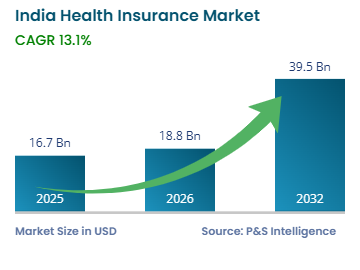
The Indian health insurance market size was USD 16.7 billion in 2025, which is predicted to reach USD 39.5 billion by 2032, growing at a CAGR of 13.1% during 2026–2032.
The major factors responsible for the growth of the market include escalating healthcare costs, increasing prevalence of lifestyle diseases, expanding government initiatives, and growing awareness about health coverage.
Healthcare costs in India are increasing at an annual rate of 14%, significantly outpacing general inflation and creating substantial financial pressure on families. Out-of-pocket expenditure continues to play a substantial role in India’s healthcare financing landscape, accounting for approximately 39.4% of total health expenditure in 2021–22, as per the Press Information Bureau. While this reflects a notable decline from the levels recorded a decade earlier, the financial burden on households remains considerable. Further, recent analyses show that around 16% of households still depend on distress financing—such as loans or the sale of assets—to meet hospitalization costs. These indicators underscore the ongoing need for broader and more comprehensive health insurance coverage to safeguard families against unexpected and potentially catastrophic medical expenses.
The Ayushman Bharat – Pradhan Mantri Jan Arogya Yojana (AB-PMJAY) has emerged as a cornerstone of India’s healthcare financing framework, providing INR 5 lakh of annual health coverage per eligible family for secondary and tertiary care services. As per official data, more than 36.9 crore Ayushman Cards had been issued as of 24 March 2025, with subsequent government updates indicating that the figure has now surpassed 41 crores. This scale of enrolment firmly positions AB-PMJAY as one of the largest publicly funded health assurance programs globally, reflecting the government’s commitment to expanding financial protection and improving access to quality healthcare.
India Health Insurance Market Dynamics
Rising Middle-Class Population and Urbanization Are Major Growth Trends
The rapid expansion of India’s middle-class population is increasing the affordability of health insurance, driving higher adoption of individual and family floater plans.
As per the World Bank, 37% of the country’s population lived in urban areas in 2024.
The Indian government further projects that by 2030, this number will rise to 30%.
Urbanization is exposing households to better awareness of healthcare risks, preventive care, and the financial benefits of insurance coverage.
Urban residents have greater access to private hospitals and organized healthcare services, prompting stronger demand for comprehensive insurance products.
Rising disposable incomes enable families to allocate a portion of their budget toward long-term financial protection, including health insurance.
According to the India Brand Equity Foundation, the proportion of India's middle class is projected to reach 61% of the total population by 2047, an increase from 31% in 2020–21.
The shift toward nuclear families in urban areas reduces the traditional support system during medical emergencies, increasing reliance on insurance.
Lifestyle changes associated with urban living, such as higher stress levels, sedentary habits, and unhealthy diets, are elevating the risk of chronic diseases, making health insurance more essential.
Increased digital connectivity in urban and semi-urban regions has improved access to online policy purchases, renewals, and comparison tools, accelerating market penetration.
Escalating Healthcare Costs Is Key Market Growth Driver
Healthcare inflation in India remains significantly higher than general inflation, increasing the cost of hospitalization and medical treatments year over year.
The rising prices of medicines, diagnostics, and advanced medical technologies have pushed treatment costs upward across both urban and rural regions.
In May 2025, the Ahmedabad Hospitals & Nursing Homes Association (AHNA) restored cashless services for Star Health Insurance after both parties resolved disputes related to claim settlements and service delays, ensuring uninterrupted access to cashless treatment for policyholders.
Private hospitals, which handle a large share of inpatient care, have steadily increased tariffs for surgeries, specialty treatments, and critical care services.
Growing incidence of chronic and lifestyle diseases is driving long-term medication and monitoring expenses, adding pressure on household budgets.
Public healthcare infrastructure gaps are forcing more patients to seek treatment in costlier private facilities, amplifying overall medical expenditure.
Higher operational costs for hospitals, including medical equipment, consumables, infrastructure, and skilled medical staff, are directly reflected in patient bills.
India's health expenditure has witnessed remarkable growth, rising to INR 6.1 lakh crore in 2024-2025 from INR 3.2 lakh crore in 2020-2021, reflecting a compound annual growth rate of 18%.
As medical costs rise, insurers face higher claim payouts, resulting in an upward revision of health insurance premiums and product pricing.
India Health Insurance Market Segmentation Analysis
Insurance Type Analysis
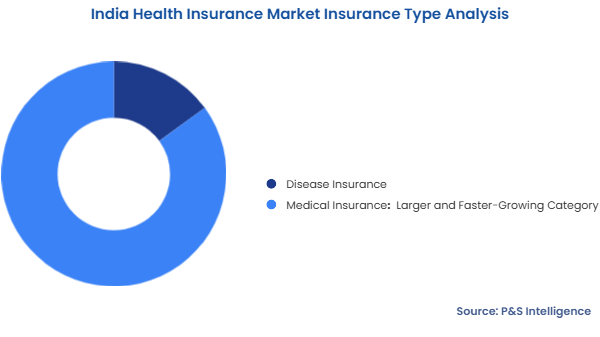
The medical insurance category holds the larger share in 2025, of approximately 85%, and it will witness a CAGR of approximately 13.5% during the forecast period, because it offers the broadest and most essential health coverage, making it the preferred choice for individuals, employers, and governments. Medical insurance typically covers hospitalization, surgeries, outpatient services, diagnostics, and emergency treatments—needs that apply to nearly every age group. Rising rates of chronic diseases, such as diabetes, cardiovascular disorders, and respiratory issues, increases the demand for comprehensive medical coverage.
Here are the insurance types studied in the report:
Disease Insurance
Medical Insurance (Larger and Faster-Growing Category)
Provider Analysis
The private providers category holds the larger share in the Indian health insurance market in 2025, of approximately 65%, and it is expected to witness a CAGR of approximately 13.4% during the forecast period. This lead stems primarily from private insurers' ability to offer customized health plans with comprehensive coverage options, faster claim settlements, and superior customer service. Private sector insurers have invested heavily in digital infrastructure, enabling seamless policy purchases, instant claim processing, and enhanced customer engagement through mobile applications and online portals.
These specialized insurers focus exclusively on health insurance products, enabling them to develop deep expertise in underwriting, claims management, and healthcare partnerships. Standalone health insurers are driving innovation through product differentiation, superior claim ratios, and customer-centric service models.
These provider types are covered:
Private (Larger and Faster-Growing Category)
Public
Plan Type Analysis
The medical insurance category holds the largest share in the Indian health insurance market in 2025, of approximately 60%, driven by the fundamental demand for hospitalization coverage and basic healthcare protection. Medical insurance policies provide comprehensive coverage for inpatient hospitalization expenses, including room charges, surgical procedures, diagnostic tests, and post-hospitalization care. The category's dominance reflects the primary concern among Indian families regarding catastrophic healthcare expenses arising from major illnesses or accidents requiring hospitalization.
The breadth of medical insurance coverage extends across various healthcare services, including pre-hospitalization expenses, ambulance charges, daycare procedures, and emergency treatments. Insurers have expanded medical insurance offerings to include additional benefits such as no-claim bonuses, health checkups, second medical opinions, and restoration of sum insured. The category benefits from increasing awareness about financial protection needs, rising hospitalization costs, and growing acceptance of insurance as an essential financial planning tool.
Critical illness insurance represents the fastest-growing category, during the forecast period. This acceleration stems from the heightening awareness about life-threatening diseases, such as cancer, cardiac conditions, stroke, and kidney failure, which require substantial financial resources for treatment. As per the Ministry of Science & Technology, in India, non-communicable diseases are responsible for 53% of total deaths and account for 44% of the disability-adjusted life-years that are lost. Critical illness policies provide lump-sum payouts upon diagnosis of specified critical conditions, offering financial cushioning for expensive treatments, income replacement during recovery, and coverage of indirect expenses beyond hospitalization.
Lifetime coverage holds the larger share in the Indian health insurance market in 2025, of approximately 70%, reflecting consumers’ preference for long-term financial security and continuous health protection. Lifetime coverage policies eliminate the concern of policy discontinuation upon reaching a certain age, providing healthcare protection throughout the policyholder's life. This category addresses a critical need in India's aging demographic landscape, where elderly populations face increasing healthcare requirements and higher insurance premiums in traditional term-based policies.
The term insurance category is expected to register the faster growth during the forecast period. This growth is driven by affordability considerations, flexibility in coverage amounts, and suitability for specific life stages such as early career phases or temporary international assignments. Insurers are enhancing term insurance attractiveness through features like easy upgrade options to lifetime policies, flexible tenures, and competitive renewal benefits. The category particularly appeals to younger demographics, who prioritize lower immediate costs to build financial stability.
These coverage types are covered:
Lifetime Coverage (Larger Category)
Term Insurance (Faster-Growing Category)
Type Analysis
The group health insurance category holds the larger share, of 55%, in 2025, and it is expected to register the higher CAGR, of approximately 13.3%, during the forecast period. This is because it covers a broad population through employer-sponsored and organization-based policies. Corporate group insurance plans form a major share, as most medium and large companies in India provide health coverage to employees as part of their benefits package. This leads to large volumes of insured members being added in a single policy, significantly boosting the overall market share. Group policies also tend to have lower premiums, no medical underwriting, and instant enrollment, making them attractive for businesses, families, and SMEs alike.
The types analyzed in this report are:
Individual
Group (Larger and Faster-Growing Category)
Corporate
Family
SME
Provider Type Analysis
The point of service category holds the largest share in the Indian health insurance market in 2025, of approximately 45%, offering policyholders a balanced approach between network-based and out-of-network healthcare access. POS plans combine features of both HMOs and PPOs, allowing members to choose their healthcare providers while encouraging utilization of in-network services through preferential pricing and reduced out-of-pocket costs. This flexibility appeals to Indian consumers seeking both cost efficiency and provider choice.
The POS model's success stems from its ability to address India's diverse healthcare landscape, where quality varies significantly between urban and rural areas. Members benefit from lower copayments and deductibles when using network providers while retaining the option to access out-of-network specialists, when necessary, albeit at higher costs.
Exclusive provider organizations represent the fastest-growing category, with a CAGR of approximately 13.2%, during the forecast period. EPO plans restrict coverage to services received from network providers except in emergency situations, offering lower premiums compared to more flexible options while maintaining quality care through carefully selected provider networks. This model appeals to cost-conscious consumers willing to accept network limitations in exchange for affordable premium structures.
The adult category accounts for the largest revenue share, of around 65%, in 2025, because adults represent the biggest portion of the insurable population and are the primary purchasers of health insurance. As per the World Bank, in 2024, 68% of India’s population fell in the age group of 15 to 64 years. Most employer-provided group health policies cover adults, significantly increasing penetration in this category. Adults are also more likely to buy individual and family floater plans as they are financially responsible for their households.
Senior citizens represent the fastest-growing category, during the forecast period, due to rapidly increasing healthcare needs and higher medical expenses among older adults. India’s aging population is expanding, and this demographic faces a higher prevalence of chronic illnesses requiring frequent medical care, surgeries, and long-term treatments. As a result, demand for specialized senior citizen health insurance policies—offering higher coverage, no medical tests, and coverage for pre-existing diseases—is rising sharply. Government initiatives and insurer-driven awareness campaigns have also encouraged more seniors to purchase insurance.
The ages covered in the report are:
Senior Citizens (Fastest-Growing Category)
Adult (Largest Category)
Minors
Distribution ChannelAnalysis
The brokers/agents category accounts for the largest revenue share in 2025, and this category is expected to witness the highest CAGR during the forecast period. This is because most health insurance buyers in India still rely on personal guidance when choosing a policy. Health insurance products can be complex, involving comparisons of premiums, exclusions, waiting periods, network hospitals, and add-on covers.
Agents and brokers help customers navigate these details, making them the preferred channel, especially for first-time buyers. Digital integration is also boosting their efficiency. Modern agents now use online platforms, comparison tools, instant quote systems, and digital KYC, allowing them to sell more policies in less time. Insurers are strengthening their partnerships with intermediaries by offering higher commissions, specialized training, and digital sales tools.
The different distribution channels covered in the report are:
Direct Sales
Brokers (Largest and Fastest-Growing Category)
Banks
Others
Drive strategic growth with comprehensive market analysis
India Health Insurance Market Regional Outlook
North Indian health insurance market Size
North India holds the larger share in the Indian health insurance market in 2025, of approximately 40%, driven by high urbanization rates, substantial middle-class population, and strong insurance awareness in major metropolitan areas. The region encompasses key markets, including Delhi, Punjab, Haryana, Uttar Pradesh, and Uttarakhand, collectively representing significant economic activity and healthcare infrastructure development. North India benefits from concentration of corporate headquarters, government offices, and industrial sectors, all of which contribute to robust group health insurance penetration through employer-sponsored coverage.
The region's market lead stems from the higher per capita income in urban centers, well-developed private healthcare infrastructure, and strong presence of both public and private insurance companies. Delhi NCR alone accounts for substantial health insurance premiums owing to its large population, high healthcare costs, and extensive network of tertiary care hospitals. The region has witnessed significant expansion of insurance distribution networks through agents, brokers, and bancassurance channels, enhancing market accessibility across socioeconomic segments.
South Indian health insurance market Forecast
South India is expected to register the fastest growth in the Indian health insurance market during the forecast period, of approximately 13.2%. This exceptional growth trajectory reflects the region's advanced healthcare infrastructure, high health consciousness, progressive regulatory environment, and strong digital adoption. The region encompasses Karnataka, Tamil Nadu, Andhra Pradesh, Telangana, and Kerala, each demonstrating distinct strengths in healthcare delivery and insurance penetration.
Karnataka, particularly Bangalore, has emerged as a hub for health-tech innovation and insurance technology startups, driving digital transformation in insurance distribution and claims processing. The state's robust IT sector contributes to high group health insurance coverage while generating demand for comprehensive individual policies among tech professionals. Tamil Nadu boasts extensive healthcare infrastructure with world-class hospitals attracting medical tourism, creating spillover effects on domestic health insurance demand. The state has among the highest diabetes prevalence at 6.60%, driving substantial insurance uptake for chronic disease management.
The regions analyzed in this report are:
North India (Largest Regional Market)
South India (Fastest-Growing Regional Market)
West and Central India
East India
India Health Insurance Market Share
The Indian health insurance market exhibits a consolidated competitive structure. This consolidation reflects the capital-intensive nature of insurance operations, regulatory compliance requirements, and advantages of scale in distribution networks, hospital tie-ups, and claims management infrastructure. The market features a dynamic mix of public sector insurers, private general insurance companies, and standalone health insurance specialists, each competing through differentiated strategies in product innovation, service quality, and market reach.
The competitive landscape is characterized by intense rivalry in product development, with insurers continuously launching specialized offerings targeting specific demographic segments and healthcare needs. In March 2025, Prudential plc announced a joint venture with Vama Sundari Investments to establish a standalone health insurance company in India, with Prudential holding 70% and Vama Sundari 30%, reflecting strong foreign investor confidence in the country’s expanding health insurance market. Private sector players have gained significant market share through superior customer service, faster claim settlements, digital-first approaches, and customized policy structures.
Standalone health insurers have carved distinct positions by focusing exclusively on health products, enabling specialized expertise in medical underwriting, healthcare partnerships, and claims management. Public sector insurers maintain relevance through extensive rural reach, competitive pricing, and government scheme implementation partnerships. In February 2025, nine insurance companies, including HDFC Ergo and SBI General, submitted IPO plans to raise capital and strengthen governance structures, signaling market maturity and growth expectations.
Key India Health Insurance Companies:
Star Health & Allied Insurance Company Limited
Care Health Insurance Ltd.
Niva Bupa Health Insurance Company Limited
Aditya Birla Health Insurance Company Limited
HDFC ERGO General Insurance Company Limited
ICICI Lombard General Insurance Company Limited
Bajaj Allianz General Insurance Company Limited
TATA AIG General Insurance Company Limited
SBI General Insurance Company Limited
Reliance General Insurance Company Limited
ManipalCigna Health Insurance Company Limited
The New India Assurance Company Limited
India Health Insurance Market News
In April 2025, TATA AIG General Insurance Company launched a new retail health-insurance product called MediCare Select. As part of its expansion strategy, the company announced plans to increase its hospital network from around 11,500 facilities to over 14,000 by FY27, with a special focus on tier-2 and tier-3 markets.
In February 2025, Bajaj Allianz General Insurance launched HERizon Care, India's first comprehensive health insurance plan exclusively designed for women, featuring two main coverages, including Vita Shield, covering 34 critical illnesses; and Cradle Care, focusing on reproductive health, with optional benefits for infertility treatments, adoption costs, and egg freezing.
In February 2025, Care Health Insurance celebrated the launch of Ultimate Care, a comprehensive health insurance plan designed to redefine health coverage standards by offering enhanced benefits and holistic protection for policyholders.
Want a report tailored exactly to your business need?
Leading companies across industries trust us to deliver data-driven insights and innovative solutions for their most critical decisions. From data-driven strategies to actionable insights, we empower the decision-makers who shape industries and define the future. From Fortune 500 companies to innovative startups, we are proud to partner with organisations that drive progress in their industries.
Client Testimonials
Working with P&S Intelligence and their team was an absolute pleasure – their awareness of timelines and commitment to value greatly contributed to our project's success. Eagerly anticipating future collaborations.
McKinsey & Company
India
Unmatched Standards
Our insights into the minutest levels of the markets, including the latest trends and competitive landscape, give you all the answers you need to take your business to new heights
Complete Data Security
We take a cautious approach to protecting your personal and confidential information. Trust is the strongest bond that connects us and our clients, and trust we build by complying with all international and domestic data protection and privacy laws