Explore the market potential with our data-driven report
India Grid-Forming Inverters Market Overview
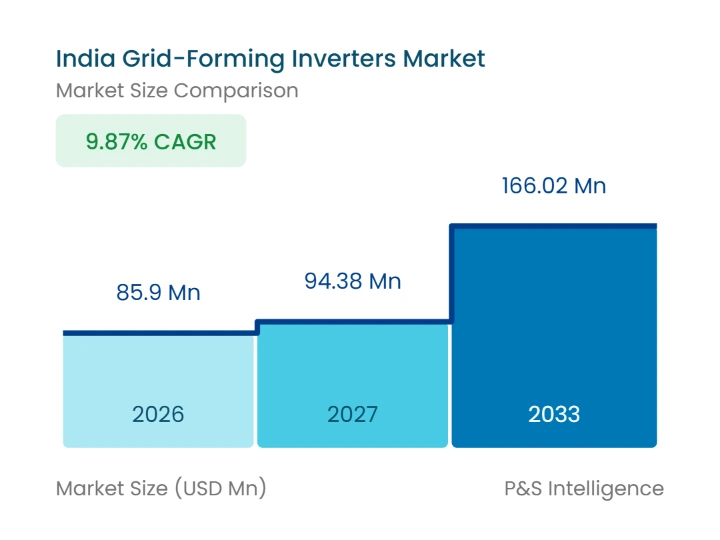
The India grid-forming inverters market was valued at USD 85.90 Million in 2026 and is heading for USD 94.38 Million in 2027 and USD 166.02 Million by 2033, a CAGR of 9.87% across 2027-2033. Behind that growth are connection rules that require large batteries to steady weak sections of the grid. Storage developers, state transmission utilities, and renewable plant owners are all buying conversion hardware that can hold voltage and frequency on its own, and for inverter makers, grid-code compliance is now a precondition for entering most utility storage tenders.
Most new orders for grid-forming power conversion systems come from utility-scale battery projects moving from award into construction. According to ICRA data, India's commissioned battery storage capacity climbed from 5.9 GWh in March 2026 to 14.5 GWh by September 2026, with another 78.9 GWh under construction. That pipeline sets the scale of the battery energy storage hardware base, though only the projects covered by the newer grid-forming requirements translate directly into demand for this equipment. PCS vendors that already have commissioning teams in India are better placed to win repeat orders as these projects reach grid connection.
Early orders are clustering in the renewable-heavy western and southern states, led by Rajasthan, Gujarat, and Karnataka, where weak pooling stations make grid-forming control a reliability requirement for new storage. Elsewhere, distribution companies and thermal generators are adding standalone batteries for peak supply, and the larger of those projects carry the same hardware requirement. Suppliers to the India grid-forming inverters market thus face two procurement routes: one led by renewable developers, the other by state utilities.
Key market insights
By inverter architecture / type, central inverters and central PCS hold the largest share in 2026, while string inverters and string PCS are set to grow fastest during 2027-2033.
By operating control mode, virtual synchronous machine (VSM) control leads in 2026, and hierarchical and virtual oscillator control is on course for the quickest expansion over 2027-2033.
By power rating, the above 100 kW band accounts for the largest share in 2026 and is also expected to record the fastest growth through 2027-2033.
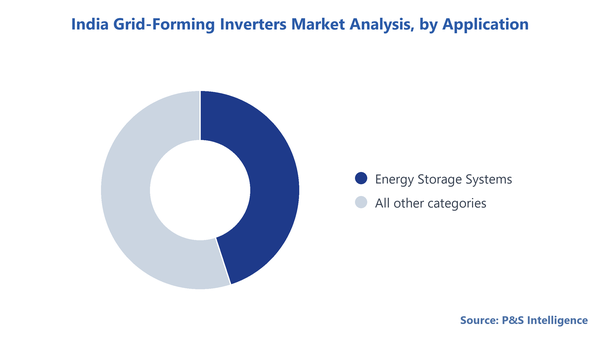
By application, energy storage systems (standalone and co-located BESS) lead demand in 2026 and are projected to expand fastest during 2027-2033.
India Grid-Forming Inverters Market Trends & Drivers
Dual-mode inverter platforms are reshaping utility plant specifications
Indian solar and storage developers are now gaining access to utility-scale inverters that run grid-following and grid-forming control in a single unit, with switchable models announced for India around the October 2026 Renewable Energy India Expo. These give plant owners the option to run in following mode under today's connection terms and switch to forming mode once system strength falls or rules tighten. That flexibility shifts the purchase decision toward control firmware and software support, since the hardware itself no longer fixes the operating mode.
For developers financing long-lived solar and storage assets, a switchable unit lowers the risk that a later rule change strands an installed inverter fleet. The competition is moving toward validated simulation models, firmware updates, and field engineering, areas where vendors with power electronics staff already in India can respond faster to grid-operator requests. Manufacturers that offer only fixed grid-following designs are likely to find less room in utility tenders as owners plan for stricter connection terms.
Grid support requirements for large batteries are driving conversion system upgrades
Developers of large battery storage projects are now expected to buy power conversion systems capable of setting voltage and frequency on their own, which turns storage tender volume directly into grid-forming hardware demand. The cheapest grid-following PCS no longer qualifies for these assets, so the specification and value of the conversion package should rise per megawatt. The requirement also adds engineering work ahead of construction, since each project must prove compliance before it connects.
The Central Electricity Authority has advised that storage projects of 50 MW or above use grid-forming inverters from July 10, 2026 onward, unless purchase orders predate that day or bids were concluded by August 10, 2026. Developers must also submit electromagnetic transient studies at the design stage and demonstrate grid-forming and black-start capability during commissioning. Vendors that supply validated simulation models alongside the hardware can shorten approval times for their customers, an edge that carries over into the next tender.
Funded storage capacity with local content rules is opening a domestic supply pathway
Federal funding for new grid-scale storage gives conversion system vendors a pipeline of distribution-company projects running to the start of the 2030s. Since the support carries a minimum domestic content requirement for battery projects, developers now have a reason to favor PCS assembled in India, which helps them clear that threshold without relying on cells alone. Vendors that already run Indian assembly lines stand to gain an edge over importers shipping in finished units.
According to the Press Information Bureau, the Union Cabinet approved a viability gap funding scheme on November 4, 2026, backing 92 GWh of storage capacity, including 30 GWh of battery storage, for FY2026-27 to FY2030-31, with a minimum 40% domestic content requirement for battery projects. Battery awards under the scheme that exceed the size threshold would fall within the grid-forming requirement, pushing PCS demand beyond the projects already tendered.
Thin storage tariffs are limiting developer spending on premium conversion hardware
Aggressive bidding in standalone storage auctions has left many awarded projects with thin margins, which limits how much extra cost developers can absorb for grid-forming PCS. A developer locked into a fixed monthly capacity tariff has a direct incentive to push hardware prices down, cut specifications, or delay equipment orders until financing is secure. Each of these responses slows how fast tender awards turn into actual PCS purchases, and the effect falls hardest on vendors without a local cost base.
A report co-authored by IEEFA on standalone battery storage auctions found that nearly 75% of the 2-hour capacity allocated in 2025 sits in an at-risk viability category. Projects in that group may struggle to reach financial close on schedule, which could delay PCS deliveries. Vendors that cut the number of conversion blocks per project through higher unit ratings, or bundle long-term service into the price, make a stronger case to cost-constrained developers.
Segmentation Outlook
By inverter architecture / type
Central inverters and central PCS hold the largest share of the India grid-forming inverters market in 2026, largely because the multi-megawatt battery and solar plants that grid-forming rules cover first favor this format. Site owners prefer fewer high-capacity inverters, which simplifies substation integration. NTPC Green Energy's November 2026 tender for 40.58 GWh of battery containers with grid-forming PCS illustrates the bulk volumes central designs serve.
String inverters and string PCS are set to grow the fastest over 2027-2033. Because modular string units let an operator isolate a fault to a single block, they matter most at co-located storage and commercial sites where downtime costs revenue. Liquid-cooled string PCS of several hundred kilowatts are now on offer in India, and the smaller units ease installation for EPC contractors working at remote sites.
By operating control mode
Virtual synchronous machine control holds the largest share in 2026, being the most commercially mature grid-forming method among vendors bidding in Indian storage tenders. VSM firmware emulates the inertia and damping of a rotating generator, which gives grid operators a response they can study using established models. That familiarity shortens the review of developer transient studies and lowers approval risk on a first grid-forming asset.
Hierarchical and virtual oscillator control is expected to expand the fastest during 2027-2033. These schemes allow many inverters to share load and hold voltage without a master unit, which suits large multi-block storage sites and islanded microgrids. As connection reviews shift toward plant-level transient modeling, owners will likely place more value on coordination across dozens of units, favoring vendors able to tune these controls on site.
By power rating
Units rated above 100 kW form the largest band in 2026, since grid-forming demand is concentrated in utility storage and generation projects sized in the tens or hundreds of megawatts. At that scale, developers buy megawatt-range conversion blocks to keep unit counts, cabling, and commissioning tests manageable. Lower-rated units instead serve commercial sites and islanded systems, where grid-forming capability is rarely a connection condition.
The above 100 kW band is also expected to grow the fastest through 2027-2033. Every new utility storage tender inside the grid-forming requirement adds demand for high-rated conversion hardware, and funded storage programs extend that pipeline further. With central units above 1 MW already sitting in vendor catalogs for India, suppliers of hybrid inverters below 50 kW instead depend on commercial, industrial, and microgrid buyers.
By application
Energy storage systems, covering standalone and co-located BESS, form the largest application in 2026. Batteries were the first asset class in India to face a grid-forming requirement, and every storage block needs a bi-directional conversion system. Since that capability must be demonstrated at commissioning, developers cannot bargain it away in price talks, which keeps PCS specifications firm even when tariffs run thin.
Copyright P&S Intelligence. Reuse requires attribution under CC BY 4.0.
Storage is also projected to lead growth during 2027-2033. According to the Renewable Energy Association of Rajasthan, a September 2026 draft regulatory proposal seeks grid-forming capability in at least 15% of inverter capacity at renewable plants commissioned after July 1, 2027, as well as in BESS conversion systems. If adopted, batteries at solar and wind parks would open a second stream of PCS orders.
The following segments are analyzed in this report.
By Inverter Architecture / Type
Central Inverters & Central PCS
String Inverters & String PCS
Microinverters & Modular Hybrid Inverters
By Operating Control Mode
Droop Control
Virtual Synchronous Machine (VSM)
Hierarchical & Virtual Oscillator Control
By Power Rating
Below 50 kW
50-100 kW
Above 100 kW
By Application
Energy Storage Systems (Standalone & Co-located BESS)
Renewable Energy Integration (Utility Solar & Wind Plants)
Demand in the India grid-forming inverters market is concentrated in Rajasthan, Gujarat, and Karnataka, where large solar and wind parks feed power through remote pooling stations with low system strength. GRID-INDIA's discussion paper on grid-forming technology recorded about 68 incidents between January 2022 and July 2025 in which more than 1,000 MW of renewable generation was lost, mostly in these same three states, citing low short-circuit ratio as one contributing cause. Storage and generation projects planned around these hubs are the first candidates for grid-forming conversion hardware, and their tender terms will likely shape specifications in other Indian states.
State transmission utilities are emerging as a second major buyer group for grid-forming conversion hardware across India. The Prime Minister's Office confirms that the Union Cabinet approved Green Energy Corridor Phase-III on September 30, 2026, to evacuate up to 135 GW of renewable energy across states and Union Territories by FY2032-33, including 50 GWh of battery storage at renewable generation ends or other points important for grid flexibility. Batteries sited at weak pooling points are the assets most likely to need grid-forming power conversion, extending PCS tendering beyond private renewable developers and into states well beyond Rajasthan, Gujarat, and Karnataka.
States with smaller renewable fleets are moving more slowly toward grid-forming procurement. Across much of northern and eastern India, grid-forming demand will likely arrive through standalone battery tenders run by state distribution companies and through transmission-linked storage, timed to state network upgrades rather than plant-level weak-grid problems. Orders outside the western and southern clusters are expected to build gradually toward 2033. For vendors, commissioning and service teams based near Rajasthan and Gujarat allow a faster response to the current concentration of projects, while national service coverage becomes more valuable as storage tenders spread to more states over the 2027-2033 forecast period.
India Grid-Forming Inverters Market Competition Analysis
The India grid-forming inverters market is moderately fragmented, with international suppliers drawn from the global grid-forming inverter business, diversified power-equipment groups, and India-based power electronics manufacturers all bidding for the same storage and solar tenders. Entry depends more on grid-code qualification, validated transient simulation models, and a local commissioning team than on manufacturing scale alone. The structure is still evolving: local content conditions on subsidized battery projects are pushing suppliers to assemble conversion hardware in India, which could narrow the field toward firms with local plants.
Solar and storage inverter specialists, including Sungrow Power Supply, Sineng Electric, SMA Solar Technology, and Delta Electronics, compete on string and central PCS ranges that pair grid-forming with grid-following control, with pricing aimed at high-volume utility tenders. Power-equipment groups such as Hitachi Energy, Siemens Energy, ABB, Schneider Electric, TMEIC, and Hitachi Hi-Rel Power Electronics instead compete on system integration and high-power converters, often packaging conversion hardware with substation and control equipment for transmission-linked projects. For developers, this spread of bidders keeps price competition active, while compliance demands make firmware, simulation support, and service capacity just as decisive as unit price.
Major Companies in India Grid-Forming Inverters Market:
Sungrow Power Supply Co., Ltd.
Sineng Electric Co., Ltd.
SMA Solar Technology AG
Hitachi Energy Ltd.
Siemens Energy AG
ABB Ltd.
Delta Electronics, Inc.
TMEIC Corporation
Hitachi Hi-Rel Power Electronics Private Limited
Schneider Electric SE
India Grid-Forming Inverters Market News
October 2026, Sineng Electric Co., Ltd. unveiled a 430 kW liquid-cooled grid-forming string PCS at the Renewable Energy India Expo and signed 1.5 GW string inverter distribution agreements with each of Impulse Green Energy and OSG Oriana. Together, the 3 GW of agreements extend Sineng's reach into Indian developers beyond direct utility tenders.
October 2026, Sungrow Power Supply Co., Ltd. launched its SG510HX utility-scale inverter in India, a 1,000 V AC unit that switches between grid-forming and grid-following control without shutting down, timed to the Renewable Energy India Expo. The design targets weak-grid solar sites facing tighter connection requirements.
August 2026, Hitachi Energy India Limited secured its first battery energy storage order, a 165 MW / 330 MWh project in Andhra Pradesh. The order marks a transmission equipment supplier's entry into utility battery projects, a segment where large new storage blocks are now expected to use grid-forming conversion.
May 2026, Schneider Electric SE launched an integrated battery energy storage system for India at its Innovation Summit India 2026, built around a skid that combines PCS, DC converters, inverter-duty transformers, and MV panels. Supplying these components as one package gives storage buyers a single vendor for conversion and medium-voltage integration.
Last Updated: November 2026
Frequently Asked Questions About This Report
What is the size of the India grid-forming inverters market?+
Valued at USD 85.90 Million in 2026, the India grid-forming inverters market is heading for USD 94.38 Million in 2027 and USD 166.02 Million by 2033, advancing at a CAGR of 9.87% during 2027-2033.
Are grid-forming inverters mandatory for BESS projects in India?+
The Central Electricity Authority advised that upcoming storage projects of 50 MW or above use grid-forming inverters from July 10, 2026, unless purchase orders predate that day or bids concluded by August 10, 2026.
Why is demand for grid-forming inverters growing in India?+
Developers of large battery storage projects are now expected to buy power conversion systems able to set voltage and frequency themselves, which converts storage tender volume directly into grid-forming hardware demand.
Which application leads the India grid-forming inverters market?+
By application, energy storage systems (standalone and co-located BESS) lead demand in 2026 and are projected to expand fastest during 2027-2033.
Which Indian states need grid-forming inverters the most?+
Batteries sited at weak pooling points are the assets most likely to need grid-forming power conversion, which carries PCS tendering beyond private renewable developers and into states well beyond Rajasthan, Gujarat, and Karnataka.
Who are the key grid-forming inverter companies in India?+
Solar and storage inverter specialists, including Sungrow Power Supply, Sineng Electric, SMA Solar Technology, and Delta Electronics, compete on string and central PCS ranges that pair grid-forming with grid-following control.
What are the challenges for battery storage and grid-forming inverter projects in India?+
A report co-authored by IEEFA on standalone battery storage auctions found that nearly 75% of the 2-hour capacity allocated in 2025 falls in an at-risk viability category.
Want a report tailored exactly to your business need?
Leading companies across industries trust us to deliver data-driven insights and innovative solutions for their most critical decisions. From data-driven strategies to actionable insights, we empower the decision-makers who shape industries and define the future. From Fortune 500 companies to innovative startups, we are proud to partner with organisations that drive progress in their industries.
Client Testimonials
Working with P&S Intelligence and their team was an absolute pleasure – their awareness of timelines and commitment to value greatly contributed to our project's success. Eagerly anticipating future collaborations.
McKinsey & Company
India
Unmatched Standards
Our insights into the minutest levels of the markets, including the latest trends and competitive landscape, give you all the answers you need to take your business to new heights
Complete Data Security
We take a cautious approach to protecting your personal and confidential information. Trust is the strongest bond that connects us and our clients, and trust we build by complying with all international and domestic data protection and privacy laws