India Embedded System Market Size & Share Analysis - Trends, Drivers, Competitive Landscape, and Forecasts (2026 - 2032)
This Report Provides In-Depth Analysis of the India Embedded System Market Report Prepared by P&S Intelligence, Segmented by Software (Microcontrollers, Microprocessors, Digital Signal Processors (DSP), Field-Programmable Gate Arrays (FPGA), Application-Specific Integrated Circuits (ASIC), Memories, Power Management ICs, Operating Systems (OS), Middleware), System Size (Small-Scale (8-bit), Medium-Scale (16-32-bit), Large-Scale (Above 32-bit)), Functionality (Standalone Embedded Systems, Real-Time Embedded Systems, Network Embedded Systems, Mobile Embedded Systems), Application (Automotive, Consumer Electronics, Industrial, Healthcare, Telecommunications, Aerospace & Defense), and Geographical Outlook for the Period of 2019 to 2032
Explore the market potential with our data-driven report
India Embedded System Market Overview
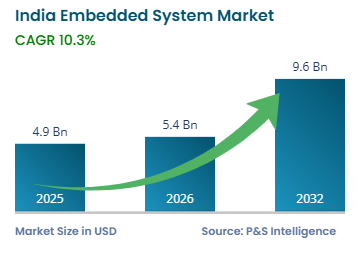
The Indian embedded systems market values USD 4.9 billion in 2025 and is projected to grow at a CAGR of 10.3% during 2026–2032, to reach USD 9.6 billion by 2032. The major factors responsible for the market growth include rapid expansion of electronics manufacturing, surging adoption of IoT-enabled devices across industries, and increasing government initiatives under Digital India and Make in India programs.
The expanding electronics production base is a key factor for the rising demand for embedded systems in India. This substantial growth in electronics manufacturing directly translates into higher demand for embedded hardware and software components across consumer electronics, automotive electronics, and industrial applications. The government's target of achieving USD 500 billion in electronics manufacturing by 2030 further reinforces the growth trajectory for embedded systems in the country.
The proliferation of IoT devices is creating significant opportunities for embedded systems integration. India's IoT market is driven by smart city initiatives, industrial automation, and connected healthcare solutions. This surge in IoT adoption necessitates advanced embedded systems for device connectivity, data processing, and real-time analytics. Additionally, the automotive sector's transition toward electric vehicles and advanced driver assistance systems is accelerating embedded system deployment.
India Embedded System Market Emerging Trends
Surging Smartphone Production Is Driving Market Growth
The explosive growth in smartphone manufacturing is a primary driver for India's embedded systems market.
India has emerged as the second-largest mobile phone manufacturer globally, producing approximately 330 million devices annually, as per the Press Information Bureau.
Mobile phone production increased to INR 4,22,000 crore in 2024–25, while exports crossed INR 1,29,000 crore.
This dramatic expansion requires substantial embedded processors, memory chips, and software for device functionality.
The integration of embedded systems in smartphones enables advanced features like AI-powered cameras, biometric security, 5G connectivity, and seamless user interfaces.
Major global players, including Apple, Samsung, and Xiaomi, have established manufacturing facilities in India, further driving demand for embedded solutions.
As of November 2024, investments pledged under the PLI scheme amounted to INR 1.61 lakh crore, the Press Information Bureau reveals.
This positive trend continued into 2025, with actual investments increasing to approximately INR 1.76 lakh crore, supported by 806 approved applications as numerous projects transitioned from the approval stage to active implementation.
Government Initiatives to Boost Local Manufacturing Offer Opportunities
Strategic government policies and schemes are creating a favorable environment for embedded systems growth in India.
The Production Linked Incentive scheme across 14 sectors has attracted investments and scaled up manufacturing capabilities.
The India Semiconductor Mission, launched in December 2021, aims to make India a global hub for semiconductor production with five major projects receiving approval.
These include Micron Technology's USD 2.75 billion semiconductor assembly and testing facility in Gujarat, operational by 2025.
Moreover, the Electronics Components Manufacturing Scheme approved in May 2025 with a fiscal outlay of INR 22,919 received 249 applications with anticipated investment commitments of INR 1,15,351 crores, nearly double the original target.
This scheme is expected to generate production worth INR 10,347 billion over six years and create 142,000 direct jobs.
Additionally, initiatives like Digital India and Make in India promote technology adoption and local manufacturing, directly benefiting the embedded systems ecosystem.
As per the India Brand Equity Foundation, the government has committed nearly USD 17 billion over six years across four PLI schemes covering semiconductors, smartphones, IT hardware, and components.
India Embedded System Market Segmentation Analysis
Component Insights
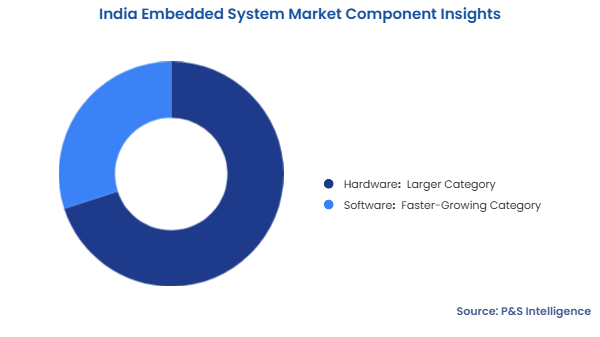
The hardware category holds the larger share in the Indian embedded systems market in 2025, of 70%, and is expected to maintain its position during the forecast period. This dominance is primarily attributed to the fundamental role hardware components play in embedded system functionality.
The growing production of consumer electronics devices drives substantial demand for these hardware components. The automotive sector's transformation with electric vehicles and advanced driver assistance systems requires sophisticated microcontrollers and processors. Industrial automation applications demand ruggedized hardware capable of operating in harsh environments. The increasing complexity of devices necessitates more powerful processors and larger memory capacities.
Software is witnessing the faster growth, during the forecast period, due to the rising demand for sophisticated software solutions to manage increasingly complex embedded systems. The integration of artificial intelligence and machine learning capabilities into embedded devices requires advanced software frameworks.
IoT applications demand secure and scalable software architectures for device management and data analytics. The shift toward software-defined systems in automotive and telecommunications sectors amplifies software demand. Cloud connectivity and edge computing implementations require robust embedded software stacks. The growing emphasis on cybersecurity necessitates sophisticated security protocols and firmware updates.
These components are covered:
Hardware (Larger Category)
Microcontrollers
Microprocessors
Digital Signal Processors (DSP)
Field-Programmable Gate Arrays (FPGA)
Application-Specific Integrated Circuits (ASIC)
Memories
Power Management ICs
Software (Faster-Growing Category)
Operating System (OS)
Middleware
Others
System Size Analysis
The medium-scale category holds the largest share in 2025, of 65%, as these 16–32-bit systems offer an optimal balance between processing power, cost, and energy efficiency. Medium-scale systems are extensively deployed in consumer electronics including smart home devices, wearables, and IoT sensors. The automotive industry utilizes these systems for body electronics, infotainment systems, and basic driver assistance features.
Industrial applications employ medium-scale embedded systems for process control, motor drives, and human-machine interfaces. The proliferation of connected devices in smart cities and industrial IoT implementations drives demand for these versatile systems. Their ability to handle moderate computational requirements while maintaining cost-effectiveness makes them attractive for manufacturers.
Large-scale embedded systems will witness the fastest growth, during 2026–2032, as above 32-bit systems provide high processing power and memory capacity essential for advanced applications. The category’s growth is driven by the increasing adoption in autonomous vehicles requiring extensive computational capabilities for sensor fusion and real-time decision-making. Modern vehicles contain 60 to 70 microcontrollers for advanced functionality, up from 25 to 35 in regular vehicles.
Advanced driver assistance systems demand powerful processors for image recognition and artificial intelligence algorithms. Industrial automation with complex robotics and machine vision applications requires large-scale embedded systems. The deployment of 5G infrastructure and edge computing nodes necessitates high-performance embedded solutions. Aerospace and defense applications with stringent reliability and processing requirements further drive the adoption of sophisticated large-scale systems.
Standalone systems hold the largest share in the market in 2025, of 45%, due to their independence and reliability in dedicated applications. These systems operate autonomously without requiring host computers or external networks, making them ideal for consumer appliances, digital cameras, smartwatches, and medical devices. The simplicity of standalone systems reduces complexity and enhances reliability, which is crucial for safety-critical applications.
Their cost-effectiveness appeals to manufacturers of high-volume consumer products. The ability to function independently ensures consistent performance regardless of network connectivity. Industrial equipment and home appliances benefit from standalone embedded systems that provide specific functionalities without external dependencies.
Real-time systems are expected to register the highest CAGR , during the forecast period. These systems process data and respond within strict time constraints, making them essential for time-sensitive applications. The automotive sector's adoption of advanced driver assistance systems and autonomous driving technologies drives the demand for real-time embedded systems. Manufacturing industries deploying predictive maintenance and quality control systems require real-time processing capabilities.
Healthcare applications, including patient monitoring systems and diagnostic equipment, depend on real-time data processing. Telecommunications infrastructure for 5G networks requires real-time embedded systems for network management. Aerospace & defense applications with mission-critical requirements rely on real-time systems for precision and reliability.
These functionalities are covered:
Standalone (Largest Category)
Real-Time (Fastest-Growing Category)
Network
Mobile
Application Analysis
Consumer electronics hold the largest share in 2025, of 30%, reflecting the massive scale of consumer device production in India. Embedded systems are integral to smartphones, tablets, smart TVs, wearable devices, and home appliances, enabling connectivity, user interfaces, and intelligent features. According to the IBEF, India's smartphone production reached USD 49.55 billion in FY24 and establishing the country as the world's second-largest mobile phone manufacturer after China.
Smart home devices including voice assistants, smart lighting, and connected appliances require embedded systems for IoT connectivity and automation. The growing middle-class population with rising disposable incomes drives consumer electronics demand. Declining electronics prices make advanced devices accessible to broader markets, amplifying embedded systems adoption.
The automotive application is projected to register the fastest growth, during 2026–2032, due to the growing adoption of electric vehicles, connected cars, and autonomous driving systems. Embedded systems power engine control units, advanced driver assistance systems, infotainment systems, and vehicle-to-everything communication. The electronic content in vehicles increases from 20% to almost 50% with electrification and automation, substantially expanding embedded systems demand.
The revenue of the automotive electronics market was recorded at USD 235.7 billion in 2019, and it is set to increase to USD 615.3 billion by the year 2030. Government initiatives promoting electric vehicle adoption through subsidies and charging infrastructure development support market growth. Safety regulations mandating advanced safety features in vehicles drive embedded systems integration.
These applications are covered:
Automotive (Fastest-Growing Application)
Consumer Electronics (Largest Application)
Industrial
Healthcare & Medical Devices
Telecommunications
Aerospace & Defense
Others
Drive strategic growth with comprehensive market analysis
India Embedded System Market Regional Outlook
Karnataka Embedded Systems Market Share
Karnataka holds the largest share in India's embedded systems market in 2025, at 40%, primarily attributed to Bangalore's status as India's technology capital and a major hub for electronics manufacturing and embedded systems design. The state hosts numerous global semiconductor companies, embedded systems design firms, and electronics manufacturing services providers. Major multinational corporations, including Intel, Texas Instruments, ARM, STMicroelectronics, Qualcomm, Analog Devices, and Cypress Semiconductor, operate significant design and development centers in Bangalore. Further, many indigenous companies specializing in embedded product development, including Mistral Solutions, Tessolve Semiconductor, and eInfochips, are headquartered in the state.
Karnataka's strong educational ecosystem with premier institutions including Indian Institute of Science, National Institute of Technology Karnataka, and numerous engineering colleges provides a steady supply of skilled embedded systems engineers. The state government's proactive policies promoting electronics manufacturing facilitate industry growth. The concentration of startups working on IoT solutions, robotics, and smart devices creates a vibrant innovation ecosystem. Proximity to global research and development centers enables technology transfer and collaboration. Karnataka's reliable power supply, connectivity, and industrial parks also support large-scale manufacturing operations.
Tamil Nadu Embedded Systems Market Growth
Tamil Nadu is expected to be the fastest-growing state market, with a CAGR of approx. 11.5%, during 2026–2032. The state's growth is driven by expanding electronics manufacturing capabilities and strategic government initiatives. Tamil Nadu hosts major electronics manufacturing clusters in Chennai, Coimbatore, and Hosur, attracting investments from global companies. The state government's proactive industrial policies including subsidies, land allocation, and single-window clearances incentivize electronics manufacturing. Major automotive manufacturers including Hyundai, Renault-Nissan, Ford, and numerous component suppliers drive automotive embedded systems demand.
Chennai's emergence as a smartphone manufacturing hub with facilities from Samsung, Foxconn, and other major players creates substantial demand for embedded components. Mitsubishi Electric Corporation plans to invest USD 222.5 million (JPY 26.7 billion) to establish an air conditioner and compressor manufacturing plant in Tamil Nadu, creating over 2,000 jobs. In March 2025, Ennoconn, a Foxconn subsidiary, commenced operations in its industrial automation facility in Tamil Nadu, providing industrial IoT and embedded technology solutions.
The state's focus on developing smart city infrastructure in Chennai, Coimbatore, and Madurai drives IoT-enabled embedded systems deployment. Tamil Nadu's strong textile and manufacturing base is increasingly adopting industrial automation with embedded control systems. The presence of educational institutions producing engineering talent supports industry requirements.
These states are covered:
Karnataka (Largest State Market)
Tamil Nadu (Fastest-Growing State Market)
Maharashtra
Telangana
Uttar Pradesh
Gujarat
Rest of India
India Embedded System Market Share
The Indian embedded systems market exhibits a fragmented nature due to the presence of both global multinational corporations and numerous domestic players offering specialized solutions. The market comprises established semiconductor manufacturers, embedded systems design firms, electronics manufacturing services providers, and emerging startups focusing on IoT and AI-powered embedded solutions.
The market's fragmented structure stems from diverse application requirements across industries necessitating specialized expertise. Global players leverage their advanced technology portfolios, extensive research and development capabilities, and established customer relationships. Domestic companies compete through cost advantages, deep understanding of local market requirements, and agility in customizing solutions. The differentiation between hardware-focused companies and software-centric firms further contributes to market fragmentation.
Strategic activities in the market focus on expanding manufacturing capabilities, developing advanced embedded solutions integrating artificial intelligence and machine learning, and establishing partnerships with automotive and industrial automation companies. Companies are investing in building skilled workforce through training programs and collaborations with educational institutions. The emphasis on localization of supply chains drives partnerships between global technology providers and Indian manufacturing firms. Several companies are expanding their presence in emerging application areas including electric vehicle systems, industrial IoT platforms, and smart city solutions.
Key India Embedded System Companies:
Intel Corporation
Qualcomm Incorporated
Texas Instruments Incorporated
Samsung Electronics Co. Ltd.
Analog Devices Inc.
STMicroelectronics N.V.
NXP Semiconductors N.V.
Infineon Technologies AG
Broadcom Inc.
MediaTek Inc.
Advanced Micro Devices Inc.
NVIDIA Corporation
Micron Technology Inc.
ON Semiconductor Corporation
Renesas Electronics Corporation
Microchip Technology Inc.
Realtek Semiconductor Corp.
Sony Semiconductor Solutions Corporation
ROHM Co. Ltd.
India Embedded System Market News
In March 2025, Ennoconn, a subsidiary of Foxconn, commenced operations in its newly established industrial automation facility in Tamil Nadu, introducing industrial IoT and embedded technology solutions to the Indian market.
In September 2024, Zoho, the Chennai-based tech firm, entered the ONDC network with Zoho IoT solutions, a platform enabling businesses to create and implement custom IoT applications for real-time management of industrial IoT device data.
In May 2024, Faculty, students, and researchers at the Indian Institute of Technology celebrated the successful creation and activation of India's first commercial RISC-V based secure IoT system on chip by the startup Mindgrove.
In November 2023, Sibros and Accolade Electronics partnered to provide embedded hardware systems for connected vehicles in India, aiming to optimize power efficiency, reduce costs, and expedite market entry.
Want a report tailored exactly to your business need?
Leading companies across industries trust us to deliver data-driven insights and innovative solutions for their most critical decisions. From data-driven strategies to actionable insights, we empower the decision-makers who shape industries and define the future. From Fortune 500 companies to innovative startups, we are proud to partner with organisations that drive progress in their industries.
Client Testimonials
Working with P&S Intelligence and their team was an absolute pleasure – their awareness of timelines and commitment to value greatly contributed to our project's success. Eagerly anticipating future collaborations.
McKinsey & Company
India
Unmatched Standards
Our insights into the minutest levels of the markets, including the latest trends and competitive landscape, give you all the answers you need to take your business to new heights
Complete Data Security
We take a cautious approach to protecting your personal and confidential information. Trust is the strongest bond that connects us and our clients, and trust we build by complying with all international and domestic data protection and privacy laws