India Battery Material Market Size & Share Analysis - Emerging Trends, Growth Opportunities, Competitive Landscape, and Forecasts (2026 - 2032)
This Report Provides In-Depth Analysis of the India Battery Material Market Report Prepared by P&S Intelligence, Segmented by Type (Cathode, Anode, Electrolyte, Separator), Battery Type (Lithium Ion, Lead Acid), Application (Automotive, Consumer Electronics, Energy Storage Systems, Industrial, Telecom & Data Centers, Medical Devices, Defense & Aerospace, Power Backup/UPS Systems), and Geographical Outlook for the Period of 2019 to 2032
Explore the market potential with our data-driven report
India Battery Material Market Future Outlook
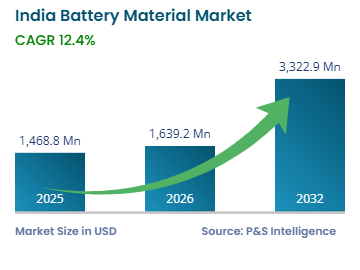
The Indian battery materials market values at USD 1,468.8 million in 2025, and it is projected to grow at a CAGR of 12.4% during 2026–2032, reaching USD 3,322.9 million by 2032. The market expansion is driven by the accelerating electric vehicle adoption, burgeoning renewable energy storage requirements, and government initiatives promoting domestic manufacturing of battery components. Battery materials, encompassing cathode, anode, electrolyte, and separator components, form the foundation of energy storage solutions powering the nation's clean energy transition.
The PLI scheme for advanced-chemistry-cell battery storage, approved in May 2021 with a budgetary outlay of INR 18,100 crore, aims to establish 50 GWh of ACC production capacity within the country. The scheme requires beneficiary firms to achieve domestic value addition of at least 25%, rising to 60% within five years, thereby creating opportunities for battery material suppliers. Additionally, the Viability Gap Funding program supports 4 GWh of battery energy storage capacity by 2030–31, with funding covering up to 40% of project capital costs. These policy measures collectively create a favorable environment for battery materials manufacturers by ensuring sustained demand and reducing market uncertainties.
India Battery Material Market Trends & Drivers
Expanding Energy Storage Requirements Are Major Market Trends
India's aggressive renewable energy deployment is creating parallel demand for battery energy storage systems, consequently driving battery materials consumption.
According to the Ministry of New and Renewable Energy, India added a record 29.52 GW of renewable energy capacity during FY 2024-25, bringing total installed capacity to 220.10 GW.
Solar energy led this expansion with 23.83 GW added, while wind capacity increased by 4.15 GW.
The intermittent nature of solar and wind generation necessitates efficient energy storage solutions to ensure grid stability and a reliable power supply, creating substantial demand for battery materials.
Between 2022 and May 2025, India auctioned approximately 12.8 GWh of battery energy storage system capacity for hybrid and standalone applications.
This utility-scale storage market represents a significant consumption channel for battery materials, particularly LFP cathode materials and graphite anodes optimized for grid-scale applications.
Rising Electric Vehicle Adoption Is Propelling Growth of Market
The proliferating adoption of electric vehicles across India represents a fundamental growth catalyst for the market.
The nation is witnessing a paradigm shift toward sustainable transportation, with EV sales demonstrating consistent double-digit growth over consecutive years.
The revenue from electric rickshaw sales in India will increase from USD 291.9 million in 2023 to USD 463.9 million by 2030, whereas electric two-wheeler sales may yield USD 113.8 billion by 2032.
Moreover, 430,603 electric cars will be sold in India by 2030, in contrast to 19,778 in 2023, while the market value of electric buses in India could attain USD 905.4 million by the end of the decade.
The PM E-DRIVE scheme, launched in October 2024 with an outlay of INR 10,900 crore, allocates INR 2,000 crore for public charging infrastructure and INR 500 crore specifically for electric trucks.
This translates into a rising demand for battery materials, particularly cathode materials containing lithium, cobalt, nickel, and manganese, as well as graphite-based anode materials.
The growing electric two- and three-wheeler sale is creating a substantial demand for battery materials optimized for smaller-capacity applications, particularly LFP cathode material, for their safety and cost-effectiveness.
Likewise, the rising electric passenger vehicle sale is driving demand for higher energy density nickel manganese cobalt cathode materials.
Discovery of New Lithium Reserves Presents Strategic Opportunity
The discovery of significant lithium reserves within India has emerged as a transformative opportunity for the domestic battery materials industry.
The Geological Survey of India identified approximately 5.9 million tonnes of lithium resources in the Salal-Haimana area of Reasi district in Jammu & Kashmir.
Preliminary studies by the Bhabha Atomic Research Centre have also confirmed the presence of approximately 2.5 million tonnes of lithium resources in Rajasthan's Nagaur district.
These discoveries present a pathway toward reducing raw material import dependency for cathode material production.
The Indian parliament's passage of legislation in August 2023 permits the auctioning and mining of newly discovered lithium reserves.
The removal of lithium from the list of atomic minerals has opened exploration to private companies, accelerating development timelines.
According to WRI India, in 2024, the central government successfully auctioned 24 blocks of critical and strategic minerals, including lithium and graphite, for battery production.
Additionally, Khanij Bidesh India Limited (KABIL) has been established to acquire strategic minerals from overseas, signing a INR 200-crore lithium exploration pact for five blocks in Argentina in January 2024.
India Battery Material Market Segmentation Analysis
Type Analysis
The cathode category holds the largest share in the Indian battery materials market in 2025, of 45%. Cathode is the most cost-intensive component of a battery, comprising essential elements including lithium, cobalt, nickel, manganese, iron, and aluminum, depending on the battery chemistry. The category's dominance is attributed to the increasing domestic manufacturing of lithium-ion cells and the rising demand from both EV and energy storage applications. Lithium-ion batteries account for 40–50% of total EV costs, with cathode materials constituting the largest proportion of cell material expenses.
The anode category is expected to witness the highest CAGR during the forecast period, driven by expanding domestic graphite processing capabilities and growing investments in silicon-carbon anode technologies. Epsilon Advanced Materials has commissioned a synthetic graphite anode manufacturing facility and is investing INR 9,000 crore to establish a 90,000-tonne-annual-capacity anode plant in Karnataka.
These types are covered:
Cathode (Largest Category)
Lithium
Cobalt
Nickel
Manganese
Iron
Aluminum
Others
Anode (Fastest-Growing Category)
Graphite
Silicon–Carbon Composite
Others
Electrolyte
Separator
Others
Battery Type Analysis
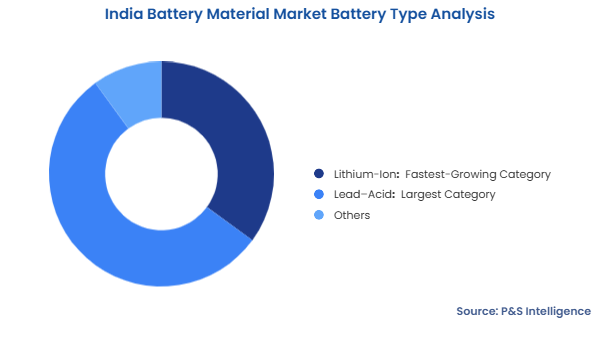
The lead–acid battery category dominates the Indian battery materials market in 2025 with 55% share, driven by the established prominence of SLA batteries for automotive starting and industrial backup power applications. India has an established lead–acid battery manufacturing ecosystem with players like Exide Industries and Amara Raja operating extensive production facilities. According to the Battery Council International, 99% of all lead batteries manufactured are recycled, making this segment attractive from a circular economy perspective. However, the lead–acid segment's growth rate is expected to trail lithium-ion as the market transitions toward advanced chemistry cells for mobility and storage applications.
The lithium-ion category has the highest CAGR, of 12.6%, credited to its superior energy density and longer cycle life than conventional alternatives and the declining costs of lithium-ion technology. Lithium prices have seen significant long-term declines, with battery pack prices hitting a record low of USD 108/kWh in late 2025, a 93% drop since 2010. Lithium-ion batteries are powering a widening range of critical applications, from electric two-wheelers, cars, and three-wheelers to residential and commercial energy-storage systems. They also support telecom infrastructure, data centers, portable electronics, and industrial automation. Their high energy density and fast-charging capability make them essential for India’s transition to clean mobility and reliable renewable-energy integration.
These battery types are covered:
Lithium-Ion (Fastest-Growing Category)
Lithium–Cobalt Oxide (LCO)
Lithium–Iron Phosphate (LFP)
Lithium–Nickel–Manganese–Cobalt (NMC)
Lithium–Nickel–Cobalt–Aluminum Oxide (NCA)
Others
Lead–Acid (Largest Category)
Others
Application Analysis
The automotive category holds the largest share in the Indian battery materials market in 2025, of 40%, due to the rising demand for materials for both electric vehicle traction and conventional automobiles’ auxiliary batteries. The automotive category’s dominance reflects India's position as the fourth-largest automobile market globally and the government's aggressive EV adoption targets. As per OICA, after slumping to 22,29,082 units in the first two quarters of 2021 due to the COVID-19 pandemic, automotive production in India rebounded to 26,68,647 units; 29,04,832 units; 30,85,537 units; and 32,12,705 units during the same period of 2022, 2023, 2024, and 2025, respectively.
According to industry data, major automotive manufacturers have announced cumulative investments of approximately USD 5.4 billion to expand EV manufacturing capacity in India. This is driving the demand for high-performance cathode materials, particularly NMC and LFP chemistries, as well as high-purity graphite anode materials.
The energy storage segment is expected to register the fastest growth during the forecast period, driven by the expanding grid-scale battery energy storage requirements and distributed energy storage applications. According to the Institute for Energy Economics and Financial Analysis, between 2022 and May 2025, India auctioned approximately 12.8 GWh of battery energy storage system capacity. The share of hybrid tendered capacity (renewable energy plus storage) has increased from approximately 12% in 2021 to over 49% in 2024 in overall renewable energy tenders. Energy storage applications primarily utilize LFP chemistry due to its safety, longevity, and cost-effectiveness for stationary applications.
These applications are covered:
Automotive (Largest Category)
Consumer Electronics
Energy Storage Systems (Fastest-Growing Category)
Industrial
Telecom & Data Centers
Medical Devices
Defense & Aerospace
Power Backup/UPS Systems
Others
Drive strategic growth with comprehensive market analysis
India Battery Material Market Geographical Analysis
Karnataka Battery Materials Market Size
Karnataka holds the largest state-level share in the Indian battery materials market in 2025, of 20%. This is attributed to its well-established industrial ecosystem, presence of leading battery manufacturers, and proactive state-level policies supporting clean energy transition. Karnataka hosts approximately 6,097 public EV charging stations as of 2025, the highest among Indian states. The state has emerged as a preferred destination for battery materials investments, with Epsilon Advanced Materials establishing primary manufacturing operations in Karnataka.
The state benefits from Bengaluru's technology ecosystem, which hosts numerous research and development facilities focused on battery technology innovation. Additionally, the state hosts the 2-GW Sharavathy pumped storage project under development through Karnataka Power Corporation Limited, creating demand for battery materials in energy storage applications.
Gujarat Battery Materials Market Outlook
Gujarat is expected to be the fastest-growing state market, with a CAGR of 12.5%, during 2026–2032. The state has emerged as a preferred destination for battery manufacturing investments, leveraging its industrial infrastructure, port connectivity, and favorable investment climate. The Tata Group has signed agreements, worth INR 13,000 crore in the first phase, to build a 20 GWh lithium battery manufacturing facility in Sanand, Gujarat, with potential expansion to 40 GWh. According to the Ministry of New and Renewable Energy, Gujarat led wind energy capacity additions in 2024 with 1,250 MW installed, creating a complementary demand for battery storage systems and associated battery materials.
The state's market growth is further supported by ample raw material imports and finished goods exports via its numerous ports. Manikaran Power Limited has invested INR 1,000 crore to build a refinery in Gujarat that will process lithium ore to produce basic battery components. The state government's incentive programs for clean energy investments are accelerating project development timelines and attracting domestic and international battery materials manufacturers.
These states are covered:
Karnataka (Largest State Market)
Gujarat (Fastest-Growing State Market)
Tamil Nadu
Maharashtra
Andhra Pradesh
Telangana
Rajasthan
Rest of India
India Battery Material Market Share
The Indian battery materials market is fragmented due to the presence of established domestic players, emerging startups, and increasing participation from international manufacturers. The competitive landscape is evolving rapidly as companies invest in capacity expansion, technology partnerships, and vertical integration strategies. The market fragmentation reflects the nascent stage of domestic battery cell manufacturing and the diverse material requirements across different battery chemistries and applications. Established players dominate the traditional lead–acid battery materials segment, while transitioning toward lithium-ion technologies.
The cathode and anode materials segments are witnessing the entry of specialized manufacturers. International players are increasing their presence through joint ventures and technology partnerships. Strategic collaborations between Indian companies and global technology leaders are facilitating knowledge transfer and accelerating the development of domestic manufacturing capabilities. The competitive environment is further shaped by government policies favoring domestic manufacturing and the availability of PLI incentives for qualifying investments.
Key India Battery Material Companies:
Tata Chemicals Limited
Epsilon Advanced Materials Pvt. Ltd.
Himadri Speciality Chemical Ltd.
LOHUM Cleantech Pvt. Ltd.
Reliance New Energy Ltd.
Umicore SA
BASF SE
Sumitomo Metal Mining Co. Ltd.
POSCO Chemical Co. Ltd.
Targray Technology International Inc.
LG Chem Ltd.
Samsung SDI Co. Ltd.
Huntsman Corporation
Dow Inc.
DuPont de Nemours Inc.
India Battery Material Market News
In February 2025, Epsilon Group signed an MoU with the Government of Karnataka to invest INR 15,350 crore for developing battery materials manufacturing and research facilities. The project includes a 90,000-tonne graphite anode plant and an LFP cathode manufacturing facility.
In January 2025, Himadri Speciality Chemical announced a technology licensing partnership with Sicona to access, localize, and commercialize proprietary Silicon–Carbon anode technology in India.
In January 2025, the Indian government cabinet approved a INR 163 billion program to secure supplies of critical minerals essential for battery production, including lithium, cobalt, and nickel, aiming to reduce import dependence and strengthen domestic manufacturing capabilities.
In December 2024, LG Energy Solutions entered negotiations with JSW Energy to establish a joint venture for manufacturing batteries for electric vehicles and renewable energy storage, with projected investment exceeding USD 1.5 billion.
In September 2024, the Ministry of Heavy Industries selected Reliance Industries Limited as the successful bidder for the 10-GWh advanced chemistry cell manufacturing tender under the PLI scheme, with a maximum budgetary outlay of INR 3,620 crore.
In July 2024, LOHUM announced plans to expand its recycling capacity from 5 GWh to 30 GWh over the next three years to strengthen domestic cathode material supply.
Want a report tailored exactly to your business need?
Leading companies across industries trust us to deliver data-driven insights and innovative solutions for their most critical decisions. From data-driven strategies to actionable insights, we empower the decision-makers who shape industries and define the future. From Fortune 500 companies to innovative startups, we are proud to partner with organisations that drive progress in their industries.
Client Testimonials
Working with P&S Intelligence and their team was an absolute pleasure – their awareness of timelines and commitment to value greatly contributed to our project's success. Eagerly anticipating future collaborations.
McKinsey & Company
India
Unmatched Standards
Our insights into the minutest levels of the markets, including the latest trends and competitive landscape, give you all the answers you need to take your business to new heights
Complete Data Security
We take a cautious approach to protecting your personal and confidential information. Trust is the strongest bond that connects us and our clients, and trust we build by complying with all international and domestic data protection and privacy laws