India Automotive Electronics Market Size & Share Analysis - Key Trends, Future Opportunities, Growth Strategies, and Forecasts (2026 - 2032)
This Report Provides In-Depth Analysis of the India Automotive Electronics Market Report Prepared by P&S Intelligence, Segmented by Component Type (Current Carrying Device, Electronic Control Unit (ECU), Sensors), System (Engine Electronics, Transmission Electronics, Chassis Electronics, Passive Safety System, Driver Assistance System, Passenger Comfort System, Entertainment System, Electronic Integrated Cockpit System), Vehicle Type (Cars, Two-Wheelers, Three-Wheelers, Trucks & Buses), Distribution Channel (Original Equipment Manufacturer (OEM), Aftermarket), Propulsion (Internal Combustion Engine (ICE), Battery Electric Vehicle (BEV), Hybrid/Plug-in Hybrid Electric Vehicle (HEV/PHEV), Fuel Cell Electric Vehicle (FCEV)), and Geographical Outlook for the Period of 2019 to 2032
India Automotive Electronics Market Size Estimation
Key Highlights
Study Period
2019 - 2032
Market Size in 2025
USD 12.6 Billion
Market Size in 2026
USD 14.0 Billion
Market Size by 2032
USD 27.8 Billion
Projected CAGR
12%
Largest State
Maharashtra
Fastest-Growing State
Karnataka
Market Structure
Fragmented
Market Size
Explore the market potential with our data-driven report
India Automotive Electronics Market Analysis
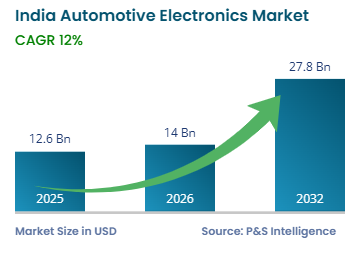
The Indian automotive electronics market values USD 12.6 billion in 2025, and it is projected to reach USD 27.8 billion by 2032, growing at a CAGR of 12.0% during 2026–2032. The market growth is primarily driven by increasing vehicle production, rising adoption of advanced driver assistance systems (ADAS), expanding electric vehicle penetration, and growing consumer demand for enhanced safety and infotainment features in vehicles.
India produced over 3.1 crore vehicles in FY 2024–25, compared to 2.84 crore vehicles in FY 2023–24, according to the Society of Indian Automobile Manufacturers (SIAM). This robust vehicle production directly translates into increased demand for automotive electronic components across all vehicle categories.
Road safety concerns continue to accelerate ADAS adoption across the country. According to estimates India recorded over 4.8 lakh road accidents in 2023, claiming approximately 1.73 lakh lives. These statistics have prompted regulatory mandates and consumer awareness, pushing automakers to integrate electronic safety features such as automatic emergency braking, lane departure warning, and blind-spot detection systems.
India Automotive Electronics Market Segmentation Analysis
Component Type Analysis
The current-carrying devices category holds the largest share in the Indian automotive electronics market in 2025, of 50%. Current-carrying devices, including wiring harnesses, connectors, and cables, form the fundamental infrastructure for all vehicle electrical systems. The increasing electronic content per vehicle, driven by the proliferation of sensors, actuators, and control modules, is expanding demand for sophisticated current-carrying solutions. Wiring harness complexity has grown significantly as modern vehicles incorporate numerous electronic features, with premium vehicles containing over 5 kilometers of wiring.
The sensors category is projected to witness the highest CAGR of approximately 12.2% during the forecast period, driven by the expanding adoption of ADAS, autonomous driving technologies, and electric powertrain systems. LiDAR, radar, cameras, ultrasonic sensors, and various position and temperature sensors are becoming integral to modern vehicles. The mandatory implementation of certain safety features is accelerating sensor deployment across all vehicle segments. Additionally, EV powertrains require specialized sensors for battery monitoring, thermal management, and motor control, further expanding the sensor market opportunity.
These component types are covered:
Current-carrying Devices (Largest Category)
Electronic Control Units (ECU)
Sensors (Fastest-Growing Category)
System Analysis
Engine electronics hold the largest share in the Indian automotive electronics market in 2025. Engine electronics encompass electronic fuel injection systems, engine management units, ignition systems, and emission control modules. The transition to BS-VI emission norms has substantially increased the electronic complexity of engine systems, requiring sophisticated sensors and control units for precise fuel management and emissions compliance.
The driver assistance system category is expected to register the fastest growth during the forecast period. The increasing regulatory push for vehicle safety, combined with consumer demand for advanced safety features, is driving rapid adoption of ADAS technologies. Features such as adaptive cruise control, automatic emergency braking, lane departure warning, and parking assistance systems are becoming standard across vehicle segments. The integration of these systems requires multiple sensors, cameras, and sophisticated processing units, representing significant value addition for automotive electronics suppliers.
These systems are covered:
Engine Electronics (Largest Category)
Transmission Electronics
Chassis Electronics
Passive Safety System
Driver Assistance System (Fastest-Growing Category)
Passenger Comfort System
Entertainment System
Electronic Integrated Cockpit System
Others
Vehicle Type Analysis
The passenger cars category dominates the Indian automotive electronics market in 2025 with 65% share, and it also has the highest CAGR. Passenger vehicles exhibit higher electronic content per unit compared to commercial vehicles, incorporating advanced infotainment systems, ADAS features, comfort electronics, and sophisticated powertrain controls. The rising consumer preference for technology-equipped vehicles and the growing availability of feature-rich models across price segments are driving segment growth. The entry of new electric vehicle models with premium electronic features is further expanding the passenger car electronics market.
These vehicle types are covered:
Cars (Largest and Fastest-Growing Category)
Two-Wheelers
Three-Wheelers
Trucks & Buses
Others
Distribution Channel Analysis
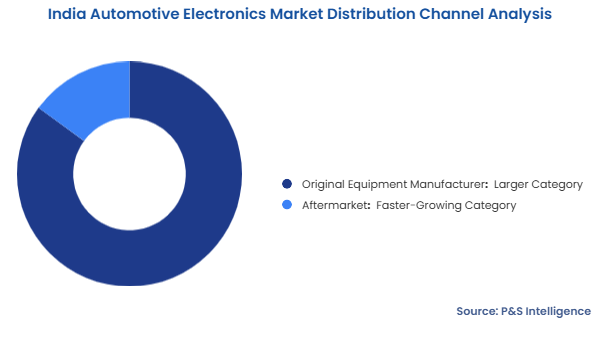
The OEM category holds the larger share in the Indian automotive electronics market in 2025, of 85%. OEMs procure electronic components directly from Tier-1 suppliers for integration into new vehicles during manufacturing. The increasing electronic content in modern vehicles, driven by safety mandates, emission regulations, and consumer feature preferences, is expanding OEM procurement of automotive electronics. Major automakers are forming strategic partnerships with electronics suppliers to develop India-specific solutions optimized for local driving conditions and price points.
The aftermarket category is expected to grow at a higher rate during the forecast period, driven by the expanding vehicle parc, increasing awareness of upgrade options, and growing e-commerce penetration in automotive parts. Electronic accessories, including advanced infotainment systems, dash cameras, parking sensors, and GPS navigation units, are experiencing strong aftermarket demand. The Indian used car market growth, with sales revenue exceeding USD 5,621.4 million and forecasts for USD 12,417.6 million by 2030, is creating additional opportunities for aftermarket electronics upgrades.
These distribution channels are covered:
Original Equipment Manufacturer (OEM) (Largest Category)
Aftermarket (Fastest-Growing Category)
Propulsion Analysis
ICE is the largest category, with 70% value share in 2025, due to their extensive installed base, mature supply chain, and cost advantages. Despite growing electrification, ICE platforms dominate passenger and commercial segments, driving substantial demand for engine control units, sensors, emission-management electronics, and fuel-system controllers. Regulatory pressure for cleaner emissions also boosts electronic content within ICE vehicles, as manufacturers integrate advanced OBD, efficiency optimization, and safety systems. While growth is slowing, ICE electronics still anchor overall market volume.
BEVs represent the fastest-growing category, with 12.3% CAGR, propelled by falling battery costs, strong policy incentives, rapid charging-infrastructure expansion, and rising adoption in two-wheelers and three-wheelers. BEVs require significantly higher electronic content—motor controllers, inverters, BMS, onboard chargers, power modules, and high-voltage architectures—making them a major growth driver for automotive electronics. Localization efforts and new OEM investments accelerate domestic demand.
Battery Electric Vehicle (BEV) (Fastest-Growing Category)
Hybrid/Plug-in Hybrid Electric Vehicle (HEV/PHEV)
Fuel Cell Electric Vehicle (FCEV)
Drive strategic growth with comprehensive market analysis
India Automotive Electronics Market Regional Outlook
Maharashtra Automotive Electronics Market Size
Maharashtra holds the largest share in the Indian automotive electronics market in 2025, of 20%. This is attributed to its well-established automotive manufacturing ecosystem, with Pune serving as a major automotive hub hosting Tata Motors, Mercedes-Benz, Bajaj Auto, and numerous Tier-1 component suppliers.
The state benefits from strong infrastructure, skilled workforce availability, and proximity to major ports for export activities. Major automotive electronics companies have established manufacturing and research facilities in Maharashtra. In January 2024, Hyundai Motor India finalized the acquisition of General Motors India's Talegaon Plant in Maharashtra and committed INR 6,000 crore in the state, indicating continued OEM investment that will drive automotive electronics demand.
Karnataka Automotive Electronics Market Outlook
Karnataka is expected to register the highest CAGR of approximately 12.1% in the Indian automotive electronics market during the forecast period, driven by its strong technology ecosystem and emerging position as an ADAS development hub. Bengaluru's IT prowess extends to automotive software development, with companies such as KPIT Technologies, Tata Elxsi, and Bosch Engineering operating significant R&D centers. The state recorded 179,037 EV registrations in 2024, ranking third nationally and demonstrating strong adoption of technology-intensive vehicles.
Toyota operates manufacturing facilities in Bidadi near Bangalore, while Volvo and other premium manufacturers have established presence in the state. Karnataka is leading in public EV charging infrastructure, with approximately 6,097 operational stations, facilitating EV adoption and associated electronics demand. The state government's proactive policies supporting electric mobility and technology innovation are attracting investments in automotive electronics manufacturing and R&D.
These states are covered:
Maharashtra (Largest State Market)
Tamil Nadu
Karnataka (Fastest-Growing State Market)
Gujarat
Haryana
Delhi
Uttar Pradesh
Rajasthan
Telangana
Andhra Pradesh
Rest of India
India Automotive Electronics Market Share
The Indian automotive electronics market is fragmented, characterized by the presence of global Tier-1 suppliers, multinational technology companies, and domestic component manufacturers. The competitive landscape features a mix of established international players with extensive product portfolios and regional companies developing India-specific solutions. Market participants are focusing on localization strategies, cost optimization, and technology partnerships to strengthen their positions in this high-growth market.
The top five players collectively hold less than half the market share in 2025, indicating a slightly fragmented market structure with significant opportunities for both established and emerging players. Global Tier-1 suppliers possess extensive product portfolios spanning engine electronics, ADAS systems, infotainment modules, and electrical components. These companies have established manufacturing facilities and R&D centers across India, adapting their global technologies for Indian driving conditions and price requirements.
Domestic players are gaining market share through competitive pricing, strong OEM relationships, and localized manufacturing capabilities. Strategic partnerships and technology collaborations are enabling faster technology transfer and localized product development, benefiting both global suppliers and domestic manufacturers seeking to upgrade their capabilities.
India Automotive Electronics Companies:
Robert Bosch GmbH
Continental AG
Hitachi Ltd.
Delphi Technologies PLC
ZF Friedrichshafen AG
Texas Instruments Incorporated
DENSO CORP.
NXP Semiconductors N.V.
Valeo SA
Infineon Technologies AG
Hella Gmbh & Co. KGaA
Panasonic Holdings Corporation
Visteon Corporation
Magna International Inc.
Hyundai Mobis Co. Ltd.
Lear Corp.
STMicroelectronics N.V.
ON Semiconductor Corporation
ROHM CO. LTD.
Renesas Electronics Corporation
Intel Corporation
Advanced Micro Devices Inc.
Qualcomm Technologies Inc.
Analog Devices Inc.
Harman International Industries Inc.
Murata Manufacturing Co. Ltd.
Microchip Technology Inc.
TE Connectivity Ltd.
Vishay Intertechnology Inc.
Aptiv PLC
India Automotive Electronics Market News
In October 2025, Bosch Engineering showcased a high-performance electric drive for agricultural machinery powered by up to 800-Volt batteries at AGRITECHNICA. Its compact size facilitates easy integration into confined installation areas, allowing existing device platforms to be retrofitted with environment-friendly electric drives.
In March 2025, Infineon Technologies and ARAI signed an MoU to develop advanced semiconductor solutions for India's automotive sector, focusing on EV inverters, vehicle control units, and ADAS technologies.
In December 2024, Hitachi ZeroCarbon announced a strategic alliance with COBUS Industries to equip 100 e.COBUS extended-range airport buses globally with its ZeroCarbon BatteryManager solution by 2025. This solution will assess the health and performance of COBUS's electric vehicle battery assets, assisting their clients in lowering the total cost of ownership, prolonging battery lifespan, and enhancing residual value via a reduced risk of degradation, optimized route planning, and early fault intervention.
In April 2023, HARMAN established an Automotive Engineering Centre in Chennai, India, aiming to become a key a supplier of vehicle electronics, advanced connected car and infotainment solutions for the Indian market.
Want a report tailored exactly to your business need?
Leading companies across industries trust us to deliver data-driven insights and innovative solutions for their most critical decisions. From data-driven strategies to actionable insights, we empower the decision-makers who shape industries and define the future. From Fortune 500 companies to innovative startups, we are proud to partner with organisations that drive progress in their industries.
Client Testimonials
Working with P&S Intelligence and their team was an absolute pleasure – their awareness of timelines and commitment to value greatly contributed to our project's success. Eagerly anticipating future collaborations.
McKinsey & Company
India
Unmatched Standards
Our insights into the minutest levels of the markets, including the latest trends and competitive landscape, give you all the answers you need to take your business to new heights
Complete Data Security
We take a cautious approach to protecting your personal and confidential information. Trust is the strongest bond that connects us and our clients, and trust we build by complying with all international and domestic data protection and privacy laws