In Vitro Fertilization Market Size & Opportunities Analysis - Growth Strategies, Competitiveness, and Forecasts (2026 - 2032)
This Report Provides In-Depth Analysis of the In Vitro Fertilization Market Report Prepared by P&S Intelligence, Segmented by Product (Equipment, Reagents & Media, Accessories & Disposables), Procedure Type (Fresh Non-Donor, Fresh Donor, Frozen Non-Donor, Frozen Donor), Technology (Conventional IVF, ICSI (Intracytoplasmic Sperm Injection), IVF with Donor Programs, IVF with Preimplantation Genetic Testing (PGT), IVF with Assisted Hatching), End User (Fertility Clinics, Hospitals, Research Laboratories & Academic Institutes), and Geographical Outlook for the Period of 2019 to 2032
Explore the market potential with our data-driven report
In Vitro Fertilization Market Analysis
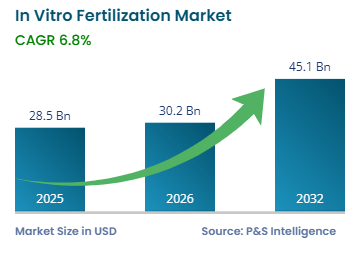
The in-vitro fertilization market size will be an estimated USD 28.5 billion for 2025, and it will grow by 6.8% during 2026–2032, to reach USD 45.1 billion by 2032.
The market is experiencing robust growth driven by the increasing prevalence of infertility worldwide, rising awareness about assisted reproductive technologies, and significant technological advancements such as artificial intelligence-powered embryo selection that have improved success rates.
One of the most significant trends reshaping the IVF market is the rapid adoption of AI and ML technologies for embryo selection. The integration of AI-powered embryo selection systems, which analyze time-lapse imaging and morphological data, has demonstrated the potential to improve implantation rates compared to traditional methods, making IVF procedures more successful and cost-effective for patients.
Another key factor driving market expansion is the growing trend of delayed parenthood, particularly among women in developed economies. As more women prioritize career advancement and financial stability, the average age at first childbirth has increased significantly, leading to age-related fertility challenges that necessitate assisted reproductive interventions. This demographic shift, combined with increasing acceptance of fertility preservation through egg freezing and embryo banking, has created a sustained demand for IVF services across all age groups.
In Vitro Fertilization Market Emerging Trends
Technological Innovations Are Key Trends Revolutionizing IVF Success Rates
The IVF industry is witnessing unprecedented technological advancement that is fundamentally transforming treatment outcomes and patient experiences.
The implementation of AI for embryo selection represents a paradigm shift in reproductive medicine.
AI-powered systems can now analyze thousands of embryo images and developmental sequences, providing automated scoring and predictive insights on embryo viability with up to 90% accuracy.
This technological leap has enabled fertility clinics to standardize embryo assessment procedures, reduce subjectivity in selection, and significantly improve pregnancy rates while potentially reducing the number of treatment cycles needed.
Time-lapse imaging systems integrated with deep learning algorithms have become increasingly sophisticated, allowing continuous monitoring of embryo development without disturbing the culture environment.
These systems capture images at short intervals, creating comprehensive developmental profiles that help embryologists identify the most viable embryos for transfer.
The technology has proven particularly valuable in identifying embryos with optimal division patterns and morphokinetic parameters, leading to improved implantation rates and reduced risk of multiple pregnancies.
Singapore’s Ministry of Health approved the adoption of AI-supported embryo grading tools under strict clinical governance requirements, enabling regulated deployment of machine-learning systems in accredited IVF labs.
Hamilton Thorne expanded its computer-assisted sperm analysis (CASA) system capabilities with enhanced deep-learning algorithms for motility and morphology scoring, improving precision in male-factor infertility assessment.
Rising Infertility RatesAre Biggest Driver
The global burden of infertility continues to escalate, driven by a complex interplay of lifestyle, environmental, and demographic factors.
According to the World Health Organization's comprehensive analysis of infertility prevalence from 1990–2021, the lifetime prevalence of infertility stands at 17.5% globally, with minimal variation between high-income countries (17.8%) and low- and middle-income countries (16.5%).
This widespread prevalence underscores the universal nature of fertility challenges across different socioeconomic contexts.
Environmental factors and lifestyle changes have emerged as significant contributors to declining fertility rates.
Increasing exposure to endocrine-disrupting chemicals, rising obesity rates, stress, and sedentary lifestyles have all been linked to impaired fertility in both men and women.
Male factor infertility, in particular, has shown alarming trends, with studies indicating declining sperm quality and count in many regions worldwide.
These factors, combined with the increasing prevalence of conditions such as polycystic ovary syndrome (PCOS) and endometriosis in women, have created a large patient population requiring assisted reproductive interventions.
As per the American Society for Reproductive Medicine, the number of infants conceived through IVF climbed from 91,771 in 2022 to 95,860 in 2023, representing 2.6% of all births in the USA.
The overall number of IVF cycles conducted at the 371 SART member clinics rose from 389,993 in 2022 to 432,641 in 2023.
The UK’s National Health Service (NHS) reports a consistent rise in the number of women seeking fertility treatment above age 38, reflecting a demographic trend contributing to increased ART demand.
In Vitro Fertilization Market Segmentation Analysis
Product Analysis
The equipment category holds the largest market share, of 40%, in 2025, driven by continuous technological innovations and the critical role of advanced instrumentation in improving IVF success rates. The dominance of this segment is primarily attributed to the widespread adoption of sophisticated imaging systems, AI-powered embryo selection platforms, state-of-the-art incubators with time-lapse technology, and automated sperm analysis systems. Fertility centers are significantly modernizing their equipment infrastructure to remain competitive and deliver superior patient outcomes, with particular emphasis on systems that offer integrated workflows and data analytics capabilities.
The reagents & media category will have the highest CAGR, of 7.0%, fueled by continuous improvements in culture media formulations and the development of specialized media for different stages of embryo development. The advancement in vitrification media has been particularly significant, with universal warming protocols now achieving 94% post-thaw survival rates across clinics. The increasing focus on optimizing culture conditions to support embryo development to the blastocyst stage, combined with the growing adoption of single embryo transfer protocols requiring higher-quality culture systems, drives demand for premium reagents and media products.
The products analyzed in this report are:
Equipment (Largest Category)
Sperm Analyzer Systems
Imaging Systems
Ovum Aspiration Pumps
Micromanipulator Systems
Incubators
Gas Analyzers
Laser Systems
Cryosystems
Sperm Separation Devices
IVF Cabinets
Anti-vibration Tables
Witness Systems
Others
Reagents & Media (Fastest-Growing Category)
Culture Media
Cryopreservation Media
Others
Accessories & Disposables
Needles
Pipettes
Dishes & Tubes
Others
Procedure Analysis
The fresh non-donor category holds the largest market share, in 2025, driven by its higher success rates compared to frozen cycles, particularly for women under 35 years of age, and the preference of many patients for immediate treatment using their own genetic material. Fresh non-donor cycles provide optimal embryo quality and allow immediate transfer after retrieval, which makes them especially suitable for first-time IVF patients and individuals with strong ovarian response.
The frozen non-donor category will have the highest CAGR, driven by significant improvements in vitrification technology and increasing adoption of elective single embryo transfer protocols. Additionally, frozen cycles offer greater flexibility in treatment timing, reduced risk of ovarian hyperstimulation syndrome (OHSS), and the ability to perform comprehensive genetic testing on embryos before transfer. The growing trend of fertility preservation and the success of freeze-all strategies in certain patient populations are further accelerating this segment's growth.
The procedures analyzed in this report are:
Fresh Non-Donor (Largest Category)
Fresh Donor
Frozen Non-Donor (Fastest-Growing Category)
Frozen Donor
Technology Analysis
The conventional IVF category holds the largest market share, of 35%, in 2025, maintaining its position as the foundational technology in assisted reproduction. This reflects its established efficacy, widespread availability, and lower cost compared to more advanced techniques. Conventional IVF remains the first-line treatment for many infertility cases, particularly those involving tubal factor infertility, unexplained infertility, and mild male factor infertility. The technique's proven track record and extensive clinical experience make it a reliable option for patients beginning their fertility journey.
The IVF with preimplantation genetic testing category will have the highest CAGR, driven by increasing awareness of genetic screening benefits and improving accessibility of genetic testing technologies. The ability to screen embryos for chromosomal abnormalities and specific genetic conditions before transfer has revolutionized fertility treatment for couples at risk of genetic disorders and women of advanced maternal age. According to industry data, the integration of PGT can improve implantation rates and reduce miscarriage risk, particularly in patients over 35 years old. The declining costs of genetic testing and the development of more comprehensive screening panels are making this technology accessible to a broader patient population.
The technologies analyzed in this report are:
Conventional IVF (Largest Category)
ICSI (Intracytoplasmic Sperm Injection)
IVF with Donor Programs
IVF with Preimplantation Genetic Testing (PGT) (Fastest-Growing Category)
IVF with Assisted Hatching
End User Analysis
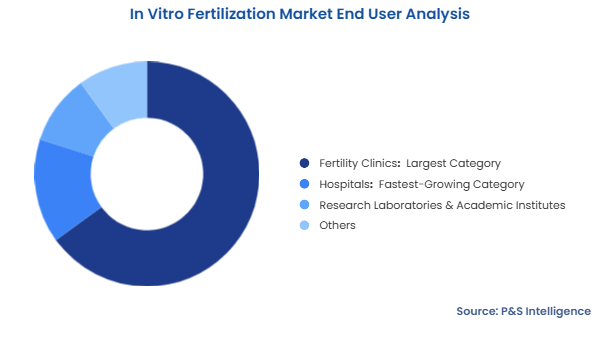
The fertility clinics category holds the largest market share, of 65%, in 2025. This is attributed to their specialized infrastructure, dedicated expertise in reproductive medicine, and comprehensive service offerings that encompass the entire fertility treatment journey. These specialized centers provide patients with access to state-of-the-art equipment, experienced embryologists, reproductive endocrinologists, and support staff trained specifically in fertility care. The personalized treatment protocols, higher success rates, and patient-centric approach offered by fertility clinics make them the preferred choice for couples seeking IVF treatment.
The hospitals category will have the highest CAGR, of 7.1%, driven by the increasing integration of fertility services within comprehensive healthcare systems and the expansion of reproductive medicine departments in major medical centers. Hospitals are increasingly recognizing the strategic importance of offering fertility services as part of their women's health portfolios, investing in advanced IVF laboratories, and recruiting specialized personnel.
The advantage of hospitals lies in their ability to provide integrated care for complex cases, immediate access to multidisciplinary teams for high-risk pregnancies, and established infrastructure for managing complications. Additionally, the trend toward value-based care and bundled payment models is encouraging hospitals to develop comprehensive fertility programs that can leverage their existing resources and patient base.
The end users analyzed in this report are:
Fertility Clinics (Largest Category)
Hospitals (Fastest-Growing Category)
Research Laboratories & Academic Institutes
Others
Drive strategic growth with comprehensive market analysis
In Vitro Fertilization Market Regional Outlook
Europe In Vitro Fertilization Market Size
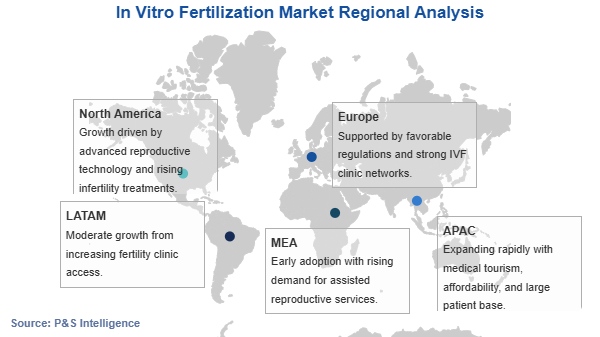
Europe holds the largest market share, of 35%, in 2025, supported by favorable regulatory frameworks, comprehensive insurance coverage in many countries, and well-established fertility infrastructure. The region's dominance is underpinned by progressive policies that mandate IVF coverage in France, Belgium, Denmark, and the Netherlands, making fertility treatments accessible to a broader population. Additionally, Europe's aging population and trend toward delayed childbearing have created sustained demand for assisted reproductive services.
The European market benefits from a highly developed network of both public and private fertility clinics, with Spain, the Czech Republic, and Greece emerging as major destinations for cross-border reproductive care. The harmonization of quality standards across EU member states and the establishment of comprehensive registries for tracking ART outcomes have further strengthened Europe's position as a leader in reproductive medicine.
Asia-Pacific In Vitro Fertilization Market Size
Asia-Pacific will have the highest CAGR, of 6.9%, driven by rapidly expanding healthcare infrastructure, increasing awareness of fertility treatments, and rising disposable incomes. The region's growth is particularly pronounced in countries like China, India, and Japan, where cultural shifts regarding family planning coincide with improving access to advanced reproductive technologies. China alone conducts over one million IVF cycles annually, representing the largest patient volume globally.
Government initiatives across the region are playing a crucial role in market expansion. Japan's insurance coverage expansion for fertility treatments, South Korea's support for IVF procedures, and Singapore's co-funding schemes for assisted reproduction have significantly improved treatment accessibility. South Korea’s Ministry of Health expanded subsidies for IVF and ICSI cycles in response to a record-low fertility rate of 0.72 (2023), one of the lowest in the world, significantly boosting access to infertility treatments.
The proliferation of fertility clinics in tier-2 and tier-3 cities, particularly in India and China, is bringing IVF services closer to previously underserved populations. Additionally, the region's emergence as a destination for affordable fertility treatments is attracting international patients, with Thailand and Malaysia offering high-quality services at competitive prices.
Middle East and Africa In Vitro Fertilization Market Size
The Middle East region, particularly the Gulf Cooperation Council (GCC) countries, is experiencing substantial growth in the IVF market, driven by high infertility rates, increasing government support, and significant healthcare investments aligned with national vision programs. Saudi Arabia has a significant market in MEA, supported by Vision 2030 initiatives to enhance healthcare quality and accessibility. The Kingdom's efforts to establish world-class fertility centers and attract international expertise are positioning it as a regional leader in reproductive medicine.
UAE In Vitro Fertilization Market Size
The UAE has positioned itself as a leading hub for fertility care in the region, with Dubai and Abu Dhabi hosting internationally accredited IVF centers that combine advanced technology with luxury healthcare experiences. The country's liberal regulations compared to neighboring nations, combined with its strategic location and world-class infrastructure, have made it attractive for medical tourism. Government initiatives to support Emirati couples through subsidized treatments and the establishment of specialized fertility preservation programs for cancer patients demonstrate the region's commitment to comprehensive reproductive healthcare.
The regions and countries of the market are as follows:
North America
U.S. (Larger and Faster-Growing Country Market)
Canada
Europe (Largest Regional Market)
Germany
U.K. (Largest Country Market)
France
Italy
Spain (Fastest-Growing Country Market)
Rest of Europe
Asia-Pacific (Fastest-Growing Regional Market)
China
India (Fastest-Growing Country Market)
Japan (Largest Country Market)
South Korea
Australia
Rest of APAC
Latin America
Brazil (Largest Country Market)
Mexico (Fastest-Growing Country Market)
Rest of LATAM
Middle East and Africa
Saudi Arabia (Fastest-Growing Country Market)
South Africa
U.A.E. (Largest Country Market)
Rest of MEA
In Vitro Fertilization Market Share
The market is semi-consolidated, characterized by the presence of numerous specialized fertility clinic chains, medical device manufacturers, and pharmaceutical companies operating across different segments of the value chain. While no single player commands a dominant market position globally, regional consolidation is evident as larger fertility networks expand through acquisitions and partnerships.
The competitive landscape is evolving rapidly as private equity firms and healthcare conglomerates recognize the attractive growth prospects and recurring revenue potential of fertility services. Recent years have witnessed significant consolidation activity, with major players acquiring regional fertility clinic chains to build integrated networks offering standardized protocols and improved patient experiences.
Leading medical device companies such as CooperSurgical, Vitrolife, and Thermo Fisher Scientific maintain significant market presence through their comprehensive product portfolios spanning equipment, consumables, and software solutions. These companies have strengthened their positions through strategic acquisitions and continuous innovation, with particular focus on developing integrated platforms that streamline laboratory workflows.
Key In Vitro Fertilization Companies:
The Cooper Companies, Inc.
Vitrolife AB
FUJIFILM Irvine Scientific, Inc.
Cook Medical LLC
Thermo Fisher Scientific Inc.
Merck KGaA
Ferring Pharmaceuticals
Hamilton Thorne Ltd.
Esco Lifesciences Group
Genea Biomedx
Kitazato Corporation
Eppendorf SE
Cryo Bio System
Nidacon International AB
Rocket Medical plc
In Vitro Fertilization Market News
In August 2025, Nova IVF Fertility Private Limited partnered with South Korea's Kai Health Co. Ltd. to implement Vita Embryo, an AI-powered embryo assessment tool across 120 clinics in 65 cities. They aim to enhance pregnancy rates and reduce treatment cycles through advanced machine learning algorithms.
In June 2025, SpOvum Technologies Private Limited partnered with Khushi Fertility LLP in India to integrate AI-powered laboratory automation, embryo tracking systems, and comprehensive lab management platforms, including the establishment of a dedicated R&D hub for real-time clinical trials.
In May 2025, AutoIVF Inc. secured a syndicated investment led by Vitrolife AB to advance automation in egg retrieval and preparation systems, addressing critical workflow bottlenecks in IVF laboratories.
In April 2025, Overture Life Inc. successfully raised USD 20.6 million in Series B funding to commercialize its automated IVF workstations designed to reduce per-cycle labor costs by up to 40% while standardizing laboratory procedures across fertility clinics.
In September 2024, Burjeel Holdings PLC announced plans to introduce comprehensive IVF services in Saudi Arabia through its Trust Fertility Clinic at Burjeel Medical City, integrating fertility treatments with specialized maternal and neonatal care in a single facility.
Want a report tailored exactly to your business need?
Leading companies across industries trust us to deliver data-driven insights and innovative solutions for their most critical decisions. From data-driven strategies to actionable insights, we empower the decision-makers who shape industries and define the future. From Fortune 500 companies to innovative startups, we are proud to partner with organisations that drive progress in their industries.
Client Testimonials
Working with P&S Intelligence and their team was an absolute pleasure – their awareness of timelines and commitment to value greatly contributed to our project's success. Eagerly anticipating future collaborations.
McKinsey & Company
India
Unmatched Standards
Our insights into the minutest levels of the markets, including the latest trends and competitive landscape, give you all the answers you need to take your business to new heights
Complete Data Security
We take a cautious approach to protecting your personal and confidential information. Trust is the strongest bond that connects us and our clients, and trust we build by complying with all international and domestic data protection and privacy laws