Hyperscale Data Center Market Size & Share Analysis - Trends, Drivers, Competitive Landscape, and Forecasts (2026 - 2032)
This Report Provides In-Depth Analysis of the Hyperscale Data Center Market Report Prepared by P&S Intelligence, Segmented by Component (Solutions, Services), Data Center Type (Colocation Hyperscale Data Centers, Cloud Hyperscale Data Centers, Enterprise Hyperscale Data Centers), Deployment (Cloud-Based, Hybrid, On-Premises), Industry (IT & Telecom, Retail & E-commerce, Banking, Financial Services, and Insurance, Government & Defense, Healthcare, Energy & Utilities, Media & Entertainment), and Geographical Outlook for the Period of 2021 to 2032
Explore the market potential with our data-driven report
Hyperscale Data Center Market Future Outlook
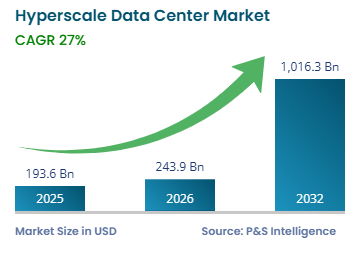
The hyperscale data centre market size was USD 1,93.6 billion for 2025, and it will grow by 27.0% during 2026-2032, to reach USD 1,016.3 billion by 2032.
The hyperscale data centre market is expanding as large-scale facilities become essential infrastructure for cloud computing, artificial intelligence, digital platforms, and data-intensive enterprise operations. Organisations are generating increasing volumes of information through connected devices, business applications, streaming platforms, digital transactions, and analytics systems, creating demand for infrastructure capable of delivering high computing capacity, extensive storage resources, and reliable network performance. The growing adoption of cloud-native architectures, software-as-a-service platforms, and hybrid IT environments is encouraging technology providers and enterprises to invest in hyperscale facilities that can efficiently scale alongside rapidly expanding workloads while maintaining service availability and low-latency performance.
The market is also benefiting from rising deployment of artificial intelligence, machine learning, and advanced analytics workloads that require significantly greater computing power than traditional enterprise applications. Major cloud providers, technology companies, and colocation operators are expanding capacity to support AI model training, inference processing, and high-performance computing environments. According to the International Telecommunication Union, 5.5 billion people were online globally in 2024, representing 68% of the world's population. The growing number of internet users is increasing consumption of cloud services, digital platforms, online content, connected applications, and real-time data processing activities. This expansion is creating greater demand for hyperscale infrastructure capable of supporting large-scale computing, storage, networking, and AI workloads while encouraging continued investment in fibre connectivity, power systems, advanced cooling technologies, and energy-efficient facility designs across established and emerging digital markets.
Key Market Insights
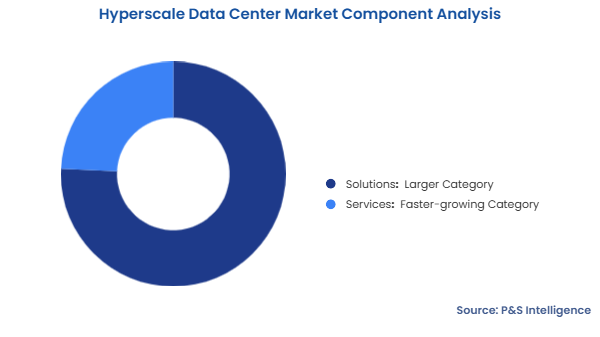
Solutions is the larger component, holding a market share of 75.5%, due to substantial investments in servers, storage systems, networking infrastructure, and software platforms.
Cloud Hyperscale Data Centres are the fastest-growing facility type, registering a CAGR of 27.9%, driven by expanding cloud-native workloads, AI applications, and regional cloud infrastructure investments.
Cloud-Based is the largest deployment category, holding a market share of 60.0%, driven by increasing enterprise adoption of scalable cloud infrastructure.
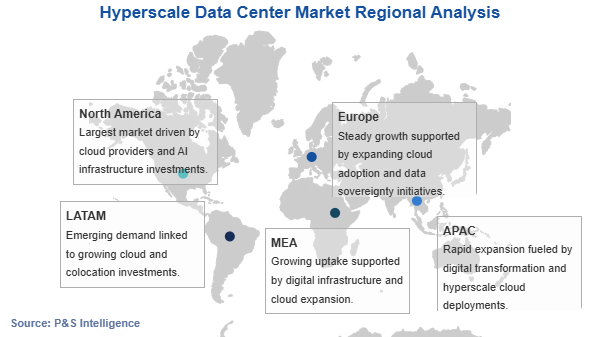
North America holds the largest share, of 45.0%, supported by the presence of major hyperscale cloud providers, leading technology companies, and advanced digital infrastructure.
Asia-Pacific has the highest CAGR, of 28.5%, driven by expanding cloud computing, AI adoption, and digital economies.
Hyperscale Data Center Market Trends and Drivers
AI-Optimized Hyperscale Infrastructure Deployment Is a Major Trend
The hyperscale data centre industry is increasingly shifting towards infrastructure designed specifically for artificial intelligence workloads rather than traditional cloud computing environments. Operators are deploying high-density computing architectures, advanced cooling technologies, specialised networking systems, and power-intensive server clusters to support AI model training, inference processing, and high-performance computing applications. According to the International Energy Agency (IEA), electricity consumption from AI-focused data centres increased by 50% in 2025, while the power density of AI servers became 11 times higher in 2025 than in 2020. As AI models continue to grow in complexity and scale, hyperscale operators are redesigning facilities with higher rack densities, liquid cooling technologies, advanced power distribution systems, and energy-efficient infrastructure to manage increasing computational requirements. These developments are accelerating investments in AI-ready data centres, enabling operators to improve processing performance, optimise energy efficiency, and support the growing demand for next-generation AI computing and cloud services.
Rising Enterprise and Cloud Data Generation Drives Market
The market is growing because organisations are creating, storing, and processing significantly larger volumes of digital information across cloud platforms, enterprise applications, connected devices, online transactions, artificial intelligence applications, and digital collaboration systems. Businesses increasingly depend on data-driven operations, requiring infrastructure capable of supporting continuous workload growth while maintaining high performance, scalability, and reliability. According to the International Telecommunication Union (ITU), global fixed broadband traffic reached 7.3 ZB in 2025, while mobile broadband traffic reached 1.5 ZB. The ITU also reported that approximately 6 billion people, representing nearly 75% of the world's population, were using the internet in 2025. The rapid growth in internet users, cloud adoption, AI workloads, and global data traffic is significantly increasing demand for hyperscale data centres capable of delivering large-scale computing, storage, networking, and workload management capacity while supporting the continued expansion of cloud and digital service ecosystems.
Power Availability and Infrastructure Development Constraints Limit Market Expansion
Power availability remains one of the most significant restraints affecting hyperscale data centre development. Large-scale facilities require substantial and reliable electricity supplies, making expansion increasingly dependent on grid capacity, transmission infrastructure, utility approvals, and long-term access to affordable energy. In many regions, delays in grid connections, limited power availability, and lengthy permitting processes are extending project timelines and restricting the development of new hyperscale facilities. According to the International Energy Agency (IEA), data centres consumed approximately 415 TWh of electricity globally in 2024, accounting for around 1.5% of worldwide electricity consumption. As electricity demand from AI-driven workloads and cloud services continues to grow, concerns over power availability, grid stability, and sustainable energy sourcing are becoming more significant, creating additional challenges for hyperscale operators seeking to expand capacity efficiently while meeting environmental and regulatory requirements.
Expansion of Emerging Data Centre Hubs Creates Significant Growth Opportunity
Power availability and infrastructure development challenges remain major constraints affecting the expansion of the hyperscale data centre market. Large-scale facilities require substantial and uninterrupted electricity supplies, making new developments highly dependent on grid capacity, transmission infrastructure, utility approvals, and access to reliable energy sources. In many regions, limited grid availability, lengthy permitting processes, and delays in power connections are increasing project costs and extending construction timelines. According to the International Energy Agency (IEA), data centres consumed approximately 415 TWh of electricity globally in 2024, accounting for around 1.5% of worldwide electricity consumption. As demand for AI computing, cloud services, and high-performance workloads continues to rise, operators face growing challenges in securing sufficient power capacity, maintaining grid stability, and meeting sustainability targets, thereby slowing the timely deployment and expansion of hyperscale data centre facilities.
Hyperscale Data Center Market Segmentation Analysis
Component Analysis
Solutions is the larger category, holding a market share of 75.5%, because hyperscale data centres require substantial investments in servers, storage systems, networking infrastructure, and software platforms to support cloud computing, artificial intelligence, and high-performance computing workloads. These core infrastructure components form the foundation of hyperscale operations and account for a significant share of capital expenditure during the construction and expansion of large-scale facilities. According to the International Energy Agency (IEA), global data centre electricity consumption reached approximately 415 TWh in 2024, driven primarily by the increasing deployment of high-performance servers and AI computing infrastructure.
Services are the faster-growing category, registering a CAGR of 27.5%, due to increasing demand for specialised expertise in designing, deploying, integrating, and maintaining complex hyperscale environments. Operators are expanding their reliance on consulting, installation, deployment, and maintenance services to support AI-ready infrastructure, sustainability initiatives, cloud expansion, and operational optimisation. As hyperscale facilities become more sophisticated and geographically distributed, organisations increasingly require external technical expertise to improve performance, minimise deployment risks, and ensure continuous operations.
The components analysed in this report are:
Solutions (Larger Category)
Servers
Storage
Networking
Software
Services (Faster-growing Category)
Consulting
Installation & Deployment
Maintenance & Support
Data Centre Type Analysis
Colocation Hyperscale Data Centres is the largest category, holding a market share of 65.0%, because global cloud service providers such as Amazon Web Services, Microsoft Azure, Google Cloud, Oracle Cloud, and Alibaba Cloud continue to invest heavily in expanding hyperscale infrastructure to support cloud computing, artificial intelligence, big data analytics, and high-performance computing workloads. These facilities provide the scalability, reliability, and computing capacity required to serve millions of enterprise and consumer applications while supporting rapid growth in digital services worldwide. According to Amazon Web Services (AWS), the company launched the AWS Asia Pacific (Taipei) Region in 2025, expanding its global cloud infrastructure to support increasing demand for cloud services, lower latency, and local data residency requirements.
Cloud Hyperscale Data Centres is the fastest-growing category, registering a CAGR of 27.9%, because enterprises, digital platform providers, and cloud companies increasingly prefer leasing scalable infrastructure instead of investing in the construction and operation of their own large-scale facilities. Colocation providers offer flexible capacity expansion, high-speed connectivity, reliable power infrastructure, and operational expertise while reducing capital expenditure and accelerating deployment timelines.
The data centre types analysed in this report are:
Colocation Hyperscale Data Centres (Largest Category)
Cloud Hyperscale Data Centres (Fastest-growing Category)
Enterprise Hyperscale Data Centres
Deployment Analysis
Cloud-Based is the largest category, holding a market share of 60.0%, because enterprises increasingly rely on scalable and cost-efficient cloud infrastructure to support business operations, application deployment, artificial intelligence workloads, and digital transformation initiatives. Cloud-based deployment enables organisations to rapidly scale computing resources, improve operational flexibility, and reduce infrastructure management costs while ensuring high availability and business continuity. According to Eurostat, approximately 53% of enterprises in the European Union purchased cloud computing services in 2025.
Hybrid is the fastest-growing category, registering a CAGR of 28.1%, as organisations increasingly seek to combine the scalability of public cloud platforms with the security and control of on-premises infrastructure. Hybrid deployment enables businesses to optimise workload placement based on performance, compliance, security, and operational requirements while supporting multi-cloud strategies and business continuity. Growing demand for data sovereignty, AI applications, and modern enterprise workloads is accelerating the adoption of hybrid infrastructure.
The deployments analysed in this report are:
Cloud-Based (Largest Category)
Hybrid (Fastest-growing Category)
On-Premises
Industry Analysis
IT & Telecom is the largest category, holding a market share of 25.0%, because the sector generates enormous volumes of digital data through cloud computing, telecommunications networks, internet services, streaming platforms, and enterprise applications. Telecommunications operators, cloud service providers, and technology companies rely on hyperscale data centres to deliver scalable computing, storage, networking, and AI capabilities while ensuring high availability and low-latency connectivity.
Retail & E-commerce is the fastest-growing category, registering a CAGR of 27.6 because retailers are increasingly adopting digital commerce platforms, AI-powered customer analytics, real-time inventory management, personalised shopping experiences, and omnichannel business models. According to Eurostat, 78% of internet users in the European Union purchased or ordered goods or services online in 2025. The continued growth of e-commerce and digital retail is driving greater demand for hyperscale data centres to support transaction processing, cloud applications, customer analytics, recommendation engines, and AI-enabled retail operations.
The industries analysed in this report are:
IT & Telecom (Largest Category)
Retail & E-commerce (Fastest-growing Category)
Banking, Financial Services, and Insurance (BFSI)
Government & Defense
Healthcare
Energy & Utilities
Media & Entertainment
Others
Drive strategic growth with comprehensive market analysis
Hyperscale Data Center Market Regional Analysis
North America Hyperscale Data Centre Market Analysis
North America holds the largest share, of 45.0%, because the region hosts the world's most mature hyperscale data centre ecosystem, supported by the strong presence of major cloud service providers, digital platform companies, and leading technology enterprises. The region benefits from extensive fibre-optic connectivity, reliable power infrastructure, advanced networking capabilities, and a well-established colocation industry that enables rapid deployment of hyperscale facilities. Continuous investments in artificial intelligence infrastructure, high-performance computing environments, and cloud capacity expansion are further strengthening market demand. According to the World Bank, North America accounted for more than 5,700 operational data centres in 2023, including 5,375 in the United States and 335 in Canada, highlighting the region's highly developed digital infrastructure and reinforcing its leadership in the global data centre industry.
U.S. Hyperscale Data Centre Market Analysis
The United States is the largest country market, because it hosts the world's leading cloud service providers, artificial intelligence companies, and some of the largest interconnected hyperscale data centre campuses. Extensive fibre-optic connectivity, a mature colocation ecosystem, abundant digital infrastructure, and continuous investments in cloud computing and AI technologies continue to support large-scale capacity expansion across the country. According to the U.S. Department of Energy (DOE), data centres are projected to consume between 6.7% and 12.0% of total U.S. electricity by 2028, compared with approximately 4.4% in 2023, driven primarily by the rapid growth of artificial intelligence and cloud computing workloads.
Canada Hyperscale Data Centre Market Analysis
Canada is the fastest-growing country market, because operators are increasingly investing in sustainable and domestically hosted digital infrastructure. The country's cooler climate supports energy-efficient operations, while growing cloud adoption and data residency requirements are encouraging new hyperscale developments. According to Statistics Canada, renewable sources accounted for 63.9% of total electricity production in 2024. Strong availability of renewable electricity supports long-term facility expansion strategies and strengthens Canada's attractiveness for hyperscale operators seeking scalable infrastructure with lower-carbon energy supply options.
Asia-Pacific Hyperscale Data Centre Market Analysis
Asia-Pacific has the highest CAGR, of 28.5%, driven by the rapid expansion of digital economies, cloud computing, artificial intelligence, and internet-based services across both developed and emerging countries. Strong growth in enterprise digitalisation, e-commerce, fintech, and AI adoption is significantly increasing demand for large-scale data processing and storage infrastructure. According to the International Telecommunication Union (ITU), the Asia-Pacific region accounted for approximately 3.4 billion internet users in 2025, representing the largest online population globally. The region's expanding digital user base is generating massive volumes of data, accelerating investments in hyperscale data centres to support cloud services, AI workloads, and digital applications. China remains the largest country market, supported by its extensive cloud ecosystem, large domestic data generation volumes, and continued investments in advanced computing infrastructure. India is the fastest-growing country market due to accelerating data localisation initiatives, expanding digital public infrastructure, and increasing investments from global hyperscale operators seeking long-term capacity expansion opportunities.
China Hyperscale Data Centre Market Analysis
China is the largest country market, because its vast digital economy, expanding cloud ecosystem, and growing adoption of artificial intelligence continue to increase demand for advanced computing infrastructure. Domestic technology companies are investing heavily in hyperscale deployments to support data-intensive applications and enterprise digitalisation initiatives. According to the National Data Administration of China, the country's computing power reached 280 EFLOPS in 2024. Expanding computing capacity is increasing demand for hyperscale facilities capable of supporting large-scale processing, storage, networking, and artificial intelligence workloads across multiple industries.
India Hyperscale Data Centre Market Analysis
India is the fastest-growing country market, because rapid growth in digital services, cloud adoption, e-commerce platforms, and data localisation requirements is increasing demand for large-scale processing infrastructure. Global cloud providers and colocation operators are expanding investments to support growing digital activity across the country. According to the Telecom Regulatory Authority of India, wireless data usage reached 228,779 PB during 2024–25. Rising data consumption is creating stronger demand for hyperscale facilities capable of supporting cloud workloads, digital applications, content delivery, and high-volume data processing requirements.
Europe Hyperscale Data Centre Market Analysis
Europe's hyperscale data centre market is supported by strong enterprise digitalisation, increasing cloud adoption, and growing regulatory emphasis on data sovereignty. Organisations across the region are expanding investments in localised data infrastructure to comply with data governance requirements while maintaining operational flexibility. According to Eurostat, approximately 53% of enterprises in the European Union purchased cloud computing services in 2025, reflecting the growing adoption of cloud-based technologies across businesses. Rising cloud utilisation, together with increasing demand for artificial intelligence applications, digital services, and secure data storage, is driving investments in hyperscale data centre infrastructure across the region. Growing investments in energy-efficient facilities, high-speed connectivity infrastructure, and AI-ready data centres are further supporting the expansion of hyperscale capacity across Europe.
The regions and countries analysed in this report are:
North America (Largest Regional Market)
U.S. (Larger Country)
Canada (Faster-Growing Country)
Europe
Germany
U.K. (Largest Country)
France
Italy (Fastest-Growing Country)
Spain
Rest of Europe
Asia-Pacific (Fastest-Growing Regional Market)
China (Largest Country)
India (Fastest-Growing Country)
Japan
South Korea
Australia
Rest of APAC
Latin America
Brazil (Largest Country)
Mexico (Fastest-Growing Country)
Rest of LATAM
Middle East and Africa
Saudi Arabia (Largest and Fastest-Growing Country)
U.A.E.
South Africa
Rest of MEA
Hyperscale Data Center Market Competitive Landscape
The hyperscale data centre market is consolidated, with a limited group of global cloud providers, colocation operators, and large-scale infrastructure companies accounting for a substantial share of installed capacity and ongoing expansion projects. Market participation requires significant capital investment, extensive access to power and connectivity infrastructure, specialised operational expertise, and the ability to develop facilities at scale, creating high barriers to entry for new participants. Leading companies continue to strengthen their positions through large campus developments, long-term land acquisitions, strategic partnerships, and expansion into emerging data centre locations. Their established customer relationships, global footprints, and financial resources enable them to secure critical infrastructure assets more effectively than smaller competitors. As demand for cloud computing and AI-ready capacity continues to rise, market leadership remains concentrated among major operators that possess the scale, technical capabilities, and investment capacity necessary to support hyperscale deployments across multiple regions.
Leading Companies in the Hyperscale Data Center Market:
Amazon.com, Inc.
Microsoft Corporation
Alphabet Inc.
Alibaba Group Holding Limited
Oracle Corporation
Meta Platforms, Inc.
Tencent Holdings Limited
Equinix, Inc.
Digital Realty Trust, Inc.
NTT DATA Group Corporation
GDS Holdings Limited
Arista Networks, Inc.
Vertiv Holdings Co.
Intel Corporation
IBM Corporation
CyrusOne Inc.
Hyperscale Data Center Market Developments
In July 2025, CyrusOne Inc. announced a strategic partnership with Calpine Corporation through a 190 MW power supply and infrastructure agreement to support the development of a new hyperscale data center campus adjacent to the Thad Hill Energy Center in Bosque County, Texas.
In March 2025, Arista Networks, Inc. introduced the EOS Smart AI Suite, featuring Cluster Load Balancing (CLB) and CloudVision Universal Network Observability (CV UNO), to enhance networking performance and operational visibility for AI clusters in hyperscale data centres. The solution enables intelligent Ethernet traffic management, AI job-centric observability, and optimized network utilisation, helping hyperscale cloud providers improve the scalability, efficiency, and reliability of AI infrastructure deployments.
In October 2024, Equinix, Inc. announced the formation of a more than US$15 billion joint venture with Canada Pension Plan Investment Board (CPP Investments) and GIC to accelerate the expansion of its xScale hyperscale data center portfolio across the United States. The joint venture will support the acquisition of land and development of new hyperscale data center campuses, adding more than 1.5 GW of capacity to meet the growing demand for artificial intelligence and cloud computing infrastructure.
Frequently Asked Questions About This Report
What does the hyperscale data center market include for organizations?+
It includes very large facilities designed to support massive cloud, AI, storage, networking, and digital service workloads.
What factors are driving demand in the hyperscale data center market?+
Demand is driven by cloud growth, AI computing, streaming, enterprise digitization, data storage, and need for scalable infrastructure.
Why are organizations adopting hyperscale data center solutions across operations?+
Companies adopt hyperscale data centers to run large workloads, improve service availability, and support global digital platforms.
How do hyperscale data center solutions improve decision making and efficiency?+
These facilities improve operations by providing scalable compute, dense storage, redundant power, cooling, and high capacity network connectivity.
What challenges affect adoption of hyperscale data center solutions today?+
Adoption is affected by power availability, cooling needs, land access, capital intensity, sustainability requirements, and supply chain constraints.
Want a report tailored exactly to your business need?
Leading companies across industries trust us to deliver data-driven insights and innovative solutions for their most critical decisions. From data-driven strategies to actionable insights, we empower the decision-makers who shape industries and define the future. From Fortune 500 companies to innovative startups, we are proud to partner with organisations that drive progress in their industries.
Client Testimonials
Working with P&S Intelligence and their team was an absolute pleasure – their awareness of timelines and commitment to value greatly contributed to our project's success. Eagerly anticipating future collaborations.
McKinsey & Company
India
Unmatched Standards
Our insights into the minutest levels of the markets, including the latest trends and competitive landscape, give you all the answers you need to take your business to new heights
Complete Data Security
We take a cautious approach to protecting your personal and confidential information. Trust is the strongest bond that connects us and our clients, and trust we build by complying with all international and domestic data protection and privacy laws