This Report Provides In-Depth Analysis of the Hydrogen Market Report Prepared by P&S Intelligence, Segmented by Production Process (Steam, Coal Gasification, Electrolysis, Partial Oxidation), Generation Method (On-Site Generation, Cylinder, Tanker), End User (Chemical, Refineries, Metal Processing), and Geographical Outlook for the Period of 2021 to 2032
Explore the market potential with our data-driven report
Hydrogen Market Overview
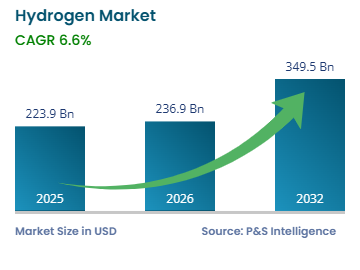
The global hydrogen market was valued at USD 223.9 billion in 2025 and is expected to grow at a CAGR of 6.6% between 2026 and 2032, reaching USD 349.5 billion by 2032. This growth is largely driven by hydrogen’s key role in producing ammonia for fertilisers and its use in the refining sector. Hydrogen is crucial for ammonia production, which in turn is used to create nitrogen-based fertilisers that boost crop yields, improve soil health, and support sustainable farming practices. As the world’s population continues to rise, the demand for higher crop productivity and efficient nutrient management is pushing the need for more fertilisers—and, consequently, more hydrogen for ammonia synthesis.
Key Market Insights
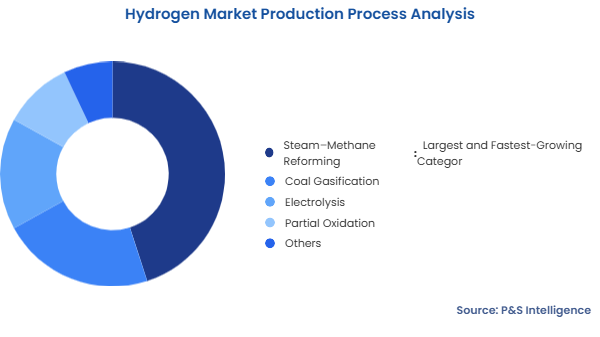
Steam–methane reforming held the largest share, of 45%, and will also record the highest CAGR, of approximately 7.0%.
On-site generation accounted for the largest share, of 60%, and it is also expected to achieve the highest CAGR, of approximately 6.8%.
The chemical industry accounted for the largest share, of 45%, and it will also record the highest CAGR, of approximately 7.2%.
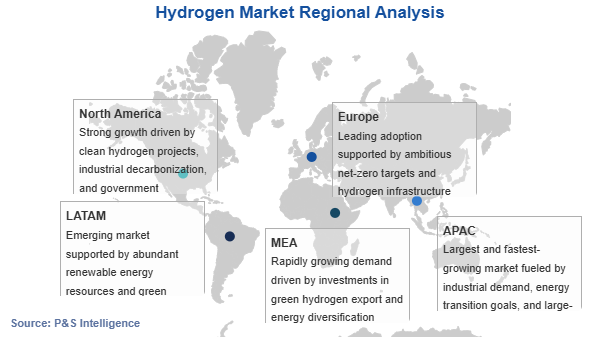
The APAC region held the largest share, of 40%, and it also has the highest CAGR, of approximately 7.5%.
At the same time, stricter environmental regulations aimed at reducing sulphur in fuels and cutting emissions are increasing hydrogen consumption in crude oil refining. Refineries are increasingly relying on hydrogen-intensive processes like hydrodesulphurisation and other clean fuel production techniques to meet these standards. Beyond agriculture and refining, hydrogen is becoming increasingly important in emerging areas such as fuel cells, energy storage, and as a potential clean energy source in industrial applications—highlighting the global shift toward low-carbon energy solutions.
The combined growth in agricultural demand, expanding refining operations, and the adoption of sustainable energy practices continue to drive the global hydrogen market. With its wide range of applications and critical role in supporting both environmental and food security goals, hydrogen is set to remain a cornerstone of industrial and energy innovation over the next decade.
Hydrogen Market Trends and Drivers
Eco-Friendly Production Processes Are Trending
Around the world, governments and companies are working toward making Earth a net-zero emissions planet, and hydrogen is increasingly seen as a key energy carrier in this transition. Its potential as a low-emission fuel and clean energy source has made it central to many strategies for a greener future. A variety of initiatives, policies, and investments are underway to integrate hydrogen more deeply into energy systems and industrial processes. However, most hydrogen today is still produced using fossil fuel–based methods like steam methane reforming, coal gasification, and partial oxidation, which generate significant greenhouse gas emissions during production. According to the International Energy Agency (IEA), global hydrogen production was responsible for nearly 920 million tonnes of CO₂ emissions in 2023, mainly from unabated natural gas and coal pathways. This clearly underscores the urgent need for cleaner production methods.
To meet this challenge, there is growing focus on green hydrogen—produced by water electrolysis powered by renewable energy sources such as solar and wind. This approach can virtually eliminate CO₂ emissions at the point of production. By using electricity with low carbon intensity to split water into hydrogen and oxygen, green hydrogen opens up new possibilities for decarbonizing sectors that are hard to electrify directly. Despite its promise, green hydrogen still makes up only a small fraction of global production, with renewable and low-carbon hydrogen accounting for less than 1% of total production in 2024. The economics of green hydrogen largely depend on the cost of renewable electricity and electrolyser technology. Falling costs for solar and wind power, along with advances in electrolyser manufacturing, are gradually closing the price gap between green hydrogen and fossil-based hydrogen. Policy measures, such as subsidies and carbon pricing, are also helping accelerate adoption. Continued declines in renewable energy costs—driven by technology scale-up and wider deployment—are expected to further boost green hydrogen production and expand its role in global energy systems as nations push toward decarbonisation goals.
Growing Fertiliser and Refining Industries Drive Market
In recent years, a combination of climatic, environmental, and human factors—such as soil degradation, water scarcity, and the need to feed a growing global population—has heightened the focus on using available arable land efficiently. This has, in turn, increases the demand for fertilisers. According to the United Nations Department of Economic and Social Affairs (UN DESA), the world’s population is expected to reach around 9.7 billion by 2050, driving a substantial rise in food demand.
The Food and Agriculture Organization (FAO) estimates that global food production will need to increase by about 70% by 2050 compared with levels in the early 2000s to meet this demand. The OECD-FAO Agricultural Outlook 2025–2034 further projects that total consumption of agricultural and fish commodities will grow by roughly 13% by 2034. However, the global harvested area is expected to expand only slightly, meaning most future production gains will need to come from higher yields rather than land expansion.
At the same time, the FAO’s State of Land, Soil and Water Resources (SOFA 2025) report highlights that over 60% of human-induced land degradation occurs on agricultural land. Around 1.7 billion people live in areas where crop yields are reduced by at least 10% due to degraded soils, underscoring the importance of nutrient inputs like nitrogen fertilisers to maintain productivity. Nitrogen fertilisers—which rely primarily on ammonia, produced by combining hydrogen with nitrogen—are central to boosting yields.
In 2024, the global fertilizer market generated USD 210.19 billion in revenue, and it is expected to reach USD 281.92 billion by 2032. As fertiliser demand grows to support food security and offset the effects of degraded soils, the need for ammonia, and therefore hydrogen feedstock, rises accordingly. Many governments are also implementing policies and programs to support fertiliser production, strengthen domestic food systems, and reduce dependency on imports, further reinforcing hydrogen requirements in agriculture.
Beyond agriculture, hydrogen is equally critical in the refining industry, where it is used in hydrodesulphurisation to remove sulphur compounds from crude oil and petroleum products, ensuring fuels meet strict low-sulphur standards. For example, the International Maritime Organization’s IMO 2020 regulation lowered the global sulphur cap for marine fuels from 3.50% to 0.50% starting January 1, 2020, significantly tightening sulphur standards and boosting demand for hydrogen-based desulphurisation at refineries. Regional fuel quality regulations, including ultra-low sulphur diesel mandates in major markets, also rely heavily on hydrogen in refining to achieve compliance. Taken together, rising food demand, yield limitations on existing land, and stricter sulphur regulations are key drivers behind the growing global demand for hydrogen across both agriculture and industrial energy sectors.
Technical and Infrastructure Challenges in Production Limit Market Growth
A major combined challenge for the global hydrogen market comes from high production costs, limited availability of renewable energy at scale, long project lead times, underdeveloped infrastructure, technical challenges in storage and transport, the dominance of fossil-fuel-based production, and slow capital deployment. Low-emissions hydrogen—especially green hydrogen produced via water electrolysis using renewable energy—still accounts for less than 1% of global hydrogen production as of 2024.
Fossil fuels like natural gas and coal continue to dominate the supply. In that year, dedicated low-emissions hydrogen production totalled under 1 million tonnes globally, while fossil-fuel-based hydrogen relied on 290 billion cubic meters of natural gas and 90 million tonnes of coal equivalent. This starkly illustrates the gap between low-carbon ambitions and current production realities.
The cost difference between low-carbon and fossil-based hydrogen remains significant, largely due to renewable electricity prices and electrolyser capital costs. Currently, green hydrogen production—heavily influenced by electricity costs and investment in electrolyser technology—can be several times more expensive than conventional hydrogen.
Although renewable energy costs have fallen dramatically over the past decade—solar PV and wind have become the cheapest sources of new power in many regions—scaling renewable capacity for large-scale electrolysis remains challenging. According to IRENA, the cost of solar and wind dropped 89% and 69%, respectively, between 2010 and 2022. However, the availability of cheap, dedicated renewable energy varies by region, directly affecting hydrogen production costs where renewables are less abundant.
Hydrogen infrastructure—including pipelines, long-distance transport, storage facilities, and refuelling networks—is still underdeveloped compared with fossil fuel systems. This contributes to long lead times and high capital requirements. Hydrogen’s low volumetric energy density means that compressing, liquefying, or converting it for transport adds both complexity and cost. Investments in storage and distribution networks have lagged behind announced production projects, which themselves face long lead times and delays in final investment decisions. These factors slow the market’s scalability and prevent green hydrogen from achieving the economies of scale needed to close the cost gap with fossil-based hydrogen.
Expanding Hydrogen Trade and Infrastructure Offer Opportunities
A major opportunity for the global hydrogen market lies in expanding international hydrogen trade, supported by large-scale public–private partnerships (PPPs) that develop the necessary infrastructure. As countries pursue decarbonisation goals and energy security, regions rich in renewable energy are positioning themselves as hydrogen suppliers. Planned export-oriented projects could reach around 16 million tonnes per year of low-emissions hydrogen equivalent by 2030, with roughly 45% of announced low-emissions hydrogen production earmarked for export.
Early trade pilot shipments—like the 75 tonnes of liquefied hydrogen sent from Australia to Japan in 2022—have already demonstrated the feasibility of international hydrogen supply chains. The IEA projects that interregional trade in hydrogen and hydrogen-based fuels could exceed 70 million tonnes (Mt) in hydrogen-equivalent terms by 2050, representing nearly 20% of projected global low-carbon hydrogen demand.
Public-private partnerships are playing a crucial role in developing the infrastructure to support this trade. In the USA, the Department of Energy has committed up to USD 2.2 billion for two Regional Clean Hydrogen Hubs, supporting production, storage, and delivery across the Gulf Coast and Midwest, while also catalysing private sector investment. In China, Sinopec launched a RMB 5-billion (USD 690 million) hydrogen-focused venture fund to invest in production and refuelling infrastructure nationwide. In India, the National Green Hydrogen Mission has allocated USD 7.8 million to four green hydrogen projects aimed at developing renewable hydrogen hubs and associated facilities.
Together, international trade opportunities and collaborative infrastructure development are opening new markets, unlocking private investment, and accelerating large-scale deployment.
Hydrogen Market Segmentation Analysis
Production Process Analysis
Steam–methane reforming held the largest share of the global hydrogen market in 2025, of 45%, and will also record the highest CAGR during the forecast period, of approximately 7.0%. The popularity of this process is driven by its relatively low production cost compared with other methods, the easy availability of feedstock, and a well-established supply chain. Widespread adoption is further supported by its high operational efficiency and the maturity of existing infrastructure, which enables large-scale production and seamless integration into industrial applications such as ammonia synthesis, refining, and methanol production.
Ongoing technological improvements, including process optimization and the integration of carbon capture solutions, are expected to enhance both efficiency and sustainability, reinforcing steam–methane reforming’s dominant position in the hydrogen market in the years ahead. The carbon capture, utilization, and storage (CCUS) market was valued at approximately USD 5.1 billion in 2024, and it is expected to reach about USD 18.0 billion by 2030.
The segment has the following categories:
Steam–Methane Reforming (Largest and Fastest-Growing Category)
Coal Gasification
Electrolysis
Partial Oxidation
Others
Generation Method Analysis
In 2025, the on-site generation method accounted for the largest share of the global hydrogen market, of 60%, and it is also expected to achieve the highest CAGR during the forecast period. This is largely because on-site generation is a simpler and more cost-effective way to deliver hydrogen to end users compared with cylinder or tanker distribution, especially over the long term (typically 10–15 years).
Producing hydrogen on-site also helps companies ensure smooth operations by minimizing supply chain risks, such as disruptions caused by border closures or adverse environmental conditions. In addition, on-site generation allows for a quicker response to fluctuating demand, optimizes storage needs, and supports integration with renewable energy sources. These advantages make it the preferred approach for industries that require a continuous and reliable hydrogen supply.
The segment has the following categories:
On-Site Generation (Largest and Fastest-Growing Category)
Cylinder
Tanker
End User Analysis
In 2025, the chemical industry accounted for the largest share of the global hydrogen market, of 45%, and will also record the highest CAGR during the forecast period. Hydrogen serves as a key raw material in producing several basic chemicals, including ammonia, methanol, and other hydrogen-derived intermediates. The blue ammonia market is expected to grow from USD 79.1 million to USD 3,579.7 million, while the green ammonia market is projected to increase from USD 781.9 million to USD 48.2 billion from 2024 to 2032.
Demand for these chemicals is rising due to global population growth, increasing fertiliser consumption, and expanding industrial activity, which in turn drives the need for hydrogen within the chemical sector. Beyond its traditional uses, the industry is increasingly relying on hydrogen for refining, petrochemical processing, and emerging applications such as synthetic fuels and clean energy carriers. These trends further reinforce the chemical industry’s position as the largest end-use segment in the hydrogen market.
The segment has the following categories:
Chemical (Largest and Fastest-Growing Category)
Ammonia
Methanol
Polymer
Resin
Refineries
Metal Processing
Others
Drive strategic growth with comprehensive market analysis
Hydrogen Market Geographical Analysis
Asia-Pacific Hydrogen Market Analysis
The APAC region held the largest share of the global hydrogen market in 2025, of 40%, and it also has the highest CAGR, of approximately 7.5%. It is driven by rapid growth in hydrogen-dependent industries across China, India, Japan, and South Korea. According to the Organization of the Petroleum Exporting Countries Annual Statistical Bulletin 2025, global refining capacity increased by 1.04 million barrels per day (mb/d) in 2024 to reach 103.80 mb/d, while global refinery throughput rose to 85.97 mb/d, with significant capacity additions occurring in China and India. These large-scale refining operations rely on hydrogen for hydroprocessing and desulphurisation. The OPEC World Oil Outlook 2024 projects that Asia-Pacific will account for approximately 3.2 million barrels per day of refining capacity additions over the medium term to 2029, supporting increased hydrogen demand from refining operations.
The OECD-FAO Agricultural Outlook 2025–2034 projects that total agricultural and fish production in the region will grow by roughly 14% over the next decade. This growth increases the need for fertilisers, and consequently, ammonia production, which requires hydrogen. Domestic policies also reinforce hydrogen use. China’s National Energy Administration’s 2025 Hydrogen Industry Development Report highlights that the country accounts for roughly 50% of global green hydrogen production capacity, reflecting the alignment of energy, refining, chemical, and hydrogen strategies.
China Hydrogen Market Trends
China is one of the world’s largest hydrogen markets, largely due to its extensive refining, chemical, and fertiliser industries. According to the National Energy Administration’s Hydrogen Industry Development Report 2025, China produced around 36.5 million metric tonnes of hydrogen in 2024, primarily through steam methane reforming and coal gasification. The International Energy Agency’s Ammonia Technology Roadmap notes that China accounts for nearly 30% of global ammonia production, the main feedstock for nitrogen fertilisers.
Crude oil refining is another key driver: Reuters reported that China’s refining throughput reached about 15.15 million barrels per day in mid-2025, the highest level in several years, reflecting rising demand for fuels and industrial feedstocks. On the clean energy front, the National Energy Administration highlights that China represented roughly 50% of global green hydrogen production capacity by the end of 2024.
India Hydrogen Market Growth
India’s hydrogen market is driven by growth in refining, chemicals, and fertiliser production. According to the U.S. Energy Information Administration, India’s 23 refineries had a combined refining capacity of just under 5.2 million barrels per day in 2024, with hydrogen widely used for desulphurisation processes. The International Energy Agency notes that India is among the top producers of ammonia, which is essential for nitrogen fertiliser production.
The OECD-FAO Agricultural Outlook 2025–2034 projects steady increases in India’s agricultural output over the next decade, driving higher demand for nitrogen fertilisers. Government initiatives, including India’s National Green Hydrogen Mission and the Strategic Interventions for Green Hydrogen Transition programme, aim to produce up to five million tonnes of renewable hydrogen annually, supporting ammonia production for fertilisers.
North America Hydrogen Market Share
North America’s hydrogen market is primarily driven by its refining and chemical industries. According to the U.S. Energy Information Administration’s Refinery Capacity Report 2025, the United States has an operable atmospheric distillation refining capacity of 18.4 million barrels per day. Refineries rely on hydrogen for hydroprocessing and sulphur removal to meet low-sulphur fuel standards. In addition, facilities like Coffeyville Resources produce ammonia and urea ammonium nitrate, illustrating the strong link between hydrogen and fertiliser production.
The IEA also notes that North America has a large and diversified chemical sector, producing both basic and intermediate chemicals that depend on hydrogen. Investment in renewable and low-carbon hydrogen technologies further supports industrial use, while stable refining and chemical outputs ensure continued demand for hydrogen across the region.
Europe Hydrogen Market Forecast
Europe’s hydrogen market is largely driven by its refining and chemical industries. According to Eurostat, the European Union produced around 218 million tonnes of industrial chemicals in 2023, underscoring the scale of hydrogen-dependent chemical manufacturing. The IEA also highlights Europe’s investments in green and low-carbon hydrogen projects aimed at decarbonizing the chemical and refining sectors. The combination of substantial refining and chemical output, along with ongoing industrial modernization, continues to drive strong hydrogen demand across the region.
These regions and countries are analysed:
North America
U.S. (Larger and Faster-Growing Country)
Canada
Europe
Germany (Largest and Fastest-Growing Country)
France
U.K.
Italy
Spain
Rest of Europe
Asia-Pacific (APAC) (Largest and Fastest-Growing Region)
China (Largest Country)
India (Fastest-Growing Country)
Japan
South Korea
Australia
Rest of APAC
Latin America (LATAM)
Brazil (Largest and Fastest-Growing Country)
Mexico
Rest of LATAM
Middle East and Africa (MEA)
Saudi Arabia (Largest and Fastest-Growing Country)
U.A.E.
South Africa
Rest of MEA
Hydrogen Market Share Analysis
The global hydrogen market is largely consolidated, with a handful of major industrial gas and energy companies controlling a significant portion of production and supply. These leading players dominate key segments, including conventional hydrogen production, on-site generation, and large-scale industrial supply. They benefit from extensive production infrastructure, well-established distribution networks, and long-term contracts with major industrial users such as refineries, chemical manufacturers, and fertiliser producers. This concentration of capacity and operational expertise allows them to maintain economies of scale, secure reliable feedstock, and exert influence over pricing in the market.
At the same time, opportunities for smaller companies remain limited. High capital requirements, technological expertise, and regulatory compliance create significant barriers to entry. Although some emerging firms are active in renewable hydrogen and modular electrolyser technologies, their market share is still relatively small compared with the dominant global players. Overall, the hydrogen industry is defined by a core of powerful multinational companies that control most of the supply, supported by smaller, technology-focused firms operating in niche areas. This consolidated structure enables coordinated investment in production capacity, technological development, and infrastructure expansion, while maintaining stability in industrial supply chains and reinforcing the leadership of established companies in global hydrogen production and distribution.
Key Players in the Hydrogen Market:
Air Products and Chemicals Inc.
Linde Plc
Air Liquide S.A.
Iwatani Corporation
Showa Denko K.K.
Messer Group GmbH
Yateem Oxygen
SOL SpA
Air Water Inc.
Nel ASA
Cummins Inc.
Monolith Inc.
NeuEN Green Energy Private Limited
Plug Power Inc.
Shell plc
Saudi Aramco
BP p.l.c.
TotalEnergies SE
Equinor ASA
ExxonMobil Inc.
BASF SE
Taiyo Nippon Sanso Corporation
Gulf Cryo
Hydrogen Market News
In December 2025, HDF Energy and the National Development Company signed a memorandum of understanding to advance Renewstable green hydrogen power plant projects in the Philippines.
In November 2025, Nel ASA received a firm purchase order from Kaupanes Hydrogen AS and HyFuel AS for MC500 containerized PEM systems totalling 40 MW, supporting hydrogen production projects in Norway.
In October 2025, Nel ASA secured a purchase order from H2 Energy for a 2.5 MW containerized MC500 PEM electrolyser for a hydrogen production and refuelling facility in Buchs, Switzerland. In March 2025, the company also received a purchase order for a 2.5 MW containerized PEM electrolyser for the Aberdeen Hydrogen Hub project in Scotland, aimed at supporting renewable hydrogen production and distribution.
In April 2025, Hy2gen AG secured EUR 47 million in funding from Hy24, Technip Energies, and other investors to accelerate renewable hydrogen and derivative projects across Europe, Canada, and South America.
In April 2024, Air Products and Chemicals Inc. announced plans to build a network of commercial-scale, multi-modal hydrogen refuelling stations connecting Edmonton and Calgary in Alberta, Canada. In June 2024, Air Products Membrane Solutions unveiled a planned expansion of its manufacturing and logistics centre in Missouri, representing an investment of over USD 70 million.
In August 2024, Linde plc signed an agreement to build a 100 MW renewable hydrogen plant for the REFHYNE II project at Shell’s Energy & Chemicals Park Rheinland in Germany.
In August 2024, Linde plc signed a long‑term agreement to supply clean hydrogen to the Dow Path2Zero project in Fort Saskatchewan, Alberta, Canada, for a large integrated facility.
In April 2024, Linde plc announced plans to increase green hydrogen production in Brazil by building a 5 MW electrolyser plant in São Paulo to supply industrial customers with renewable hydrogen.
In August 2024, Linde plc supplied its first electrolysis plant to RWE for a hydrogen production project in Lingen, Germany, and will support additional large‑scale units there.
Frequently Asked Questions About This Report
What will be the hydrogen market 2032 size?+
In 2032, the market for hydrogen will value USD 349.5 billion.
Which production process leads the hydrogen industry?+
SMR dominates the hydrogen industry with 45% revenue.
Which is the largest region in the hydrogen market?+
APAC is the largest market for hydrogen, with 40% share.
What are the key hydrogen industry drivers?+
The global hydrogen industry is driven by rising demand for ammonia and fertilizers, stricter low?sulphur fuel regulations in refining, growth in chemical production, increasing adoption of clean energy and fuel cell technologies, and global initiatives for decarbonization and net-zero emissions.
What is the hydrogen market nature?+
The market for hydrogen is consolidated.
Want a report tailored exactly to your business need?
Leading companies across industries trust us to deliver data-driven insights and innovative solutions for their most critical decisions. From data-driven strategies to actionable insights, we empower the decision-makers who shape industries and define the future. From Fortune 500 companies to innovative startups, we are proud to partner with organisations that drive progress in their industries.
Client Testimonials
Working with P&S Intelligence and their team was an absolute pleasure – their awareness of timelines and commitment to value greatly contributed to our project's success. Eagerly anticipating future collaborations.
McKinsey & Company
India
Unmatched Standards
Our insights into the minutest levels of the markets, including the latest trends and competitive landscape, give you all the answers you need to take your business to new heights
Complete Data Security
We take a cautious approach to protecting your personal and confidential information. Trust is the strongest bond that connects us and our clients, and trust we build by complying with all international and domestic data protection and privacy laws