High and Hyper Pressure Compressor Market Size & Opportunities Analysis - Growth Strategies, Competitiveness, and Forecasts (2025 - 2032)
This Report Provides In-Depth Analysis of the High and Hyper Pressure Compressor Market Report Prepared by P&S Intelligence, Segmented by Type (High-Pressure, Hyper-Pressure), Double-Acting (Reciprocating, Rotary Screw, Centrifugal, Diaphragm, Scroll), Stage (Single-Stage, Multi-Stage), Lubrication Type (Oil-Free, Oil-Flooded), Application (Oil & Gas, Chemical & Petrochemical, Automotive, Food & Beverage, Healthcare & Medical Systems, Mining, Aerospace & Defense, Construction & Infrastructure), and Geographical Outlook for the Period of 2019 to 2032
High and Hyper Pressure Compressor Market Revenue Scope
Key Highlights
Study Period
2019 - 2032
Market Size in 2024
USD 29.8 Billion
Market Size in 2025
USD 30.9 Billion
Market Size by 2032
USD 42.5 Billion
Projected CAGR
4.7%
Largest Region
Asia-Pacific
Fastest Growing Region
North America
Market Structure
Moderately Consolidated
Market Size
Major Companies
Important Takeaways
Market Size and Forecast
Industry Trend
Regulatory Landscape
Demand Trend Analysis
Companies Recent Strategical Developments
Key Stakeholders
Voice of Industry Experts/KOLs
Future Opportunity
Explore the market potential with our data-driven report
High and Hyper Pressure Compressor Market Future Outlook
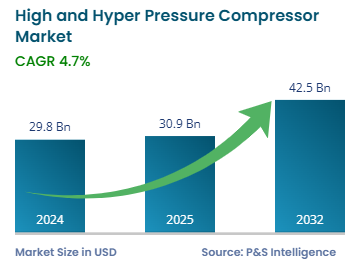
The global high and hyper pressure compressor market size was USD 29.8 billion in 2024, and it will grow by 4.7% during 2025–2032, to reach USD 42.5 billion by 2032.
The market growth is driven by the increasing oil & gas exploration activities, expanding CNG storage & transportation infrastructure, and the integration of hydrogen fuel cell technology in various industries. For instance, the final investment decision has seen a dramatic increase from 102 committed projects in 2020, worth USD 10 billion, to 434 in 2024, valued at approximately USD 75 billion.
The high demand for high- and hyper-pressure compressors for industrial hydrogen production and gas grid injections has been another major driver. With hydrogen being an important alternative fuel in the global clean energy transition, the need for special compression systems for storage and transportation is critical. The International Energy Agency (IEA) said that hydrogen demand in 2022 was 95 million tonnes.
Compressors are used at the hydrogen filling stations, as storage and dispensing require pressures up to 900 bars. Moreover, the market is also witnessing the growing use of advanced compressor technologies that provide better energy efficiencies and reduced operational costs. Manufacturers are investing in research and development to introduce smart compressors installed with IoT sensors and predictive maintenance capabilities, which offer real-time monitoring and improvement in compressor performance.
High and Hyper Pressure Compressor Market Dynamics
Technological Advancements and Digitalization for Energy Efficiency Are Key Trends
The integration of advanced technologies in high-pressure compressors is aimed at meeting efficiency and environmental standards.
Manufacturers are focusing on energy-efficient compressors with advanced features, such as variable-speed drives, digital controls, and IoT connectivity.
These new features improve the compressor performance, reliability, and operational efficiency.
The integration of AI and ML algorithms for performance optimization allows for real-time adjustments to maintain optimal compression ratios and minimize energy usage.
Japan's Ministry of Economy, Trade and Industry (METI) aims to install 1,000 hydrogen refueling stations by 2030.
These stations are expected to utilize high-pressure compressors capable of delivering hydrogen at 700–900 bars, which is ideal for fueling fuel-cell vehicles.
South Korea's Green New Deal targets 6.2 million hydrogen vehicles and 1,200 refueling stations by 2040.
Expansion of CNG Infrastructure and Natural Gas Vehicle Sales Are Biggest Driver
Transport contributes about 24% of global COâ‚‚ emissions, mainly from road vehicles. CNG vehicles reduce tailpipe COâ‚‚ emissions by around 25% compared to petrol and emit fewer pollutants like NOâ‚“ and particulates.
Growing adoption, especially in countries like India, helps improve air quality and supports cleaner, more sustainable urban mobility.
The rapid rise in the sale of natural gas vehicles and expansion of the CNG framework are major drivers for the market.
As governments globally are implementing stricter emission regulations and encouraging cleaner transportation alternatives, the establishment of CNG filling stations is accelerating.
According to the Natural Gas Vehicle Association, the global NGV fleet exceeded 28 million vehicles in 2023.
Each CNG filling station requires compressors capable of delivering gas at pressures between 200 and 250 bars.
The development of mobile CNG refueling units for fleet operations and remote locations has emerged as a growing application segment, requiring compact and efficient high-pressure compression solutions.
The expansion of CNG vehicle fleets, particularly in India and China, accelerates market growth, with India targeting 15 million CNG vehicles by 2030 under its sustainable mobility initiative.
The growing utilization of CNG as a transportation fuel in countries like Egypt and Iran, driven by abundant natural gas resources and environmental concerns.
This continues to improve demand for high-pressure compression equipment in vehicle refueling infrastructure.
High and Hyper Pressure Compressor Market Segmentation Analysis
Type Analysis
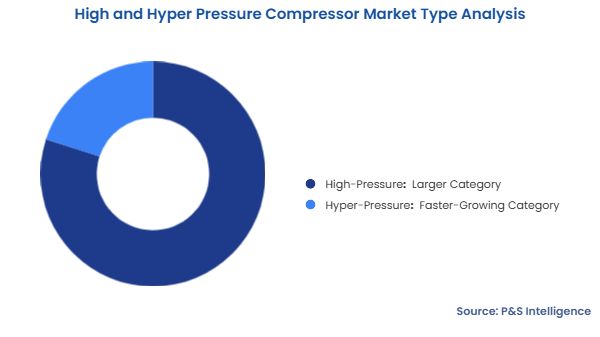
The high-pressure category held the larger market share, of around 80%, in 2024, because they are widely used across various industries such as oil and gas processing, chemical manufacturing, and industrial gas production. The compressors offer the right balance between performance criteria and affordability under most industrial applications.
The hyper-pressure category will have the higher CAGR due to its niche applications in sectors such as advanced materials processing, hydrogen compression for fuel cell vehicles, and nascent technologies in aerospace and defense. This multi-stage piston compressor is used to compress low-density polyethylene plants, ethylene vinyl acetate, and ethylene with discharge pressure up to 3,500 bars (50,000 psia).
The types analyzed in this report are:
High-Pressure (Larger Category)
Hyper-Pressure (Faster-Growing Category)
Technology Analysis
The reciprocating category held the largest market share in 2024, as it provides reliability, high pressure, and adaptability as per changing circumstances. These compressors are crucial for mechanical arrangements that physically compress gases through piston mechanisms to the highest degree of compression for many industrial applications. Furthermore, the double-acting type witnesses a strong growth because of its great efficiency and extended maintenance compression.
The diaphragm category will have the highest CAGR, of 5.2%, due to the growing need for sterile compressing pressures in sectors, such as pharmaceutical, food processing, and semiconductor manufacturing industries. They have a hermetically sealed design, which helps to remove the risk of gas contamination, making these compressors suitable for compressing high-purity gases and corrosive gases. Furthermore, the rise in hydrogen has also increased this category due to its ability to achieve pressure up to 1,000 bars with no risk of oil contamination.
The technologies analyzed in this report are:
Reciprocating (Largest Category)
Single-Acting
Double-Acting
Rotary Screw
Centrifugal
Diaphragm (Fastest-Growing Category)
Metal
Teflon
Scroll
Stage Analysis
The single-stage category held the larger market share, of approx. 65%, in 2024. These compressors are used in specialized applications, such as small CNG filling stations, laboratories, and portable compression systems, where initial capital costs are primary concerns. The utilization of small CNG stations has further increased the usage of single-stage compressors, even in cluttered urban centers.
The multi-stage category will have the higher CAGR as they are most-efficient and reliable at maintaining the temperature between stages. They essentially share compression work over several stages to reduce power consumption and increase equipment life by reducing thermal stress on the components. These compressors are used for keeping the pressure above 200 bar to reduce the costs and increase efficiency. For instance, hydrocracking and hydrotreating in the oil-refining industry compress hydrogen to more than 150 bars.
The stages analyzed in this report are:
Single-Stage (Larger Category)
Multi-Stage (Faster-Growing Category)
Lubrication Type Analysis
The oil-flooded category held the larger market share in 2024, because they are used in general industries as well as heavy-duty applications due to better efficiency, flexibility, and reduced initial expenditure. These compressors are suitable for applications where it is not necessary to have very high gas purity, making them a cost-efficient compressor option in industries such as oil and gas.
The oil-free category will have the higher CAGR due to the increased demand for clean and contaminant-free compressions from various applications, such as electronics and pharmaceuticals, where a high gas purity is required, thereby leading to the implementation of the oil-free technology.
The stages analyzed in this report are:
Oil-Free (Larger Category)
Oil-Flooded (Faster-Growing Category)
Application Analysis
The oil & gas category held the largest market share, of about 35%, in 2024, as this industry uses high-pressure compressors at various stages, including collection, processing gas, and refining operations. The rising investments in infrastructure works and capacity enhancements in the sector are also fueling demand. According to the IEA, in 2023, a total of USD 528 billion is being invested in oil & gas operations globally, where a significant share is invested in enhancing and growing compression systems.
According to the International Energy Agency (IEA), the global oil supply—which encompasses crude oil, condensate, and other liquid forms—is anticipated to average approximately 104 million barrels per day by 2025. Of this aggregate, crude oil is projected to account for around 82.4 million barrels per day, as per the U.S. Energy Information Administration (EIA). In 2023, the total worldwide production of petroleum liquids surpassed 4.5 billion tonnes, as reported by BP’s Statistical Review of World Energy. In terms of natural gas, the International Gas Union (IGU) has indicated that global production reached an estimated 4.1 trillion cubic meters in 2023. This highlights the increasing significance of gas within the global energy framework, particularly for uses in power generation, heating, and industrial processes.
The chemical & petrochemical category will have the highest CAGR because of large capacity expansions, particularly in Asia, and rising industry transitions towards high-end chemicals that require exact pressure control. They transport bulk chemicals safely within the facility to prevent any leaks and to store any high-pressure requirements. Also, other factors encouraging fast growth include production capacities and flexibility.
The applications analyzed in this report are:
Oil & Gas (Largest Category)
Chemical & Petrochemical (Fastest-Growing Category)
Automotive
Food & Beverage
Healthcare & Medical Devices
Mining
Aerospace & Defense
Construction & Infrastructure
Drive strategic growth with comprehensive market analysis
High and Hyper Pressure Compressor Market Regional Outlook
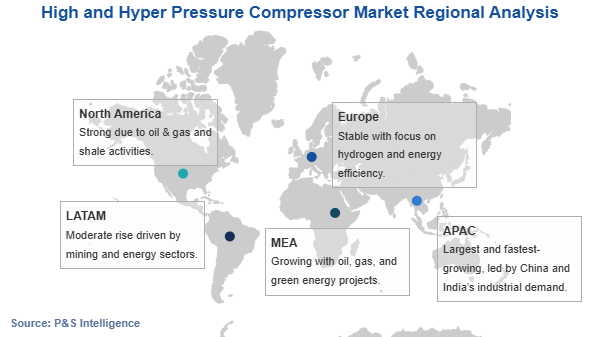
Asia-Pacific held the largest market share, of about 45%, in 2024, due to rapid industrialization, growing petrochemical capacity addition, and heavy investments in energy infrastructure. China holds more than 50% of the compressor market due to its industrial expansion plans and growing self-sufficiency goals in the chemicals and energy sectors. The push towards hydrogen economy development, with several green hydrogen projects under construction, further creates demand for high-pressure compression equipment.
According to the China Petroleum and Chemical Industry Federation, the country's petrochemical industry was engaged in capacity expansion projects, with investments exceeding USD 45 billion in 2023, creating enormous demand for high- and hyper-pressure compression equipment.
In 2023, the Asia-Pacific region produced approximately 346 million metric tons of crude oil and 692 billion cubic meters of natural gas, reflecting a steady output in line with previous years. Refining capacity is expanding, with China adding 520,000 barrels per day and India planning 353,000 barrels per day by 2026. However, India's refining capacity has increased by only 5% over the past seven years, falling short of the targeted 69% expansion by 2025. Despite these challenges, the region's oil and gas sectors continue to grow, driving demand for high- and hyper-pressure compressors in extraction, refining, and petrochemical applications.
North America will have the highest CAGR due to its application in the mature oil and gas industry, advanced manufacturing capabilities, and growing investments in hydrogen infrastructure. U.S. Department of Energy plans to invest USD 7 billion in launching seven clean hydrogen hubs across the nation, providing strong government support for hydrogen economy development.
High- and hyper-pressure compressor demand in North America is rising, driven by oil & gas, chemical, and construction growth. According to the U.S. Energy Information Administration, crude oil production is projected to reach record highs in 2025, supporting compressor use in LNG, refining, and carbon capture. The American Chemistry Council reports a 4.1% rise in chemical production in 2024, boosting demand for high-pressure process equipment. Meanwhile, the U.S. Census Bureau notes a 6.5% year-over-year increase in construction spending, reflecting strong infrastructure investment. These trends point to sustained growth in compressor deployment across critical, pressure-intensive applications in these expanding industries.
In 2024, North America—led by the United States—produced an average of 13.2 million barrels of crude oil per day, reaching a record 13.47 million bpd by April 2025. The Permian Basin alone contributed approximately 6.3 million bpd, nearly half of the U.S. total. Dry natural gas output stood at nearly 38 trillion cubic feet, while natural gas plant liquids reached a record 4 trillion cubic feet, up 7% from 2023. Refining capacity also grew modestly, with U.S. facilities reaching around 18.38 million bpd by 2025. These high volumes underscore sustained demand for high- and hyper-pressure compressors across upstream and downstream sectors.
The geographical breakdown of the market is as follows:
North America (Fastest Regional Market)
U.S. (Larger Country)
Canada (Faster-Growing Country)
Europe
Germany (Larger Country)
U.K.
France (Fastest-Growing Country)
Italy
Spain
Rest of Europe
Asia-Pacific (Largest Regional Market)
China (Largest Country)
India (Fastest-Growing Country)
Japan
South Korea
Australia
Rest of APAC
Latin America
Brazil (Largest Country)
Mexico (Fastest-Growing Country)
Rest of LATAM
Middle East and Africa
Saudi Arabia (Larger Country)
South Africa
U.A.E. (Fastest-Growing Country)
Rest of MEA
High and Hyper Pressure Compressor Market Share
The market is moderately consolidated, due to the presence of several major players dominating the faster growth. Companies, such as Atlas Copco, Siemens Energy, and Ingersoll Rand, hold a large market share due to their strong technologies. Moreover, the market has many SMEs providing innovative solutions, bringing niche and emerging markets to grow, making it highly competitive.
Key High and Hyper Pressure Compressor Companies:
Burckhardt Compression AG
Atlas Copco Aktiebolag
Ingersoll Rand Inc.
Siemens Energy AG
Baker Hughes Company
Ariel Corporation
Howden Group Ltd.
Sundyne, LLC
BAUER COMPRESSORS, INC.
J.P. Sauer & Sohn Maschinenbau GmbH
Hitachi Industrial Equipment Systems Co., Ltd.
Kobe Steel, Ltd.
High and Hyper Pressure Compressor Market News & Updates
In January 2024, Atlas Copco Aktiebolag acquired Hycomp Inc., a U.S.-based provider of high-pressure oil-free compressors, integrating Hycomp’s technology into Atlas Copco’s compressor technique division.
In April 2025, Burckhardt Compression AG introduced the Predictive Intelligence module for its PROGNOST-NT monitoring platform, enabling real-time AI-driven prediction of remaining life for key compressor components, such as valves and packings, improving uptime and maintenance efficiency.
In April 2023, Sundyne LLC joined the International Compressor Applications and Machinery Committee to collaborate with peers on compressor standards, safety, performance, and compliance.
Want a report tailored exactly to your business need?
Leading companies across industries trust us to deliver data-driven insights and innovative solutions for their most critical decisions. From data-driven strategies to actionable insights, we empower the decision-makers who shape industries and define the future. From Fortune 500 companies to innovative startups, we are proud to partner with organisations that drive progress in their industries.
Client Testimonials
Working with P&S Intelligence and their team was an absolute pleasure – their awareness of timelines and commitment to value greatly contributed to our project's success. Eagerly anticipating future collaborations.
McKinsey & Company
India
Unmatched Standards
Our insights into the minutest levels of the markets, including the latest trends and competitive landscape, give you all the answers you need to take your business to new heights
Complete Data Security
We take a cautious approach to protecting your personal and confidential information. Trust is the strongest bond that connects us and our clients, and trust we build by complying with all international and domestic data protection and privacy laws