High-Bandwidth Memory Test Handler Systems Market Outlook (2027 - 2033)
This Report Provides In-Depth Analysis of the High-Bandwidth Memory Test Handler Systems Market Report Prepared by P&S Intelligence, Segmented by Handler Type (Pick-and-Place Memory Test Handlers, Die-Level and Cube Handler-Prober Systems, Burn-In Sorters and Loader/Unloader Handlers), Test Stage (Stacked-Die (KGSD) and Final Test, Burn-In and Reliability Test, System-Level Test), HBM Generation (HBM3 and Earlier, HBM3E, HBM4 and HBM4E), End User (Memory Manufacturers, Foundries, OSATs), and Geographical Outlook for the Period of 2022 to 2033
High-Bandwidth Memory Test Handler Systems Market Statistics
Key Highlights
Study Period
2022 - 2033
Market Size in 2026
USD 267.37 Million
Market Size in 2027
USD 312.82 Million
Market Size by 2033
USD 802.44 Million
Projected CAGR
17%
Largest Region
Asia-Pacific
Fastest Growing Region
North America
Market Structure
Moderately Concentrated
Market Size
Explore the market potential with our data-driven report
High-Bandwidth Memory (HBM) Test Handler Systems Market Overview
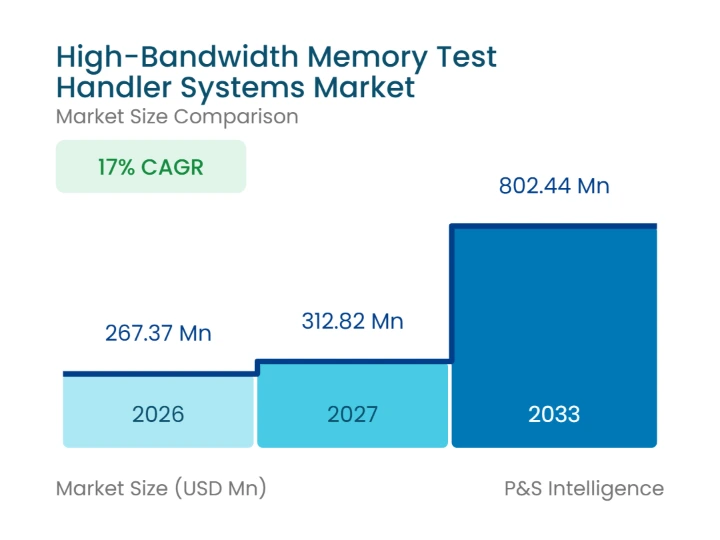
The global high-bandwidth memory (HBM) test handler systems market is estimated at USD 267.37 million in 2026 and is projected to reach USD 312.82 million in 2027. Spending is expected to climb to USD 802.44 million by 2033, advancing at a CAGR of 17.0% during 2027-2033. Memory makers are adding handler capacity so that more of the stacks they ship into AI accelerator packages are screened one by one before bonding. Screening every stack multiplies the parts passing through each test cell, which favors handler makers already qualified at those memory makers.
HBM supply contracts for AI accelerators, filled by SK hynix, Samsung Electronics, and Micron, generate most new orders in the high-bandwidth memory (HBM) test handler systems market, because each stack has to clear final test before it is bonded beside a processor. A stack that fails after packaging scraps an expensive accelerator with it, so memory makers add test steps as stacks grow taller. SEMI projects 2026 sales of semiconductor test equipment at USD 15.3 billion, a 31.0% increase after a 55.3% rise in 2025, and ties further growth to stricter reliability requirements for AI and HBM devices.
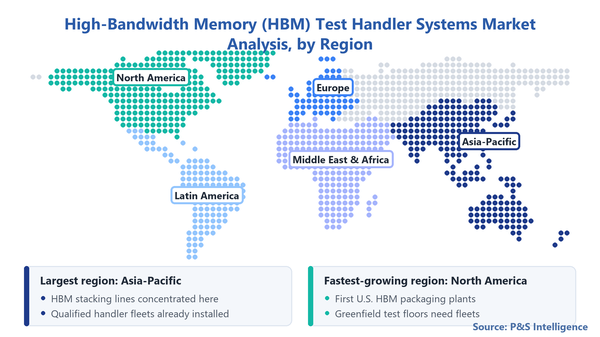
Asia-Pacific accounted for 66% of 2026 revenue, because HBM stacking and stack test are concentrated at memory maker sites in South Korea, Taiwan, Japan, and Singapore, where most handler spending extends lines that are already running. North America is projected to post an 18.2% CAGR during 2027-2033, the fastest regional rate, as the U.S. gains its first HBM packaging plants, starting with SK hynix's site in Indiana. A new U.S. plant equips its test floor from scratch, so its first handler order covers a complete fleet instead of a few added sites.
Key market insights
By handler type, pick-and-place memory test handlers held the largest share in 2026, while die-level and cube handler-prober systems are projected to grow the fastest during 2027-2033.
By test stage, stacked-die (KGSD) and final test held 70% in 2026, while the same category is projected to expand at a 17.74% CAGR during 2027-2033.
By HBM generation, HBM3E held 58% in 2026, while HBM4 and HBM4E are projected to grow at a 17.58% CAGR during 2027-2033.
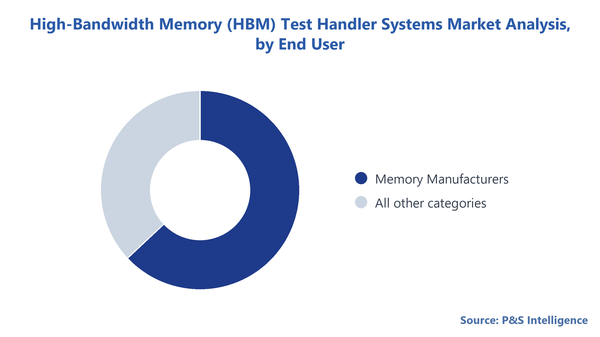
By end user, memory manufacturers held 63% in 2026, while foundries are projected to grow at a 17.61% CAGR during 2027-2033.
By geography, Asia-Pacific held 66% in 2026, while North America is projected to grow at an 18.2% CAGR during 2027-2033.
High-Bandwidth Memory (HBM) Test Handler Systems Market Dynamics
Unit-level stack screening is reshaping how HBM test cells are equipped
Memory makers are moving HBM test from sampled checks toward screening every stack individually, and that shift changes which handling tools a back-end line buys. Tray-based memory handlers were designed for packaged parts, while a bare stack must be aligned to within micrometers, kept free of particles, and cooled while it is in contact with the tester. Tools that combine handling and probing in one platform remove transfer steps between separate machines, which cuts the number of times a fragile stack is picked up. For handler makers, value is moving from tray mechanics toward vision alignment and thermal control.
In its quarterly report for January-March 2026, filed on May 15, 2026, TECHWING describes its Cube Prober as a tool built to inspect every HBM unit individually, and says vision precision of 5 micrometers or better lets wafers move straight to the chuck without the usual loader, unloader, and tray steps. The same filing dates the first Samsung Electronics order for the tool to January 2025. A single tool that absorbs those steps could let memory makers fold handling and probing into one purchase, which would shift part of the budget on new lines away from standalone tray handlers.
Rising HBM output at memory makers is accelerating handler fleet additions
Handler demand rises with the number of HBM stacks a memory maker tests each month and with the time each stack occupies a test site. Both are increasing. Output is expanding to meet accelerator orders, and taller stacks with more channels are likely to need longer test times, so a line producing the same number of stacks still needs more handler sites after a generation change. Older lines also tend to keep running for existing products while new lines are equipped for the next generation, which adds handler purchases on top of routine replacement.
Samsung Electronics said on February 12, 2026, when it began mass production and shipped commercial HBM4, that it expects its HBM sales to more than triple in 2026 compared with 2025 and is expanding HBM4 production capacity. Sales growth is not a count of test cells, but capacity added on that scale has to pass through stack test before shipment. Handler makers already qualified at Samsung's back-end sites are better positioned to take repeat orders as that capacity starts up, while newcomers must first complete a qualification cycle that can run for several quarters.
New HBM packaging plants outside Asia are opening greenfield handler orders
Until now, most HBM handler sales have gone into existing back-end lines in South Korea, Taiwan, and Japan, where each purchase adds sites to a working operation. A packaging plant built in a new country works differently. It equips its entire test floor in one round, covering final test, burn-in, and handling, which makes the first order from a new site much larger than a typical expansion. Handler makers that can staff local service teams and hold spare parts near the site are likely to be better placed, because uptime commitments form part of back-end tool selection.
Per the National Institute of Standards and Technology, SK hynix holds a final CHIPS Act award of up to USD 458 million in direct funding, supporting an investment of about USD 3.87 billion in West Lafayette, Indiana, for an advanced packaging line that will mass-produce next-generation HBM. Test equipment for a plant of this kind is normally bought ahead of volume production, so handler orders would track the construction schedule. A first U.S. HBM line also gives handler makers a reason to build North American service capacity, which could support them in later U.S. projects.
Concentrated HBM supply among a few memory makers is limiting handler order diversity
HBM supply comes mainly from three memory makers, so a handler maker's order book depends on a short list of customers and their capital spending calendars. A pause in one maker's back-end investment, a delay in a product qualification, or a change in test flow can remove a large part of a handler maker's orders for several quarters. Each memory maker also runs its own qualification for handlers, carriers, and change kits, so a design win at one does not automatically carry over to another.
SK hynix stated in its U.S. listing prospectus, dated July 9, 2026, that it ranked first in global HBM revenue with a 56.4% share in the first quarter of 2026. With more than half of HBM revenue at one company, its test-flow choices and approved-vendor lists carry heavy weight for handler demand across the market. Handler makers are spreading that exposure by placing evaluation tools at a second and third memory maker, although moving from a demonstration unit to volume orders takes a full qualification cycle.
Segmentation Analysis
Handler Type
Pick-and-place memory test handlers accounted for the largest share of the high-bandwidth memory (HBM) test handler systems market by handler type in 2026. Gravity, turret, and strip handlers are built for packaged parts, whereas a bare HBM stack has to be lifted, set into a carrier, and seated on contacts without stressing its through-silicon vias. Pick-and-place platforms already run memory final test at the memory makers, and units on these platforms count here only when configured and sold for HBM lines. Adding HBM carriers and thermal modules extends a qualified tool family, which favors incumbent handler makers.
Die-level and cube handler-prober systems are likely to expand fastest during 2027-2033, as memory makers widen screening from samples to every stack. In a TestConX Korea 2024 workshop paper, AMT Co., Ltd. noted that HBM die pads sit at a 0.1 mm pitch, against 0.3 mm for BGA packages, and that taller stacks narrow the gaps between dies and worsen heat dissipation. Combining handling and probing in one tool shortens the path from alignment to contact. Handler makers that hold fine vision alignment while controlling particles and heat at the contact point are better positioned in these evaluations.
Test Stage
Stacked-die (KGSD) and final test accounted for 70% of 2026 revenue by test stage. Final test is the last point at which a defective stack can be caught before it is bonded beside a processor, and a failure found after packaging scraps the accelerator package along with the memory. Each stack normally passes through a handler at this stage, while burn-in and system-level test can be applied according to product and customer requirements. Final test also carries much of the thermal handling, since stacks are often tested across temperature extremes.
Stacked-die (KGSD) and final test is also projected to grow at a 17.74% CAGR during 2027-2033, the highest among the three test stages. Taller HBM4 stacks with more channels lengthen test time per part, which increases the number of handler sites a fab needs for a given output. Custom HBM, with customer-specific logic on the base die, is expected to add product variants that each need their own test programs and, often, their own change kits. Longer test times combined with more variants favor handler makers that can turn change kits around quickly.
HBM Generation
HBM3E held 58% of 2026 revenue by generation, reflecting that much of the year's HBM output still comes from HBM3E lines. Handler fleets for this generation were largely equipped during earlier ramps and remain in use while HBM3E production continues, so much of the 2026 spending on this generation is likely to go to added sites and to change kits sold with new systems for existing lines. The size of this installed base keeps HBM3E a steady source of equipment revenue for incumbent handler makers, even as new-generation lines take a growing part of budgets.
HBM4 and HBM4E are projected to grow at a 17.58% CAGR during 2027-2033. JEDEC confirms that its HBM4 standard, released on April 16, 2025, supports stacks of up to 16 dies and doubles the independent channels per stack from 16 to 32. More channels per stack raise the contacts and test patterns a handler-docked tester must run, and taller stacks raise the cost of shipping a defective part. Each move to a new generation also brings new carriers and contactor footprints, so handler makers collect a fresh round of kit and equipment orders at every transition.
End User
Memory manufacturers accounted for 63% of 2026 revenue by end user, because SK hynix, Samsung Electronics, and Micron stack and test HBM largely in their own back-end facilities. Keeping stacking and stack test in-house protects yield data and lets each maker tune test flows to its own bonding process. Handler purchases therefore come mostly from three procurement organizations with long qualification programs, which rewards suppliers already embedded in their test lines and makes new wins slow to secure.
Foundries are projected to grow at a 17.61% CAGR during 2027-2033, the fastest among end users. Starting with HBM4, base dies can be made on foundry logic processes, which brings foundries deeper into the HBM flow both as base-die makers and as integrators of stacks into advanced packages. A foundry that tests stacks on arrival or after integration would need its own handling capacity, separate from the memory maker's outgoing test. For handler makers, foundry accounts widen the buyer base beyond three memory makers and reduce dependence on any single capital spending cycle.
The following segments are analysed in this report.
Handler Type
Pick-and-Place Memory Test Handlers
Die-Level and Cube Handler-Prober Systems
Burn-In Sorters and Loader/Unloader Handlers
Test Stage
Stacked-Die (KGSD) and Final Test
Burn-In and Reliability Test
System-Level Test
HBM Generation
HBM3 and Earlier
HBM3E
HBM4 and HBM4E
End User
Memory Manufacturers
Foundries
OSATs
Copyright P&S Intelligence. Reuse requires attribution under CC BY 4.0.
Geographical Outlook
Asia-Pacific high-bandwidth memory (HBM) test handler systems market outlook
Asia-Pacific held 66% of the high-bandwidth memory (HBM) test handler systems market in 2026, because most operating HBM stacking and stack-test lines are in the region. SK hynix runs HBM back-end work at Icheon and Cheongju, Samsung Electronics at Cheonan and Onyang, and Micron at Taichung and Hiroshima, with a Singapore HBM packaging plant due to add capacity from early 2027. Handler demand here comes from adding sites and kits to already-qualified lines, which ties purchasing to each maker's quarterly capacity plans. South Korea is the region's largest market, home to SK hynix and Samsung Electronics.
China follows a separate path. According to the U.S. Bureau of Industry and Security, rules announced on December 2, 2024 placed new controls on U.S.-origin HBM and on foreign-produced HBM subject to U.S. export regulations, describing HBM as critical to AI training and inference at scale. Restricted access to imported stacks gives Chinese memory makers a reason to develop HBM at home, which could create a distinct pool of handler demand served partly by domestic handler makers. Asia-Pacific's lead looks secure through 2033, though new U.S. lines are likely to trim its share at the margin.
North America high-bandwidth memory (HBM) test handler systems market growth
North America is projected to grow at an 18.2% CAGR during 2027-2033, the fastest of any region, because the U.S. is gaining HBM packaging capacity for the first time. These are greenfield lines, so each one buys a full complement of final test, burn-in, and handling equipment in a single round instead of adding sites over several years. The U.S. is the region's fastest-growing market, with federal manufacturing incentives lowering the cost of building back-end capacity on American soil.
Micron's June 12, 2025 filing with the U.S. Securities and Exchange Commission states that the company plans to bring advanced HBM packaging capabilities to the U.S. following completion of its second Idaho fab. Together with SK hynix's Indiana project, that plan would give the U.S. two HBM back-end sites, each needing a qualified handler fleet. Because both depend on construction schedules, most U.S. handler spending is likely to land in the second half of the forecast period, and handler makers with U.S. service teams are better positioned to support those ramps.
Copyright P&S Intelligence. Reuse requires attribution under CC BY 4.0.
Europe market analysis
Europe holds a smaller position in HBM handler demand because no volume HBM stacking line operates in the region, so commercial demand is minimal. The region matters more as a supply base, since SPEA, an Italian maker of test handlers and automatic test equipment, sells to chip makers worldwide. Germany and the Netherlands host semiconductor manufacturing and equipment industries that buy test handlers for other device types, which gives European handler makers a home customer base outside HBM.
As per the European Commission, the European Chips Act entered into force on September 21, 2023, with the aim of doubling the EU's current share of the global semiconductor market by 2030. The act covers chip manufacturing broadly and does not single out HBM, so HBM handler demand in Europe would depend on a memory maker or packaging house choosing to place HBM back-end capacity there. Until such a project is announced, European purchases of HBM handlers are likely to stay occasional and tied to engineering work.
Latin America market analysis
Latin America accounts for a small part of HBM handler spending, with no HBM production in the region and purchases limited to occasional engineering use. Mexico hosts semiconductor assembly and test operations that serve North American electronics supply chains, and Brazil packages memory chips mainly for its domestic phone and PC makers. Neither country stacks HBM, so handler demand from the region depends on whether memory makers ever extend HBM test outside Asia and the U.S.
In July 2024, the U.S. Department of State announced a CHIPS Act-funded Western Hemisphere Semiconductor Initiative to build semiconductor assembly, testing, and packaging capabilities in partner countries, starting with Mexico, Panama, and Costa Rica, with work planned through 2026. The program targets general chip assembly and test, not HBM, so it builds the workforce and supplier base that HBM back-end work would need without creating handler orders by itself. Mexico could benefit most if a memory maker later looks for back-end capacity close to U.S. customers.
Middle East & Africa market analysis
The Middle East and Africa hold the smallest position in HBM handler demand, because the region has no HBM stacking or stack-test operations. Israel, the region's main semiconductor center, hosts chip design and wafer fabrication, so its demand for HBM handlers is limited to engineering and evaluation use. Gulf states investing in AI data centers consume accelerators that carry HBM, but those purchases do not create stack-test demand, since HBM is tested where it is stacked.
The U.S. Department of Commerce marked the May 2025 groundbreaking of a 1GW first phase of a planned 5GW AI campus in Abu Dhabi, to be built by G42 and operated with several U.S. companies. A campus of this kind buys finished accelerator modules, while the handler purchase sits with the memory maker or packaging house that ships the stack. Handler sales into the region are therefore likely to stay tied to research and development budgets at chip design companies until a memory maker or packaging house places HBM back-end capacity there.
The following geographies are analysed in this report.
Asia-Pacific
South Korea
Taiwan
Japan
China
Singapore
Malaysia
Rest of Asia-Pacific
North America
U.S.
Canada
Europe
Germany
Netherlands
Italy
Rest of Europe
Latin America
Mexico
Brazil
Rest of Latin America
Middle East & Africa
Saudi Arabia
U.A.E.
Rest of Middle East & Africa
High-Bandwidth Memory (HBM) Test Handler Systems Market Competition Analysis
The high-bandwidth memory (HBM) test handler systems market is served by a small group of handler makers based mainly in South Korea, Japan, and Taiwan, which mirrors where HBM is stacked and tested. Three factors keep the group small. Each memory maker qualifies handlers, carriers, and change kits over long programs, bare-stack handling requires vision alignment and thermal control that gravity and turret handlers were not built for, and suppliers need service staff inside customers' back-end sites. The structure is stable for current lines, though combined handler-prober tools are bringing new competition into stack-level screening.
Advantest Corporation pairs its memory handlers with its own memory testers, which lets a fab buy handler and tester as one qualified test cell. TECHWING Inc. combines handling and probing in its Cube Prober for unit-level stack screening and also supplies memory test handlers to the large memory makers. Mirae Corporation has filed patents on a glass-socket HBM die carrier designed to run on modified existing test equipment, together with a fourth-generation Quantum handler, an approach that could lower upgrade costs for its installed base. Hon.Precision, Inc. supplies DRAM test sorting handlers and burn-in ovens from Taiwan.
For memory makers, the small number of qualified suppliers raises switching costs, since moving to a new handler maker means requalifying carriers, kits, and test programs. Running lines therefore tend to stay with the incumbent, and challengers usually win business when a new product generation or an added test step opens a fresh qualification. Handler makers able to offer both tray-based final test handlers and stack-level screening tools could capture more of each line's equipment budget as screening moves earlier in the test flow.
Major Companies in High-Bandwidth Memory Test Handler Systems Market:
Advantest Corporation
TECHWING Inc.
Cohu Inc.
Teradyne Inc.
Hon.Precision Inc.
Chroma ATE Inc.
ASMPT Limited
Mirae Corporation
Hangzhou Changchuan Technology Co. Ltd.
DI Corporation
SPEA S.p.A.
AMT Co. Ltd.
High-Bandwidth Memory (HBM) Test Handler Systems Market News & Developments
In June 2026, TECHWING Inc. secured its first commercial Cube Prober order from SK hynix, three months after passing SK hynix qualification, adding a second HBM maker to its existing Samsung Electronics supply. The order brings unit-level stack screening into the back-end lines of the two largest HBM suppliers.
In December 2025, Advantest Corporation launched the M5241 Memory Handler, which tests up to 512 devices in parallel at up to 46,000 units per hour across an extended range of -55°C to +150°C, with first shipments scheduled for the second quarter of 2026. The handler docks to the T5801 DRAM tester, giving memory makers a single-vendor test cell for AI-oriented memory.
Last Updated: October 2026
Frequently Asked Questions About This Report
How big is the HBM test handler market?+
The global high-bandwidth memory (HBM) test handler systems market is estimated at USD 267.37 million in 2026 and is projected to reach USD 312.82 million in 2027.
What is driving demand for HBM test handlers?+
Memory makers are adding handler capacity so that more of the stacks they ship into AI accelerator packages are screened one by one before bonding.
Why is HBM harder to handle during test than standard memory?+
Tray-based memory handlers were designed for packaged parts, while a bare stack must be aligned to within micrometers, kept free of particles, and cooled while it is in contact with the tester.
How does HBM4 affect test handler demand?+
Each move to a new generation also brings new carriers and contactor footprints, so handler makers collect a fresh round of kit and equipment orders at every transition.
Which region leads the HBM test handler market?+
Asia-Pacific held 66% of the high-bandwidth memory (HBM) test handler systems market in 2026, because most operating HBM stacking and stack-test lines are in the region.
Why is North America the fastest-growing region for HBM test handlers?+
North America is projected to grow at an 18.2% CAGR during 2027-2033, the fastest of any region, because the U.S. is gaining HBM packaging capacity for the first time.
Who makes HBM test handlers?+
The high-bandwidth memory (HBM) test handler systems market is served by a small group of handler makers based mainly in South Korea, Japan, and Taiwan, which mirrors where HBM is stacked and tested.
Want a report tailored exactly to your business need?
Leading companies across industries trust us to deliver data-driven insights and innovative solutions for their most critical decisions. From data-driven strategies to actionable insights, we empower the decision-makers who shape industries and define the future. From Fortune 500 companies to innovative startups, we are proud to partner with organisations that drive progress in their industries.
Client Testimonials
Working with P&S Intelligence and their team was an absolute pleasure – their awareness of timelines and commitment to value greatly contributed to our project's success. Eagerly anticipating future collaborations.
McKinsey & Company
India
Unmatched Standards
Our insights into the minutest levels of the markets, including the latest trends and competitive landscape, give you all the answers you need to take your business to new heights
Complete Data Security
We take a cautious approach to protecting your personal and confidential information. Trust is the strongest bond that connects us and our clients, and trust we build by complying with all international and domestic data protection and privacy laws