GCC Data Center Market Size & Opportunities Analysis - Growth Strategies, Competitiveness, and Forecasts (2026 - 2032)
This Report Provides In-Depth Analysis of the GCC Data Center Market Report Prepared by P&S Intelligence, Segmented by Infrastructure (IT, Support), Type (Hyperscale, Co-Location), Industry (IT & Telecom, BFSI, Healthcare, Government & Defense), and Geographical Outlook for the Period of 2019 to 2032
Explore the market potential with our data-driven report
GCC Data Center Market Overview
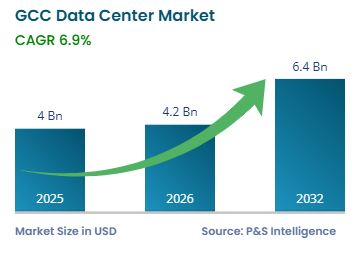
The GCC data center market size will be an estimated USD 4.0 billion for 2025, and it will grow by 6.9% during 2026–2032, to reach USD 6.4 billion by 2032.
The market growth is primarily driven by the accelerating digital transformation initiatives across the region, substantial government investments in technology infrastructure aligned with national vision programs, and the rapidly growing adoption of cloud computing, artificial intelligence, and emerging technologies across various industry sectors.
The GCC region has emerged as one of the highest growth markets for data centers globally, with estimates suggesting roughly 80-90 operational data centers across the GCC as of 2024, with Saudi Arabia and the UAE accounting for over 75% of the region's existing data center rack capacity. This concentration reflects the strategic importance of these markets in driving regional digital transformation while supporting the broader economic diversification goals outlined in Vision 2030 and similar national initiatives.
Data centers in GCC nations are rapidly adopting advanced operational technologies to support increasing data demand. Liquid cooling systems are replacing traditional air cooling to improve energy efficiency and thermal management. AI-driven monitoring tools optimize power usage, predict equipment failures, and automate workload distribution. Modular data centers and prefabricated units allow rapid scalability and deployment. Edge computing infrastructure is being deployed closer to urban centers to reduce latency. High-density server racks and software-defined infrastructure enable greater compute power within smaller footprints. Additionally, GCC operators are implementing renewable energy integration and advanced battery storage for improved sustainability and uninterrupted operations.
GCC Data Center Market Trends & Drivers
Growing Demand for AI and Other Emerging TechnologiesIs Key Trend
The rapid adoption of artificial intelligence and machine learning technologies is a key trend fundamentally reshaping data center requirements across the GCC.
The growth necessitates specialized infrastructure capable of handling high-performance computing workloads, including GPU-accelerated servers and advanced cooling systems.
King Faisal Specialist Hospital & Research Center (KFSHRC) in Saudi Arabia conducted 1,195 robotic-assisted procedures in 2023 alone, setting new standards in surgical precision and efficiency.
These advanced medical applications require robust data center infrastructure to support real-time data processing, AI-driven diagnostics, and secure storage of sensitive patient information.
The integration of IoT technologies across industries is generating massive volumes of data requiring local processing and storage.
Smart city projects, industrial automation, and connected vehicle initiatives are creating exponential growth in data generation, necessitating edge computing capabilities and distributed data center architectures.
In GCC countries, cloud computing and data consumption are accelerating rapidly. Average data traffic per smartphone was around 30 GB/month in 2023, projected to rise to 66 GB/month by 2029.
In 2022, it was ~25 GB, with forecasts indicating nearly 53 GB/month per smartphone by 2030.
As per Ericsson, Mobile network traffic in the GCC is growing at a 21% annual rate, with total mobile data volumes expected to triple by 2030.
In the broader MENA region, monthly mobile data traffic is projected to increase from ~10.81 exabytes in 2025 to ~26.84 exabytes by 2030.
Government Vision Programs and Strategic InitiativesIs Biggest Driver
Government-led digital transformation initiatives across the GCC are catalyzing unprecedented data center investments.
Saudi Arabia's Vision 2030 has committed billions in investment into industries like automotive, advanced manufacturing, AI, and space exploration, all of which require advanced digital infrastructure and substantial data center capacity.
The NEOM project, slated to invest over USD 500 billion in digital infrastructure, highlights the government’s dedication to creating top-tier data center facilities.
The UAE has made notable advancements through strategic initiatives to integrate AI into various services, launching an AI-powered smart auditing system for health facility engineering plans and a national platform for unified health professional licensing.
Dubai's Smart City initiatives and Abu Dhabi's digital government strategy have created substantial demand for local data processing capabilities, with government services digitization exceeding 90% across the region.
In January 2024, Saudi Arabia implemented its Data Centers Regulations to support the kingdom's Vision 2030 by fostering sustainable digital infrastructure to attract investment and meet the demands of its tech-savvy, youthful population.
In April 2025, Reunion Neuroscience unveiled a study design for phase 2 clinical trials, demonstrating healthcare sector's growing reliance on data center infrastructure for medical research.
These regulatory frameworks are establishing clear guidelines for data sovereignty, cybersecurity requirements, and operational standards, creating a stable environment for long-term data center investments.
GCC Data Center Market Segmentation Analysis
Infrastructure Analysis
The IT category holds the largest market share, of 70%, in 2025, driven by massive investments in both IT infrastructure and support infrastructure components. The IT infrastructure category leads with substantial deployments of servers, storage systems, and networking equipment to support cloud computing and AI workloads.
The support category will have the highest CAGR, of 7.2%, propelled by the critical need for advanced cooling systems, uninterruptible power supply systems, and sophisticated power distribution units capable of supporting high-density computing environments. The shift towards liquid cooling technologies is particularly pronounced in hyperscale facilities, where traditional air cooling methods prove inadequate for managing heat generated by AI workloads. Advanced cooling solutions, including direct-to-chip liquid cooling and immersion cooling systems, are being deployed to achieve power usage effectiveness ratios below 1.2, aligning with sustainability goals while supporting compute densities exceeding 30kW per rack.
The infrastructure analyzed in this report are:
IT (Largest Category)
Support (Fastest-Growing Category)
Others
Type Analysis
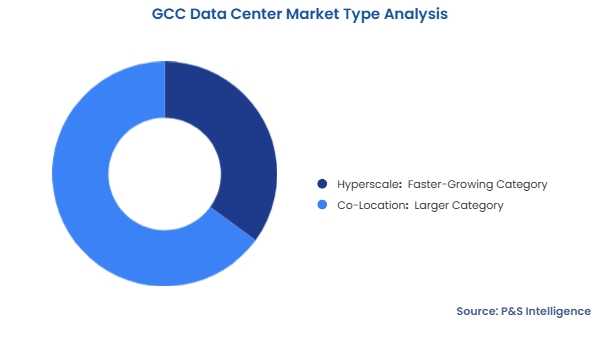
The co-location category holds the larger market share, of 65%, in 2025, driven by enterprises seeking to outsource data center operations while maintaining control over their IT equipment. The wholesale co-location model dominates with 70% of the co-location market share, catering to cloud service providers and large enterprises requiring dedicated data halls. Retail co-location services are expanding to serve small and medium enterprises seeking cost-effective solutions without significant capital investments.
The hyperscale category will have the higher CAGR, of 7.1%, driven by investments from global cloud giants establishing regional presence. Leading cloud providers such as Google, AWS, Microsoft, Oracle, Alibaba, and Huawei are establishing dedicated cloud regions and data centers across key cities, including Dubai, Abu Dhabi, Riyadh, Jeddah, Dammam, Doha, and Manama. These facilities typically exceed 10,000 square feet of white space and 5MW of IT load capacity, designed to support massive cloud computing workloads.
Several hyperscale data centers are operational or under construction across GCC nations to meet surging digital demand. In the UAE, Stargate in Abu Dhabi, developed by G42, is a massive AI-focused campus aiming for 5 GW, with 200 MW coming online in 2026. Khazna Data Centers is building a 100 MW AI-optimized facility in Ajman and recently launched a 31.8 MW hyperscale center in Masdar City. In Dubai, du and Microsoft are collaborating on a new hyperscale site. In Saudi Arabia, the Desert Dragon Data Centers project spans multiple cities with 187 MW capacity, while Equinix and Dune Vaults with Pure Data Centres are also developing 100+ MW facilities.
The types analyzed in this report are:
Hyperscale (Faster-Growing Category)
Co-Location (Larger Category)
Industry Analysis
The IT & telecom category holds the largest market share, of 55%, in 2025, driven by telecommunications operators' 5G infrastructure deployments and cloud service providers' expansion. The IT and telecom sector is widely using high-speed connectivity and low latency for improving network performance and cloud computing, with telecom operators constantly upgrading their infrastructure while IT firms utilize the technology for data centers, edge computing, and AI applications.
The BFSI category will have the highest CAGR during the forecast period, propelled by digital banking transformation, fintech innovation, and regulatory compliance requirements. The UAE central bank announced "The Financial Infrastructure Transformation" plan in 2023 to accelerate digital transformation in the financial services sector, with banks engaged with vendors for API management implementation, cloud integration, and digital payment systems. Financial institutions are leveraging data centers for real-time transaction processing, fraud detection systems, and AI-driven customer analytics.
The industries analyzed in this report are:
IT & Telecom (Largest Category)
BFSI (Fastest-Growing Category)
Healthcare
Government & Defense
Others
Drive strategic growth with comprehensive market analysis
GCC Data Center Market Regional Growth Dynamics
Saudi Arabia Data Center Market Size
Saudi Arabia holds the largest market share, of 40%, in 2025, driven by Vision 2030 initiatives and massive government investments in digital infrastructure. The kingdom's strategic focus on becoming a regional technology hub has attracted significant international investments, with Riyadh, Jeddah, and Dammam emerging as primary data center locations.
By 2030, the kingdom plans to expand its data center capacity from around 300 MW to 1300 MW, reflecting continued investor confidence and ongoing strategic development. The NEOM project represents a transformative initiative, with Tonomus actively developing a data center hub, which required digital facilities and forging partnerships with international players. The kingdom's investment in renewable energy for data center operations, coupled with favorable regulatory frameworks, positions it as the preferred destination for hyperscale deployments.
Major investments include Equinix committing USD 1 billion for a 100MW data center to serve hyperscale and enterprise demand, while Microsoft and the National Information Technology Academy are launching a Data Center Academy to develop local talent. The government's support through initiatives like the Cloud Computing Special Economic Zone and data sovereignty regulations ensures sustained growth momentum. Saudi Arabia's National Strategy for Data and AI aims to attract USD 20 billion in AI investments and train 20,000 AI specialists and data scientists by 2030.
UAE Data Center Market Size
UAE will have the highest CAGR, of 7.0%, supported by its role as a global connectivity hub and its business-friendly policies. According to reports, Abu Dhabi and Dubai have been ranked as the world's top two emerging data center markets, assessed across 20 key variables, including power availability, fiber connectivity, development pipeline, and land pricing. Strategic initiatives, including the UAE Digital Government Strategy and Smart City projects, continue to drive substantial investments in data center infrastructure.
Additionally, the UAE government has introduced incentives such as tax exemptions, fast-track licensing, and regulatory support to attract foreign and domestic data center investments. The country is witnessing the rapid adoption of hybrid cloud solutions by enterprises and government organizations, increasing demand for secure, high-performance colocation and hyperscale facilities. The expansion of undersea cable networks connecting the UAE to Europe, Africa, and Asia is enhancing its position as a regional data hub, enabling low-latency services and robust international connectivity. Sustainability initiatives are also gaining traction, with operators deploying energy-efficient cooling systems, renewable energy sources, and PUE optimization strategies to meet both regulatory requirements and corporate ESG commitments.
The countries of the market are as follows:
Saudi Arabia (Largest Regional Market)
UAE (Fastest-Growing Regional Market)
Kuwait
Qatar
Bahrain
Oman
GCC Data Center Market Share
The market is fragmented with numerous global and regional players competing for market share. The competitive landscape is characterized by the presence of established global cloud providers, regional telecommunications operators, and specialized data center operators, creating a dynamic environment with intense competition for prime locations and customer contracts. Global hyperscalers maintain a significant influence through both direct investments and strategic partnerships with local operators.
AWS, Microsoft Azure, Google Cloud, and Oracle Cloud have a significant influence with multiple cloud regions across the GCC, serving as key tenants for colocation facilities while building their own infrastructure. Companies are pursuing aggressive expansion strategies through greenfield developments, acquisitions, and strategic partnerships. Additionally, the entry of new players such as Agility, DataVolt, Desert Dragon Data Centers, Pure Data Centres, and Sahayeb Datacenters indicates strong market attractiveness and growth expectations.
Key GCC Data Center Companies:
Khazna Data Centres
Gulf Data Hub (GDH)
center3
Equinix
Amazon Web Services (AWS)
Microsoft Azure
Google Cloud
Digital Realty
NTT
Alibaba Cloud
Mobily
SDS
GCC Data Center Market News
In November 2024, Gcore and Qareeb Data Centres signed a memorandum of understanding to integrate Gcore's AI, cloud, and Edge solutions with Qareeb Data Centres' platform to enhance digital infrastructure across the GCC region.
In October 2024, Khazna Data Centers announced its plan to develop a new AI-optimized data center facility in Ajman, UAE, comprising 20 data halls, with the first phase expected to become operational by 2026.
In March 2024, Saudi Arabia's TAWAL signed an MOU with Dell Technologies to explore opportunities in edge computing and develop Open RAN technology for advancing telecommunications infrastructure.
In March 2023, King Faisal Specialist Hospital and Research Center signed an MoU with Oracle to accelerate electronic medical records technology and improve digital transformation in the Saudi healthcare sector.
Want a report tailored exactly to your business need?
Leading companies across industries trust us to deliver data-driven insights and innovative solutions for their most critical decisions. From data-driven strategies to actionable insights, we empower the decision-makers who shape industries and define the future. From Fortune 500 companies to innovative startups, we are proud to partner with organisations that drive progress in their industries.
Client Testimonials
Working with P&S Intelligence and their team was an absolute pleasure – their awareness of timelines and commitment to value greatly contributed to our project's success. Eagerly anticipating future collaborations.
McKinsey & Company
India
Unmatched Standards
Our insights into the minutest levels of the markets, including the latest trends and competitive landscape, give you all the answers you need to take your business to new heights
Complete Data Security
We take a cautious approach to protecting your personal and confidential information. Trust is the strongest bond that connects us and our clients, and trust we build by complying with all international and domestic data protection and privacy laws