Healthcare Data Integration Market Size & Share Analysis - Trends, Drivers, Competitive Landscape, and Forecasts (2026 - 2032)
This Report Provides In-Depth Analysis of the Healthcare Data Integration Market Report Prepared by P&S Intelligence, Segmented by Component (Tools, Services), Integration Type (Data Integration, Device Integration, Application Integration, Healthcare Information Exchange), Deployment Mode (Cloud-Based, Hybrid, On-Premises), Organization Size (Large Enterprises, Small and Medium Enterprises), End User (Hospitals, Research Institutions, Clinics, Diagnostic Laboratories, Ambulatory Care Centers, Healthcare Payers), and Geographical Outlook for the Period of 2021 to 2032
Healthcare Data Integration Market Size Estimation
Key Highlights
Study Period
2021 - 2032
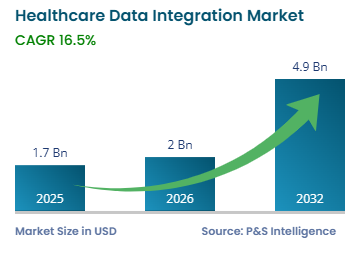
Market Size in 2025
USD 1.7 Billion
Market Size in 2026
USD 2.0 Billion
Market Size by 2032
USD 4.9 Billion
Projected CAGR
16.5%
Largest Region
North America
Fastest Growing Region
Asia-Pacific
Market Structure
Fragmented
Market Size
Explore the market potential with our data-driven report
Healthcare Data Integration Market Future Outlook
The healthcare data integration market size was USD 1.7 billion for 2025, and it will grow by 16.5% during 2026-2032, to reach USD 4.9 billion by 2032.
The healthcare data integration market is expanding as healthcare organisations seek to connect information distributed across electronic health records, laboratory systems, medical imaging platforms, pharmacy databases, payer networks, and digital health applications. Healthcare delivery increasingly depends on timely access to complete patient information, making data integration essential for clinical decision-making, care coordination, and operational efficiency. Growing adoption of telehealth, remote patient monitoring, connected medical devices, and digital care platforms continues to increase the volume and complexity of healthcare data generated across the care continuum.
The need for integration is becoming stronger as healthcare organisations modernise their digital infrastructure and adopt value-based care models. Cloud-based platforms, application programming interfaces, and interoperability frameworks are being deployed to enable secure information exchange between previously disconnected systems. According to the Global Digital Health Monitor, 73% of participating countries reached Phase 3 or higher in digital health services and applications in 2024, reflecting the growing maturity of digital healthcare environments and the increasing requirement for connected information systems across clinical workflows. Healthcare organisations are also expanding their use of analytics, artificial intelligence, population health management tools, and patient engagement platforms, all of which depend on accurate and accessible data from multiple sources. Integrated data environments help reduce information silos, improve data consistency, and support more efficient healthcare operations.
Key Market Insights
Tools is the larger category, holding a market share of 75.0%, due to rising demand for software that connects and manages healthcare information across disparate systems.
Data Integration is the largest category, holding a market share of 40.0%, due to increasing requirements for consolidating clinical, operational, financial, and digital health information.
Cloud-Based is the largest category, holding a market share of 65.0%, due to growing adoption of scalable infrastructure supporting healthcare data exchange across distributed care networks.
North America holds the largest share of 45.0%, due to widespread interoperability adoption, advanced healthcare IT infrastructure, and extensive electronic health record usage.
Asia-Pacific is the fastest-growing region, registering a CAGR of 18.0%, driven by healthcare digitalisation programmes, expanding digital health infrastructure, and increasing interoperability initiatives.
Healthcare Data Integration Market Trends and Drivers
AI-Enabled Interoperability Platforms and FHIR-Based Data Exchange Is Major Trend
Healthcare data integration is increasingly shifting toward AI-enabled interoperability platforms that can connect and exchange information across healthcare systems in real time. Healthcare organisations are moving beyond traditional point-to-point integrations toward API-driven architectures based on standards such as FHIR, enabling more efficient connectivity between electronic health records, laboratories, imaging systems, payer platforms, and digital health applications. According to the Global Digital Health Monitor, only 15% of participating countries had national architectures enabling seamless real-time data sharing in 2024, highlighting the continued need for stronger interoperability infrastructure. In addition, 45% of participating countries remained unprepared for AI and emerging technologies in 2024, indicating significant scope for healthcare organisations to strengthen the digital infrastructure required to support AI-enabled workflows. These developments are encouraging investment in cloud-native integration platforms, automated data mapping tools, and real-time information exchange capabilities that can improve data accessibility, support clinical decision-making, and enable increasingly connected healthcare ecosystems.
Rising Need for Unified Patient Records Across Fragmented Healthcare Systems Drives Market
The growing need to unify fragmented patient information remains a key driver for the healthcare data integration market. Healthcare providers operate across hospitals, speciality clinics, laboratories, imaging centres, pharmacies, and payer organisations that often use separate information systems, making it difficult to access complete patient records. Integration platforms help consolidate information from multiple sources, improving care coordination, reducing duplicate procedures, and supporting more informed clinical decisions. According to the Global Digital Health Monitor, 46% of participating countries lacked a master patient index in 2024, limiting the ability to accurately connect patient information across healthcare systems. The same source reported that 34% of participating countries still lacked unique patient identification systems in 2024, creating additional challenges for maintaining consistent patient records. These gaps are increasing demand for data integration solutions that can establish reliable patient matching, improve information continuity, and support coordinated healthcare delivery across multiple care settings.
Legacy System Complexity and Data Standardization Challenges Restrain Market Growth
Legacy healthcare systems remain a major barrier to healthcare data integration adoption. Many healthcare organisations continue to operate ageing software, proprietary applications, and departmental databases that were not designed to exchange information with modern digital platforms. This creates integration challenges, increases implementation complexity, and often requires extensive customisation. According to the Global Digital Health Monitor, 58% of participating countries did not have a fully established national health information exchange system in 2024, highlighting persistent interoperability gaps across healthcare ecosystems. These limitations make it harder to standardise data, maintain information accuracy, and support secure information sharing. Healthcare providers therefore face longer deployment timelines, higher integration costs, and greater operational effort when attempting to build connected data environments across multiple systems.
Expansion of Population Health and Predictive Analytics Programs Creates Market Opportunity
The growing use of population health management and advanced healthcare analytics is creating significant opportunities for healthcare data integration providers. Healthcare organisations increasingly require connected datasets that combine clinical, operational, financial, and patient-generated information to support predictive analytics, risk stratification, and outcome-based care programmes. High-quality analytics depends on information being accessible across multiple healthcare settings rather than remaining isolated within individual systems. According to the Global Digital Health Monitor, 95% of participating countries used digital health systems to monitor population health in 2024, demonstrating the expanding role of data-driven healthcare management. This shift is increasing demand for integration platforms that can aggregate information from diverse sources, improve analytics readiness, and support artificial intelligence applications that depend on consistent and connected healthcare data.
Healthcare Data Integration Market Segmentation Analysis
Component Analysis
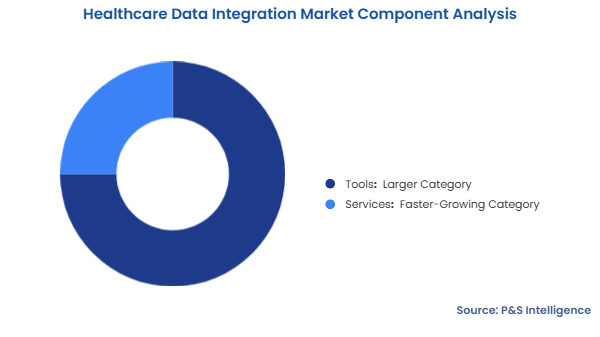
Tools is the larger category, holding a market share of 75.0%, because healthcare organisations rely on software platforms to connect, standardise, and exchange information across clinical and administrative systems. According to the Global Digital Health Monitor, 73% of participating countries reached Phase 3 or higher in digital health services and applications in 2024. The expansion of digital healthcare workflows is increasing demand for integration tools that improve data visibility, automate information exchange, and support coordinated access to healthcare data across connected systems.
Services is the faster category, registering a CAGR of 16.9%, due to the increasing complexity of healthcare integration projects and the need for specialized implementation expertise. Organizations often require consulting, deployment, migration, and ongoing support to connect diverse systems while maintaining regulatory compliance and data security. The expansion of cloud-based healthcare platforms, interoperability initiatives, and digital transformation programs is creating stronger demand for professional and managed services that help healthcare providers accelerate integration efforts and optimize long-term system performance.
The components analysed in this report are:
Tools (Larger Category)
Data Integration Software
Middleware Tools
Data Mapping Tools
Extract, Transform, and Load Tools
Services (Faster-Growing Category)
Consulting Services
Implementation Services
Support Services
Cloud Integration Services
Managed Services
Integration Type Analysis
Data Integration is the largest category, holding a market share of 40.0%, because healthcare organisations must consolidate information generated across clinical, operational, financial, and digital health systems. Unified datasets support care coordination, analytics, reporting, and clinical decision-making while reducing information fragmentation. Data integration also forms the foundation for interoperability tools and cloud-based healthcare environments. According to the Global Digital Health Monitor, 33% of participating countries had adopted some form of health data exchange standards in 2024.
Device Integration is the fastest-growing category, registering a CAGR of 17.5%, due to the rapid adoption of connected medical devices, remote patient monitoring solutions, and digital health technologies. Healthcare providers increasingly seek to capture and exchange data generated by monitoring equipment, wearable devices, and clinical instruments within broader healthcare information systems. As connected care models expand and patient-generated data becomes more valuable for treatment and monitoring, demand for efficient device connectivity and interoperability continues to accelerate across healthcare settings.
The integration types analysed in this report are:
Data Integration (Largest Category)
Device Integration (Fastest-growing Category)
Application Integration
Healthcare Information Exchange
Others
Deployment Mode Analysis
Cloud-Based is the largest category, holding a market share of 65.0%, because healthcare organisations increasingly require scalable infrastructure to support interoperability, data integration, and information sharing across distributed care networks. Cloud deployment simplifies connectivity between electronic health records, analytics platforms, and digital health applications while reducing reliance on complex on-site systems. According to the Global Digital Health Monitor, 86% of participating countries were in Phase 3 or 4 for network readiness in 2024.
Hybrid is the fastest-growing category, registering a CAGR of 17.2%, because many healthcare organizations operate a combination of legacy systems and modern cloud platforms. A hybrid approach allows providers to maintain critical on-premises applications while benefiting from the scalability and interoperability offered by cloud technologies. This deployment model supports gradual modernization without requiring complete infrastructure replacement. As healthcare institutions pursue digital transformation while preserving existing investments, demand for hybrid integration environments continues to increase steadily.
The deployment modes analysed in this report are:
Cloud-Based (Largest Category)
Hybrid (Fastest-growing Category)
On-Premises
Organization Size Analysis
Large Enterprises is the larger category, holding a market share of 80.0%, because major healthcare systems operate extensive networks of hospitals, laboratories, speciality centres, and outpatient facilities that generate substantial volumes of clinical and administrative data. These organisations require advanced integration capabilities to support interoperability, analytics, and coordinated care initiatives across multiple locations. According to HIMSS, 86% of respondents used artificial intelligence in their medical organisations in 2024, highlighting the increasing adoption of data-intensive technologies across healthcare organisations.
Small and Medium Enterprises is the faster category, registering a CAGR of 17.9%, due to increasing access to cloud-based integration technologies and lower deployment barriers. Smaller healthcare providers are investing in digital health systems, electronic medical records, and connected care solutions to improve operational efficiency and patient engagement. As affordable and scalable integration platforms become more widely available, these organizations are accelerating technology adoption.
The organization sizes analysed in this report are:
Large Enterprises (Larger Category)
Small and Medium Enterprises (Faster-Growing Category)
End User Analysis
Hospitals is the largest category, holding a market share of 30.5%, because they manage large volumes of patient, diagnostic, clinical, and operational information across multiple departments and care settings. Effective integration is necessary to connect electronic health records, laboratory systems, imaging platforms, pharmacy databases, and administrative applications within a unified environment. According to the Organisation for Economic Co-operation and Development, at least 95% of primary care practices in 13 of 17 OECD countries used electronic medical records in 2024.
Research Institutions is the fastest-growing category, registering a CAGR of 17.4%, due to rising use of advanced analytics, clinical research platforms, and data-driven healthcare studies. These organizations increasingly require access to integrated datasets that combine information from multiple healthcare sources to support research activities and evidence generation. Growing interest in artificial intelligence, precision medicine, and population health analysis is further increasing demand for connected and high-quality healthcare data.
The end users analysed in this report are:
Hospitals (Largest Category)
Research Institutions (Fastest-growing Category)
Clinics
Diagnostic Laboratories
Ambulatory Care Centers
Healthcare Payers
Others
Drive strategic growth with comprehensive market analysis
Healthcare Data Integration Market Regional Analysis
North America Healthcare Data Integration Market Analysis
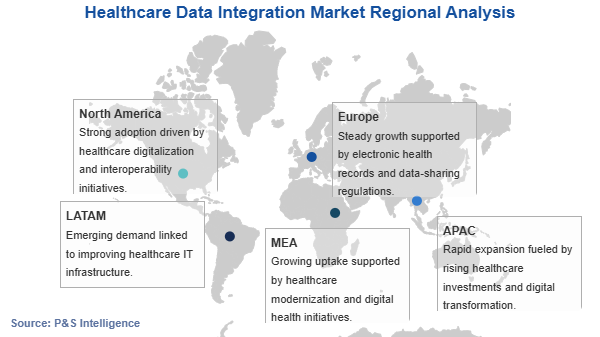
North America holds the largest share of 45.0%, supported by its mature healthcare information technology infrastructure, widespread adoption of electronic health records, established health information exchange networks, and strong investment in interoperability and connected healthcare systems. Healthcare organisations across the region are increasingly integrating clinical, administrative, diagnostic, and patient-generated data to improve information accessibility and care coordination. According to the Office of the National Coordinator for Health Information Technology, 76% of hospitals engaged in all four measured interoperability domains in 2025, including electronically sending, receiving, finding, and integrating health information, highlighting the region's advanced interoperability environment. The continued adoption of API-based data exchange, cloud technologies, and interoperable healthcare platforms is supporting demand for healthcare data integration solutions across the region.
U.S. Healthcare Data Integration Market Analysis
The U.S. healthcare data integration market benefits from a highly developed healthcare IT ecosystem and widespread adoption of digital health technologies. Providers, payers, laboratories, pharmacies, and healthcare networks routinely exchange clinical and administrative information across multiple platforms. Strong adoption of electronic health records, value-based care programmes, remote patient monitoring, and patient engagement technologies continues to increase interoperability requirements. According to the Office of the National Coordinator for Health Information Technology, 76% of U.S. non-federal acute care hospitals engaged in all four interoperability domains in 2025, including sending, receiving, finding, and integrating health information. This level of connectivity is supporting demand for advanced integration platforms that improve information accessibility, reduce data silos, and strengthen coordinated care delivery across healthcare organisations.
Canada Healthcare Data Integration Market Analysis
Canada's healthcare data integration market is supported by ongoing efforts to improve information sharing across provincial and regional healthcare networks. Healthcare authorities are investing in digital modernisation initiatives that enable better access to patient information across hospitals, clinics, and community care settings. Expansion of virtual care services and increasing focus on integrated healthcare delivery are creating stronger requirements for interoperability and connected healthcare systems. According to Health Canada, only 35% of physicians shared patient information outside their practice in 2024. The limited exchange of healthcare information highlights persistent connectivity challenges across the healthcare system. Integration platforms are therefore gaining importance as organisations seek to improve information flow, support coordinated care pathways, and provide healthcare professionals with broader access to patient records.
Asia-Pacific Healthcare Data Integration Market Analysis
Asia-Pacific has the highest CAGR of 18.0%, driven by the rapid expansion of digital healthcare infrastructure and increasing investments in connected healthcare environments across the region. Healthcare systems are increasingly modernising information infrastructure, adopting electronic health records, and developing interoperability frameworks to improve the exchange and accessibility of healthcare data. According to the World Health Organization, at least 80% of countries in the WHO South-East Asia Region had drafted or completed national digital health strategies, providing a structured foundation for strengthening health information systems, interoperability, and digital health innovation. The region's continued shift from fragmented digital systems toward interconnected healthcare ecosystems is increasing demand for data integration platforms that can support information exchange, analytics, and coordinated healthcare delivery.
China Healthcare Data Integration Market Analysis
China's healthcare data integration market is expanding alongside large-scale healthcare digitalisation programmes and continued investment in smart hospital infrastructure. Healthcare institutions are increasingly deploying integrated information platforms to manage clinical, operational, and administrative information generated across complex healthcare environments. Government support for digital healthcare transformation and regional health information platforms is strengthening demand for technologies that connect multiple systems and improve information accessibility. According to the National Bureau of Statistics of China, the country recorded 10.11 billion medical visits in 2024. This substantial volume of healthcare activity generates extensive patient and operational data that must be connected across healthcare systems. Integration platforms are helping organisations improve data management, support clinical workflows, and enable more efficient healthcare operations.
India Healthcare Data Integration Market Analysis
India is witnessing rapid growth in healthcare data integration as healthcare providers accelerate their transition towards connected digital healthcare environments. National digital health initiatives are encouraging interoperability, secure information exchange, and wider adoption of digital patient records across healthcare stakeholders. Healthcare providers are expanding investments in electronic medical records, telehealth platforms, and digital patient management systems, creating greater demand for integration technologies. According to the Press Information Bureau of the Government of India, 67.19 crore health records were linked with ABHA under the Ayushman Bharat Digital Mission in 2025. The expanding volume of connected health records is increasing the need for platforms that can exchange, manage, and access patient information efficiently across diverse healthcare organisations and care settings.
Europe Healthcare Data Integration Market Analysis
Europe remains an important market for healthcare data integration due to ongoing efforts to improve cross-border health information exchange, strengthen interoperability standards, and support digitally connected healthcare services. Healthcare providers across the region are increasingly focused on linking clinical, administrative, and diagnostic data sources to improve care coordination and operational efficiency. According to the European Commission, the EU-27 average eHealth maturity score reached 87% in 2025, increasing by 4 percentage points from 2024, with improvements including wider availability of health data and a greater number of healthcare providers connected and sharing data. This continued advancement in digital health infrastructure is strengthening the need for integrated healthcare information systems across the region.
The regions and countries analysed in this report are:
North America (Largest Regional Market)
U.S. (Larger Country)
Canada (Faster-Growing Country)
Europe
Germany (Fastest-Growing Country)
U.K. (Largest Country)
France
Italy
Spain
Rest of Europe
Asia-Pacific (Fastest-Growing Regional Market)
China (Largest Country)
India (Fastest-Growing Country)
Japan
South Korea
Australia
Rest of APAC
Latin America
Brazil (Largest Country)
Mexico (Fastest-Growing Country)
Rest of LATAM
Middle East and Africa
Saudi Arabia (Largest Country)
U.A.E. (Fastest-Growing Country)
South Africa
Rest of MEA
Healthcare Data Integration Market Competitive Landscape
The healthcare data integration market is fragmented, with participation from a broad mix of global healthcare technology providers, interoperability specialists, integration platform vendors, cloud service companies, and niche healthcare IT firms. The diversity of healthcare environments, varying interoperability requirements, and the presence of multiple integration approaches have created opportunities for numerous vendors to compete across different customer segments and application areas. Market participants often differentiate themselves through specialized capabilities such as healthcare interoperability, cloud integration, application connectivity, data management, analytics enablement, or regulatory compliance support. In addition, healthcare organizations frequently select integration partners based on existing technology ecosystems, customization needs, and implementation expertise rather than relying on a limited group of providers.
Leading Companies in the Healthcare Data Integration Market:
Astera Software
Cloud Software Group, Inc.
Denodo Technologies
Innovaccer Inc.
Microsoft Corporation
Oracle Corporation
QlikTech International AB
Informatica Inc.
Salesforce Inc.
International Business Machines Corporation
SAP SE
SAS Institute Inc.
InterSystems Corporation
Rhapsody
Health Catalyst
Healthcare Data Integration Market Developments
In March 2026, Rhapsody announced the general availability of Rhapsody Axon, an AI-powered integration agent embedded within its Rhapsody and Corepoint platforms. The solution helps healthcare interoperability teams accelerate integration development, streamline troubleshooting, and improve clinical data exchange workflows
In February 2026, InterSystems Corporation launched InterSystems Payer Connector on the Epic Showroom. The solution connects Epic Payer Platform with health plan applications, enabling governed data exchange for enrollment, claims processing, clinical document sharing, and quality management activities.
In December 2025, Cloud Software Group, Inc. completed the acquisition of Arctera, a global data management company, adding data resilience, data compliance, and data protection capabilities to its enterprise software portfolio.
In January 2025 QlikTech International AB acquired Upsolver, a real-time data streaming and Apache Iceberg optimization company, strengthening its real-time data ingestion and end-to-end data integration capabilities.
Frequently Asked Questions About This Report
What does the healthcare data integration market include for organizations?+
It includes platforms that connect clinical, claims, laboratory, imaging, pharmacy, and device data across healthcare systems and applications.
What factors are driving demand in the healthcare data integration market?+
Demand is driven by interoperability goals, coordinated care, analytics programs, digital health tools, and need for complete patient views.
Why are organizations adopting healthcare data integration solutions across operations?+
Healthcare organizations adopt data integration to reduce data silos, support care coordination, improve reporting, and enable analytics.
How do healthcare data integration solutions improve decision making and efficiency?+
These solutions improve operations by moving data securely between systems, normalizing formats, and giving users access to connected records.
What challenges affect adoption of healthcare data integration solutions today?+
Adoption is affected by legacy systems, inconsistent standards, privacy rules, data mapping complexity, and coordination among many technology vendors.
Want a report tailored exactly to your business need?
Leading companies across industries trust us to deliver data-driven insights and innovative solutions for their most critical decisions. From data-driven strategies to actionable insights, we empower the decision-makers who shape industries and define the future. From Fortune 500 companies to innovative startups, we are proud to partner with organisations that drive progress in their industries.
Client Testimonials
Working with P&S Intelligence and their team was an absolute pleasure – their awareness of timelines and commitment to value greatly contributed to our project's success. Eagerly anticipating future collaborations.
McKinsey & Company
India
Unmatched Standards
Our insights into the minutest levels of the markets, including the latest trends and competitive landscape, give you all the answers you need to take your business to new heights
Complete Data Security
We take a cautious approach to protecting your personal and confidential information. Trust is the strongest bond that connects us and our clients, and trust we build by complying with all international and domestic data protection and privacy laws