This Report Provides In-Depth Analysis of the GCC Private Equity Market Report Prepared by P&S Intelligence, Segmented by Fund Type (Buyout, Venture Capital, Real Estate, Growth Equity, Private Debt, Infrastructure), Sector (IT & Telecommunications, Healthcare, Consumer & Retail, Financial Services, Industrial & Manufacturing, Energy & Power, Real Estate and Services, Media & Entertainment, Telecom), and Geographical Outlook for the Period of 2019 to 2032
Explore the market potential with our data-driven report
GCC Private Equity Market Analysis
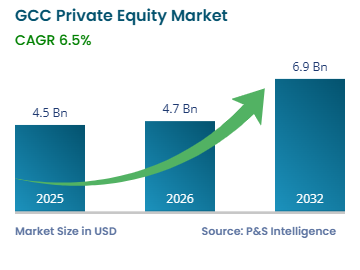
The GCC private equity market value is estimated at USD 4.5 billion in 2025, and it is projected to reach USD 6.9 billion by 2032, growing at a CAGR of 6.5% during 2026–2032.
This robust growth trajectory reflects the region's ongoing economic diversification efforts, increased institutional investor participation, and the maturation of exit environments across Gulf Cooperation Council countries. The market has witnessed significant transformation as sovereign wealth funds increasingly co-invest alongside international private equity firms, while regional family offices professionalize their investment approaches and seek higher returns through alternative asset classes.
The surge in private equity activity across GCC nations stems from ambitious national transformation programs, particularly Saudi Arabia's Vision 2030 and the UAE's economic diversification initiatives. These strategic frameworks have created unprecedented investment opportunities across non-oil sectors, attracting both regional and international private equity players. According to the Saudi Central Bank (SAMA), non-oil private sector growth reached 5.9% in 2024, demonstrating the expanding opportunity set for private equity investments beyond oil. The privatization of government assets and initiation of public–private partnerships have generated substantial deal flow, with state-owned enterprises across utilities, telecommunications, and financial services sectors attracting private equity interest. According to the International Monetary Fund, Saudi Arabia's non-oil real GDP grew by 4.2% in 2024, primarily driven by private consumption and non-oil private investment.
Regional family offices are undergoing fundamental transformation in their investment approach, moving from traditional wealth preservation strategies toward growth-oriented, innovation-driven portfolios. A report by LOGIC Consulting reveals that 78% of family offices globally are planning to invest in digital assets over the next two to three years, highlighting their shift toward tech-focused investment models. This evolution reflects the influence of younger generations taking leadership roles in family enterprises, bringing greater sophistication and global perspective to investment decisions.
Rising Family Office Sophistication Is Major Trend
The evolution of GCC family offices from passive wealth preservers to active venture capitalists represents a paradigm shift in regional investment patterns.
Family offices in the Gulf are adopting investment strategies that look more like venture capital, reflecting the influence of younger generations, evolving risk appetites, and a desire to link capital with purpose and long-term impact.
This transformation has created new sources of capital for private equity funds while also increasing direct investment activity.
The dynamic between family offices and traditional institutional investors is further evidenced by their increasing collaboration.
In 2024, over 200 new family offices joined the Dubai International Financial Centre, bringing the total to 800, while Saudi Arabia is building a regulatory environment to attract family offices through its Financial Sector Development Programme.
These offices increasingly partner with international private equity firms, providing patient capital and regional expertise while gaining access to global investment opportunities.
Government Diversification Initiatives Are Accelerating Market Growth
The ambitious economic transformation programs across GCC nations constitute the primary driver for private equity market expansion.
Saudi Arabia's Vision 2030, the UAE's economic diversification initiatives, and similar programs across Kuwait, Qatar, Bahrain, and Oman have created unprecedented investment opportunities in non-oil sectors.
These initiatives have fundamentally reshaped the investment landscape by opening previously restricted sectors to private capital participation, establishing specialized economic zones, and implementing regulatory reforms that facilitate foreign investment.
The Saudi government aims to increase the private sector's contribution to GDP from 40% to 65%, with the Public Investment Fund playing a crucial role by injecting capital into strategic industries and fostering public–private partnerships.
This massive shift in economic structure has generated substantial deal flow opportunities for private equity firms, particularly in sectors undergoing privatization, such as healthcare, education, transport, and utilities.
The participation of sovereign wealth funds has fundamentally transformed the private equity landscape in the GCC.
By the third quarter of 2024, M&A aggregate deal value in the Middle East increased by 25.3% compared to the same period in 2023, with SWFs regularly featuring in big-ticket transactions as sought-after co-investment partners.
Gulf SWFs deployed USD 82 billion in 2023 and an additional USD 55 billion in the first nine months of 2024, with five major players: ADIA, Mubadala, ADQ, PIF, and QIA.
These institutions increasingly co-invest alongside international private equity firms, providing not only capital but also strategic guidance and market access.
GCC Private Equity Market Segmentation Analysis
Fund Type Analysis
Infrastructure is currently the largest private capital fund category in the GCC, with 35% share in 2025. This is driven by massive government spending on transportation, renewable energy, tourism, logistics, digital infrastructure, and giga-projects under initiatives like Saudi Vision 2030 and the UAE’s economic diversification plans. Sovereign wealth funds and state-backed entities are the primary allocators, channeling significant capital into long-term infrastructure assets due to their strategic importance, inflation-hedging potential, and stable cash flows.
Private debt is the fastest-growing category, during 2026–2032. This reflects the fundamental shift in regional financing dynamics as companies increasingly seek alternatives to traditional bank lending. This expansion is driven by regulatory reforms enabling non-bank lending, growing demand for acquisition financing, real estate development funding, and infrastructure project finance. Private debt funds offer speed of execution, covenant flexibility, and certainty of funding that traditional lenders often cannot match, particularly for complex or time-sensitive transactions.
These fund types are covered:
Buyout
Venture Capital
Real Estate
Growth Equity
Private Debt (Fastest-Growing Category)
Infrastructure (Largest Category)
Others
Sector Analysis
The financial services sector commands the largest share of private equity investments in 2025, of 25%. This concentration reflects the ongoing transformation of regional banking, insurance, and fintech sectors driven by digital disruption, regulatory modernization, and demographic shifts. Private equity firms have actively invested in payment platforms, digital banks, insurance technology providers, and wealth management firms capitalizing on the region's young, tech-savvy population and increasing financial inclusion initiatives. The sector benefits from strong regulatory support for financial innovation, particularly in the UAE and Saudi Arabia, where regulatory sandboxes and digital banking licenses have facilitated new market entrants.
The IT & telecommunications category demonstrates the highest growth potential, for 2026–2032. This acceleration is fueled by government digital transformation agendas, massive investments in smart city initiatives, and the rapid adoption of emerging technologies, including artificial intelligence, blockchain, and Internet of Things solutions. Saudi Arabia accounts for 40% of total venture capital deals in MENA, closing 178 deals in 2024, with government entities fast-tracking investments in local startup ecosystems through seed funding and strategic advice. The sector's growth is further supported by the establishment of technology funds by major regional players and increased participation from global technology investors.
Here are the sectors studied in this report:
IT & Telecommunications (Fastest-Growing Category)
Healthcare
Consumer & Retail
Financial Services (Largest Category)
Industrial & Manufacturing
Energy & Power
Real Estate and Services
Media & Entertainment
Telecom
Others
Deal Size Analysis
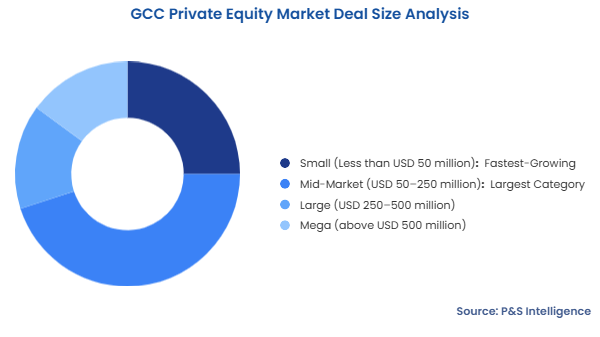
Mid-market deals (USD 50–250 million) hold the largest share, of 45%, in 2025, reflecting the maturity of the regional private equity market. Here, firms have developed expertise in executing complex mid-sized transactions across diverse sectors. These deals typically involve established businesses with proven revenue models, making them attractive to both regional and international investors. The segment benefits from a robust pipeline of family business successions, corporate divestments, and growth capital requirements from expanding regional champions.
Small deals (less than USD 50 million) will exhibit the highest CAGR, during 2026–2032. This growth is driven by the proliferation of venture capital and growth equity investments in technology startups, the increasing activity in lower mid-market buyouts, and the emergence of specialized small-cap funds targeting niche sectors. The category has benefited from improved exit environments through strategic acquisitions, secondary sales, and an active regional IPO market that provides liquidity options even for smaller investments.
These deal sizes are covered:
Small (Less than USD 50 million) (Fastest-Growing Category)
Saudi Arabia dominates the GCC private equity landscape in 2025 with 40% share in 2025. The Kingdom's leadership position stems from its massive economic transformation program, which has created unprecedented investment opportunities across multiple sectors. As per an article in Arab News, the kingdom's gross fixed capital formation reached SAR 1.18 trillion in 2024, with the private sector accounting for 88% of total GFCF at SAR 1.03 trillion, signaling a strategic shift toward private sector-led growth. The privatization pipeline alone includes over 160 initiatives across 16 government sectors, offering substantial opportunities for private equity participation in utilities, healthcare, education, and transportation assets.
The Saudi private equity market benefits from the Public Investment Fund's aggressive deployment strategy, which has catalyzed broader market activity through co-investment programs and sector-specific funds. The Kingdom's focus on developing mega-projects, including NEOM, Red Sea Development, and Qiddiya, has created substantial opportunities for infrastructure and real estate-focused private equity funds. Additionally, the development of specialized economic zones and the establishment of regional headquarters requirements for international companies have driven significant investment activity in commercial real estate, logistics, and business services sectors.
Kuwait Private Equity Market Outlook
Kuwait represents the fastest-growing private equity market in the GCC, with a projected CAGR of approx. 7.0% during 2026–2032. This acceleration is driven by the government's Vision 2035 transformation program, which aims to diversify the economy and reduce oil dependency through private sector development. The Kuwait Investment Authority, one of the world's oldest and largest sovereign wealth funds, has increased its allocation to alternative investments, including private equity, providing significant capital and credibility to the local market.
The Kuwaiti market benefits from ongoing privatization initiatives across telecommunications, utilities, and transportation sectors. The government's commitment to developing the Silk City megaproject and expanding the northern economic zone has created substantial infrastructure investment opportunities. Additionally, Kuwait's relatively underpenetrated private equity market compared to its GCC peers presents significant growth potential as regulatory reforms improve the investment environment and local family offices increasingly embrace alternative investments.
These countries are covered:
Saudi Arabia (Largest country Market)
UAE
Kuwait (Fastest-Growing Country Market)
Qatar
Bahrain
Oman
GCC Private Equity Market Share
The GCC private equity market exhibits moderate consolidation. This concentration reflects the dominant role of sovereign wealth funds and large regional investment firms that possess the capital, expertise, and relationships necessary to execute major transactions. The market structure is evolving toward greater sophistication as international private equity giants establish regional offices and partner with local institutions, creating a competitive yet collaborative ecosystem.
Market concentration stems from several structural factors. First, the capital-intensive nature of private equity requires substantial resources to compete effectively, particularly in buyout and infrastructure segments where deal sizes often exceed USD 500 million. Second, regulatory relationships and government partnerships favor established players with proven track records and deep local knowledge. Third, the importance of sovereign wealth fund relationships creates barriers to entry for new firms lacking these critical connections.
International private equity giants have increasingly recognized the GCC's strategic importance, with major firms establishing dedicated regional teams and offices. Blackstone, with over USD 1.27 trillion in AUM globally, has cultivated a well-diversified portfolio with approximately 32% in corporate private equity, 28% in real estate, 7% in multi-asset investing, and 33% in credit and insurance. These global players bring sophisticated investment strategies, operational expertise, and international networks that complement the capital and regional knowledge of local partners.
The competitive landscape is characterized by increasing collaboration between international and regional players. Co-investment structures have become the norm for large transactions, with sovereign wealth funds often taking anchor positions alongside international private equity firms. This collaborative approach reduces risk, combines complementary expertise, and facilitates knowledge transfer. The model has proven particularly successful in complex sectors such as healthcare, technology, and infrastructure, where both global best practices and local market understanding are essential.
Regional private equity firms have carved out defensible niches by focusing on mid-market transactions, specialized sectors, or specific geographies where their local expertise provides competitive advantages. Gulf Capital, Investcorp, and NBK Capital have successfully competed by maintaining deep relationships with regional family businesses, understanding local regulatory environments, and providing culturally aligned investment approaches. These firms often serve as co-investors or partners for international firms seeking regional exposure.
The emergence of specialized sector-focused funds represents another competitive dynamic. Healthcare-focused funds like TVM Capital Healthcare, technology specialists like STV, and infrastructure-focused vehicles have proliferated as investors seek targeted exposure to high-growth sectors. This specialization trend reflects market maturation and the increasing sophistication of both general partners and limited partners in the region.
Key GCC Private Equity Companies:
Mayo Clinic
Mubadala Investment Company
Abu Dhabi Investment Authority (ADIA)
Abu Dhabi Developmental Holding Company (ADQ)
Qatar Investment Authority (QIA)
Kuwait Investment Authority (KIA)
Public Investment Fund (PIF)
Investcorp
Gulf Capital
Wafra International Investment Company
Jadwa Investment
NBK Capital Partners
SHUAA Capital
Alkhabeer Capital
SEDCO Capital
Riyad Capital
GCC Private Equity Market News
In September 2024, Mubadala Investment Company announced its participation in a USD 25-billion private credit and direct lending program with Apollo Global Management and Citigroup, initially focusing on North American markets with potential expansion globally.
In July 2024, Saudi Arabia's Public Investment Fund committed USD 20 billion as an anchor investment in Blackstone's new infrastructure investment platform dedicated to U.S. infrastructure.
In June 2024, Gulf Capital successfully closed its Growth Capital Fund III at USD 750 million, exceeding its target and attracting commitments from regional sovereign wealth funds, development finance institutions, and global institutional investors.
In May 2024, the Abu Dhabi Investment Authority increased its allocation to private equity to 17% of its total portfolio, up from 12% five years earlier.
In March 2024, the Kuwait Investment Authority announced the establishment of a USD 5 billion dedicated private equity fund focusing on technology and healthcare investments across emerging markets.
In February 2024, Investcorp completed the acquisition of a controlling stake in a leading GCC healthcare provider for USD 1.1 billion.
In January 2024, The Saudi Exchange introduced new regulations facilitating private equity-backed IPOs, including reduced lock-up periods and streamlined listing requirements for portfolio companies.
Want a report tailored exactly to your business need?
Leading companies across industries trust us to deliver data-driven insights and innovative solutions for their most critical decisions. From data-driven strategies to actionable insights, we empower the decision-makers who shape industries and define the future. From Fortune 500 companies to innovative startups, we are proud to partner with organisations that drive progress in their industries.
Client Testimonials
Working with P&S Intelligence and their team was an absolute pleasure – their awareness of timelines and commitment to value greatly contributed to our project's success. Eagerly anticipating future collaborations.
McKinsey & Company
India
Unmatched Standards
Our insights into the minutest levels of the markets, including the latest trends and competitive landscape, give you all the answers you need to take your business to new heights
Complete Data Security
We take a cautious approach to protecting your personal and confidential information. Trust is the strongest bond that connects us and our clients, and trust we build by complying with all international and domestic data protection and privacy laws