GCC In Vitro Fertilization Market Size & Opportunities Analysis - Growth Strategies, Competitiveness, and Forecasts (2026 - 2032)
This Report Provides In-Depth Analysis of the GCC In Vitro Fertilization Market Report Prepared by P&S Intelligence, Segmented by Product (Equipment, Reagents & Media, Accessories & Disposables), Procedure Type (Fresh Non-Donor, Fresh Donor, Frozen Non-Donor, Frozen Donor), Technology (Conventional IVF, ICSI (Intracytoplasmic Sperm Injection), IVF with Donor Programs, IVF with Preimplantation Genetic Testing (PGT), IVF with Assisted Hatching), End User (Fertility Clinics, Hospitals, Research Laboratories & Academic Institutes), and Geographical Outlook for the Period of 2019 to 2032
Explore the market potential with our data-driven report
GCC In Vitro Fertilization Market Outlook
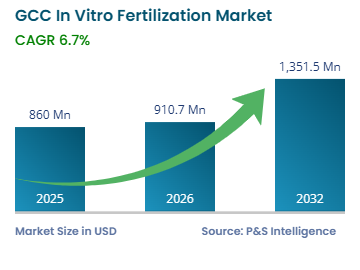
The GCC in vitro fertilization market size will be an estimated USD 860.0 million for 2025, and it will grow by 6.7% during 2026–2032, to reach USD 1,351.5 million by 2032.
The market growth is primarily attributed to the rising infertility rates, increasing trend of delayed childbearing, growing acceptance of assisted reproductive technologies, and implementation of supportive government policies across GCC countries. The market has transformed from a niche medical service to a mainstream fertility solution, supported by substantial investments in healthcare infrastructure and the establishment of world-class fertility clinics equipped with cutting-edge technologies.
The expanding medical tourism sector has positioned the GCC as a premier destination for fertility treatments, attracting patients from neighboring regions seeking high-quality and accessible IVF services. The GCC's strategic location, combined with internationally accredited facilities and skilled reproductive health professionals, has created a competitive advantage in the global fertility tourism market. Furthermore, innovations including preimplantation genetic testing (PGT), intracytoplasmic sperm injection (ICSI), and advanced cryopreservation techniques have significantly enhanced success rates, making IVF treatments more reliable and appealing to prospective parents throughout the region.
The societal shift toward delayed childbearing has emerged as a key trend reshaping the GCC IVF market.
This trend is particularly evident in urban centers, where career advancement and financial stability often take precedence over early family formation.
The pursuit of advanced degrees and professional establishment has led many couples to postpone parenthood until their thirties or beyond, when natural fertility begins to decline significantly.
Age-related fertility decline presents substantial challenges, as women over 35 face reduced oocyte quality and quantity, leading to decreased conception rates and increased risk of chromosomal abnormalities.
Demographic and clinical evidence consistently show that women in their late 30s have significantly lower natural fertility compared to those in their late 20s, increasing reliance on assisted reproductive treatments.
In 1995, the fertility rates in Saudi Arabia, Qatar, and Oman were notably high, averaging 6.5 children per woman.
However, by 2022, these rates had decreased significantly, falling to less than 2 children per woman across all GCC countries, with the exception of Saudi Arabia and Oman.
Recent data released in September 2023 by Qatar’s Planning and Statistics Authority indicates a decrease in marriage rates among Qatari citizens.
The marriage rate for females has fallen from 21.6 in 2016 to 17.1 in 2022.
This paradigm shift has prompted fertility clinics to develop specialized protocols for advanced maternal age patients, including comprehensive fertility assessments, egg freezing options for fertility preservation, and enhanced IVF techniques to optimize outcomes for older patients.
Growing Prevalence of Polycystic Ovary SyndromeIs Biggest Driver
The increasing incidence of PCOS represents a critical driver for the GCC IVF market growth.
According to a systematic review published in 2024, PCOS affects approximately 30% of infertile women across the GCC region, significantly higher than global averages.
This endocrine disorder, characterized by hormonal imbalances and ovulatory dysfunction, has emerged as one of the leading causes of female infertility in the region.
Studies indicate that up to 30% of the women in the GCC suffer from PCOS, driven by genetic predisposition, lifestyle factors, and increasing rates of obesity.
The condition's impact on fertility is substantial, with approximately 75% of women with PCOS experiencing anovulation-related infertility.
Recent data from specialized fertility clinics across the GCC indicate that PCOS patients constitute nearly 30% of all IVF treatment seekers.
The rising awareness about PCOS diagnosis and treatment options, coupled with improved access to reproductive endocrinologists, has led to increased demand for specialized IVF protocols tailored for PCOS patients.
Advanced treatment approaches, including controlled ovarian stimulation with careful monitoring to prevent ovarian hyperstimulation syndrome, have improved success rates among this patient population, further driving market growth.
GCC In Vitro Fertilization Market Segmentation Analysis
Product Type Analysis
The equipment category holds the largest market share, of 45%, in 2025, driven by substantial investments in state-of-the-art reproductive technology infrastructure across fertility centers. This dominance reflects the critical role of advanced equipment in determining IVF success rates, with technologies such as time-lapse embryo monitoring systems, laser-assisted hatching devices, and sophisticated incubators with precise environmental controls becoming standard requirements.
The reagent & media category will have the highest CAGR during the forecast period, attributed to continuous innovations in culture media formulations and the critical role these products play in embryo development. The development of sequential media systems that mimic the changing nutritional requirements of embryos as they progress from fertilization to the blastocyst stage has significantly improved implantation rates. The growing emphasis on quality control and standardization in IVF laboratories has led to increased demand for premium, pharmaceutical-grade media products that ensure consistent results across treatment cycles.
The product types analyzed in this report are:
Equipment (Largest Category)
Sperm Analyzer Systems
Imaging Systems
Ovum Aspiration Pumps
Micromanipulator Systems
Incubators
Gas Analyzers
Laser Systems
Cryosystems
Sperm Separation Devices
IVF Cabinets
Anti-vibration Tables
Witness Systems
Others
Reagents & Media (Fastest-Growing Category)
Culture Media
Cryopreservation Media
Others
Accessories & Disposables
Needles
Pipettes
Dishes & Tubes
Others
Procedure Analysis
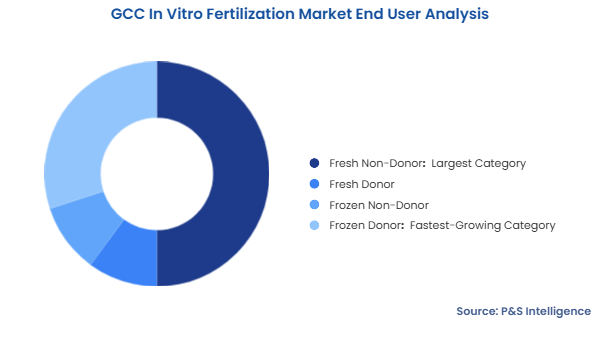
The fresh non-donor category holds the largest market share, of 50%, in 2025, driven by patient preference for using their own gametes and the immediate nature of treatment. This category's dominance reflects both cultural preferences in the region where genetic lineage holds significant importance and the higher success rates associated with fresh transfers in younger patient populations. Additionally, the lower cost compared to donor cycles and the psychological satisfaction of using one's own genetic material contribute to this segment's market leadership.
The frozen donor category will have the highest CAGR, of 6.9%, driven by increasing acceptance of donor programs among expatriate populations and evolving social attitudes, particularly in the UAE, where regulatory frameworks have become more accommodating. Advanced vitrification techniques have dramatically improved post-thaw survival rates to over 95%, making frozen donor cycles increasingly viable. The growing number of women experiencing premature ovarian failure, cancer survivors requiring donor eggs after chemotherapy, and couples with severe male factor infertility requiring donor sperm create a substantial demand for these services.
The procedures analyzed in this report are:
Fresh Non-Donor (Largest Category)
Fresh Donor
Frozen Non-Donor
Frozen Donor (Fastest-Growing Category)
Technology Analysis
The ICSI category holds the largest market share, in 2025, due to the high prevalence of male factor infertility in the region, with studies indicating that male infertility contributes to nearly 50% of all infertility cases. ICSI's ability to overcome severe male factor infertility, including oligozoospermia, asthenozoospermia, and teratozoospermia, has made it the preferred choice for fertility specialists. The technique's success in cases with previous fertilization failure and its compatibility with preimplantation genetic testing procedures have further solidified its market position.
The IVF with preimplantation genetic testing category will have the highest CAGR. The increasing awareness of genetic disorders and the desire for healthy offspring have driven demand for PGT services. In the GCC region, where consanguineous marriages are relatively common, PGT-M (monogenic disorders) and PGT-SR (structural rearrangements) have become essential tools for preventing hereditary diseases.
IVF with Preimplantation Genetic Testing (PGT) (Fastest-Growing Category)
IVF with Assisted Hatching
End User Analysis
The fertility clinics category holds the largest market share, of 60%, in 2025, reflecting their specialized focus and comprehensive service offerings. The success of fertility clinics stems from their ability to provide end-to-end fertility services, from initial consultation and diagnostic testing to complex IVF procedures and long-term embryo storage. Their specialized infrastructure, including clean rooms meeting stringent air quality standards, dedicated embryology laboratories, and integrated genetic testing facilities, enables optimal treatment outcomes.
The research laboratories & academic institutes category will have the highest CAGR, of 7.0%. This growth reflects increasing investment in reproductive medicine research and the development of innovative fertility treatments. Academic medical centers across the GCC have established dedicated reproductive research units, conducting clinical trials on novel ovarian stimulation protocols, embryo culture techniques, and fertility preservation methods. The collaboration between research institutions and clinical facilities has accelerated the translation of scientific discoveries into practical applications, improving IVF success rates.
The end users analyzed in this report are:
Fertility Clinics (Largest Category)
Hospitals
Research Laboratories & Academic Institutes (Fastest-Growing Category)
Others
Drive strategic growth with comprehensive market analysis
GCC In Vitro Fertilization Market Regional Outlook
UAE In Vitro Fertilization Market Size
UAE holds the largest market share, of 35%, in 2025, attributed to its advanced healthcare infrastructure, with Dubai and Abu Dhabi hosting internationally accredited fertility centers that rival the world's best facilities. The UAE's strategic investments in medical tourism, including the establishment of dedicated healthcare free zones and streamlined visa processes for medical travelers, have positioned it as the preferred destination for fertility treatments in the region. According to the report, IVF boasts success rates of 50–65% for women under 35 in the UAE.
The country's multicultural environment and progressive regulatory framework have created an enabling ecosystem for IVF services. The implementation of comprehensive insurance coverage for Emirati nationals undergoing fertility treatments has improved accessibility, while the presence of internationally trained reproductive medicine specialists ensures world-class care standards. Recent government initiatives, including the Emirates Health Services' fertility support programs and the integration of artificial intelligence in embryo selection processes, have further enhanced treatment outcomes.
The establishment of specialized fertility preservation facilities catering to cancer patients and career-oriented individuals has expanded the market scope, contributing to the UAE's continued dominance in the regional IVF landscape. In addition, evolving GCC regulations have significantly shaped the IVF landscape. The UAE’s Federal Decree-Law No. 7 of 2019 introduced progressive rules permitting embryo and gamete freezing and strengthening fertility center licensing and genetic testing standards.
Saudi Arabia In Vitro Fertilization Market Size
Saudi Arabia will have the highest CAGR, of 6.8%, driven by the Kingdom's Vision 2030 healthcare transformation agenda, which prioritizes reproductive health services and medical infrastructure development. The recent regulatory reforms allowing private sector participation in healthcare delivery have attracted significant investments in fertility clinics, with major healthcare groups establishing state-of-the-art IVF centers in Riyadh, Jeddah, and Dammam.
The market expansion is further fueled by changing social dynamics and increasing awareness about infertility treatments. The introduction of mandatory health insurance coverage for fertility treatments in select insurance plans has improved affordability, while the establishment of the Saudi Society for Reproductive Medicine has standardized treatment protocols and enhanced professional development. The Kingdom's large population base, combined with high prevalence of lifestyle-related infertility factors and genetic disorders requiring PGT, presents substantial growth opportunities for IVF service providers. Saudi Arabia’s Ministry of Health enforces strict guidelines on embryo handling, donor use, and IVF laboratory compliance. These regulatory measures have improved transparency, patient safety, and overall service quality across the region.
The countries analyzed are as follows:
Saudi Arabia (Fastest-Growing Country)
UAE (Largest Country)
Kuwait
Qatar
Bahrain
Oman
GCC In Vitro Fertilization Market Share
The market is semi-consolidated due to the dominance of several well-established fertility chains that operate multi-country networks and possess advanced clinical capabilities. The presence of globally recognized fertility networks such as ART Fertility Clinics, alongside homegrown success stories like Fakih IVF and HealthPlus Fertility, creates a dynamic competitive environment. These leading players have established strong market positions through strategic investments in advanced technology, recruitment of internationally trained specialists, and development of comprehensive service portfolios that address diverse patient needs. The competitive landscape is characterized by strategic partnerships and collaborative networks that enhance service delivery. This evolving landscape ultimately enhances patient access to high-quality, technologically advanced fertility solutions.
Key GCC In Vitro Fertilization Companies:
ART Fertility Clinics
Fakih IVF Fertility Center
HealthPlus Fertility Center
Bourn Hall Fertility Centre
Dubai Fertility Centre
Conceive Gynaecology & Fertility Hospital
Vitrolife AB
FUJIFILM Irvine Scientific, Inc.
The Cooper Companies, Inc.
Merck KGaA
Cook Medical LLC
Thermo Fisher Scientific Inc.
GCC In Vitro Fertilization Market News
In September 2024, Burjeel Holdings PLC expanded into the Saudi Arabian IVF market with the launch of Trust Fertility Clinic at Burjeel Medical City, offering integrated comprehensive reproductive health services, including IVF, gynecology, neonatology, and advanced NICU facilities under one roof.
In July 2024, King Faisal Specialist Hospital & Research Centre published research on the sperm-derived PLCζ protein's role in embryo implantation and infertility, providing future treatment protocols and improving success rates for previously untreatable cases.
In October 2023, HealthPlus Fertility partnered with Future Fertility in the UAE to implement AI-powered oocyte assessment technology, enhancing the precision of embryo selection accuracy and improving pregnancy outcomes.
In January 2023, Dubai Health Authority launched 'Dubai in One Day' medical tourism package, enabling international patients to schedule IVF procedures with streamlined processes while accessing comprehensive tourism amenities, strengthening Dubai's position as a fertility tourism hub.
Want a report tailored exactly to your business need?
Leading companies across industries trust us to deliver data-driven insights and innovative solutions for their most critical decisions. From data-driven strategies to actionable insights, we empower the decision-makers who shape industries and define the future. From Fortune 500 companies to innovative startups, we are proud to partner with organisations that drive progress in their industries.
Client Testimonials
Working with P&S Intelligence and their team was an absolute pleasure – their awareness of timelines and commitment to value greatly contributed to our project's success. Eagerly anticipating future collaborations.
McKinsey & Company
India
Unmatched Standards
Our insights into the minutest levels of the markets, including the latest trends and competitive landscape, give you all the answers you need to take your business to new heights
Complete Data Security
We take a cautious approach to protecting your personal and confidential information. Trust is the strongest bond that connects us and our clients, and trust we build by complying with all international and domestic data protection and privacy laws