GCC EV Charging Infrastructure Market Size & Opportunities Analysis - Growth Strategies, Competitiveness, and Forecasts (2026 - 2032)
This Report Provides In-Depth Analysis of the GCC EV Charging Infrastructure Market Report Prepared by P&S Intelligence, Segmented by Charging Type (AC, DC), Charging Level (Level 1, Level 2, Level 3), Connector Type (Type 1 (SAE J1772), Type 2 (Mennekes), Combined Charging System (CCS), CHAdeMO, GB/T), Installation Type (Fixed, Portable), Application (Commercial, Residential), and Geographical Outlook for the Period of 2019 to 2032
Explore the market potential with our data-driven report
GCC EV Charging Infrastructure Market Analysis
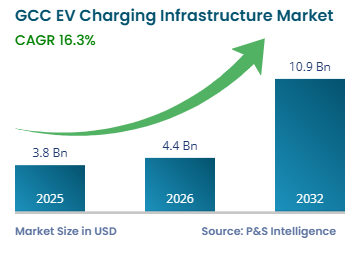
The GCC EV charging infrastructure market is set to be valued at USD 3.8 billion in 2025 and have a CAGR of 16.3% during 2026–2032, reaching USD 10.9 billion by 2032. The robust growth trajectory is primarily driven by accelerating electric vehicle adoption across GCC countries, ambitious government initiatives aligned with national sustainability visions, and substantial investments in charging network expansion by both public and private sector entities.
The surge in EV charging infrastructure development is fundamentally supported by transformative government policies and strategic investments across the region. According to Dubai Electricity and Water Authority, the UAE currently has over 2,000 public EV charging stations, with Dubai alone hosting more than 1,270 charging points across the city. The UAE's commitment to sustainable mobility is evident through initiatives such as the Global EV Market project launched by the Ministry of Energy and Infrastructure in May 2023, which aims to make the UAE a global hub for electric vehicles and establish 50% of total vehicles as EVs by 2050.
Saudi Arabia's Electric Vehicle Infrastructure Company (EVIQ), a joint venture between the Public Investment Fund and Saudi Electricity Company plans to deploy more than 5,000 fast chargers across 1,000+ strategic locations throughout the Kingdom by 2030. This ambitious rollout aligns directly with Saudi Arabia's Vision 2030 goals, particularly the target of ensuring 30% of vehicles in Riyadh are electric by 2030. The Kingdom's commitment is further demonstrated through its investment in domestic EV manufacturing, including partnerships with Lucid Motors and the establishment of Ceer, Saudi Arabia's first EV manufacturer.
The market's expansion is also driven by technological advancements in charging solutions, with the deployment of ultra-fast charging stations capable of reducing charging times to as little as 20-30 minutes. These infrastructure investments are creating a supportive ecosystem for EV adoption while addressing range anxiety concerns that traditionally hindered electric vehicle acceptance in the region.
GCC EV Charging Infrastructure Market Growth Factors
Expansion of Fast and Ultra-Fast Charging Networks Is Key Trend
The rapid deployment of high-speed charging solutions represents a defining trend in the GCC EV charging infrastructure market.
Electric vehicle batteries may be charged quickly with DC fast chargers.
Moreover, an on-board converter that is mounted within the car is not necessary for a DC fast charger to convert current.
More DC fast chargers are being installed in public and commercial spaces by both public and private entities as a result of growing car electrification and range anxiety among EV users.
Modern charging stations in the region are increasingly equipped with DC fast chargers capable of delivering 150–350 kW of power output, enabling vehicle charging in under 30 minutes.
ABB's Terra 360 chargers, recently installed by EVIQ in Saudi Arabia, can simultaneously charge up to four vehicles.
The technological advancement is particularly evident in the UAE, where ultra-fast charging solutions are being integrated with renewable energy sources.
According to Abu Dhabi Sustainability Week, solar energy could potentially provide up to 30% of the energy needed for charging stations in the region by 2030.
As per the International Energy Agency, the global stock of fast chargers (22–150 kW) reached 2 million units in 2024.
Moreover, the number of ultra‑fast chargers (≥150 kW) grew by over 50% in 2024, now making up 10% of all fast chargers.
China led with 80% of the global fast‑charger stock growth.
The EU also saw around 60% growth in the number of available ultra‑fast chargers.
Smart charging technologies are becoming increasingly prevalent, allowing for optimized energy management and improved user convenience.
These systems enable EV owners to locate available stations, schedule charging times, and take advantage of off-peak electricity rates.
The integration of mobile applications and digital payment systems is enhancing the overall user experience while providing real-time data on station availability and charging status.
This, in turn, addressed the key consumer concerns about charging accessibility and reliability.
Government Initiatives and Policy Support Drive Market Growth
The GCC EV charging infrastructure market is experiencing unprecedented growth due to comprehensive government support and policy frameworks implemented across member countries.
Under Saudi Arabia's Vision 2030, the government has established ambitious targets including 30% EV penetration in Riyadh by 2030, creating substantial demand for supporting charging infrastructure.
The UAE's strategy is equally ambitious, with Dubai aiming to increase its public Green Charging Stations by 170%, from 370 in 2023 to 1,000 by 2025, as announced by Dubai Electricity and Water Authority.
As per Qatar’s Ministry of Transport, the country had successfully converted 25% of its public transit bus fleet to electric vehicles in 2022, ahead of schedule, demonstrating the effectiveness of targeted government initiatives.
The country is now expanding its EV charging network with plans to install 600 charging stations during 2024-2025 as part of its first phase strategy.
These government-led initiatives include comprehensive incentive packages such as tax exemptions, subsidies for EV purchases, and grants for businesses establishing charging stations.
The regulatory frameworks established by GCC governments are creating long-term investment security for charging infrastructure developers.
For instance, the UAE's Public-Private Partnership decree aims to accelerate infrastructure investment through collaboration between government entities, utility companies, and private sector players.
This systematic approach ensures sustainable market growth while reducing investment risks for stakeholders.
GCC EV Charging Infrastructure Market Segmentation Analysis
Charging Type Analysis
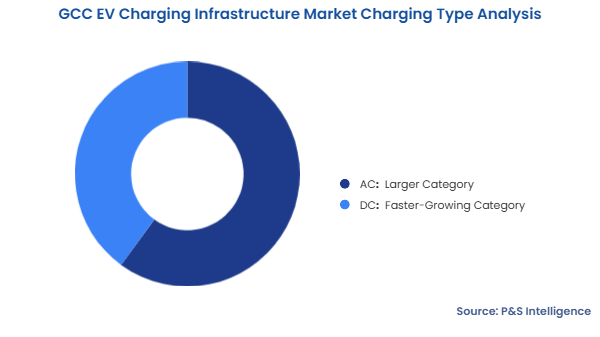
The AC category holds the larger share in the GCC EV charging infrastructure market in 2025, of 60%. This dominance is primarily driven by the cost-effectiveness, ease of installation, and versatility of AC charging solutions across residential, workplace, and commercial applications. AC chargers are particularly well-suited for daily charging needs due to their compatibility with most electric vehicle models and significantly lower operational costs compared to DC charging alternatives.
DC chargers are expected to register the higher CAGR during the forecast period of 2026–2032, of 16.5% annually. This rapid growth is fueled by the increasing demand for fast-charging solutions, particularly along highway corridors and in commercial installations where quick vehicle turnaround is essential. The deployment of high-power DC fast chargers is critical for long-distance travel and addresses consumer range anxiety concerns that can inhibit EV adoption.
These charging types are covered:
AC (Larger Category)
DC (Faster-Growing Category)
Charging Level Analysis
The Level 2 category dominates the GCC EV charging infrastructure market, generating approximately 65% of global revenue in 2025. Level 2 chargers, operating at 208-240 volts, offer an optimal balance between charging speed, installation cost, and infrastructure complexity. These chargers are ideal for residential settings, workplaces, and public charging stations, capable of adding 12 to 80 miles of range per hour depending on the vehicle's charging capacity. The widespread adoption of Level 2 chargers is attributed to their compatibility across vehicle types and relatively simple installation requirements compared to higher-level charging systems.
Level 3 charging stations represent the fastest-growing category, with a CAGR of 16.6%, during 2026–2032. These ultra-fast charging systems, delivering over 50 kW power output, can charge electric vehicles to 80% capacity in under 30 minutes. The growing deployment of Level 3 chargers is exemplified by EVIQ's installation of ABB Terra 360 systems in Saudi Arabia, which can deliver up to 350 kW power output. The rapid expansion of Level 3 infrastructure is essential for supporting long-distance travel and commercial fleet operations across the GCC region.
These charging levels are covered:
Level 1
Level 2 (Largest Category)
Level 3 (Fastest-Growing Category)
Connector Type Analysis
The Combined Charging System (CCS) category holds the largest market share in 2025. CCS connectors have gained dominance due to their versatility, supporting both AC and DC charging through a single connector system. This dual-functionality makes CCS particularly attractive for infrastructure developers seeking to maximize compatibility across different vehicle types and charging scenarios. The widespread adoption of CCS is further supported by major automotive manufacturers standardizing on this connector type for their GCC market vehicles.
The Type 2 (Mennekes) category is experiencing the highest growth rate, during 2026–2032. Type 2 connectors are becoming increasingly popular for AC charging applications, particularly in residential and workplace installations. Their three-phase charging capability and robust design make them ideal for the GCC region's high-temperature operating conditions. The growing preference for Type 2 connectors aligns with European automotive standards, as many premium EV brands entering the GCC market utilize this connector type.
The market dynamics are also influenced by regional standardization efforts, with different GCC countries showing preferences for specific connector types based on their primary vehicle import markets and infrastructure investment strategies. The UAE and Saudi Arabia are leading the adoption of international standards, while other GCC countries are following similar standardization approaches to ensure cross-border compatibility.
These connector types are covered:
Combined Charging System (CCS) (Largest Category)
Type 2 (Mennekes) (Fastest-Growing Category)
Type 1 (SAE J1772)
CHAdeMO
GB/T
Others
Application Analysis
The commercial category accounts for approximately 70% market share in 2025. This category includes charging stations installed at public locations such as shopping centers, office complexes, hotels, airports, and highway service areas. The dominance of commercial applications reflects the critical need for accessible public charging infrastructure to support widespread EV adoption, particularly for users who cannot rely solely on residential charging solutions.
The residential category is projected to experience the faster growth during the forecast period, with a CAGR of 16.7%. This growth is driven by increasing private EV ownership, government incentives for home charging installation, and the convenience factor associated with overnight charging at residential properties. The expansion of residential charging infrastructure is particularly important in supporting the growing number of individual EV owners across GCC countries.
These applications are covered:
Commercial (Largest Category)
Residential (Fastest-Growing Category)
Drive strategic growth with comprehensive market analysis
GCC EV Charging Infrastructure Market Geographical Analysis
UAE EV Charging Infrastructure Market Size
The UAE dominates the GCC EV charging infrastructure market with a share of approximately 35% in 2025. This is attributed to comprehensive government initiatives, advanced infrastructure development, and the highest EV adoption rates in the region. The UAE's charging infrastructure development is further supported by major partnerships, including the collaboration between ADNOC Distribution and TAQA, which plans to install 70,000 charging points throughout the Emirates by 2030.
The UAE's lead is reinforced by its strategic location, advanced digital infrastructure, and strong public-private partnerships. The Ministry of Energy and Infrastructure launched the Global EV Market project in May 2023, designed to establish the UAE as a global hub for electric vehicles, with ambitious targets of achieving 50% EV penetration by 2050. The country's approach includes integration of renewable energy sources, smart grid technologies, and comprehensive mobile applications for enhanced user experience.
Saudi Arabia EV Charging Infrastructure Market Growth
Saudi Arabia represents the fastest-growing market in the GCC region, with a CAGR of 16.4% during the forecast period. This growth is driven by substantial government investment, strategic partnerships with global technology companies, and alignment with Saudi Vision 2030 objectives. EVIQ has already begun the installation of ABB Terra 360 chargers at key locations, including its first highway charging station on the Riyadh-Qassim route launched in March 2025.
Saudi Arabia's charging infrastructure development is strategically focused on supporting the Kingdom's target of ensuring 30% of vehicles in Riyadh are electric by 2030. Current projections indicate the Kingdom will require between 30,000 to 34,000 charging points to meet anticipated EV growth, representing substantial market opportunities for infrastructure developers and technology providers. The government's commitment is further demonstrated through partnerships with major automotive manufacturers and the establishment of domestic EV production capabilities through companies like Ceer and Lucid Motors.
These countries are covered:
UAE (Largest Regional Market)
Saudi Arabia (Fastest-Growing Regional Market)
Qatar
Kuwait
Bahrain
Oman
GCC EV Charging Infrastructure Market Share
The GCC EV charging infrastructure market exhibits a fragmented competitive landscape due to the presence of numerous global technology providers, regional energy companies, and emerging local players. The market's fragmentation is driven by the diverse technological requirements across different charging applications, varying regulatory frameworks among GCC countries, and the opportunity for specialized players to address specific market segments or geographical areas.
The market concentration reveals that the top 10 key players collectively control the total market share, indicating a fragmented market structure. This fragmentation provides opportunities for both established international companies and emerging regional players to capture market share through technological innovation, strategic partnerships, and localized service offerings.
Key competitive strategies in the market include strategic partnerships with government entities and utility companies, technology localization to meet regional requirements, and comprehensive service offerings that combine hardware, software, and maintenance solutions. Major players are increasingly focusing on developing ultra-fast charging capabilities, renewable energy integration, and smart grid connectivity to differentiate their offerings and capture premium market segments.
Recent strategic activities demonstrate the dynamic nature of the competitive landscape. EVIQ has established partnerships with multiple global automotive manufacturers, including recent agreements with BYD, Lotus, and ZEEKR, to provide dedicated charging solutions for their vehicle customers. Similarly, international players like ABB have formed partnerships with regional infrastructure companies to leverage local market knowledge and accelerate deployment timelines.
The competitive environment is further characterized by vertical integration strategies, where utility companies are expanding into charging infrastructure, and charging network operators are developing comprehensive energy management solutions. This trend is evident in partnerships such as the collaboration between ADNOC Distribution and TAQA in the UAE, which combines fuel distribution expertise with utility-scale energy management capabilities.
The market's fragmented nature also reflects the specialized requirements of different charging applications, from residential wall-mounted units to highway ultra-fast charging stations. Companies are focusing on specific market segments where they can achieve technological or service excellence rather than attempting to serve all market segments simultaneously.
Key GCC EV Charging Infrastructure Companies:
ABB Ltd.
Tesla Inc.
ChargePoint Inc.
BYD Company Limited
Siemens AG
EVBox Group
Delta Electronics Inc.
Schneider Electric SE
Eaton Corporation plc
IONITY GmbH
Blink Charging Co.
Kempower Oyj
GCC EV Charging Infrastructure Market News
In March 2025, EVIQ launched its first highway EV charging station at SASCO Aljazeera on the Riyadh–Qassim highway in Saudi Arabia, marking a significant milestone in the Kingdom's nationwide charging network expansion strategy.
In February 2025, the UAE’s Ministry of Energy and Infrastructure announced plans to install over 500 new EV charging stations throughout the country by the end of 2025, representing more than half of the 1,000 stations targeted for deployment by 2030.
In January 2025, The UAE implemented a new paid charging model for public EV charging stations, with standardized rates of AED 1.25 per kWh for DC fast chargers and AED 0.70 per kWh for AC chargers, replacing the previously free charging system to ensure sustainable infrastructure development.
In January 2025, EVIQ signed a strategic partnership agreement with BYD Company Ltd. through Al-Futtaim Electric Mobility to expand high-speed EV charging installations at BYD dealership locations across Saudi Arabia, supporting the growing demand for Chinese electric vehicles in the Kingdom.
In December 2024, Dubai Electricity and Water Authority announced the completion of 100 new EV charging stations during 2024, bringing the total number of operational charging points in Dubai to over 740, with plans to reach 1,000 public stations by 2025.
In November 2024, Qatar General Electricity and Water Corporation (Kahramaa) launched a comprehensive mobile application and announced plans to expand the country's EV charging network to 200 stations, supporting Qatar's commitment to sustainable transportation ahead of major international events.
In October 2024, ABB Ltd. completed the installation of its first Terra 360 ultra-fast charging stations for public use in Saudi Arabia, under its partnership with EVIQ. These chargers are capable of charging up to four vehicles simultaneously with power outputs exceeding 350 kW.
Want a report tailored exactly to your business need?
Leading companies across industries trust us to deliver data-driven insights and innovative solutions for their most critical decisions. From data-driven strategies to actionable insights, we empower the decision-makers who shape industries and define the future. From Fortune 500 companies to innovative startups, we are proud to partner with organisations that drive progress in their industries.
Client Testimonials
Working with P&S Intelligence and their team was an absolute pleasure – their awareness of timelines and commitment to value greatly contributed to our project's success. Eagerly anticipating future collaborations.
McKinsey & Company
India
Unmatched Standards
Our insights into the minutest levels of the markets, including the latest trends and competitive landscape, give you all the answers you need to take your business to new heights
Complete Data Security
We take a cautious approach to protecting your personal and confidential information. Trust is the strongest bond that connects us and our clients, and trust we build by complying with all international and domestic data protection and privacy laws