This Report Provides In-Depth Analysis of the GCC Artificial Intelligence Market Report Prepared by P&S Intelligence, Segmented by Component (Software, Hardware, Services), Technology (Machine Learning, Natural Language Processing (NLP), Computer Vision, Context-Aware Computing), Deployment Model (Cloud, On-Premises, Hybrid), Organization Size (Large Enterprises, Small and Medium Enterprises), Application (Automation & Process Optimization, Predictive Analytics & Forecasting, Customer Experience & Engagement, Security & Surveillance, Decision Support & Risk Management, Content Generation & Creative Applications), End User (Banking, Financial Services, and Insurance (BFSI), Healthcare & Life Sciences, Retail & E-Commerce, Government & Defense, Manufacturing, Energy & Utilities, Information Technology (IT) & Telecommunications, Transportation & Logistics, Building & Construction, Oil & Gas), and Geographical Outlook for the Period of 2019 to 2032
Explore the market potential with our data-driven report
GCC Artificial Intelligence Market Overview
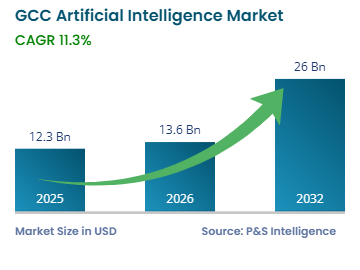
The GCC artificial intelligence market size will be an estimated USD 12.3 billion for 2025, and it will grow by 11.3% during 2026–2032, to reach USD 26.0 billion by 2032.
The market expansion is primarily driven by massive government investments in AI infrastructure, accelerating digital transformation across industries, and the region's strategic positioning as a global AI hub.
GCC countries are witnessing unprecedented AI adoption fueled by ambitious national visions and diversification strategies. The investments in countries are creating a robust ecosystem for AI innovation, attracting global technology companies, and fostering local startups. The energy sector presents significant opportunities, with AI integration expected to generate substantial annual gains through predictive maintenance, enhanced project efficiency, and improved decision-making in capital projects and infrastructure development across the region.
GCC Artificial Intelligence Market Dynamics
Rising Cloud Computing Adoption Is Biggest Trend
The accelerating shift toward cloud-based AI solutions is fundamentally transforming how organizations across the GCC deploy and scale artificial intelligence capabilities.
Almost 70% of the enterprises in GCC countries are expected to adopt cloud services to enhance operations.
Around 85% of companies in the broader Middle East have started their cloud journey; 32% use it in one area, 35% across multiple domains, and 18% at scale.
In the UAE, 85% of firms are planning or implementing hybrid cloud strategies. Looking ahead to 2025, 39% of GCC businesses expect 25–50% of their applications to run in the cloud, 23% expect 51–75%, and 20% anticipate 76–99%.
Cloud platforms offer the computational power, storage capacity, and flexible infrastructure required for AI workloads without significant upfront capital investments.
Enterprises in the region are increasingly leveraging cloud-integrated AI services to process large data volumes, implement machine learning models, and deploy AI applications rapidly.
The cloud deployment model enables organizations to access advanced AI technologies, including natural language processing, computer vision, and predictive analytics, through subscription-based models.
This democratization of AI technology allows small and medium enterprises to compete effectively with larger organizations by accessing sophisticated AI tools previously available only to well-funded corporations.
Major cloud service providers are establishing regional data centers to address data sovereignty requirements and reduce latency, further accelerating cloud AI adoption.
The hybrid deployment model is gaining traction as organizations seek to balance the flexibility of cloud solutions with the control and security of on-premises infrastructure, particularly in sectors handling sensitive data such as banking and healthcare.
Government-Led Digital Transformation Initiatives Are Key Drivers
GCC governments are spearheading comprehensive digital transformation strategies that position AI as a cornerstone technology for economic diversification.
Saudi Arabia and the UAE have emerged as regional leaders in AI infrastructure development, with both nations competing to establish dominance in the Middle East AI landscape.
These massive infrastructure investments are complemented by regulatory frameworks that encourage AI adoption across sectors.
The establishment of AI-focused investment funds demonstrates the commitment to building comprehensive AI ecosystems.
In February 2024, Saudi Arabia's Public Investment Fund introduced Alat, an investment fund focused on semiconductors and AI, with plans to invest USD 100 billion by 2030.
Qatar, Kuwait, Oman, and Bahrain are also implementing national AI strategies aligned with their economic vision programs, creating conducive environments for technology adoption and innovation.
UAE launched a USD 500-million program in February 2024 to promote research and development in AI and other emerging technologies.
In Qatar, the National Cybersecurity Agency issued guidelines for secure AI usage, promoting responsible AI practices in organizations.
Bahrain introduced a standalone Artificial Intelligence Regulation Law in April 2024, establishing an AI unit and setting licensing requirements and penalties for non-compliance.
The software category holds the largest market share, of 60%, in 2025. This lead stems from the widespread deployment of AI platforms, frameworks, and applications across diverse industries. Software solutions allow organizations to deploy AI capabilities efficiently, minimizing hardware dependency while providing scalable and adaptable implementations. The availability of pre-trained models, cloud-based AI services, and low-code/no-code platforms has reduced barriers to AI adoption, driving software demand.
The services category will have the highest CAGR, of 11.6%, owing to the growing need for AI implementation expertise, customization requirements, and ongoing support. As AI adoption expands beyond pilot projects to enterprise-wide implementations, the demand for managed services, AI-as-a-service offerings, and continuous optimization support accelerates. The services category benefits from the need to integrate AI systems with existing IT infrastructure, customize solutions for specific business processes, and provide ongoing model retraining and performance optimization.
The components analyzed in this report are:
Software (Largest Category)
Hardware
Services (Fastest-Growing Category)
Technology Analysis
The machine learning category holds the largest market share, of 50%, in 2025, driven by its versatility and broad applicability across business functions. Machine learning enables predictive analytics, pattern recognition, automated decision-making, and continuous learning from data. Organizations deploy machine learning for customer behavior analysis, fraud detection, demand forecasting, risk assessment, and operational optimization. The technology's maturity, availability of tools and frameworks, and proven business value drive widespread adoption.
The context-aware computing category will have the highest CAGR, of 11.5%, as organizations seek AI systems that understand and respond to environmental context, user behavior, and situational factors. This technology enables personalized experiences, adaptive interfaces, and intelligent automation that adjusts to changing conditions. Context-aware AI in retail provides real-time, personalized recommendations based on location, time, and user preferences. In smart buildings and cities, context-aware systems optimize energy usage, security protocols, and service delivery based on occupancy patterns and environmental conditions.
The cloud category holds the largest market share, of 70%, in 2025, reflecting the preference for scalable, flexible, and cost-effective AI infrastructure. Cloud platforms eliminate the need for substantial upfront hardware investments and provide access to powerful computing resources on-demand. Organizations leverage public cloud services from major providers that offer pre-built AI models, development frameworks, and managed services. The cloud model supports rapid experimentation, quick scaling of successful pilots, and access to the latest AI innovations. Multi-cloud strategies allow organizations to optimize costs and avoid vendor lock-in while accessing specialized AI capabilities from different providers.
The hybrid category will have the highest CAGR during the forecast period as organizations balance the benefits of cloud flexibility with on-premises control and security. This model addresses data sovereignty requirements, regulatory compliance needs, and security concerns prevalent in banking, government, and healthcare sectors. Organizations can retain critical AI functions on-premises while accessing cloud resources for innovation, seasonal capacity, and specialized services. The hybrid model supports gradual cloud migration strategies and enables organizations to optimize workload placement based on performance, cost, and compliance requirements.
The deployment models analyzed in this report are:
Cloud (Larger Category)
On-Premises
Hybrid (Fastest-Growing Category)
Organization Size Analysis
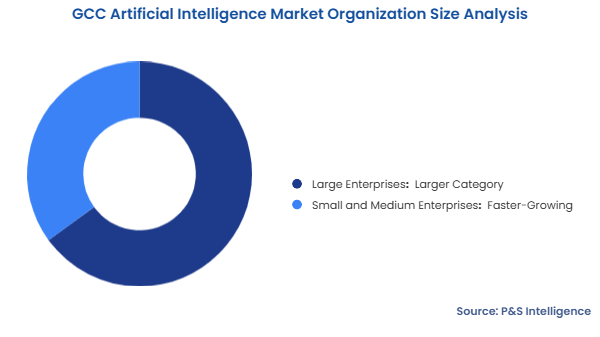
The large enterprises category holds the larger market share, of 65%, in 2025, driven by their substantial budgets, dedicated IT teams, and complex operational requirements. These organizations implement AI across multiple functions, including customer service, operations, supply chain, finance, and human resources. Large enterprises have the resources to invest in custom AI solutions, hire specialized talent, and undertake long-term AI transformation initiatives. Their ability to collect and process massive data volumes enables sophisticated AI applications that deliver competitive advantages. Enterprise-wide AI deployments require robust infrastructure, governance frameworks, and change management capabilities that large organizations are better positioned to provide.
The small and medium enterprises category will have the higher CAGR, of 11.7%, as AI solutions become more accessible through cloud platforms, pre-built applications, and AI-as-a-service offerings. SMEs increasingly recognize AI's potential to level the playing field by automating routine tasks, enhancing customer experiences, and improving decision-making. Government initiatives supporting SME digital transformation and AI literacy programs are accelerating adoption among smaller organizations. SMEs in the GCC benefit from cloud-based AI solutions that eliminate infrastructure requirements and offer pay-as-you-go pricing models aligned with their budget constraints.
The organization sizes analyzed in this report are:
Large Enterprises (Larger Category)
Small and Medium Enterprises (SMEs) (Faster-Growing Category)
Application Analysis
The automation & process optimization category holds the largest market share, in 2025, as organizations prioritize efficiency gains and cost reduction through AI-powered automation. AI enables intelligent process automation that goes beyond simple rule-based systems to handle complex, judgment-based tasks. Robotic process automation integrated with AI capabilities processes unstructured data, makes contextual decisions, and continuously improves through learning. Organizations deploy AI automation across back-office functions, manufacturing operations, supply chain management, and customer service.
The predictive analytics & forecasting category will have the highest CAGR during the forecast period, due to the rising demand for data-driven decision-making across industries such as finance, healthcare, retail, and energy. Businesses and governments are increasingly adopting AI to forecast trends, optimize operations, reduce risks, and improve efficiency. The surge in big data and cloud adoption further accelerates the growth of predictive analytics solutions.
The applications analyzed in this report are:
Automation & Process Optimization (Largest Category)
The BFSI category holds the largest market share, of 25%, in 2025, reflecting the industry's substantial investments in AI for fraud detection, risk assessment, customer service, and regulatory compliance. Financial institutions deploy AI-powered chatbots and virtual assistants for customer support, reducing operational costs while improving service availability. Machine learning models analyze transaction patterns to identify fraudulent activities in real-time, protecting customers and institutions from financial losses. Credit scoring and loan approval processes leverage AI to assess risk more accurately while processing applications faster.
The healthcare & life sciences category will have the highest CAGR during the forecast period as the sector embraces AI for diagnostics, treatment planning, drug discovery, and patient care management. AI-powered medical imaging analysis assists radiologists in detecting diseases earlier and more accurately. Predictive analytics identify patients at risk of developing chronic conditions, enabling preventive interventions. Natural language processing analyzes electronic health records to generate actionable insights, enhancing clinical decision-making and patient outcomes.
The end users analyzed in this report are:
Banking, Financial Services, and Insurance (BFSI) (Largest Category)
Healthcare & Life Sciences (Fastest-Growing Category)
Retail & E-Commerce
Government & Defense
Manufacturing
Energy & Utilities
Information Technology (IT) & Telecommunications
Transportation & Logistics
Building & Construction
Oil & Gas
Drive strategic growth with comprehensive market analysis
Saudi Arabia holds the largest market share, of 40%, in 2025, with a value of USD 5.2 billion. The kingdom's dominance stems from its ambitious Vision 2030 program that positions AI as a strategic technology for economic diversification beyond oil dependence. The government's commitment to building world-class AI infrastructure attracts multinational technology companies and venture capital. Major initiatives include developing AI-powered smart cities, modernizing government services through digital platforms, and creating innovation hubs that bring together researchers, entrepreneurs, and investors.
The education sector is integrating AI curricula to develop local talent capable of driving the AI economy. Large enterprises across banking, telecommunications, energy, and retail are implementing AI solutions for competitive advantage. The establishment of AI research centers at leading universities supports fundamental research and applied innovation. Regulatory sandboxes allow companies to test AI applications in controlled environments before full-scale deployment.
UAE Artificial Intelligence Market Size
UAE will have the highest CAGR, of 11.4%, driven by its mature digital infrastructure, business-friendly environment, and strategic focus on becoming a global AI leader. The nation appointed the world's first Minister of State for Artificial Intelligence in 2017, signaling its commitment to AI-driven governance and economic development. Dubai and Abu Dhabi are home to a thriving AI ecosystem, comprising startups, research laboratories, and innovation hubs that drive technological advancement. Microsoft faced criticism in 2024 for its USD 1.5 billion partnership with the UAE-based companies, highlighting the scale of international investment in the emirates' AI sector.
The government deploys AI across services, including visa processing, traffic management, and healthcare delivery. Free zones dedicated to technology and innovation provide tax incentives, streamlined regulations, and access to capital for AI companies. The financial services sector extensively adopts AI for fraud detection, customer service automation, and investment analysis. Retail and e-commerce platforms leverage AI for personalized recommendations, inventory optimization, and supply chain management. The hospitality and tourism industry uses AI to enhance guest experiences and operational efficiency.
The countries of the market are as follows:
Saudi Arabia (Largest Country)
UAE (Fastest-Growing Country)
Kuwait
Qatar
Oman
Bahrain
GCC Artificial Intelligence Market Share
The market is fragmented due to a mix of global technology giants, regional system integrators, and specialized AI solution providers competing across different industries and applications. International companies leverage their advanced AI platforms, extensive R&D capabilities, and global experience to secure large enterprise contracts and government projects. Regional players compete through local market knowledge, Arabic language capabilities, cultural understanding, and established relationships with GCC organizations. The competitive landscape is characterized by strategic partnerships between global technology providers and local entities to meet regulatory requirements and access government contracts.
Key GCC Artificial Intelligence Companies:
Group 42 Holding Ltd (G42)
Humain
AIQ LLC
Mozn
NeuralSpace FZ-LLC
DataLab FZ-LLC
Semantic Brains
Quant Data & Analytics Co.
FalconViz
Amazon Web Services, Inc. (AWS)
Oracle Corporation
IBM Middle East FZ-LLC
GCC Artificial Intelligence Market News
In October 2025, the legaltech startup Oqood, based in Abu Dhabi, secured USD 1 million in seed funding, aimed at enhancing digital transformation within the legal industry. The startup intends to utilize the funds to broaden its reach throughout the GCC region and to further enhance its intelligent digital platforms designed for client communication and workflow automation.
In October 2025, Inception, a subsidiary of Group 42 Holding Ltd.; began a strategic alliance with Symanto to create and expand applied AI solutions for both organizations to design and implement sophisticated, scalable technologies that expedite digital transformation for governments and enterprises within the region and beyond.
In October 2025, DOO, a customer experience platform integrated with AI, announced the completion of its USD 1.7-million funding round, led by Merak Capital, Plus VC, and other GCC-based investors.
In March 2024, International Business Machines Corporation opened an AI innovation lab in Saudi Arabia to collaborate with local enterprises and government agencies on developing AI applications for Arabic language processing, financial services, and smart government initiatives.
Want a report tailored exactly to your business need?
Leading companies across industries trust us to deliver data-driven insights and innovative solutions for their most critical decisions. From data-driven strategies to actionable insights, we empower the decision-makers who shape industries and define the future. From Fortune 500 companies to innovative startups, we are proud to partner with organisations that drive progress in their industries.
Client Testimonials
Working with P&S Intelligence and their team was an absolute pleasure – their awareness of timelines and commitment to value greatly contributed to our project's success. Eagerly anticipating future collaborations.
McKinsey & Company
India
Unmatched Standards
Our insights into the minutest levels of the markets, including the latest trends and competitive landscape, give you all the answers you need to take your business to new heights
Complete Data Security
We take a cautious approach to protecting your personal and confidential information. Trust is the strongest bond that connects us and our clients, and trust we build by complying with all international and domestic data protection and privacy laws