Saudi Arabia Artificial Intelligence Market Size & Opportunities Analysis - Growth Strategies, Competitiveness, and Forecasts (2026 - 2032)
This Report Provides In-Depth Analysis of the Saudi Arabia Artificial Intelligence Market Report Prepared by P&S Intelligence, Segmented by Component (Hardware, Software, Services), Technology (Machine Learning, Natural Language Processing (NLP), Computer Vision, Context-Aware Computing), Deployment (On-Premises, Cloud, Hybrid), Organisation Size (Large Enterprises, Small and Medium Enterprises (SMEs)), Application (Predictive Analytics & Forecasting, Customer Experience & Engagement, Automation & Process Optimization, Security & Surveillance, Decision Support & Risk Management, Content Generation & Creative Applications), End Use (Banking, Financial Services and Insurance (BFSI), Healthcare & Life Sciences, Retail & E-Commerce, Government & Defense, Manufacturing, Energy & Utilities, Information Technology (IT) & Telecommunications, Transportation & Logistics, Building & Construction), Oil & Gas, and Geographical Outlook for the Period of 2019 to 2032
Saudi Arabia Artificial Intelligence Market Growth Potential
Key Highlights
Study Period
2019 - 2032
Market Size in 2025
USD 5.2 Billion
Market Size in 2026
USD 6.0 Billion
Market Size by 2032
USD 14.3 Billion
Projected CAGR
15.8%
Largest Region
Al-Riyadh
Fastest Growing Region
Eastern Province
Market Structure
Consolidated
Market Size
Explore the market potential with our data-driven report
Saudi Arabia Artificial Intelligence Market Outlook
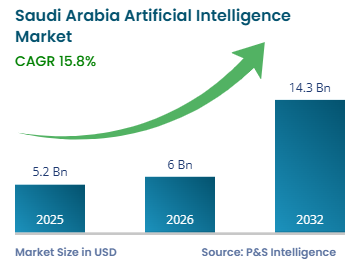
The Saudi Arabian artificial intelligence market revenue is estimated at USD 5.2 billion for 2025, and it is projected to grow at a CAGR of 15.8% during 2026–2032, to reach USD 14.3 billion by 2032.
The remarkable growth trajectory of the AI market in Saudi Arabia is primarily driven by the kingdom's Vision 2030 initiative, substantial government investments in digital transformation, and the establishment of strategic partnerships with global technology leaders to develop indigenous AI capabilities.
Saudi Arabia's commitment to becoming a global AI hub is evidenced by its ambitious national strategy and substantial financial allocations. The kingdom has positioned artificial intelligence as a cornerstone of its economic diversification efforts, moving beyond oil dependency toward a knowledge-based economy. The establishment of the Saudi Data and AI Authority (SDAIA) and the launch of multiple AI-focused initiatives demonstrate the nation's serious approach to leveraging AI technologies across various sectors. The government's dedication to fostering an AI ecosystem is further reinforced by its investments in education and training programs, ensuring the development of local talent capable of driving AI innovation.
The rapid adoption of AI technologies across Saudi Arabia's public and private sectors reflects a broader digital transformation agenda that encompasses smart city developments, enhanced government services, and industrial modernization. Major sectors, including finance, healthcare, energy, and retail, are increasingly integrating AI solutions to optimize operations, enhance customer experiences, and drive innovation. The kingdom's strategic geographical position, combined with its significant financial resources and young, tech-savvy population, creates an ideal environment for AI market expansion and technological advancement.
Saudi Arabia Artificial Intelligence Market Emerging Trends
Strategic Partnerships with Global Tech Giants Are Major Trend
The formation of strategic alliances between Saudi Arabia and leading global technology companies represents a significant driver for the AI market.
Major partnerships with companies like Microsoft, Google, Amazon, and IBM have resulted in the establishment of cloud regions, AI research centers, and technology transfer programs within the kingdom.
According to the reports, these partnerships have contributed to a 45% increase in AI-related foreign direct investment in 2024 compared to the previous year.
These collaborations extend beyond infrastructure development to include knowledge transfer, capacity building, and joint research initiatives.
Global tech giants are working with Saudi universities and research institutions to develop AI curricula, establish innovation labs, and conduct cutting-edge research tailored to regional challenges.
The partnerships also facilitate access to advanced AI platforms, tools, and expertise, enabling Saudi organizations to rapidly deploy sophisticated AI solutions without the need for extensive in-house development.
This ecosystem of collaboration is creating a multiplier effect, attracting additional international companies and startups to establish operations in the kingdom.
Government Vision 2030 and National AI Strategy Are Catalyzing Market Growth
Saudi Arabia's Vision 2030 and the National Strategy for Data and AI (NSDAI) serve as fundamental catalysts for the artificial intelligence market expansion.
The government has allocated over USD 20 billion for developing AI and emerging technologies as part of its digital transformation agenda.
This comprehensive strategy aims to position Saudi Arabia among the top 15 countries in AI by 2030, focusing on developing local capabilities, attracting international partnerships, and creating an enabling regulatory environment.
The kingdom's commitment extends beyond financial investment to include structural reforms and institutional development.
The establishment of specialized entities such as the National Center for AI and the Saudi Company for Artificial Intelligence demonstrates the government's systematic approach to AI development.
These institutions are tasked with accelerating AI adoption across government services, developing use cases for critical sectors, and fostering collaboration between public and private stakeholders.
The government has also implemented regulatory sandboxes and innovation zones that allow companies to test and deploy AI solutions in controlled environments, reducing barriers to entry and accelerating time-to-market for innovative applications.
Saudi Arabia Artificial Intelligence Market Segmentation Analysis
Component Analysis
The software category holds the largest share in 2025, of approximately 55%, and is expected to maintain its dominance throughout the forecast period. This is attributed to the increasing demand for AI platforms and solutions that enable organizations to develop, deploy, and manage AI applications without extensive hardware investments. Saudi enterprises are particularly focused on acquiring ready-to-deploy AI software solutions that can be quickly integrated into existing IT infrastructure, reducing implementation time and complexity. The availability of cloud-based AI software platforms has further accelerated adoption, as organizations can access sophisticated AI capabilities through subscription models without significant upfront capital expenditure.
Services will witness the highest CAGR, during the forecast period, driven by the growing need for specialized expertise in AI implementation, customization, and maintenance. As Saudi organizations embark on AI transformation journeys, they require comprehensive support ranging from strategic consulting to technical implementation and ongoing management. The shortage of in-house AI expertise has created substantial demand for professional services, including AI strategy development, solution design, system integration, and training programs. Managed services are also gaining traction as organizations seek to outsource AI operations to specialized providers, ensuring optimal performance while focusing on core business activities.
These components are covered:
Hardware
Processors
Memory
Networking devices
Others
Software (Largest Category)
Services (Fastest-Growing Category)
Professional
Managed
Technology Analysis
Machine learning dominates the market in 2025 with a share of 40%, primarily due to its versatility and proven effectiveness across various applications. Organizations across the kingdom are leveraging machine learning algorithms for predictive analytics, pattern recognition, and automated decision-making processes. The technology's ability to improve continuously through data analysis makes it particularly valuable for Saudi enterprises dealing with large volumes of data in sectors such as oil and gas, finance, and telecommunications. Deep learning, a subset of machine learning, is experiencing rapid adoption for complex tasks, including image recognition, natural language understanding, and autonomous systems development.
Computer vision is projected to register the highest CAGR, during 2026–2032, driven by increasing deployment in security and surveillance applications, quality control in manufacturing, and medical imaging analysis. The Saudi government's focus on enhancing public safety and security has led to widespread implementation of AI-powered video analytics systems in public spaces, airports, and critical infrastructure. Additionally, the retail sector is increasingly adopting computer vision for customer behavior analysis, inventory management, and checkout automation. The technology's applications in autonomous vehicles and drone operations align well with Saudi Arabia's smart city initiatives, further accelerating market growth.
These technologies are covered:
Machine Learning (Largest Category)
Natural Language Processing
Computer Vision (Fastest-Growing Category)
Context-Aware Computing
Others
Deployment Mode Analysis
The cloud category holds the largest share, of 65%, in 2025, driven by the rapid expansion of cloud infrastructure and the government's cloud-first policy for digital initiatives. The establishment of local data centers by major cloud providers has addressed data sovereignty concerns while providing Saudi organizations with access to scalable, cost-effective AI capabilities. Cloud deployment offers significant advantages including reduced infrastructure costs, automatic updates, and the ability to scale resources based on demand. As per reports, government entities migrating to cloud-based AI solutions have achieved 40% cost savings compared to on-premises deployments.
Hybrid deployment is experiencing the highest CAGR, during 2026–2032, as organizations seek to balance the benefits of cloud computing with the control and security of on-premises infrastructure. This approach is particularly prevalent in highly regulated industries such as banking and healthcare, where sensitive data must remain within organizational boundaries while leveraging cloud resources for compute-intensive AI workloads. Saudi financial institutions are adopting hybrid models to comply with Saudi Central Bank regulations while maintaining operational flexibility. The hybrid approach also enables organizations to optimize costs by keeping critical applications on-premises while utilizing cloud resources for development, testing, and burst capacity requirements.
These deployment modes are covered:
On-Premises
Cloud (Largest Category)
Hybrid (Fastest-Growing Category)
Organization Size Analysis
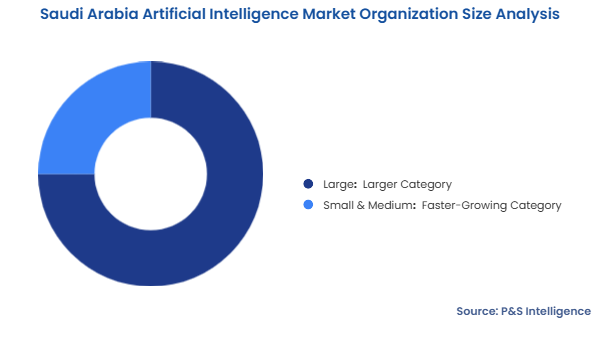
Large enterprises dominate the market with 75% share in 2025, reflecting their greater financial resources, technical capabilities, and strategic focus on digital transformation. Major Saudi corporations including Saudi Aramco, SABIC, Saudi Telecom Company, and National Commercial Bank have been early adopters of AI technologies, implementing enterprise-wide solutions for various applications. These organizations possess the necessary infrastructure, data resources, and skilled personnel to successfully deploy and manage complex AI systems. Government entities and semi-government organizations, classified as large enterprises, contribute significantly to this segment's dominance through massive AI investments aligned with Vision 2030 objectives.
Small and medium enterprises are projected to witness the higher growth rate, during the forecast period, driven by the democratization of AI technologies and government support programs. Monsha'at has launched multiple initiatives to facilitate AI adoption among SMEs, including subsidized training programs, technology grants, and partnerships with AI vendors for affordable solutions. According to reports, over 5,000 SMEs have participated in AI readiness programs in 2024, with 30% already implementing AI solutions for customer service, inventory management, or marketing automation. The availability of AI-as-a-Service offerings and pre-trained models has significantly lowered entry barriers for smaller organizations.
These organization sizes are covered:
Large (Largest Category)
Small & Medium (Fastest-Growing Category)
Application Analysis
Automation & process optimization represent the largest category in 2025, capturing 35% of the market share, as Saudi organizations prioritize operational efficiency and cost reduction. Companies across industries are implementing AI-driven automation solutions to streamline workflows, reduce manual intervention, and minimize errors in repetitive tasks. The oil and gas sector, a cornerstone of the Saudi economy, has been particularly active in deploying AI for production optimization, predictive maintenance, and supply chain management. Government entities are also leveraging automation to enhance service delivery, with initiatives such as automated document processing and intelligent routing of citizen requests showing significant efficiency improvements.
Security & surveillance applications are expected to grow at the highest CAGR, during the forecast period, driven by national security priorities and smart city requirements. The Saudi government's investment in AI-powered surveillance systems for crowd management during Hajj and other major events has demonstrated the technology's effectiveness in ensuring public safety. According to reports, the implementation of AI-based security systems has contributed to a 40% improvement in incident response times. Private sector adoption is also accelerating, with businesses implementing AI-driven cybersecurity solutions to protect against sophisticated threats and ensure compliance with data protection regulations.
These applications are covered:
Predictive Analytics & Forecasting
Customer Experience & Engagement
Automation & Process Optimization (Largest Category)
The government & defense sector holds the largest share, of 30%, in 2025, reflecting the government's leadership role in driving AI adoption. Major government initiatives, including the digitization of public services, smart city developments, and national security enhancements, have created substantial demand for AI technologies. The sector's dominance is further reinforced by dedicated budgets for digital transformation and the establishment of specialized agencies focused on AI implementation. Defense applications, including autonomous systems, intelligence analysis, and simulation training, represent a significant portion of government AI investments.
The healthcare & life sciences category will witness the highest CAGR, during 2026–2032, driven by the kingdom's healthcare transformation program and increasing focus on personalized medicine. Saudi Arabia's investment in healthcare infrastructure, including the development of medical cities and specialized treatment centers, incorporates AI as a fundamental component for diagnosis, treatment planning, and patient care optimization. AI implementation in radiology departments has improved diagnostic accuracy by 25% and reduced interpretation time by 50%. The growing adoption of telemedicine platforms, accelerated by recent global health challenges, further drives demand for AI-powered healthcare solutions.
These end uses are covered:
Banking, Financial Services and Insurance
Healthcare & Life Sciences (Fastest-Growing Category)
Retail & E-Commerce
Government & Defense (Largest Category)
Manufacturing
Energy & Utilities
IT & Telecommunications
Transportation & Logistics
Building & Construction
Oil & Gas
Others
Drive strategic growth with comprehensive market analysis
Saudi Arabia Artificial Intelligence Market Regional Growth Dynamics
Riyadh Province AI Market Size
Al-Riyadh dominates the market with a share of 40% in 2025, driven by its position as the kingdom's capital and largest economic center. The concentration of government institutions, corporate headquarters, and technology companies in Riyadh creates a robust ecosystem for AI adoption and innovation. The city's AI market benefits from direct access to decision-makers, proximity to major technology partners, and the presence of leading universities and research centers. Major initiatives such as the Riyadh Smart City project and the establishment of AI research facilities have positioned the province as the epicenter of Saudi Arabia's AI transformation.
The development of dedicated technology zones and innovation districts within Riyadh has attracted both local and international AI companies, creating clusters of expertise and collaboration. According to reports, the number of AI startups in the province increased by 65% in 2024, with many focusing on localized solutions for Arabic language processing and region-specific applications. The province's AI ecosystem is further strengthened by government procurement programs that prioritize AI-enabled solutions, creating a substantial market for vendors and driving continuous innovation.
Eastern Province AI Market Outlook
The Eastern Province is experiencing the highest CAGR, of approx. 16.0%, during 2026–2032, primarily driven by the oil and gas sector's digital transformation initiatives. Saudi Aramco, headquartered in Dhahran, has emerged as a major driver of AI adoption, implementing advanced analytics, predictive maintenance, and optimization algorithms across its operations. The company's commitment to becoming a global leader in AI-powered energy operations has created a ripple effect, encouraging suppliers and partners to develop AI capabilities.
The province's industrial cities, including Jubail and Dammam, are witnessing increased AI deployment in manufacturing, logistics, and port operations. AI implementation in industrial facilities has resulted in a 20% improvement in production efficiency and a 35% reduction in unplanned downtime. The development of NEOM in the northern part of the province represents a massive opportunity for AI vendors, with the mega-project serving as a showcase for cutting-edge AI applications in urban planning, environmental management, and autonomous systems.
These provinces are covered:
Al-Riyadh (Largest Province)
Makkah
Eastern Province (Fastest-Growing Province)
Madinah
Qassim
Asir
Tabuk
Ha'il
Northern Borders
Jazan
Najran
Al-Baha
Al-Jouf
Saudi Arabia Artificial Intelligence Market Share
The Saudi Arabian artificial intelligence market is consolidated due to the technical complexity and capital requirements of AI solutions, as well as the preference of Saudi organizations for established vendors with proven track records and local presence. The market's consolidated nature is primarily driven by the dominance of major international technology companies that have established strong partnerships with the Saudi government and large enterprises.
These companies leverage their global expertise, extensive R&D capabilities, and comprehensive solution portfolios to maintain leadership positions. However, the market also shows signs of increasing competition as local players emerge with specialized solutions tailored to Saudi-specific requirements, particularly in Arabic language processing, Islamic finance applications, and culturally relevant AI implementations.
Leading players dominate through strategic positioning and comprehensive offerings, continuous innovation, local capacity building initiatives, and deep integration with Saudi Arabia's digital transformation programs. Recent competitive strategies have focused on localization and partnership development. Major players are establishing local offices, hiring Saudi talent, and developing Arabic-language capabilities to better serve the market. Companies are also forming strategic alliances with Saudi universities, research institutions, and government entities to co-develop solutions addressing local challenges.
Key Saudi Arabia Artificial Intelligence Companies:
Humain
Nvidia Corporation
Microsoft Corporation
Alphabet Inc.
Amazon.com Inc.
IBM Corporation
Advanced Micro Devices Inc.
Oracle Corporation
SAP SE
Accenture plc
Siemens AG
Honeywell International Inc.
GE Vernova Inc.
STC Group
Aramco Digital Company
Alat
Groq Inc.
Intel Corporation
Super Micro Computer Inc.
Qualcomm Incorporated
Huawei Technologies Co. Ltd.
EdgeCortix Inc.
Kneron Inc.
Saudi Arabia Artificial Intelligence Market News
In October 2024, Saudi Aramco announced a USD 1-billion investment in AI and digital transformation initiatives, including the establishment of an AI center of excellence in Dhahran focused on developing applications specific to the energy sector.
In September 2024, the Saudi Data and AI Authority launched the Global AI Summit in Riyadh, announcing partnerships with 50 international companies to develop AI solutions for government services and smart city applications.
In July 2024, Microsoft Corporation expanded its cloud and AI presence in Saudi Arabia with the opening of new data centers in Riyadh and Jeddah, investing USD 2.5 billion to support the kingdom's digital transformation objectives.
In May 2024, NEOM signed agreements with multiple AI companies to develop autonomous transportation systems, smart grid solutions, and environmental monitoring platforms for the mega-city project.
In March 2024, the Saudi Ministry of Health implemented a nationwide AI-powered diagnostic system across 200 hospitals, developed in partnership with local and international technology providers to improve healthcare delivery.
In January 2024, King Abdullah University of Science and Technology (KAUST) established an AI research institute with USD 500-million funding to develop indigenous AI capabilities and foster innovation in emerging technologies.
Want a report tailored exactly to your business need?
Leading companies across industries trust us to deliver data-driven insights and innovative solutions for their most critical decisions. From data-driven strategies to actionable insights, we empower the decision-makers who shape industries and define the future. From Fortune 500 companies to innovative startups, we are proud to partner with organisations that drive progress in their industries.
Client Testimonials
Working with P&S Intelligence and their team was an absolute pleasure – their awareness of timelines and commitment to value greatly contributed to our project's success. Eagerly anticipating future collaborations.
McKinsey & Company
India
Unmatched Standards
Our insights into the minutest levels of the markets, including the latest trends and competitive landscape, give you all the answers you need to take your business to new heights
Complete Data Security
We take a cautious approach to protecting your personal and confidential information. Trust is the strongest bond that connects us and our clients, and trust we build by complying with all international and domestic data protection and privacy laws