Fluid Transfer System Market Size & Share Analysis - Emerging Trends, Growth Opportunities, Competitive Landscape, and Forecasts (2026 - 2032)
This Report Provides In-Depth Analysis of the Fluid Transfer System Market Report Prepared by P&S Intelligence, Segmented by Component (Hoses, Tubes & Pipes, Couplings & Fittings, Seals & Gaskets, Assemblies), Material (Stainless Steel, Aluminum, Rubber, Nylon), System Type (Engine, Fuel Delivery, Thermal Management, Transmission, Power Steering, Brake & Clutch, Suspension, Exhaust & Emission, Body & Auxiliary, Lubrication), Vehicle Type (Passenger Vehicles, Light Commercial Vehicles, Heavy Commercial Vehicles, Off-Highway Vehicles), Propulsion Type (Internal Combustion Engine, Hybrid Electric Vehicles, Plug-in Hybrid Electric Vehicles, Battery Electric Vehicles), and Geographical Outlook for the Period of 2021 to 2032
Explore the market potential with our data-driven report
Fluid Transfer System Market Key Insights
The couplings & fittings category will have the highest CAGR, of approximately 6.5%, supported by increasing modular system integration.
The stainless steel category holds the largest market share, of 40% in 2025, due to durability and high-pressure resistance.
The fuel delivery category holds the largest market share, of 25% in 2025, driven by its essential role in ICE vehicle operation and compliance with emission standards.
The passenger vehicles category holds the largest market share, of 45% in 2025, supported by high production volumes.
Asia-Pacific holds the largest market share, of 40% in 2025, and it will have the highest CAGR, of approximately 7.0% driven by strong automotive manufacturing activity.
Fluid Transfer System Market Analysis
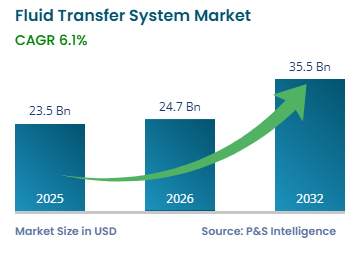
The fluid transfer system market size was USD 23.5 billion for 2025, and it will grow by 6.1% during 2026–2032, to reach USD 35.5 billion by 2032.
The market growth is supported by tightening emission regulations, increasing integration of advanced after-treatment systems, and rising complexity of thermal and fluid management architectures across modern vehicles. Fluid transfer systems, including hoses, pipes, couplings, and assemblies, serve as critical infrastructure for transporting fuel, coolant, lubricants, and exhaust gases, supporting vehicle efficiency and emissions control systems, and operational reliability.
The structural expansion of global vehicle production and regulatory-driven system complexity continues to reinforce demand. According to the International Organization of Motor Vehicle Manufacturers, global vehicle production exceeded 93 million units in 2023, while the International Energy Agency highlights increasing integration of emission control technologies such as SCR and EGR systems across ICE vehicles. Regulatory mandates, including Euro 6 and proposed Euro 7 standards, U.S. EPA Tier 3 norms, and Bharat Stage VI requirements are driving higher system complexity and increased component density. Additionally, rising electrification is introducing new thermal management requirements, particularly in battery and power electronics cooling systems. These factors collectively sustain long-term demand for advanced fluid transfer systems across both conventional and electrified vehicle platforms.
Fluid Transfer System Market Trends and Drivers
Material Innovation and Lightweighting Are Key Trends
A defining trend in the fluid transfer system market is the increasing transition toward lightweight materials and advanced polymer-based architectures to enhance fuel efficiency and reduce emissions. Automotive manufacturers are progressively replacing conventional metal-based systems with high-performance polymers such as nylon and multi-layer composites, which offer improved corrosion resistance, reduced weight, and enhanced flexibility. This transformation is enabling optimized routing designs and integration within increasingly compact vehicle platforms.
The adoption of bio-based polyamides is expected to gain further momentum as automotive manufacturers prioritize lifecycle emissions reduction. Materials such as PA-11, developed by Arkema and derived from renewable castor oil feedstock, are gaining traction, particularly among European OEMs focusing on lifecycle emissions reduction and sustainable material adoption. Additionally, electrified powertrains require advanced thermal management systems with compact and efficient fluid routing, further driving material innovation. The shift toward lightweight and high-performance materials is becoming a central factor in product development and competitive differentiation.
Escalating Emission Standards and After-Treatment Mandates Are Biggest Drivers
Escalating emission standards and increasing deployment of after-treatment technologies represent the primary driver of the fluid transfer system market. Modern vehicles incorporate complex systems such as SCR, DPF, and EGR, all of which require precise and reliable fluid transfer mechanisms to function effectively. These systems significantly increase the number of fluid pathways and component requirements within vehicles.
Global regulatory frameworks are reinforcing this demand. The European Union’s Euro 6 and proposed Euro 7 regulations impose stringent limits on NOx and particulate emissions, while the Environmental Protection Agency continues to tighten emission norms in North America. In India, Bharat Stage VI standards mandate advanced emission control technologies. In China National 6b norms, implemented since July 2023 with transitional flexibility, and Bharat Stage VI Phase 2 requirements, including real-driving emission compliance, are strengthening the need for advanced fluid transfer architectures across key automotive markets. This regulatory development is increasing component density per vehicle, thereby raising content value per platform and supporting sustained demand across both OEM production and aftermarket replacement cycles. These regulatory requirements are directly increasing the integration of high-performance fluid transfer components, thereby driving sustained market growth.
Raw Material Price Volatility and Geopolitical Supply Chain Pressures Are Key Restraints
Raw material price volatility and geopolitical supply chain disruptions represent a significant restraint affecting profitability across the fluid transfer system market. Key materials such as steel, aluminum, and synthetic polymers are subject to fluctuations driven by global economic conditions, trade policies, and geopolitical instability. These variations directly impact production costs and margin stability for manufacturers.
According to the Organisation for Economic Co-operation and Development, supply chain disruptions have significantly affected automotive component manufacturing, including delays in raw material availability. Additionally, fluctuations in crude oil prices influence polymer costs used in hoses and seals. These cost pressures reduce pricing flexibility and constrain profitability, particularly in highly competitive automotive supply chains.
Electrification of Commercial Vehicles and Off-Highway Equipment Are Biggest Opportunities
The electrification of commercial vehicles and off-highway equipment presents a significant opportunity for fluid transfer system manufacturers. While electric vehicles reduce reliance on traditional fuel delivery systems, they introduce new requirements for thermal management and cooling of batteries and power electronics, which depend heavily on advanced fluid transfer architectures.
The International Energy Agency reports accelerating adoption of electric vehicles, including commercial segments such as electric trucks and buses. Additionally, electrification trends are expanding into construction and agricultural equipment, requiring advanced cooling systems. Leading suppliers such as Parker Hannifin and Continental AG have introduced advanced thermal management hose and tubing solutions specifically designed for electric vehicle battery cooling and power electronics applications, reflecting increasing industry focus on electrification-driven fluid transfer innovation. Programs such as India’s FAME II Scheme and zero-emission vehicle mandates in Europe are supporting the adoption of electric buses and commercial fleets, indirectly driving demand for advanced fluid transfer systems. These developments are creating new demand pathways for fluid transfer components, enabling manufacturers to diversify their product portfolios and capture emerging revenue streams.
Fluid Transfer System Market Segmentation Analysis
Component Analysis
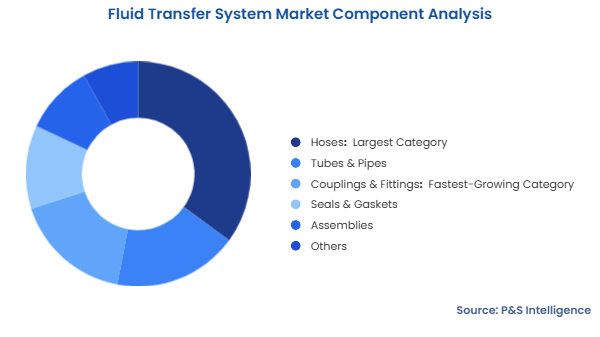
The hoses category holds the largest market share, of 35%, in 2025, driven by their extensive deployment across multiple fluid transfer applications, including fuel delivery, coolant circulation, braking systems, air conditioning, and thermal management circuits. Their inherent flexibility, vibration resistance, and ability to be routed through increasingly compact and complex vehicle architectures make them indispensable across both internal combustion engine and electrified vehicle platforms.
The couplings & fittings category will have the highest CAGR, of approximately 6.5%, driven by increasing adoption of advanced quick-connect and modular connection technologies across modern vehicle platforms. Companies such as Stäubli International AG are expanding portfolios of advanced quick-connect coupling systems designed for high-pressure fluid and thermal management applications, supporting the shift toward modular and serviceable vehicle architectures. As vehicle architectures evolve toward modular assembly and higher serviceability standards, couplings and fittings are witnessing higher integration per platform, thereby accelerating segment growth across both passenger and commercial vehicle applications.
The components analyzed in this report are:
Hoses (Largest Category)
Tubes & Pipes
Couplings & Fittings (Fastest-Growing Category)
Seals & Gaskets
Assemblies
Others
Material Analysis
The stainless steel category holds the largest market share in 2025, driven by its superior corrosion resistance, high-pressure tolerance, and wide operating temperature range. Stainless steel is established as the preferred material for critical applications including fuel lines, brake lines, and emission control circuits such as SCR and DPF systems. In commercial vehicles and off-highway equipment, stainless steel tube assemblies are further valued for their durability and long service life under operating conditions involving vibration, temperature fluctuations, and chemical exposure. According to the International Organization of Motor Vehicle Manufacturers, sustained global vehicle production volumes continue to underpin demand for stainless steel-based fluid transfer components across high-volume manufacturing environments.
The nylon category will have the highest CAGR, driven by the automotive industry’s shift toward lightweight materials and the evolving requirements of electrified vehicle platforms. This combination of low mass and thermal compatibility makes nylon well suited for thermal management systems in battery and power electronics cooling applications. According to the International Energy Agency, global electric car sales exceeded 14 million units in 2023, further accelerating demand for advanced thermal management systems and expanding the addressable market for lightweight polymer-based fluid transfer solutions.
The materials analyzed in this report are:
Stainless Steel (Largest Category)
Aluminum
Rubber
Nylon (Fastest-Growing Category)
Others
System Type Analysis
The fuel delivery category holds the largest market share in 2025, driven by its essential role in ICE vehicle operation and compliance with emission standards. Its dominance is further supported by the need for high-pressure fuel injection systems and return line architectures in modern engines, which increase the integration of specialized fluid transfer components per vehicle.
The thermal management category will have the highest CAGR, of approximately 6.7%, supported by increasing demand for battery and power electronics cooling in electric vehicles. Modern electrified platforms incorporate multi-loop thermal architectures separating battery, cabin, and power electronics cooling circuits, significantly increasing the complexity and number of fluid transfer pathways required per vehicle. This structural shift is accelerating demand for advanced cooling lines and associated components.
The system types analyzed in this report are:
Engine
Fuel Delivery (Largest Category)
Thermal Management (Fastest-Growing Category)
Transmission
Power Steering
Brake & Clutch
Suspension
Exhaust & Emission
Body & Auxiliary
Lubrication
Vehicle Type Analysis
The passenger vehicles category holds the largest market share, of 45%, in 2025, driven by high global production volumes and broad integration of fluid transfer components across fuel delivery, cooling, braking, air conditioning, and thermal management applications. According to the International Organization of Motor Vehicle Manufacturers, global passenger car production reached approximately 67.7 million units in 2024, accounting for nearly three-fourths of total vehicle production, reinforcing the segment’s dominant demand base for fluid transfer systems.
The heavy commercial vehicles category will have the highest CAGR, supported by the increasing adoption of advanced vehicle architectures and the growing need for high-performance fluid transfer systems capable of operating under demanding load, pressure, and temperature conditions. The segment is also benefiting from expanding electrification of trucks and buses, which is increasing the integration of thermal management and air suspension-related fluid transfer assemblies across commercial vehicle platforms.
The vehicle types analyzed in this report are:
Passenger Vehicles (Largest Category)
Light Commercial Vehicles
Heavy Commercial Vehicles (Fastest-Growing Category)
Off-Highway Vehicles
Agricultural Tractors
Construction Equipment
Mining Equipment
Propulsion Type Analysis
The ICE category holds the largest market share, of 45%, in 2025, driven by the extensive global vehicle parc and continued high production of petrol, diesel, and CNG vehicles across emerging markets. ICE platforms incorporate a wide range of fluid transfer systems, including fuel delivery, lubrication, exhaust after-treatment, and cooling circuits. This breadth of system integration translates into higher fluid transfer component content per vehicle than any other propulsion type. According to the International Organization of Motor Vehicle Manufacturers, global vehicle production increased from 92.7 million units in 2024 to 96.4 million units in 2025. This production volume reinforces the dominant role of ICE vehicles in overall fluid transfer system consumption.
The BEV category will have the highest CAGR, of approximately 6.3%, driven by the rapid expansion of electric vehicle adoption and the increasing complexity of battery and power electronics thermal management systems. BEVs rely on advanced cooling architectures, and fluid transfer content per vehicle is rising as these systems become more sophisticated, accelerating segment growth beyond what adoption volumes alone would suggest. Companies such as Valeo are expanding dedicated EV thermal management solutions, including integrated cooling modules for batteries and power electronics, reflecting the broader shift toward electrification-driven fluid transfer engineering as a distinct product category.
Battery Electric Vehicles (BEV) (Fastest-Growing Category)
Drive strategic growth with comprehensive market analysis
Fluid Transfer System Market Geographical Analysis
Asia-Pacific Fluid Transfer System Market Size
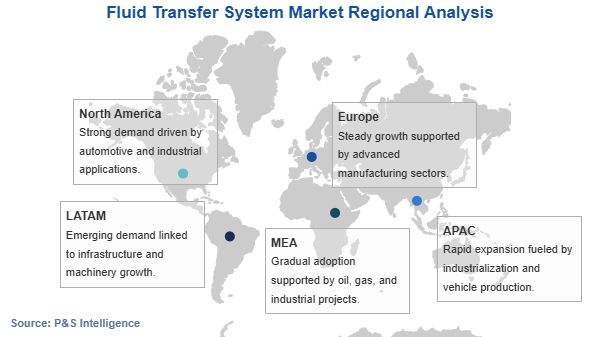
Asia-Pacific holds the largest market share, of 40%, in 2025, and it will have the highest CAGR, of approximately 7.0%, driven by the region’s large-scale automotive production base. According to the International Organization of Motor Vehicle Manufacturers, the region accounted for over 54 million vehicles in 2024, representing more than half of global vehicle output, with China alone contributing over 31 million vehicles. This production concentration creates structurally high demand for fuel lines, coolant hoses, brake assemblies, and thermal management circuits across every vehicle manufactured.
A rapidly expanding middle class in China, India, and Southeast Asian economies is driving sustained vehicle demand, supporting both OEM production and aftermarket replacement needs for fluid transfer components. Government-backed electrification initiatives in China and India are further accelerating this trajectory. In India, the government has approved an INR 25,938 crore Production Linked Incentive (PLI) scheme for the automobile and auto components sector, according to the Ministry of Heavy Industries, aimed at boosting domestic manufacturing of advanced automotive technologies, including EV components, and supporting long-term demand for fluid transfer systems. Moreover, Japan continues to advance hybrid and next-generation vehicle technologies, with leading OEMs directing investment toward electrification and fuel-efficient powertrains, thereby increasing demand for high-performance and precision-engineered fluid transfer systems in hybrid thermal management applications. OEM supply chain localization and the presence of major Tier-1 suppliers at competitive manufacturing costs further reinforce the region’s structural advantage in the global market.
China Fluid Transfer System Market Size
China is the largest country market within Asia-Pacific and holds the leading position globally, driven by its status as the world’s largest automotive producer and consumer, which creates a substantial and consistent demand base for fluid transfer systems across both OEM production and aftermarket replacement cycles. China’s transition to new energy vehicles (NEVs) is a key structural growth driver, as battery electric, plug-in hybrid, and hydrogen fuel cell vehicles require higher fluid transfer content per platform, with thermal management, battery cooling, and dielectric coolant circuits representing the primary growth areas.
China’s China 6a and 6b emission standards continue to mandate sophisticated exhaust after-treatment systems, thereby sustaining demand for SCR and DPF lines across the commercial vehicle segment. The country’s leadership in electric bus deployment is also generating specialized demand in heavy-duty applications. According to the International Energy Agency, electric vehicles accounted for nearly 50% of total new car sales in China in 2024, with electric car sales exceeding 11 million units in the same year, further expanding demand for advanced thermal management and battery cooling fluid transfer systems. Continued investments in EV infrastructure and battery manufacturing are reinforcing long-term demand for high-performance fluid transfer components, while domestic supply chain localization is strengthening component-level sourcing across electrified vehicle platforms.
North America Fluid Transfer System Market Size
North America is a mature and technologically advanced market for fluid transfer systems, driven by the United States’ large and stable vehicle parc and Canada’s integrated automotive supply chain, which together provide the structural foundation for this position. The U.S. market carries high per-vehicle fluid transfer content, driven by strong demand for SUVs and light trucks, as these vehicle categories incorporate higher levels of air suspension lines, power steering hoses, and advanced thermal management circuits than compact passenger cars. Stringent emission regulations, including EPA Tier 3 and CARB low-emission vehicle standards, continue to sustain demand for EVAP, SCR, and EGR fluid transfer systems across both passenger vehicles and commercial trucks.
Vehicle electrification is reshaping the demand structure, with the U.S. Clean Vehicle Tax Credit under the Inflation Reduction Act incentivizing EV adoption and expanding the addressable market for battery cooling hoses and power electronics thermal circuits. According to the International Energy Agency, electric vehicle sales in the United States grew by approximately 10% in 2024, with more than one in ten new cars sold being electric, further broadening fluid transfer content requirements beyond conventional powertrain applications. The International Organization of Motor Vehicle Manufacturers reports that U.S. vehicle production reached approximately 10.5 million units in 2024, reinforcing the region’s strong OEM demand base. The well-established aftermarket ecosystem across North America supports sustained replacement demand for hoses, seals, and couplings.
The regions and countries analyzed in this report include:
North America
U.S. (Larger and Faster-Growing Country Market)
Canada
Europe
Germany (Largest Country Market)
U.K.
France (Fastest-Growing Country Market)
Italy
Spain
Rest of Europe
Asia-Pacific (Largest and Fastest-Growing Region)
China (Largest Country Market)
India (Fastest-Growing Country Market)
Japan
South Korea
Australia
Rest of APAC
Latin America
Brazil (Largest Country Market)
Mexico (Fastest-Growing Country Market)
Rest of LATAM
Middle East and Africa
Saudi Arabia (Largest Country Market)
South Africa
U.A.E. (Fastest-Growing Country Market)
Rest of MEA
Fluid Transfer System Market Share Analysis
The market is fragmented due to the presence of numerous global Tier-1 suppliers and a wide base of regional manufacturers competing across different product categories. Companies such as Continental AG, Parker Hannifin, Gates Corporation, and TI Fluid Systems operate alongside several specialized and regional players, each focusing on specific components like hoses, tubes, couplings, and assemblies. The market structure is further diversified by varying application requirements across passenger vehicles, commercial vehicles, and off-highway equipment, which prevents dominance by any single player. Additionally, OEMs follow multi-sourcing strategies to reduce supply chain risks and ensure cost competitiveness, further distributing market share.
Top Companies in the Fluid Transfer System Market:
Cooper Standard
TI Fluid Systems
Continental AG
ContiTech AG
Gates Corporation
Parker Hannifin
Hutchinson SA
Sumitomo Riko Company Limited
Kongsberg Automotive
Sanoh Industrial Co., Ltd.
AKWEL
Tristone Flowtech Holding SAS
Eaton Corporation
Kadant Inc.
Applied Industrial Technologies, Inc.
Fluid Transfer System Market News
In November 2025, Gates Corporation launched Data Master Eco, a halogen-free liquid cooling hose engineered for advanced thermal management applications including emerging cooling segments, with a manufacturing process that reduces energy use by approximately 75% compared with conventional alternatives by eliminating natural gas, water, and steam curing.
In February 2025, Sumitomo Riko Company Limited exhibited its hydrogen hose for fuel cell electric vehicles at the H2 & FC EXPO 2025 in Tokyo, showcasing a hose assembly capable of maintaining sealing integrity at operating pressures of 10 MPa or higher for hydrogen supply from tank to fuel cell stack. The development reflects the company's strategic expansion of fluid transfer product lines targeting the hydrogen mobility ecosystem alongside its established battery cooling plate offerings.
In January 2025, Applied Industrial Technologies, Inc. completed the acquisition of Hydradyne, LLC, a U.S.-based fluid power and fluid conveyance distributor, strengthening its hydraulics and pneumatics distribution network across industrial and mobile equipment applications in North America.
In June 2024, Kadant Inc. completed the acquisition of Dynamic Sealing Technologies LLC and affiliates for approximately USD 55 million in cash, adding engineered fluid rotary unions and sealing solutions for hydraulic, water, air, and gas transfer applications serving industrial rotating systems across energy, defense, and automation sectors.
Frequently Asked Questions About This Report
What is driving the growth of the fluid transfer system market?+
The market is growing due to increasing vehicle production, rising electric vehicle adoption, stricter emission regulations, and growing demand for advanced thermal management systems.
How is electric vehicle adoption impacting the fluid transfer system market?+
Electric vehicles require advanced cooling and thermal management systems for batteries and power electronics, increasing demand for high-performance fluid transfer components.
Which region dominates the fluid transfer system market?+
Asia-Pacific dominates the market due to strong automotive manufacturing in China, India, Japan, and South Korea along with rapid industrialization and EV production growth.
Why are lightweight materials important in fluid transfer systems?+
Lightweight materials such as nylon and aluminum help improve fuel efficiency, reduce vehicle weight, and support emission reduction targets in modern vehicles.
What challenges does the fluid transfer system market face?+
The market faces challenges including fluctuating raw material prices, high development costs for EV-compatible systems, and complex regulatory compliance requirements.
How are emission regulations influencing fluid transfer system demand?+
Strict emission regulations are increasing the adoption of advanced fuel lines, SCR lines, brake lines, and thermal management systems to improve vehicle efficiency and reduce emissions.
Want a report tailored exactly to your business need?
Leading companies across industries trust us to deliver data-driven insights and innovative solutions for their most critical decisions. From data-driven strategies to actionable insights, we empower the decision-makers who shape industries and define the future. From Fortune 500 companies to innovative startups, we are proud to partner with organisations that drive progress in their industries.
Client Testimonials
Working with P&S Intelligence and their team was an absolute pleasure – their awareness of timelines and commitment to value greatly contributed to our project's success. Eagerly anticipating future collaborations.
McKinsey & Company
India
Unmatched Standards
Our insights into the minutest levels of the markets, including the latest trends and competitive landscape, give you all the answers you need to take your business to new heights
Complete Data Security
We take a cautious approach to protecting your personal and confidential information. Trust is the strongest bond that connects us and our clients, and trust we build by complying with all international and domestic data protection and privacy laws