Fluid Power Equipment Market Size & Opportunities Analysis - Growth Strategies, Competitiveness, and Forecasts (2026 - 2032)
This Report Provides In-Depth Analysis of the Fluid Power Equipment Market Report Prepared by P&S Intelligence, Segmented by Type (Hydraulic, Pneumatic), End User (Construction, Automotive, Oil & Gas, Chemicals, Aerospace & Defense, Metals & Mining, Food & Beverage, Medical Equipment), Component (Pumps, Motors, Valves, Cylinders, Filters, Actuators), and Geographical Outlook for the Period of 2019 to 2032
Explore the market potential with our data-driven report
Fluid Power Equipment Market Outlook
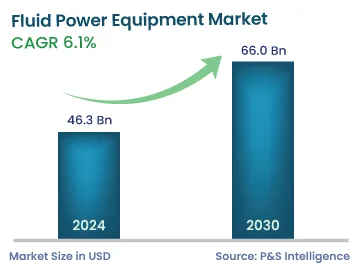
The fluid power equipment market size will be an estimated USD 48.7 billion for 2025, and it will grow by 6.1% during 2026–2032, to reach USD 73.5 billion by 2032.
The market growth is primarily driven by increasing industrial automation across manufacturing sectors, rising demand for energy-efficient equipment, and expanding construction activities worldwide. The expansion of the construction sector, especially in emerging markets, serves as a key reason for the increasing demand for fluid power equipment. Furthermore, the increasing focus on renewable energy infrastructure development has created substantial opportunities for fluid power equipment manufacturers, as wind turbines, solar tracking systems, and hydroelectric facilities rely heavily on hydraulic and pneumatic systems for optimal performance.
Additionally, rapid urbanization and a rise in purchasing capacity are expected to positively impact the market growth. Furthermore, the demand for hydraulic equipment is predicted to grow at a noticeable rate, especially in developing countries in the coming years. This can be due to the rising inclination of manufacturers to utilize these systems to perform heavy machinery jobs and the commercialization of shale gas technology.
The shift towards electrification and hybrid technologies in mobile equipment has emerged as a transformative trend reshaping the fluid power equipment landscape. Manufacturers are increasingly integrating electronic controls with traditional hydraulic systems to achieve superior performance characteristics while meeting stringent environmental regulations. This technological convergence has resulted in the development of intelligent fluid power systems capable of predictive maintenance, real-time performance optimization, and seamless integration with industrial IoT platforms.
Fluid Power Equipment Market Growth Factors
Digitalization and Smart Manufacturing Are Key Trends
The digital transformation of industrial operations and proliferation of industrial automation across manufacturing sectors is a key trend.
This serves as an incentive for fluid power equipment manufacturers to deliver value-added solutions that extend beyond traditional hardware offerings.
The integration of the internet of things technology with hydraulic and pneumatic systems enables continuous monitoring of equipment health, performance optimization, and predictive maintenance capabilities.
Cloud-based analytics platforms and artificial intelligence algorithms are increasingly being deployed to process vast amounts of operational data generated by connected fluid power systems.
These technologies enable manufacturers to offer equipment-as-a-service business models, remote troubleshooting capabilities, and customized performance optimization services.
The convergence of fluid power engineering with digital technologies has transformed traditional equipment suppliers into comprehensive solution providers, creating new revenue streams and strengthening customer relationships through enhanced service offerings.
The increasing automation in several industries, such as packaging, construction, automotive, oil & gas, agriculture, semiconductor, and chemicals, is propelling the need for equipment.
According to the International Federation of Robotics, in 2023, approximately 541,302 units of industrial robots were installed worldwide.
Pneumatic and hydraulic systems now play crucial roles in robotic actuation and material handling applications.
The integration of fluid power systems with automated production lines enables manufacturers to augment productivity, improve product quality, and reduce operational costs through precise motion control and reliable power transmission.
Smart manufacturing initiatives have accelerated the adoption of intelligent fluid power components equipped with sensors, connectivity features, and advanced control algorithms.
The growing scale of industrialization in China, India, and Brazil is accelerating the demand for automated production lines, which, in turn, drives the adoption of fluid power systems.
Energy Efficiency Regulations and Sustainability Initiatives Are Biggest Drivers
The stringent energy efficiency regulations and corporate sustainability commitments have emerged as powerful catalysts for innovation in fluid power equipment design and manufacturing.
The European Union's Ecodesign Directive mandates minimum efficiency standards for industrial equipment, compelling manufacturers to develop hydraulic and pneumatic systems that minimize energy losses while maintaining superior performance characteristics.
The U.S. Department of Energy’s standards for industrial pumps and motors, along with incentives under the Inflation Reduction Act, promote the adoption of energy-efficient equipment.
China’s Energy Conservation Law and Japan’s Top Runner Program set benchmarks for industrial energy efficiency, further stimulating the development of advanced hydraulic and pneumatic technologies.
Variable-speed drives, load-sensing hydraulics, and energy recovery systems have become increasingly prevalent as manufacturers seek to meet regulatory requirements and reduce operational costs.
The transition towards sustainable manufacturing practices has accelerated the development of bio-based hydraulic fluids, lightweight components, and energy-efficient system architectures.
Manufacturers are investing heavily in R&D to create next-generation fluid power equipment that delivers superior performance while minimizing environmental impact through reduced energy consumption, lower noise emissions, and extended service life.
Fluid Power Equipment Market Segmentation Analysis
Type Analysis
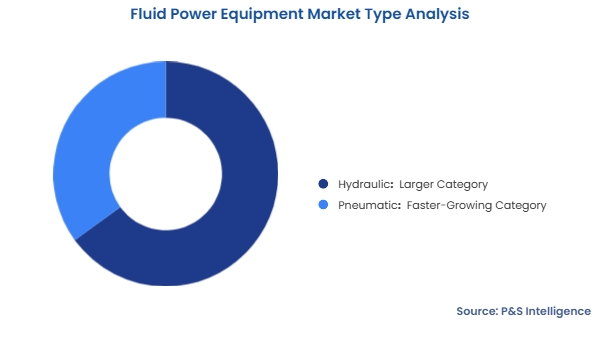
The hydraulic category holds the larger market share, of 65%, in 2025, due to its superior power density, precise control capabilities, and widespread adoption across heavy-duty applications in construction, mining, and manufacturing industries. Hydraulic equipment offers unmatched force generation capabilities in compact packages, making it indispensable for applications requiring high force, output such as excavators, cranes, metal forming presses, and injection molding machines. The prominent factors supporting the augmentation of the hydraulic category include the high efficiency and cost-effectiveness of this type of system and widely used in construction and oil & gas applications.
The pneumatic category will have the higher CAGR, of 6.4%, because these systems depend on the pressure of compressed air to transmit power and are significantly used in different industrial applications. Pneumatic valves are offered in multiple designs, configurations, and sizes, and hence permit free flow in one direction and restrict flow in the reverse direction. Furthermore, companies are focusing on offering varied designs of pneumatic equipment. Also, these types of products can be customized according to applications with the necessary pressure and force.
The types analyzed in this report are:
Hydraulic (Larger Category)
Pneumatic (Faster-Growing Category)
End User Analysis
The construction category holds the largest market share, of 35%, in 2025, due to the high utility of such components in a variety of applications in the construction sector, such as material handling and demolition. Also, companies operating in this sector can enhance efficiency by utilizing technology to reduce costs and improve job safety.
The medical equipment category will have the highest CAGR during the forecast period, propelled by increasing healthcare infrastructure investments and rising demand for advanced medical devices. Fluid power systems play critical roles in medical applications, including surgical tables, patient lifts, dental chairs, and rehabilitation equipment, where smooth, precise motion control and reliability are paramount. The aging global population and growing prevalence of chronic diseases necessitate expanded healthcare facilities and sophisticated medical equipment, driving the adoption of specialized hydraulic and pneumatic components designed for medical applications.
The end users analyzed in this report are:
Construction (Largest Category)
Automotive
Oil & Gas
Chemicals
Aerospace & Defense
Metals & Mining
Food & Beverage
Medical Equipment (Fastest-Growing Category)
Others
Component Analysis
The motors category holds the largest market share, of 35%, in 2025, because motor components offer high power and torque and are used widely in a diverse range of industries, such as automotive, agriculture, and construction. Additionally, the upgradation in motor technologies improves their efficiency and performance and hence are cost-effective solutions for companies to utilize them in various applications.
The valves category will have the highest CAGR, of 6.2%. This can be because of the surging need for valves to monitor high pressure, which will augment the valve component demand. Pneumatic valves, including mechanical, manual, vacuum-piloted, and air-piloted types, are widely utilized across the life sciences, medical, and industrial sectors, as these systems use the force of compressed air to transmit power. Moreover, the expansion of Industry 4.0, supported by advancements in technologies, results in rapid growth in the utility of smart valves to achieve control over several processes.
The components analyzed in this report are:
Pumps (Largest Category)
Motors
Valves (Fastest-Growing Category)
Cylinders
Filters
Actuators
Drive strategic growth with comprehensive market analysis
Fluid Power Equipment Market Regional Growth Dynamics
North America Fluid Power Equipment Market Size
North America holds the largest market share, of 40%, in 2025, due to the presence of superior infrastructure, the growing development in manufacturing and R&D activities, and the rising number of initiatives taken to ensure the safety of workers in industries, such as chemicals and oil and gas.
The region's emphasis on manufacturing competitiveness through advanced automation and smart factory implementations drives the adoption of intelligent fluid power systems incorporating IoT connectivity, artificial intelligence, and predictive analytics capabilities. North American manufacturers lead global innovation in energy-efficient fluid power technologies, developing electric–hydraulic hybrid systems, variable-speed pump drives, and advanced control algorithms that significantly reduce energy consumption while enhancing system performance. The presence of major aerospace and defense contractors in the region further contributes to demand for high-performance fluid power components meeting stringent reliability and precision requirements.
U.S. Fluid Power Equipment Market Size
The U.S. leads the North American market. This is because companies operating in the country are continuously introducing electric construction machines that utilize electric motors with hydraulic pumps and the presence of major industry players. Such innovations are further projected to accelerate the adoption of hydraulic equipment in the U.S.
The implementation of the Infrastructure Investment and Jobs Act in the United States, allocating USD 1.2 trillion for infrastructure improvements, creates substantial opportunities for fluid power equipment deployment in construction, transportation, and utility projects. According to the U.S. Census Bureau, construction spending in the United States reached USD 1.97 trillion in 2023, with continued growth expected through the forecast period.
Asia-Pacific Fluid Power Equipment Market Size
Asia-Pacific will have the highest CAGR, of 6.3%. This can be ascribed to the growing urbanized population coupled with the rising demand for energy, and the surging expansion of the automobile and construction sectors in countries such as India, Japan, and China. Moreover, the significant expansion of infrastructure in India coupled with rapid growth in the automotive sector is boosting the demand for fluid power systems. Further, Japan has well-developed automation and technology sectors, which leads to an increase in the need for power components.
The region's dominance is underpinned by China's Belt and Road Initiative, India's smart cities mission, and Southeast Asian countries' infrastructure modernization programs, collectively driving substantial demand for construction equipment and industrial machinery utilizing fluid power systems. According to the Asian Development Bank, Asia requires USD 1.7 trillion annual infrastructure investment through 2030, ensuring sustained growth opportunities for fluid power equipment manufacturers. The concentration of global manufacturing activities in Asia-Pacific, particularly in automotive, electronics, and consumer goods sectors, generates consistent demand for hydraulic and pneumatic systems used in production equipment.
China Fluid Power Equipment Market Size
China leads within the APAC market with factories increasingly adopting automated production systems incorporating advanced fluid power components. The National Bureau of Statistics of China reports that China's industrial robot density reached 470 units per 10,000 employees in manufacturing in 2023, reflecting the extensive adoption of automation technologies requiring sophisticated fluid power solutions.
Europe Fluid Power Equipment Market Size
Europe is a significant market, supported by the region's strong manufacturing base, stringent environmental regulations, and technological excellence in fluid power engineering. German machinery manufacturers, recognized globally for engineering precision, extensively utilize advanced hydraulic and pneumatic systems in machine tools, packaging equipment, and industrial presses.
The EU’s Green Deal and the 2050 carbon neutrality targets foster substantial investments in energy-efficient fluid power technologies and sustainable manufacturing practices. European manufacturers pioneer digital hydraulics, energy recovery systems, and bio-based hydraulic fluids that align with circular economy principles.
The geographical breakdown of the market is as follows:
North America (Largest Regional Market)
U.S. (Larger Country)
Canada (Faster-Growing Country)
Europe
Germany (Largest Country)
U.K.
France (Fastest-Growing Country)
Italy
Spain
Rest of Europe
Asia-Pacific (Fastest-Growing Regional Market)
China (Largest Country)
India (Fastest-Growing Country)
Japan
South Korea
Australia
Rest of APAC
Latin America
Brazil (Largest Country)
Mexico (Fastest-Growing Country)
Rest of LATAM
Middle East and Africa
Saudi Arabia (Largest Country)
South Africa
U.A.E. (Fastest-Growing Country)
Rest of MEA
Fluid Power Equipment Market Share
The market is fragmented due to the presence of numerous global, regional, and local players, with no single company dominating the industry. The market serves a diverse range of end-use industries, including automotive, construction, aerospace, oil & gas, food & beverage, and medical equipment, each requiring specialized solutions. Additionally, the wide variety of products, pumps, valves, actuators, power units, and control systems encourages specialization among manufacturers. Regional customization, compliance with local standards, and infrastructure differences further support numerous small-to-medium players. Strategic mergers, acquisitions, and partnerships are gradually concentrating the market, while innovation continues to sustain fragmentation.
Key Fluid Power Equipment Companies:
Sparrows Group
Kawasaki Heavy Industries Ltd.
Parker-Hannifin Corporation
HYDAC Technology Ltd.
Daikin Industries Ltd.
Bosch-Rexroth AG
Danfoss
Casappa S.p.A.
HydraForce Inc.
Eaton Corporation plc
Festo AG & Co. KG
Moog Inc.
Fluid Power Equipment Market News
In July 2025, Baker Hughes Company announced the acquisition of Chart Industries Inc. for USD 13.6 billion, marking a significant move into the liquefied natural gas and power generation sectors. This acquisition aims to position the company as a technological leader in cleaner energy sources.
In May 2023, Fluid System Components Inc. acquired Norcan Fluid Power Ltd. to enhance its product offerings and expertise in fluid power systems, broadening its market reach and customer base.
Want a report tailored exactly to your business need?
Leading companies across industries trust us to deliver data-driven insights and innovative solutions for their most critical decisions. From data-driven strategies to actionable insights, we empower the decision-makers who shape industries and define the future. From Fortune 500 companies to innovative startups, we are proud to partner with organisations that drive progress in their industries.
Client Testimonials
Working with P&S Intelligence and their team was an absolute pleasure – their awareness of timelines and commitment to value greatly contributed to our project's success. Eagerly anticipating future collaborations.
McKinsey & Company
India
Unmatched Standards
Our insights into the minutest levels of the markets, including the latest trends and competitive landscape, give you all the answers you need to take your business to new heights
Complete Data Security
We take a cautious approach to protecting your personal and confidential information. Trust is the strongest bond that connects us and our clients, and trust we build by complying with all international and domestic data protection and privacy laws