Europe Water Pump Market Size & Share Analysis - Trends, Drivers, Competitive Landscape, and Forecasts (2026 - 2032)
This Report Provides In-Depth Analysis of the Europe Water Pump Market Report Prepared by P&S Intelligence, Segmented by Type (Dynamic Pumps, Positive Displacement Pumps), Operation (Water Supply, Water Drainage), Power Range (0, 1.6, 2.1, 4.1), Application (Agriculture, Mining, Construction, Manufacturing, Water Treatment, Oil & Gas, Residential), and Geographical Outlook for the Period of 2021 to 2032
Explore the market potential with our data-driven report
Europe Water Pump Market Overview
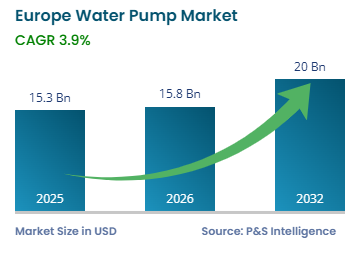
The Europe water pump market size was USD 15.3 billion for 2025, and it will grow by 3.9% during 2026–2032, to reach USD 20.0 billion by 2032.
The market growth is driven by the large-scale replacement of aging municipal and industrial pumping assets, tightening EU energy-efficiency regulations, and rising demand for reliable water supply and drainage systems across agriculture, manufacturing, water treatment, and residential applications. The EU Ecodesign Directive and the Energy Efficiency Directive are driving the adoption of high-efficiency, variable-speed pumps that reduce electricity consumption and lifecycle costs. The recast Urban Wastewater Treatment Directive is accelerating investment in wastewater treatment infrastructure and distribution network modernization.
According to the European Environment Agency (EEA), nearly 33% of water abstracted for public water supply in the EU is lost before reaching end users because of leakages in distribution networks, with losses exceeding 40% in some member states, such as Bulgaria, Croatia, and Italy. Smart, IoT-enabled pumps with remote monitoring and predictive maintenance capabilities are increasingly becoming standard specifications, enabling utilities and industrial users to improve operational efficiency, reduce downtime, and optimize maintenance costs.
Key Market Insights
The dynamic pumps category holds the larger market share, of 75%, driven by their widespread use across municipal, agricultural, and industrial water applications.
The water drainage category will have the higher CAGR, of approximately 4.1%, driven by rising investments in flood management, stormwater control, and wastewater infrastructure.
The agriculture category holds the largest market share, of 30%, in 2025, driven by extensive irrigation activities and groundwater extraction across Europe.
Germany holds the largest market share, of 40%, in 2025, driven by its strong industrial base across automotive, chemical, and manufacturing sectors.
Spain will have the highest CAGR, of approximately 4.8%, driven by its structural dependence on irrigation and intensifying water scarcity.
Europe Water Pump Market Trends and Drivers
Smart and IoT-Enabled Pumping Are Key Trends
Digitalization is reshaping the standard pump specification as utilities and industrial operators increasingly prioritize energy efficiency, remote asset management, and predictive maintenance to reduce operating costs and improve system reliability. Remote monitoring, predictive maintenance, and integrated variable-speed control are shifting from premium add-ons toward baseline requirements. This shift is most pronounced in municipal and industrial contracts, where lifecycle cost, energy efficiency, and uptime govern purchasing decisions.
According to the European Commission, smart water meters can reduce water consumption by up to 25%, while digital water management systems can deliver an additional 5–8% in water savings and leak detection technologies can reduce consumption by a further 7–14%. These efficiency gains are accelerating the adoption of connected pumping solutions. Utilities pursuing telemetry-based network optimization increasingly favor sensor-equipped units. This shift embeds software and service revenue into what was historically a pure equipment sale, creating new growth opportunities for pump manufacturers and digital solution providers.
Infrastructure Renewal and Energy-Efficiency Mandates Are Biggest Drivers
The replacement of aging water infrastructure, combined with increasingly stringent energy-efficiency regulations, is one of the primary drivers of the Europe water pump market. Decades-old municipal water and wastewater networks across Western Europe are being rehabilitated to reduce leakage, improve system reliability, and comply with stricter environmental and discharge standards. This rehabilitation is creating sustained demand for modern pumping systems.
The EU Ecodesign framework is accelerating the replacement of low-efficiency pumps through minimum efficiency index (MEI) requirements. These requirements are encouraging the adoption of high-efficiency, variable-speed pumping systems that lower energy consumption and lifecycle costs. Rising electricity costs and decarbonization targets are encouraging utilities, industries, and commercial facilities to replace aging equipment with energy-efficient pumping solutions. This replacement activity is creating long-term growth opportunities for pump manufacturers and technology providers.
High Capital Costs and Skilled-Labor Shortages Are Key Restraints
High upfront investment costs for energy-efficient pump-and-motor systems, coupled with complex regulatory compliance requirements and shortages of skilled technicians, continue to slow the adoption of advanced pumping solutions across Europe. Advanced pumping solutions equipped with variable-speed drives, digital controls, and IoT connectivity require specialized installation, commissioning, and maintenance expertise. This expertise requirement increases implementation costs for end users.
These challenges weigh most heavily on smaller municipalities, agricultural users, and small and medium-sized enterprises with limited capital budgets. Many of these users continue operating aging pumping systems rather than investing in replacements. Modernization projects are often delayed. This delay slows the adoption of high-efficiency pumping technologies despite their long-term operational and energy-saving benefits. Although replacement demand remains resilient, these financial and workforce constraints continue to moderate the pace of market expansion.
Solar-Powered and Hybrid Pumping Are Biggest Opportunities
Rising industrial electricity costs are creating a distinct opening for solar-powered and hybrid pumping systems in agriculture and off-grid applications across Southern Europe. As renewable energy targets expand, pumps compatible with solar photovoltaic systems and energy-storage solutions are creating new growth opportunities beyond conventional grid-connected demand. According to SolarPower Europe, the European Union installed approximately 65.5 GW of new solar PV capacity in 2024. This expansion of renewable energy infrastructure is supporting wider adoption of solar-powered pumping solutions across agricultural, municipal, and industrial applications.
Growing investments in decarbonization and energy resilience are encouraging end users to adopt low-energy pumping technologies that reduce operating costs and improve long-term sustainability. This is expanding the addressable market for solar-powered and hybrid pumping systems, creating long-term growth opportunities for manufacturers that offer integrated renewable energy-compatible and high-efficiency pumping solutions.
Europe Water Pump Market Segmentation Analysis
Type Analysis
The dynamic pumps category holds the larger market share, of 75%, driven by the widespread adoption of centrifugal designs across municipal, agricultural, and industrial water movement. Their leadership rests on mechanical simplicity, low maintenance, high flow-rate capability, and cost efficiency across the widest range of duties. These attributes make them the default specification for water supply and wastewater applications. According to the European Commission, the EU has more than 30,354 urban wastewater treatment plants in operation following the entry into force of the revised Urban Wastewater Treatment Directive in 2025. This treatment infrastructure sustains demand for high-capacity centrifugal pumps used in water intake, transfer, and wastewater handling.
The positive displacement pumps category will have the higher CAGR, of approximately 4.3%, driven by expanding precision-dosing requirements in chemical treatment, food processing, and specialized industrial fluid transfer where accurate, pulsation-controlled delivery is essential. Their rising uptake in niche high-value applications outpaces the mature centrifugal base.
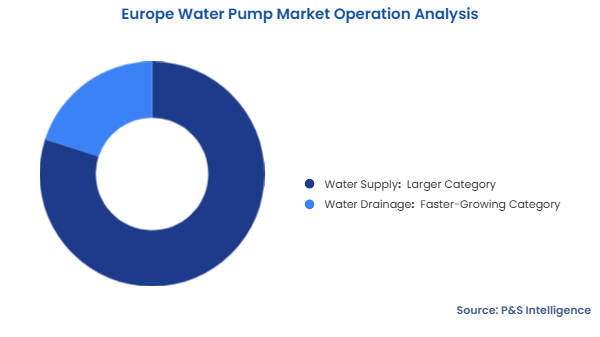
The water supply category holds the larger market share, of 80%, in 2025, driven by the fundamental role of pumping in potable water distribution, irrigation delivery, and pressure boosting across municipal and agricultural networks. The scale of Europe's drinking-water and irrigation infrastructure sustains continuous demand for water supply pumps. Ongoing network modernization and efforts to improve water-use efficiency reinforce this demand. According to the European Environment Agency (EEA), during the 2020–2023 period, agriculture accounted for 31% of total freshwater abstraction in the EU, while public water supply represented 21%. These abstraction volumes reflect the extensive water conveyance infrastructure that underpins sustained demand for water supply pumping systems.
The water drainage category will have the higher CAGR, driven by intensifying flood-risk management, stormwater control, and wastewater evacuation needs as climate variability increases extreme rainfall events across Central and Southern Europe. The growing frequency of extreme weather events is encouraging governments and municipalities to expand drainage infrastructure and invest in resilient pumping systems for urban flood management, wastewater handling, and emergency water evacuation.
The operations analyzed in this report are:
Water Supply (Larger Category)
Water Drainage (Faster-Growing Category)
Power Range Analysis
The 0-1.5 hp category holds the largest market share, in 2025, driven by its extensive use in residential water supply, light agricultural irrigation, and small commercial applications, where compact, cost-effective, and energy-efficient designs are widely adopted for low-capacity water pumping applications. This category's ubiquity across households and small farms, combined with high replacement frequency, secures its volume leadership. According to Eurostat, the European Union had approximately 9.1 million agricultural holdings in 2023, the majority of which were small and medium-sized farms. These farms commonly require compact pumping solutions for irrigation and water supply.
The 2.1-4 hp category will have the highest CAGR, of approximately 4.6%, supported by rising adoption in mid-scale agricultural irrigation, construction dewatering, and light-industrial duties requiring higher head and flow than entry-level units. Growing mechanization of medium-sized farms, expanding construction activity, and increasing investments in water management infrastructure are accelerating demand for higher-capacity pumps in this power range.
The power ranges analyzed in this report are:
0–1.5 hp (Largest Category)
1.6–2 hp
2.1–4 hp (Fastest-Growing Category)
4.1–6 hp
Application Analysis
The agriculture category holds the largest market share, of 30%, in 2025, reflecting Europe's dependence on irrigation across water-scarce Southern and Eastern regions and the sheer scale of pump installations for groundwater extraction and surface irrigation. The extensive use of pumps for irrigation, livestock watering, and water transfer across millions of agricultural holdings, along with recurring replacement demand during irrigation cycles, sustains strong demand for water pumping systems.
The water treatment category will have the highest CAGR, driven by the tightening EU discharge standards and expanding desalination in drought-affected regions, while investment in advanced wastewater and potable water treatment capacity is raising demand for high-performance pumping systems. These investments are accelerating the deployment of energy-efficient pumping systems across municipal and industrial water treatment facilities, supporting sustained demand for advanced water pumps.
The applications analyzed in this report are:
Agriculture (Largest Category)
Mining
Construction
Manufacturing
Water Treatment (Fastest-Growing Category)
Oil & Gas
Residential
Others
Drive strategic growth with comprehensive market analysis
Europe Water Pump Market Regional Outlook
Germany Water Pump Market Size
Germany holds the largest market share, of 40%, in 2025, driven by the extensive and diversified industrial base, spanning automotive, chemical, and manufacturing sectors that require advanced fluid-handling systems. Demand is structurally replacement-driven, as the country operates some of Europe's most mature municipal water distribution networks and wastewater treatment facilities, where upgrades, optimization, and energy-efficiency retrofits sustain pump demand.
Strict environmental compliance under EU directives, combined with strong federal support for renewable-energy and wastewater projects, is reinforcing the adoption of high-performance, IE4/IE5-class pumps. Germany is expected to benefit significantly from broader EU investments in water supply and sanitation because of its extensive municipal water infrastructure and large installed base of pumping equipment. European Commission and OECD analyses estimate that achieving compliance with EU drinking water and wastewater legislation and improving water supply efficiency will require approximately EUR 255 billion in additional cumulative investment in water supply and sanitation infrastructure across the EU by 2030. This investment requirement supports long-term demand for pumping equipment and related technologies.
Spain Water Pump Market Size
Spain will have the highest CAGR, of approximately 4.8%, driven by its structural dependence on irrigation and intensifying water scarcity. Agriculture accounts for approximately 80% of national water use. Persistent water stress across regions such as Andalusia, Murcia, and Valencia is increasing demand for efficient pumping solutions. Prolonged drought conditions have accelerated investments in desalination, water reuse, and irrigation modernization. This activity is strengthening demand for high-capacity municipal, agricultural, and industrial pumps.
The Spanish government's PERTE for the Digitalization of the Water Cycle includes approximately EUR 1.7 billion in direct public investment to modernize water infrastructure. The programme targets improved network efficiency, reduced water losses, and faster adoption of digital water management technologies. The initiative is expected to mobilize approximately EUR 3.06 billion in total public and private investment. This funding supports large-scale deployment of advanced pumping systems and smart water infrastructure. Rising electricity costs are encouraging utilities, industries, and agricultural users to replace older equipment with energy-efficient and solar-powered pumping systems, supporting continued market expansion.
The countries analyzed in this report are:
Germany (Largest Country)
France
Italy
Spain (Fastest-Growing Country)
U.K.
Poland
Netherlands
Belgium
Switzerland
Austria
Rest of Europe
Europe Water Pump Market Competitive Landscape
The Europe water pump market exhibits a fragmented structure, with a broad mix of global manufacturers and a deep base of regional and niche specialists characterizing the competitive landscape. No single company holds dominant share; the top five participants collectively account for only around a third of the market. This fragmentation stems from the diversity of demand across municipal, industrial, agricultural, and residential applications, each requiring different pump types, power ranges, and service models. Varied national regulatory regimes and entrenched local distribution relationships further enable smaller manufacturers to defend specialized niches.
Competition divides into recognizable clusters, with a tier of large, diversified engineering groups competing on breadth of portfolio, energy-efficient technology, and pan-European service networks. These groups position around high-efficiency and digitally enabled systems for large municipal and industrial contracts. A second cluster of mid-sized and regionally focused manufacturers competes through application specialization, customization, and proximity to local customers. These manufacturers serve agricultural, construction, and residential segments where responsiveness and price matter more than global scale. Across both groups, differentiation increasingly centers on compliance with EU efficiency standards, aftermarket and maintenance capability, and integration of monitoring and variable-speed technologies rather than on hardware alone.
Top Companies in the Europe Water Pump Market:
Grundfos Holding A/S
Wilo SE
KSB SE & Co. KGaA
Sulzer Ltd.
Xylem Inc.
Flowserve Corporation
EBARA Corporation
Franklin Electric Co., Inc.
ITT Inc.
Calpeda S.p.A.
ANDRITZ AG
Pentair plc
Europe Water Pump Market News
In March 2026, Wilo SE signed a long-term partnership agreement with AI technology company InstaDeep at Wilopark Dortmund to build a scalable AI platform integrating water technology and artificial intelligence across multiple applications. The collaboration advances Wilo's positioning in smart, connected pumping systems for water management.
In November 2025, Sulzer Ltd. signed a binding agreement to acquire Dansk Overpumpning A/S, a Danish rental company specializing in engineered wastewater pumping solutions. The acquisition expands Sulzer's rental platform in the Nordic region and strengthens its water and wastewater business by enhancing temporary pumping and emergency water management services.
In September 2024, Grundfos Holding A/S completed the acquisition of Culligan's Commercial & Industrial business in Italy, France, and the UK. The acquisition added complementary water treatment and wastewater technologies to Grundfos' portfolio, broadening its industrial and commercial water solutions across these markets.
Frequently Asked Questions About This Report
What factors are driving the growth of the Europe water pump market?+
Growth is driven by water infrastructure modernization, wastewater treatment investments, irrigation demand, and the adoption of energy-efficient pumps.
How are energy-efficiency regulations influencing the Europe water pump market?+
EU energy-efficiency regulations are accelerating the adoption of high-efficiency pumps with variable-speed drives to reduce electricity consumption.
Which industries generate the highest demand for water pumps in Europe?+
Municipal water utilities, construction, manufacturing, agriculture, and wastewater treatment account for the highest demand for water pumps.
How is digitalization changing the Europe water pump market?+
IoT-enabled smart pumps with remote monitoring and predictive maintenance are improving operational efficiency and reducing downtime.
What role does water scarcity play in the Europe water pump market?+
Water scarcity is increasing investments in water reuse, desalination, and efficient irrigation systems, boosting demand for advanced pumps.
What challenges are affecting the Europe water pump market?+
High energy costs, volatile raw material prices, and maintenance expenses remain the primary challenges for manufacturers and end users.
Want a report tailored exactly to your business need?
Leading companies across industries trust us to deliver data-driven insights and innovative solutions for their most critical decisions. From data-driven strategies to actionable insights, we empower the decision-makers who shape industries and define the future. From Fortune 500 companies to innovative startups, we are proud to partner with organisations that drive progress in their industries.
Client Testimonials
Working with P&S Intelligence and their team was an absolute pleasure – their awareness of timelines and commitment to value greatly contributed to our project's success. Eagerly anticipating future collaborations.
McKinsey & Company
India
Unmatched Standards
Our insights into the minutest levels of the markets, including the latest trends and competitive landscape, give you all the answers you need to take your business to new heights
Complete Data Security
We take a cautious approach to protecting your personal and confidential information. Trust is the strongest bond that connects us and our clients, and trust we build by complying with all international and domestic data protection and privacy laws