Electric Power Transmission Market Size & Share Analysis - Emerging Trends, Growth Opportunities, Competitive Landscape, and Forecasts (2025 - 2032)
This Report Provides In-Depth Analysis of the Electric Power Transmission Market Report Prepared by P&S Intelligence, Segmented by Transmission Mode (Overhead, Underground, Submarine), Product (Transformers, Switchgear, Insulator & Fittings, Cables & Lines), Voltage Type (Low, Medium, High), End User (Utilities, Industrial, Commercial, Residential, Independent Power Producers), and Geographical Outlook for the Period of 2019 to 2032
Electric Power Transmission Market Revenue Insights
Key Highlights
Study Period
2019 - 2032
Market Size in 2024
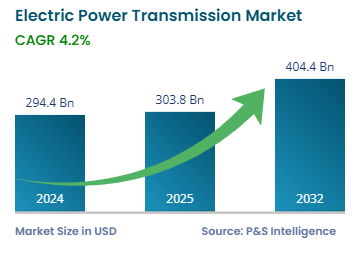
USD 294.4 Billion
Market Size in 2025
USD 303.8 Billion
Market Size by 2032
USD 404.4 Billion
Projected CAGR
4.2%
Largest Region
APAC
Fastest Growing Region
APAC
Market Structure
Consolidated
Market Size
Major Companies
Important Takeaways
Market Size and Forecast
Industry Trend
Regulatory Landscape
Demand Trend Analysis
Companies Recent Strategical Developments
Key Stakeholders
Voice of Industry Experts/KOLs
Future Opportunity
Explore the market potential with our data-driven report
Electric Power Transmission Market Future Outlook
The electric power transmission market size was USD 294.4 billion in 2024, and it will grow by 4.2% during 2025–2032, to reach USD 404.4 billion by 2032.
The market growth is primarily driven by the increasing electricity demand, aging transmission infrastructure requiring upgrades, and the rapid integration of renewable energy sources into power grids. The surge in electricity consumption, coupled with the shift toward renewable energy sources, necessitates substantial investments in transmission infrastructure to ensure reliable power delivery and grid stability. The International Energy Agency reports that the year-over-year demand for energy globally increased by 2.2% in 2024, with 38% of this growth attributed to renewable sources.
Additionally, grid modernization initiatives are a key driver for this market. Many countries are upgrading their aging infrastructure with smart grid technologies and advanced transmission equipment, while emerging economies are building new infrastructure to support industrialization and urbanization. This dual dynamic of replacement and expansion underpins the robust growth trajectory of the electric power transmission market throughout the forecast period.
The electrical grid in the U.S., primarily constructed during the 1950s and 1960s, exhibits significant inefficiency, with an average efficiency rate calculated at only 40%. The U.S. launched the Grid Resilience Innovative Partnership (GRIP) Program in 2022, allocating USD 10.5 billion to enhance the resilience of its electric grid.
Electric Power Transmission Market Trends & Drivers
Integration of Renewable Energy Sources Is Key Trend
The transition towards renewable energy is a fundamental trend transforming electric power transmission requirements.
According to the International Renewable Energy Agency, renewable energy capacity additions reached 473 GW in 2023, with the total capacity reaching 3,870 GW.
The U.S. Energy Information Administration reports that electricity generation from wind power surged from 6 billion kilowatt-hours in 2000 to 434 billion kilowatt-hours in 2022, representing 10.3% of the total utility-scale electricity generation.
This rapid renewable deployment requires extensive transmission infrastructure to connect generation sites with demand centres and manage the inherent variability of renewable sources.
Wind and solar installations are often located far from demand centres, requiring extensive transmission infrastructure to transport clean energy to urban and industrial areas.
Renewable energy installations often face geographical constraints that necessitate long-distance transmission solutions.
Wind farms are typically located in remote areas with favourable wind conditions, while large-scale solar installations require vast land areas often found far from urban centres.
The spatial mismatch between renewable generation and electricity demand creates substantial opportunities for transmission infrastructure development, including high-voltage direct current systems that efficiently transport power over long distances with minimal losses.
Grid flexibility and stability requirements are driving investments in advanced transmission technologies.
The variable nature of wind and solar generation requires transmission systems capable of managing bidirectional power flows, voltage fluctuations, and frequency variations.
Smart grid technologies, energy storage integration, and advanced grid management systems are becoming essential components of modern transmission networks.
The intermittent nature of renewable sources also demands more sophisticated transmission systems capable of managing variable power flows and maintaining grid stability.
These factors are compelling utilities and governments worldwide to modernize and expand their transmission networks, creating substantial growth opportunities for market participants.
These technological advancements enable utilities to maximize renewable energy utilization while maintaining grid reliability, creating demand for sophisticated transmission equipment and control systems throughout the forecast period.
Rising Electricity Demand due to Urbanization and Industrialization Is Biggest Driver
The rapid acceleration of global urban growth and industrial development is creating substantial demand for electric power transmission infrastructure.
Global electricity demand nearly doubled from 15,277 TWh in 2000 to 29,471 TWh in 2023, driven largely by urban population growth, especially in Asia.
In 2024, demand rose by 4.3% (or 1,080 TWh), fuelled by urban electrification and cooling needs.
According to the United Nations Department of Economic and Social Affairs, 68% of the global population will live in urban areas by 2050, compared to 56% in 2024.
This massive demographic shift necessitates extensive transmission networks to deliver reliable electricity to growing cities and industrial zones.
Industrial sectors worldwide are experiencing significant growth, particularly in emerging economies where manufacturing and processing industries are expanding rapidly.
Heavy industries such as steel, aluminium, chemicals, and automotive manufacturing require stable, high-capacity power transmission infrastructure to maintain operations.
As countries pursue industrialization strategies to drive economic growth, investments in transmission infrastructure become critical to support industrial competitiveness and productivity.
The electrification of transportation systems further amplifies electricity demand and transmission requirements.
Electric vehicle charging infrastructure, electrified rail systems, and port electrification initiatives all depend on robust transmission networks to deliver the necessary power.
This transportation electrification trend creates new load centres and changes traditional electricity consumption patterns, necessitating strategic transmission infrastructure investments to accommodate these evolving demands.
Electric Power Transmission Market Segmentation Analysis
Transmission Mode Analysis
The overhead category held the largest market share, of 60%, in 2024, due to its cost-effectiveness and established installation practices of overhead transmission systems compared to underground alternatives. Overhead lines remain the preferred choice for long-distance power transmission, particularly in rural and suburban areas where right-of-way availability and lower installation costs make them economically attractive. The segment benefits from continuous technological improvements in conductor materials, tower designs, and insulation systems that enhance capacity and reliability while maintaining cost advantages.
Submarine is the fastest-growing category, with approx. 4.5% CAGR, driven by offshore wind expansion and cross-border interconnections. Its market is growing rapidly due to demand for high-capacity, long-distance, low-loss HVDC links. Unlike overhead or underground systems, submarine cables enable efficient international energy exchange, especially across Europe and Asia’s developing offshore grids.
The transmission modes analysed in this report are:
Overhead (Largest Category)
Underground
Submarine (Fastest-Growing Category)
Product Type Analysis
The cables & lines category held the largest market share, of 50%, in 2024, due to the massive grid expansion projects in developing countries and the increasing adoption of HVDC transmission systems for long-distance power transfer. The technological innovations in conductor materials include high-temperature superconductors and advanced composite cores, which increase transmission capacity and reduce losses; and underground and submarine cable deployments for urban areas and offshore wind connections further accelerate the category’s growth.
The SAUBHAGYA scheme of India is designed to provide electricity to all households in rural areas, as well as the low-income families in urban regions across the country. Since the inception of the scheme, more than 28million homes have been electrified. However, there are still numerous households that have yet to receive electricity, and the government is diligently working toward addressing this issue, with the aim of completing the task as swiftly as possible.
The transformers category will have the highest CAGR, as power transformers form the backbone of electricity transmission and distribution networks, enabling voltage conversion essential for efficient power delivery. The segment's dominance reflects the critical role of transformers in every transmission project, from generation stations to end-user connections. The growing electricity demand, grid expansion projects, and the need to replace aging transformer fleets drive consistent demand across all regions. Advanced transformer technologies, including smart transformers with digital monitoring capabilities and eco-efficient designs using biodegradable insulating fluids, are gaining traction as utilities prioritize grid modernization and environmental sustainability.
The growing spending on smart transformers to enhance grid resilience and narrow the demand–supply gap also drives this category. For instance, Saudi Arabia is expected to spend up to USD 140.4 million on smart transformers by 2030, driven by the initiation of large-scale smart city projects, such as Red Sea and NEOM.
The product types analysed in this report are:
Transformers (Fastest-Growing Category)
Power
Distribution
Switchgear
Circuit breakers
Fuses
Distribution control panels
Others
Insulator & Fittings
Cables & Lines (Largest Category)
Others
Voltage Type Analysis
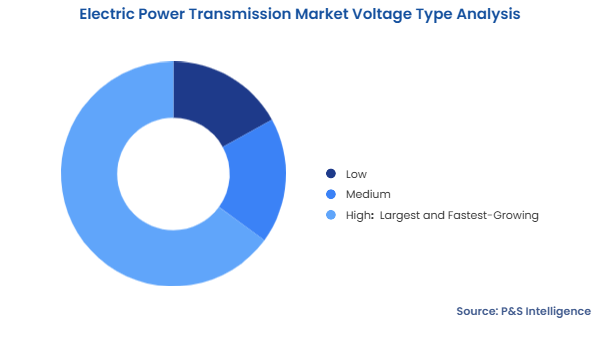
The high category held the largest market share, of 65%, in 2024, and it will have the highest CAGR, due to its critical role in bulk power transmission over long distances. High voltage transmission systems, typically operating above 230 kV, form the backbone of national and regional power grids, efficiently transporting electricity from generation centres to distribution networks. Moreover, the ongoing investments in inter-regional transmission connections and cross-border power trading infrastructure strengthen the market in this category. Countries are increasingly recognizing the economic and reliability benefits of interconnected high-voltage networks that enable resource sharing, renewable energy integration, and enhanced grid stability.
As per studies, USD 16.4 billion would be spent by countries on HVDC transmission networks by 2030. HVDC transmission typically operates between 320 kV and 800 kV, enabling efficient long-distance electricity transfer with minimal losses. It is ideal for intercontinental or submarine links.
For example, China’s Changji–Guquan project operates at 1,100 kV, the highest globally, transmitting 12 GW across 3,284 km. Similarly, India's North-East to Agra HVDC link operates at ±800 kV, transmitting up to 6,000 MW over roughly 1,728 km. Commissioned from 2015–2017, it is the world’s first multi-terminal ±800 kV HVDC system, linking converter stations in Assam, West Bengal and Agra, to deliver hydropower to North India.
The voltage types analysed in this report are:
Low
Medium
High (Largest and Fastest-Growing Category)
End User Analysis
The utilities category held the largest market share, of 35%, in 2024, driven by regulatory obligations to maintain a reliable power supply and accommodate growing electricity demand. Utility investments span new transmission line construction, substation upgrades, and grid modernization initiatives incorporating smart grid technologies. The segment benefits from regulatory frameworks that provide cost recovery mechanisms for transmission investments, ensuring stable returns that support long-term infrastructure development. Utilities worldwide are accelerating transmission investments to integrate renewable energy sources, replace aging assets, and enhance grid resilience against extreme weather events.
The independent power producers category will have the highest CAGR, of approx. 5.5%, because of its rapid expansion of renewable energy projects developed by IPPs, driving substantial demand for transmission infrastructure to connect generation facilities with the grid. These developers require dedicated transmission connections, often in remote locations with excellent renewable resources but limited existing infrastructure. The segment's growth is further supported by evolving regulatory frameworks that facilitate private sector participation in transmission development through mechanisms such as competitive bidding and merchant transmission projects.
The cooling technologies analysed in this report are:
Utilities (Largest Category)
Industrial
Commercial
Residential
Independent Power Producers (Fastest-Growing Category)
Drive strategic growth with comprehensive market analysis
Electric Power Transmission Market Geographical Analysis
Asia-Pacific held the largest market share, of 40%, in 2024, and it will have the highest CAGR, driven by rapid economic growth, urbanization, industrialization across major economies, and ambitious renewable energy targets, with countries committing to substantial solar and wind capacity additions that require extensive transmission infrastructure development.
The region leads in building advanced power lines that can carry electricity over long distances more efficiently using new high-voltage technologies. As of April 2024, China operated 38 UHV lines spanning approximately 48,000 km, enabling efficient power transmission from renewable-rich western provinces to demand centres in the east. China's transmission infrastructure investments are driven by its dual objectives of achieving carbon neutrality by 2060 and ensuring a reliable power supply for continued economic growth. China's leadership in UHV technology development and deployment creates competitive advantages for domestic equipment manufacturers while establishing technical standards adopted globally.
Moreover, India's transmission sector transformation is driven by ambitious renewable energy targets of 500 GW by 2030 and the need to strengthen interstate transmission networks. According to the Central Electricity Authority of India, transmission capacity must increase from 450,000 MVA in 2024 to over 900,000 MVA by 2032 to accommodate renewable integration and growing electricity demand. India's Green Energy Corridor project, aimed at evacuating 450 GW of renewable capacity by 2030, exemplifies the scale of transmission infrastructure development underway across the region.
The geographical breakdown of the market is as follows:
North America
U.S. (Larger and Faster-Growing Country)
Canada
Europe
Germany (Largest Country)
U.K. (Fastest-Growing Country)
France
Italy
Spain
Rest of Europe
Asia-Pacific (Largest and Fastest-Growing Regional Market)
China (Largest Country)
India (Fastest-Growing Country)
Japan
South Korea
Australia
Rest of APAC
Latin America
Brazil (Largest Country)
Mexico (Fastest-Growing Country)
Rest of LATAM
Middle East and Africa
Saudi Arabia (Largest Country)
South Africa
U.A.E. (Fastest-Growing Country)
Rest of MEA
Electric Power Transmission Market Competitive Landscape
The market is moderately consolidated due to the dominance of a few global players with extensive technical capabilities, manufacturing scale, and strong customer relationships. Moreover, the presence of several regional manufacturers, niche, and emerging players is driving localized demand, maintaining a competitive landscape with both established and rising participants.
Key Electric Power Transmission Companies:
GE Vernova Inc.
ABB Ltd.
Schneider Electric SE
Hitachi Ltd.
Mitsubishi Electric Corporation
Toshiba Corporation
CG Power and Industrial Solutions Ltd.
Nexans S.A.
Prysmian S.p.A.
Sterlite Power Transmission Ltd.
TBEA Co. Ltd.
NR Electric Co. Ltd.
Siemens AG
Eaton Corporation plc
Bharat Heavy Electricals Limited
Electric Power Transmission Market News & Updates
In July 2025, Siemens Energy AG was selected as the preferred bidder for the 2-GW Eastern Green Link 4 subsea HVDC transmission project connecting Scotland and England.
In July 2025, Hitachi Energy announced an agreement with E.ON, valued at up to USD 700 million, to supply transformers for the German energy grid.
In May 2025, GE Vernova Inc. secured a contract to supply 69 high-voltage dead-tank circuit breakers for Powerlink’s transmission network upgrade project in Queensland, Australia.
In December 2024, ABB Ltd. won a front-end engineering and design contract from Aker Solutions ASA for the 560-MW Green Volt floating offshore wind project in the U.K., being developed by Vårgrønn AS and Flotation Energy Limited. Situated 80 km off the coast of Peterhead in northeast Scotland, it will deliver 1.5 TWh of renewable energy to the grid each year after reaching full operational capacity in 2029. In the initial phase of the project, the companies will collaborate on a comprehensive electrical study encompassing system design and high-voltage equipment. ABB will also develop the electrical infrastructure, including integrated automation and telecommunications systems for the offshore platform and the onshore substation. ABB will also integrate renewable energy into the grid, utilizing advanced power and energy management systems
In July 2024, GE Vernova Inc. signed an 18-month R&D agreement with four German transmission system operators to develop a multi-terminal HVDC grid solution, including a 525-kV DC circuit breaker.
In October 2024, Siemens Energy AG entered into a strategic technology partnership with Slovenia’s TSO, ELES, to implement advanced digital solutions for power transmission.
Want a report tailored exactly to your business need?
Leading companies across industries trust us to deliver data-driven insights and innovative solutions for their most critical decisions. From data-driven strategies to actionable insights, we empower the decision-makers who shape industries and define the future. From Fortune 500 companies to innovative startups, we are proud to partner with organisations that drive progress in their industries.
Client Testimonials
Working with P&S Intelligence and their team was an absolute pleasure – their awareness of timelines and commitment to value greatly contributed to our project's success. Eagerly anticipating future collaborations.
McKinsey & Company
India
Unmatched Standards
Our insights into the minutest levels of the markets, including the latest trends and competitive landscape, give you all the answers you need to take your business to new heights
Complete Data Security
We take a cautious approach to protecting your personal and confidential information. Trust is the strongest bond that connects us and our clients, and trust we build by complying with all international and domestic data protection and privacy laws