Key Highlights
| Study Period | 2019 - 2032 |
| Market Size in 2024 | USD 100.7 Billion |
| Market Size in 2025 | USD 101.4 Billion |
| Market Size by 2032 | USD 113.9 Billion |
| Projected CAGR | 1.7% |
| Largest Region | APAC |
| Fastest Growing Region | APAC |
| Market Structure | Fragmented |

| Study Period | 2019 - 2032 |
| Market Size in 2024 | USD 100.7 Billion |
| Market Size in 2025 | USD 101.4 Billion |
| Market Size by 2032 | USD 113.9 Billion |
| Projected CAGR | 1.7% |
| Largest Region | APAC |
| Fastest Growing Region | APAC |
| Market Structure | Fragmented |
|
Explore the market potential with our data-driven report
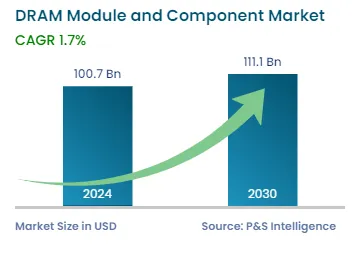
The global DRAM module and component market size was USD 100.7 billion in 2024, and the market size is predicted to reach USD 113.9 billion by 2032, advancing at a CAGR of 1.7% during 2025–2032.
The fostering adoption of IoT and 5G technologies, rising number of data centers, and increasing utilization of DRAM modules and components in various industries are the key factors that are expected to propel the market growth. Data centers and servers need advanced DRAM modules to handle large workloads, which drives growth in both chip production and module assembly. The growing popularity of smartphones, laptops, gaming consoles, and smart devices boosts the demand for DRAM. Innovations, such as the clock driver technologies CKD & RCD, improve memory speed and stability, creating more demand for the latest modules. The gaming market's expansion increases the demand for high-performance DRAM modules for speed and low latency. Enthusiasts and professional gamers prefer custom high-speed memory modules, which boosts sales for manufacturers.
The use of smart technologies, such as AI, machine learning, and high-performance computing, is growing fast, which need a lot of fast memory to work well. Industries including healthcare, banking, and self-driving cars are now using more DRAM to handle big data. Furthermore, electric and connected cars need more memory for maps, music systems, and safety features.
Moreover, there are 2,751 data centers in the U.S., which makes it a major consumer of DRAM modules for cloud computing and AI applications. The European Union has allocated around USD 50 billion to boost semiconductor manufacturing, to reduce the dependence on external suppliers. The U.K.'s focus on digital transformation and investments in AI and cloud technologies are helping in the adoption of DRAM modules across various sectors.
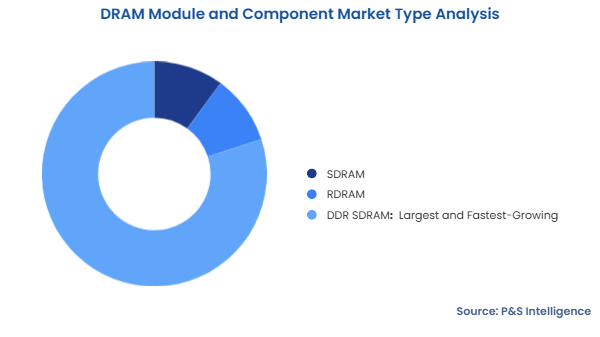
The DDR SDRAM category held the largest market share, of 80%, in 2024, and will grow at the highest CAGR, of 1.6%, during the forecast period. This is because it is the most common type of memory in computers, smartphones, laptops, and gaming consoles. These devices are used by millions of people, leading to a massive demand for DDR memory. It offers a good balance between speed and energy savings. The newer versions, such as DDR4, are faster and use less power compared to older types, making them a popular choice. It can handle more data, making it perfect for gamers as well.
Data centers and cloud computing services require a lot of memory to store and process data, and their usage is growing fast. DDR4 and DDR5 are helpful for supporting the huge amounts of data these services handle, which drives the overall growth of the DDR SDRAM market.
The types analyzed here are:
The above 8 GB category held the largest market share, of 40%, in 2024, because high-end smartphones, gaming laptops, and workstations need more than 8 GB of RAM. These devices handle powerful tasks, such as graphic-intensive games, video editing, and AI applications; so, they need more memory to run smoothly. Moreover, hyperscale data centers, which handle massive amounts of data for cloud computing and AI, require more than 8 GB of memory. These systems need a lot of RAM to quickly process huge amounts of information. For example, servers often use 16 GB, 32 GB, or even more RAM to run smoothly, when using multiple apps together, such as video editing and AR.
The 6–8 GB category will grow at the highest CAGR, of 1.8%, during the forecast period. This is as it is enough for most tasks, such as browsing the internet, watching videos, playing games, and working on documents. It is fast enough for everyday use and not too expensive. Many people are upgrading to mid-range smartphones because they offer a lot of value for money.
The memories analyzed here are:
The mobile devices category held the largest market share, of 45%, in 2024, because they are used by billions of people around the world. Each phone uses DRAM for fast performance. With so many phones being produced and sold every year, this industry uses more DRAM than any other. People change or upgrade their phones every 2–3 years, which means companies must keep producing new models with more RAM.
The automotive category will grow at the highest CAGR, of 2%, during the forecast period, as modern cars have advanced features, such as infotainment systems, digital dashboards, navigation, and driver assistance. All these systems need DRAM to run smoothly. Moreover, with the rise of electric vehicles and autonomous cars, which use advanced software and sensors, there is a greater need for faster memory to process data. Cars are now also getting connected to the internet for real-time updates, remote diagnostics, and smart features, such as voice control and OTA updates, which increases the demand for higher memories.
The industries analyzed here are:
Drive strategic growth with comprehensive market analysis
APAC held the largest market share, of 65%, in 2024, and it will grow at the highest CAGR, of 2.5% during the forecast period. The burgeoning adoption of smart digital devices in APAC countries stimulates the demand for DRAM modules and components, due to their ability to cater to the memory requirements. China, South Korea, and Japan are global leaders in electronics production and need a constant supply of DRAM modules for smartphones, PCs, and industrial machines. Moreover, the Government of India is taking initiatives to become a global hub for semiconductor production and an alternative to China. For this, it provides incentives to the manufacturers of semiconductors, and display products.
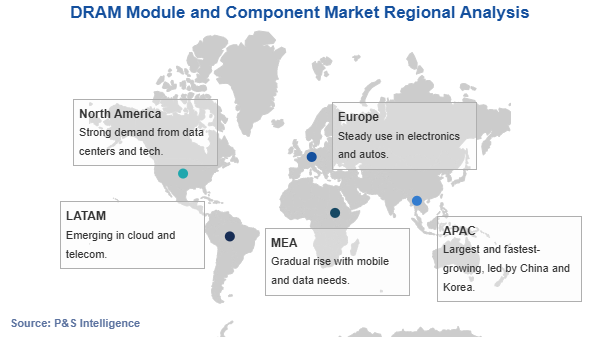
The rising internet use and increasing demand for cloud services in APAC are creating a demand for memory for servers and storage devices. SK Hynix is building a huge memory factory in South Korea with an investment of over USD 14 billion to increase DRAM production in the coming years.
The regions analyzed here are:
The market is fragmented because of the many different uses, such as laptops, gaming computers, phones, and machines. Each use needs a different kind of a memory with different sizes, speeds, and features. Many companies make memory modules for specific needs, which creates more variety. Moreover, memory technology changes quickly with new types, including DDR4, and DDR5; and special features for gaming or AI. Hence, companies try to make their products better and unique to attract customers; so, many different kinds of modules exist. Furthermore, people in different parts of the world buy from different companies. Some companies focus on one region, which is why there are many local brands.
Want a report tailored exactly to your business need?
Request CustomizationLeading companies across industries trust us to deliver data-driven insights and innovative solutions for their most critical decisions. From data-driven strategies to actionable insights, we empower the decision-makers who shape industries and define the future. From Fortune 500 companies to innovative startups, we are proud to partner with organisations that drive progress in their industries.

Working with P&S Intelligence and their team was an absolute pleasure – their awareness of timelines and commitment to value greatly contributed to our project's success. Eagerly anticipating future collaborations.
McKinsey & Company
India
Our insights into the minutest levels of the markets, including the latest trends and competitive landscape, give you all the answers you need to take your business to new heights

We take a cautious approach to protecting your personal and confidential information. Trust is the strongest bond that connects us and our clients, and trust we build by complying with all international and domestic data protection and privacy laws


Customize the Report to Align with Your Business Objectives

Request the Free Sample Pages