Major Companies in Digital Substation Market:
- Hitachi Energy Ltd.
- Siemens Energy AG
- GE Vernova Inc.
- Schneider Electric SE
- ABB Ltd
- Cisco Systems, Inc.
- Schweitzer Engineering Laboratories Inc.
- NR Electric Co. Ltd.
- Belden Inc.
- Eaton Corporation plc

| Study Period | 2022 - 2033 |
|---|---|
| Market Size in 2026 | USD 8.75 Billion |
| Market Size in 2027 | USD 9.38 Billion |
| Market Size by 2033 | USD 14.24 Billion |
| Projected CAGR | 7.2% |
| Largest Region | Asia-Pacific |
| Fastest Growing Region | Asia-Pacific |
| Market Structure | Moderately Fragmented |
Explore the market potential with our data-driven report
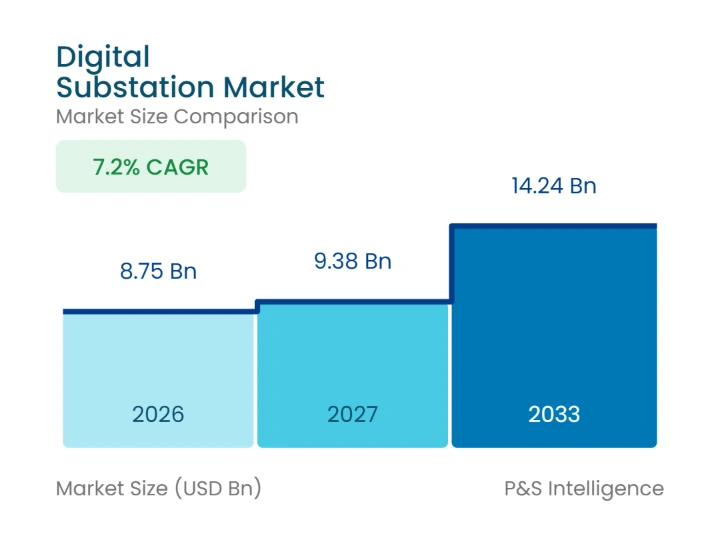
The global digital substation market size is estimated at USD 8.75 Billion in 2026 and is projected to reach USD 9.38 Billion in 2027. Revenue is projected to rise to USD 14.24 Billion by 2033, a CAGR of 7.2% during the 2027-2033 forecast period. Transmission operators and distribution utilities are buying fiber-based protection and control systems because renewable connections, data-center loads, and decades-old relay panels now compete for the same substation upgrade budgets. For suppliers, that overlap brings orders in two forms, large greenfield packages and bay-by-bay retrofit contracts.
Transmission operators facing long connection queues for wind, solar, storage, and large industrial loads generate a steady flow of new digital substation orders, because each new bay needs protection, control, and communication equipment. The International Energy Agency estimates that spending on electricity grids will approach USD 550 billion in 2026, up nearly 20% from the previous year. That figure covers all network assets, so it sizes the capital pool from which digital secondary systems are funded, not the market itself. Utilities that renew protection panels while building new lines can spread fiber and engineering costs across both programs.
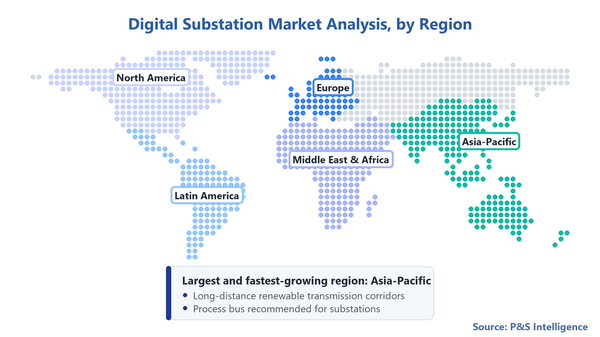
Asia-Pacific holds 37.6% of digital substation market revenue in 2026 and is projected to post the fastest regional growth, at an 8.1% CAGR during 2027-2033. China and India underpin that position, since both are building long-distance transmission corridors that add new high-voltage substations every year. Europe and North America expand more slowly because most of their spending replaces aging relays inside existing yards, a cycle set by asset age more than by new grid capacity.
European transmission operators have started running protection and control functions as software on substation servers, which changes what they buy for each site. In place of one relay per bay, a utility orders hardened computing nodes, a real-time virtualization layer, and licensed protection applications that can be updated without opening a panel. Relay counts fall, while spending on servers, time-synchronized networks, and integration engineering rises, so the value of each order shifts from bay hardware toward software and services.
LF Energy confirms that RTE runs SEAPATH, an open-source real-time virtualization platform for protection, automation, and control, in production across its R#SPACE program, while Elia, Amprion, Avangrid, Enedis, and Alliander are evaluating it. The foundation moved SEAPATH to graduated status in August 2026, its most mature project stage. A shared hosting layer lowers the cost of running protection applications from different vendors on one machine. Relay makers that already ship certified software versions of their devices are likely to benefit, while vendors whose value depends on proprietary bay units could face sharper price comparisons.
Generation and storage developers waiting for grid access create direct substation work, because every approved connection needs switching, protection, and metering at the point where the plant joins the network. Utilities that build those bays with IEC 61850 communication from the start avoid installing copper-wired yards they would have to rewire within one relay life. Connection volume therefore works as a leading indicator for orders of merging units, protection relays, and station networks, with purchases timed to each project's energization date.
About 8,200 projects, representing 1,312 GW of generation and around 749 GW of storage, were actively seeking connection to the U.S. transmission grid at the end of 2025, according to Lawrence Berkeley National Laboratory. Many of these projects will withdraw, so the queue sizes the pool of potential substation work and does not count confirmed orders for digitized bays. Vendors with standardized, pre-engineered protection packages are better positioned to shorten the design step that often holds up energization, and that speed matters to developers whose revenue starts only when the plant connects.
Distribution utilities own far more substations than transmission operators, yet many medium-voltage sites still run a separate protection relay in every feeder bay. Centralized protection replaces that row of relays with one protection and control unit fed by merging units and sensors, which lowers the cost of digitizing a small site to a level distribution capital plans can carry. The result is a high-count, lower-ticket segment whose buying pattern differs from the large transmission projects that account for most current spending.
As per ABB, its SSC600 platform provides centralized protection and control for up to 30 bays in a single product, and the SSC600 SW variant delivers the same functions as a software package without dedicated hardware. For a distribution operator, that turns a multi-device retrofit into one controller purchase plus sensors and fiber, which fits phased programs funded through regulated rate cases. Suppliers that pair centralized units with low-power instrument transformers and switchgear can capture more of each site budget than relay-only vendors.
Brownfield conversion slows when a utility cannot show payback before it commits to rewiring a working substation. A retrofit involves outage planning, parallel testing, new engineering tools, and retraining protection staff, and regulators that approve utility capital plans often expect those costs to be justified by measurable reliability or labor savings. When the case looks weak, utilities defer conversion until relays reach end of life, which pushes revenue later in the replacement cycle and lengthens sales cycles for retrofit specialists.
CIGRE's working group on process bus implementation found that estimated and reported economic benefits vary considerably with the use case and context, which makes a single industry business case hard to carry into a regulatory filing. Some utilities are responding with pilot bays that run digital and conventional protection side by side before approving wider rollout. Each pilot adds evaluation time, so vendors able to supply measured performance data from earlier installations can shorten the approval step for later buyers.
Hardware accounts for 58.0% of digital substation market revenue in 2026, because every digitized bay still needs protection relays, merging units, sensors, and hardened switches before any software can run. Relays and switches that also serve conventional yards are counted here only when supplied for IEC 61850-based digital designs. Device spending scales with bay count, so hardware dominates the bill of materials. Hitachi Energy states that a digital design can cut copper cable by up to 80% and relay-house space by up to 60%, moving budget out of cable and buildings into electronics and fiber-optic components.
SCADA & substation automation software is projected to post the highest growth in this axis, at an 8.6% CAGR during 2027-2033. Utilities are licensing more functions per site, including SCADA station control, configuration management, and security monitoring, as protection itself starts to move onto servers. The Federal Energy Regulatory Commission approved CIP-015-1 in June 2025, a reliability standard that requires internal network security monitoring for covered grid cyber systems. The rule is technology-neutral, yet it pushes operators toward monitoring software inside substation networks, and software lines renew through version updates and license terms between hardware replacement cycles.
The 220 kV to 500 kV tier holds 46.8% of 2026 revenue, since it covers the bulk of meshed transmission substations, where utilities place the most protection zones, busbar schemes, and communication links per site. Owners of these yards apply reliability rules that make redundancy standard, so a typical site buys duplicated relays, dual networks, and precision clocks. ENTSO-E's 2024 network development plan identifies 88 GW of additional cross-border capacity in Europe as economically efficient by 2030, and much of that reinforcement is likely to connect at 380 kV to 400 kV, inside this tier.
Above 500 kV is set to grow fastest, at a 7.8% CAGR during 2027-2033, as long-distance corridors carry remote renewable output to load centers. Each ultra-high-voltage substation carries high secondary-system value because of its large transformer banks and the stability risk a single fault creates. The Central Electricity Authority's monthly transmission progress report as of March 31, 2026 lists new 765/400 kV transformer additions at renewable hubs such as Khavda and Fatehgarh-3, showing where India's highest-voltage builds cluster. Qualification at this voltage class tends to take longer, which can favor suppliers already approved for 765 kV schemes.
Retrofit / brownfield projects account for 56.5% of 2026 revenue because the installed base of electromechanical and early numerical relays is far larger than the number of new substations built in any year. Utilities typically replace secondary systems when relays reach end of life, often long before transformers or switchgear. Eurelectric estimates that Europe's distribution grids need USD 4.49 billion (EUR 4 billion) a year for automation and digitalization through 2050, and much of that budget is likely to go to networks already in service. Brownfield work also carries higher engineering value per bay, since crews migrate live circuits.
Greenfield / new installations are expected to grow fastest in this axis, at an 8.0% CAGR during 2027-2033, because new substations for renewable plants, interconnectors, and large industrial loads can adopt fiber-based designs without legacy wiring constraints. A new site lets a utility specify process bus from the switchyard to the control room in one tender, which simplifies testing and shortens commissioning. For vendors, greenfield packages bundle more scope into a single contract, including merging units, station networks, time synchronization, and automation software, which raises the value of each award.
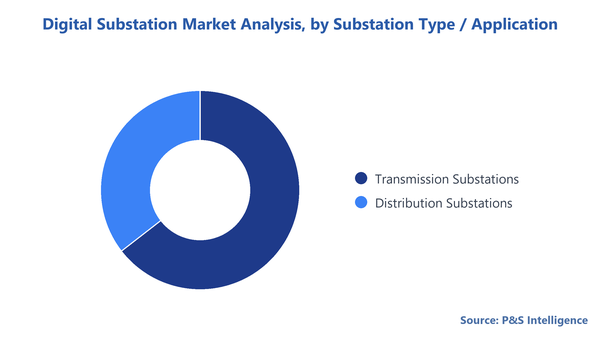
Transmission substations hold 64.5% of 2026 revenue, since a single high-voltage site carries far more protection zones and redundancy requirements than a distribution substation. Transmission operators also fund secondary-system upgrades through regulated capital plans that run for several years, so projects tend to proceed even when other utility spending slows. Spending per site is high and the buyer pool is concentrated, so vendors often compete for multi-year framework agreements that cover many substations at once.
Distribution substations are projected to grow fastest in this axis, at a 7.7% CAGR during 2027-2033, as rooftop solar, battery storage, and electric-vehicle charging reverse power flows and call for faster fault detection at medium voltage. According to the U.S. Energy Information Administration, major utilities spent USD 6.1 billion on distribution substation equipment in 2023, 15% more than in 2022, a total that covers all equipment and not digital systems alone. Centralized protection units and sensor-based switchgear lower the cost per site enough to digitize in volume, which favors suppliers with standardized, repeatable designs.
The following segments are analyzed in this report.
Asia-Pacific holds 37.6% of global digital substation market revenue in 2026 and is set to expand faster than any other region, at an 8.1% CAGR during 2027-2033. China and India add new transmission substations every year, because both are building long-distance corridors that carry wind, solar, and hydro output to industrial and coastal load centers. China is the region's largest market, with its state-owned grid companies buying secondary systems for ultra-high-voltage and provincial networks. India is the region's fastest-growing market.
India's policy direction adds a standards-led growth channel. In March 2023, the Ministry of Power accepted a task force report on transmission modernization that recommends process bus based protection, automation, and control for gas-insulated and hybrid substations, and the minister directed the country's technical planning authority to frame standards for adoption. Standards built on that recommendation would push tenders for new high-voltage substations toward IEC 61850 process bus, favoring suppliers with local engineering teams and type-tested designs. Japan, South Korea, and Australia add replacement demand from older networks, balancing the regional order book between new builds and retrofits.
North America contributes a large, replacement-led share of global revenue, with most spending in the U.S., where transmission owners are renewing relays and control houses installed decades ago while connecting new generation and data-center loads. Canadian utilities follow a similar pattern on a smaller base. Purchases in the region tend toward higher-value specifications, including security monitoring, redundant networks, and precision time synchronization, because mandatory reliability and cybersecurity standards apply to the substations that control the bulk power system.
The U.S. Department of Energy announced nearly USD 2 billion in federal funding on March 12, 2026 for the third round of its Grid Resilience and Innovation Partnerships program, aimed at fast-to-build upgrades such as reconductoring and advanced transmission technologies. The round funds grid capacity in general and does not target substation digitization specifically, and awards for it are yet to be announced. Projects that win funding would still need protection and control changes at the substations they connect to, which could add retrofit work for vendors already qualified with U.S. transmission owners.
Europe's demand comes mainly from transmission and distribution operators adapting aging networks to offshore wind, cross-border power flows, and electrified heating and transport. Transmission operators in France, Germany, the Netherlands, and the U.K. have run multi-vendor IEC 61850 projects for several years, which makes the region a reference market for virtualized protection and open engineering tools. Utilities elsewhere often study these projects before writing their own tender specifications, so European designs tend to shape what vendors standardize globally.
Figures from the European Commission put the share of Europe's distribution grids older than 40 years at around 40%, and the Commission says these networks need to become more digitalized. That age profile points to a long retrofit cycle at medium-voltage substations, which suits centralized protection and sensor-equipped switchgear. Vendors with service teams in several member states are better positioned, since distribution operators often buy through national tenders that weigh local support and spare-parts access alongside price.
Latin America trails the larger regions, but regular transmission auctions give it a predictable pipeline of new substation projects. Brazil's regulator auctions concession lots that bundle new lines, transformer capacity, and substation expansions, and the winning concessionaires buy protection and control systems as part of each build. Mexico, Chile, and Colombia add demand linked to renewable connections and grid reinforcement, although public budget limits in some countries stretch project timelines and delay equipment orders.
ANEEL's transmission auction of October 31, 2025 covered 1,081 km of lines and sectioning works, 2,000 MVA of transformation capacity, and seven synchronous compensators, and all seven lots found winning bidders. Concessionaires bid on allowed annual revenue, so they favor designs that lower build and maintenance costs over the concession term, which can support fiber-based secondary systems where the savings are proven. Suppliers offering local assembly and Portuguese-language engineering support compete more effectively for these lots.
The Middle East & Africa region combines high-specification new builds in the Gulf with large planned transmission expansions in sub-Saharan Africa. Utilities in Saudi Arabia, the U.A.E., and Qatar are adding substations for industrial zones, desalination plants, and solar parks, and new sites there can adopt digital protection from the outset. South Africa's need differs, since its grid must expand to connect private renewable generation in provinces far from existing transmission capacity.
South Africa's Minister of Electricity and Energy, replying to a parliamentary question in December 2025, said the national transmission build program would add about 14,000 km of high-voltage lines and more than 170 substations through 2034. Delivery depends on funding and construction capacity, so orders are likely to arrive in phases spread across the decade. If the program holds its schedule, suppliers able to offer local content and standardized substation designs could win repeat work across its three build phases.
The following geographies are analyzed in this report.
Competition in the digital substation market splits into two layers with different economics. Protection, control, and process interface devices come mainly from established grid-equipment makers and protection specialists, because utilities qualify each relay platform through type tests, scheme approvals, and staff training that take years to repeat with a new vendor. The communication layer is more open, since substation-hardened switches and clocks are qualified against published IEC 61850-3 and IEEE 1613 requirements that industrial networking firms can meet. Virtualized protection is gradually loosening the link between protection software and the hardware it runs on.
Hitachi Energy, Siemens Energy, and GE Vernova compete as full-scope suppliers that can combine high-voltage switchgear and transformers with substation automation, protection, and monitoring in one contract, which suits transmission operators running large framework programs. Schweitzer Engineering Laboratories competes mainly on protection depth, offering its point-to-point Time-Domain Link system alongside IEC 61850 Sampled Values for utilities that prefer to avoid process bus switching. Cisco approaches the market from networking, selling rugged substation switches, redundancy features, and operational-technology security monitoring that work beside any vendor's relays.
Switching costs for buyers come mostly from engineering tools, configuration files, and staff training, so incumbents keep an advantage at brownfield sites where their relays are already installed. NR Electric, part of the State Grid Corporation of China group, supplies protection and automation systems for Chinese transmission networks and also bids for projects abroad. Open configuration tooling and vendor-neutral hosting platforms lower switching barriers over time, giving networking and software suppliers more room to win scope that used to come bundled with relay contracts.
Want a report tailored exactly to your business need?
Request CustomizationEmpowering Leaders Across the Globe
Leading companies across industries trust us to deliver data-driven insights and innovative solutions for their most critical decisions. From data-driven strategies to actionable insights, we empower the decision-makers who shape industries and define the future. From Fortune 500 companies to innovative startups, we are proud to partner with organisations that drive progress in their industries.

Working with P&S Intelligence and their team was an absolute pleasure – their awareness of timelines and commitment to value greatly contributed to our project's success. Eagerly anticipating future collaborations.
McKinsey & Company
India
Our insights into the minutest levels of the markets, including the latest trends and competitive landscape, give you all the answers you need to take your business to new heights

We take a cautious approach to protecting your personal and confidential information. Trust is the strongest bond that connects us and our clients, and trust we build by complying with all international and domestic data protection and privacy laws

Customize the Report to Align with Your Business Objectives

Request the Free Sample Pages