Digital Identity Solutions Market Size & Share Analysis - Emerging Trends, Growth Opportunities, Competitive Landscape, and Forecasts (2025 - 2032)
This Report Provides In-Depth Analysis of the Digital Identity Solutions Market Report Prepared by P&S Intelligence, Segmented by Offering (Solutions, Hardware, Software), Solution Type (Identity Verification, Authentication, Single-Factor Authentication, Multi-Factor Authentication, Identity Lifecycle Management), Identity Type (Biometric, Non-Biometric), Organization Type (Large Organizations, SMEs), Vertical (BFSI, Retail and eCommerce, Government and Defense, Healthcare, IT and ITeS, Telecommunications, Energy and Utilities), and Geographical Outlook for the Period of 2019 to 2032
Explore the market potential with our data-driven report
Digital Identity Solutions Market Outlook
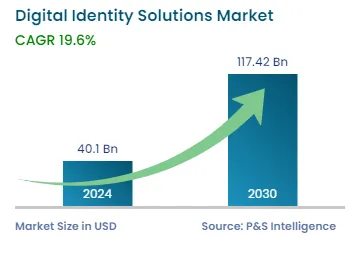
The digital identity solutions market size was USD 40.1 billion in 2024, which is predicted to reach USD 166.2 billion by 2032, growing at a CAGR of 19.6% during 2025–2032.
The biggest driver of the market is a rise in the number of cybercrimes and fraudulent activities in the BFSI and healthcare sectors. Further, ID wallets have undergone significant technological developments and a massive surge in their usage in the recent past. Additionally, AL, ML, and blockchain are being used to enhance the authentication capabilities of digital identity solutions.
A digital identity contains the attributes and data needed to ascertain the identity of a person online. Users’ names, birthdates, addresses, and other contact details are used to identify them. Based on the requirement and criticality of the application, more-foolproof information, such as fingerprints and iris scans, employment history, and social media profiles, can also be stored in a digital identity wallet.
These solutions help create trust and authenticate individuals during digital interactions. Apart from helping entities and online platforms confirm users’ identities, these solutions secure transactions and protect users against unauthorized access and fraud. IAM solutions are used to create, maintain, and use these electronic personal details in multiple applications and on various kinds of hardware.
Moreover, with single sign-on (SSO) solutions, users authenticate themselves once, following which they get access to all the allowed applications and services without confirming their identities repeatedly. Such solutions allow identity details to be shared securely between organizations, which gives users access to services offered by numerous organizations with just one set of credentials.
Further, biometric authentication solutions use fingerprints, iris scans, facial features, and other biological traits to authenticate the identity of citizens, employees, and customers. This particular solution provides a high level of security and is, thus, used in unlocking smartphones or entering secure facilities. Two- and multi-factor authentication solutions require multiple forms of information from users to ascertain who they are. These forms can be a combination of passwords or something the user has, such as a smartphone or biometric data. Digital certificates have entities’ identity information and are digitally signed by certificate authorities. Whenever a digital certificate is presented, the receiver can cross-check the certificate as being genuine by seeing a digital signature using a public key.
Digital Identity Solutions Market Trends & Drivers
Digital Transformation and Remote Work Adoption Is a Key Trend
Digital transformation across industries is driving demand for connected, software-enabled, and data-driven solutions in commercial vehicle operations.
Remote work adoption has reduced daily commuter traffic, but increased the demand for e-commerce and home deliveries, shifting fleet priorities toward last-mile logistics.
According to the American Banking Association, 55% of U.S. consumers now use mobile banking as their primary account access method.
Fleet operators are leveraging cloud-based platforms for real-time vehicle tracking, predictive maintenance, route optimization, and driver behavior monitoring.
Increased integration of telematics, IoT, and AI technologies enables enhanced decision-making, cost control, and operational transparency.
Digital fleet management systems support remote diagnostics, automated compliance reporting, and over-the-air software updates, improving efficiency.
Remote work trends have encouraged logistics companies to decentralize distribution, using data analytics to establish micro-fulfillment centers closer to residential zones.
The shift toward digital ecosystems is attracting new tech-focused entrants into the commercial vehicle value chain, including software providers and mobility-as-a-service platforms
Cybersecurity and data privacy have become critical focus areas as more vehicle functions and fleet operations move online.
Rising Cybersecurity Threats and Data Breaches Are Accelerating Market Growth
The increasing rate of digitalization in commercial vehicles and fleet management systems exposes operators to higher cybersecurity risks, including hacking, data theft, and ransomware attacks.
The growing use of telematics, connected devices, and cloud-based platforms in vehicle operations creates multiple entry points for potential breaches.
According to the Identity Theft Resource Center, the U.S. alone recorded 3,158 data compromises in 2024, affecting over 1.35 billion individuals.
Regulatory pressure around data protection and privacy compliance is prompting companies to invest in robust cybersecurity frameworks.
The rising incidents of data breaches in logistics, transportation, and automotive sectors highlight the urgency of securing vehicle-to-infrastructure and vehicle-to-cloud communications.
Companies are integrating advanced cybersecurity solutions—such as end-to-end encryption, multi-factor authentication, and intrusion detection systems—to mitigate operational risk.
The need to protect customer data, vehicle diagnostics, and route information is driving demand for secure software-defined vehicle platforms.
Cybersecurity has become a competitive differentiator, with fleet operators favoring service providers that offer certified and resilient digital ecosystems.
For instance, the financial impact of identity-related fraud continues to escalate, with cybercrime damages projected to reach USD 10.5 trillion annually by 2025, according to Cybersecurity Ventures.
Insurance providers are increasingly assessing cybersecurity maturity as part of risk profiling, further incentivizing proactive investment in security technologies.
Public and private sector collaboration on cybersecurity standards is accelerating innovation and creating market opportunities for specialized security solution vendors.
Digital Identity Solutions Market Segmentation Analysis
Offering Analysis
The solutions category dominated the digital identity solutions market in 2024, accounting for an approximately 60% market revenue. This dominance stems from organizations' increasing need for comprehensive identity management platforms that can integrate seamlessly with existing IT infrastructure. Solutions encompass various components, including biometric systems, authentication software, and identity verification platforms, that provide the technological foundation for secure digital identity management. The growing sophistication of these solutions, incorporating artificial intelligence and machine learning capabilities, enables organizations to detect fraudulent activities in real-time while maintaining user experience quality.
Hardware components are experiencing the fastest growth, during 2025–2032. The proliferation of biometric devices, smart cards, and hardware security modules reflects organizations' commitment to multi-layered security approaches. Advanced hardware solutions, including fingerprint scanners, facial recognition cameras, and iris scanning devices, are becoming standard in high-security environments. The integration of hardware-based authentication with software platforms creates a robust security ecosystem that addresses both physical and digital identity verification requirements.
These offerings are covered:
Solutions (Largest Category)
Hardware (Fastest-Growing Category)
Software
Solution Type Analysis
Authentication solutions commanded the largest market share in 2024, of 40%, in 2024. Organizations prioritize authentication as the first line of defense against unauthorized access, implementing both single-factor and multi-factor authentication mechanisms. The widespread adoption of passwordless authentication methods, including biometric verification and cryptographic keys, reflects the evolution toward more secure and user-friendly authentication processes. Multi-factor authentication adoption has become particularly prevalent, with organizations recognizing that layered security significantly reduces breach risks.
Identity lifecycle management solutions are witnessing the highest CAGR, through 2032. These solutions address the complete identity journey from onboarding through access management to eventual deprovisioning. Organizations are investing in automated identity lifecycle management to reduce administrative overhead while ensuring consistent security policies across all user accounts. The integration of artificial intelligence enables predictive analytics for identifying potential security risks based on user behavior patterns and access anomalies.
Biometric identity solutions held the dominant position in 2024, with a market share of 70%, driven by their superior security characteristics and increasing user acceptance. The COVID-19 pandemic accelerated contactless biometric adoption, with facial recognition and iris scanning gaining particular traction. Biometric solutions offer the advantage of being inherently unique to each individual, making them extremely difficult to forge or steal. The integration of artificial intelligence has enhanced biometric accuracy while reducing false positive and false negative rates.
Non-biometric solutions are projected to grow during the forecast period, maintaining relevance for specific use cases where biometric implementation faces challenges. These solutions incorporate advanced cryptographic methods, behavioral analytics, and knowledge-based authentication factors. Organizations often deploy hybrid approaches combining biometric and non-biometric elements to create comprehensive identity verification frameworks that balance security with accessibility requirements.
These identity types are covered:
Biometric (Larger Category)
Non-Biometric (Faster-Growing Category)
Organization Type Analysis
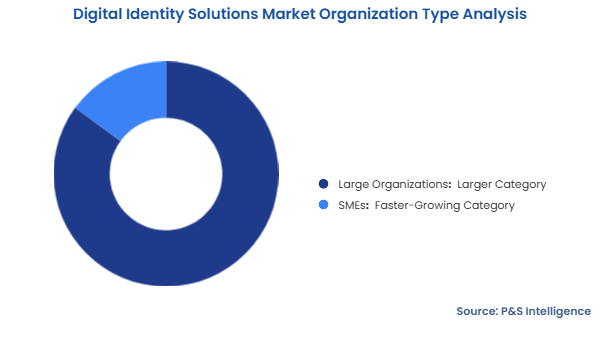
Large organizations accounted for 85% of the market revenue in 2024, leveraging substantial resources to implement enterprise-wide digital identity solutions. These organizations face complex identity management challenges with thousands of employees, multiple access points, and diverse regulatory requirements. Large enterprises typically deploy comprehensive identity and access management platforms that integrate with existing security infrastructure while providing centralized control over identity policies and procedures.
Small and medium enterprises (SMEs) represent the faster-growing category, through 2032. Cloud-based identity solutions have democratized access to enterprise-grade security capabilities, enabling SMEs to implement sophisticated identity management without significant capital investment. The increasing frequency of cyber-attacks targeting SMEs, combined with growing regulatory requirements, compels these organizations to prioritize identity security despite resource constraints.
These organization types are covered:
Large Organizations (Larger Category)
SMEs (Faster-Growing Category)
Vertical Analysis
The BFSI sector dominated the market in 2024, contributing 35% of the total revenue, due to stringent regulatory requirements and high-value transaction security needs. Financial institutions handle sensitive financial data and must comply with comprehensive KYC and AML regulations while preventing fraud and money laundering. The sector's early adoption of digital identity solutions reflects its critical need for robust authentication in online banking, mobile payments, and digital lending services.
The healthcare vertical is experiencing the fastest growth, during 2025–2032. Healthcare organizations face unique identity management challenges, balancing patient data privacy with accessibility requirements for medical professionals. The digitization of health records and expansion of telemedicine services necessitate secure identity verification systems that comply with HIPAA and other healthcare-specific regulations. The rising healthcare data breach costs, averaging USD 9.77 million in 2024, underscore the critical importance of robust identity management in this sector.
These verticals are covered:
BFSI (Largest Category)
Retail and eCommerce
Government and Defense
Healthcare (Fastest-Growing Category)
IT and ITeS
Telecommunications
Energy and Utilities
Drive strategic growth with comprehensive market analysis
Digital Identity Solutions Market Geographical Analysis
North America Digital Identity Solutions Market Size
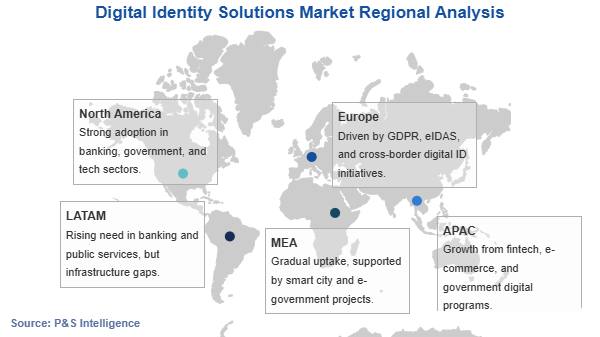
North America held the largest regional market share in 2024, of 40%, and it is expected to maintain its lead position throughout the forecast period. The region's dominance is attributed to advanced technological infrastructure, stringent regulatory frameworks, including CCPA and sector-specific requirements; and high cybersecurity awareness among organizations. The presence of major technology vendors and solution providers creates a robust ecosystem for digital identity innovation and deployment.
U.S. Digital Identity Solutions Market Size
The U.S. represents the core of North American market activity, with organizations investing heavily in identity verification to combat rising cyber threats. The rising cases of identity thefts drive both consumer and enterprise demand for enhanced identity protection. The widespread adoption of cloud computing and digital services across industries creates substantial opportunities for digital identity solution providers. Government initiatives supporting digital transformation and cybersecurity enhancement further accelerate market growth in the region.
Asia-Pacific Digital Identity Solutions Market Growth
Asia-Pacific is projected to register the highest CAGR, of approx. 20.0%, during 2025–2032, driven by rapid digital transformation, expanding internet penetration, and growing e-commerce adoption. The region's large population and increasing smartphone usage create massive demand for digital identity verification across financial services, government services, and online platforms. Singapore and India are implementing national digital identity frameworks that set precedents for identity management standards across the region.
China Digital Identity Solutions Market Outlook
China leads the regional market in terms of absolute market size, leveraging its vast digital economy and widespread adoption of mobile payment platforms. The country's emphasis on technological innovation and digital infrastructure development creates favorable conditions for digital identity solution deployment. India's digital identity initiatives, including Aadhaar, demonstrate the transformative potential of comprehensive identity systems in enabling financial inclusion and service delivery. The implementation of data protection regulations across Asian countries, inspired by GDPR, is compelling organizations to enhance their identity management capabilities.
Japan Digital Identity Solutions Market Outlook
Japan represents a significant opportunity within Asia-Pacific, with its advanced technological infrastructure and emphasis on security driving steady market growth. The country's preparation for increased digitalization, combined with an aging population requiring accessible yet secure digital services, creates unique demand patterns for identity solutions. Japanese organizations prioritize privacy-preserving technologies and are early adopters of advanced biometric systems. Government initiatives promoting society 5.0 and digital transformation across industries further support market expansion. The hosting of international events and Japan's position as a technology leader in Asia make it an attractive market for global digital identity solution providers seeking regional expansion.
The regions and countries analyzed in this report are:
North America (Largest Regional Market)
U.S. (Larger Country Market)
Canada (Faster-Growing Country Market)
Europe
Germany (Largest Country Market)
U.K. (Fastest-Growing Country Market)
France
Italy
Spain
Rest of Europe
Asia-Pacific (Fastest-Growing Regional Market)
Japan (Fastest-Growing Country Market)
China (Largest Country Market)
India
South Korea
Australia
Rest of APAC
Latin America
Brazil (Largest Country Market)
Mexico (Fastest-Growing Country Market)
Rest of LATAM
Middle East and Africa
Saudi Arabia (Largest Country Market)
South Africa
U.A.E. (Fastest-Growing Country Market)
Rest of MEA
Digital Identity Solutions Market Share
The digital identity solutions market demonstrates a moderately consolidated structure, with several global leaders holding significant positions due to their technological expertise, regulatory compliance capabilities, and well-established customer trust. While precise market share figures for the top players are not consistently disclosed, companies such as Thales, NEC Corporation, and IDEMIA are widely recognized as key players driving market growth. Their leadership is supported by continuous investment in research and development, with a focus on emerging technologies, including artificial intelligence, blockchain, and advanced biometrics. These firms offer end-to-end digital identity solutions that are scalable, secure, and compatible with existing enterprise infrastructure, which enhances their appeal across various industries.
Key Digital Identity Solutions Providing Companies:
ImageWare Systems Inc.
ForgeRock Inc.
Daon Inc.
Tessi S.A.
Jumio Corporation
iProov Limited
Samsung SDS Co., Ltd.
Thales Group
Vintegris S.L.U.
Refinitiv Limited and Refinitiv US LLC
NEC Corporation
Okta, Inc.
Digital Identity Solutions Market News
In June 2024, Thales SA launched Passwordless 360°, a comprehensive passwordless authentication platform aimed at enterprise-scale deployment. However, this offering does not specifically reference AI-powered fraud detection or target financial institutions for onboarding purposes.
In September 2024, NEC Corporation unveiled its multimodal biometric authentication system combining facial, iris, and voice recognition technologies, achieving industry-leading accuracy rates for high-security government applications.
In March 2024, Microsoft Corporation introduced the Face Check feature in its Entra Verified ID platform, leveraging Azure AI's facial recognition technology to authenticate users' real-time selfies against official identification documents.
Want a report tailored exactly to your business need?
Leading companies across industries trust us to deliver data-driven insights and innovative solutions for their most critical decisions. From data-driven strategies to actionable insights, we empower the decision-makers who shape industries and define the future. From Fortune 500 companies to innovative startups, we are proud to partner with organisations that drive progress in their industries.
Client Testimonials
Working with P&S Intelligence and their team was an absolute pleasure – their awareness of timelines and commitment to value greatly contributed to our project's success. Eagerly anticipating future collaborations.
McKinsey & Company
India
Unmatched Standards
Our insights into the minutest levels of the markets, including the latest trends and competitive landscape, give you all the answers you need to take your business to new heights
Complete Data Security
We take a cautious approach to protecting your personal and confidential information. Trust is the strongest bond that connects us and our clients, and trust we build by complying with all international and domestic data protection and privacy laws