Dental Bone Graft Substitute Market Size & Share Analysis - Trends, Drivers, Competitive Landscape, and Forecasts (2026 - 2032)
This Report Provides In-Depth Analysis of the Dental Bone Graft Substitute Market Report Prepared by P&S Intelligence, Segmented by Product Type (Xenograft, Alloplast, Allograft, Demineralized Bone Matrix, Cell-based Bone Grafts, Growth Factor-based Bone Grafts, Composite Bone Grafts), Form (Granules, Injectable, Putty, Paste, Gel, Blocks), End User (Dental Clinics, Hospitals, Ambulatory Surgical Centers, Academic & Research Institutes), and Geographical Outlook for the Period of 2021 to 2032
Explore the market potential with our data-driven report
Dental Bone Graft Substitute Market Future Outlook
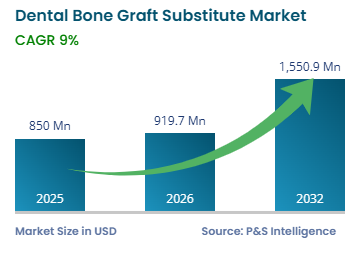
The dental bone graft substitute market size was USD 850.0 million for 2025, and it will grow by 9.0% during 2026-2032, to reach USD 1,550.9 million by 2032.
The market is expanding due to the increasing shift toward advanced dental treatments that restore both function and aesthetics over the long term. Patients are moving away from temporary solutions such as dentures and bridges and are opting for implant-based procedures that require strong and stable bone support. This transition is closely linked to the rising prevalence of tooth loss, periodontal disease, and jawbone deterioration, particularly among ageing populations and individuals with changing dietary and lifestyle habits.
These conditions often lead to insufficient bone volume, making bone grafting a necessary step before implant placement. At the same time, improvements in dental awareness and cosmetic expectations are encouraging patients to choose procedures that deliver durable and natural-looking outcomes. Additionally, the continuous development of synthetic and bioactive graft materials is improving treatment reliability by enhancing healing, compatibility, and clinical success rates. Dental clinics are also expanding their procedural capabilities, supported by better equipment and specialised training.
According to the World Health Organization Regional Office for Africa, citing the World Health Organization Tracking Progress on the Implementation of the Global Oral Health Action Plan 2023–2030: Baseline Report, the combined global prevalence of the main oral diseases and conditions over the life course was 47% at the 2024 baseline. This substantial disease burden continues to increase the number of patients requiring procedures that restore lost bone before dental implant placement. Furthermore, the growing volume of implant-based rehabilitation and regenerative dental treatments is strengthening the need for reliable bone graft substitutes that support bone regeneration, improve implant stability, and enhance long-term clinical outcomes across modern dental practice.
Key Market Insights
Xenograft is the largest product type, holding a market share of 30%, due to widespread use in implant procedures requiring stable bone support.
Alloplast is the fastest-growing product type, registering a CAGR of approximately 9.7%, driven by rising preference for synthetic grafts with consistent quality and availability.
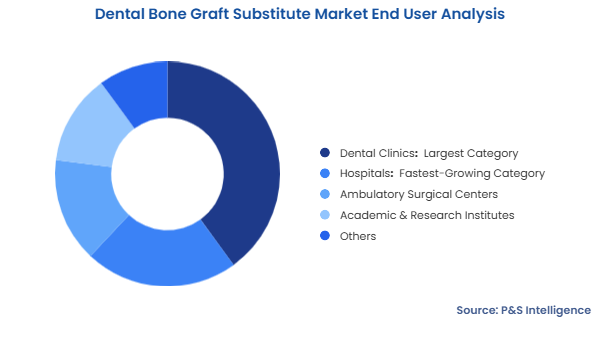
Dental clinics are the largest end user, holding a market share of 40%, due to the high volume of implants and routine bone regeneration procedures performed.
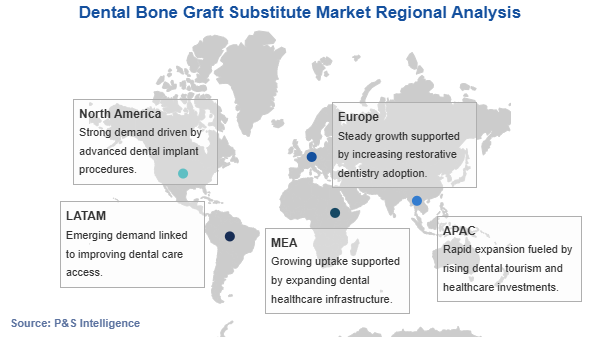
North America is the largest region, holding a market share of 40%, due to established dental infrastructure and early adoption of implant-based treatments.
Asia-Pacific is the fastest-growing region, registering a CAGR of approximately 9.9%, driven by expanding dental care access and increasing adoption of restorative procedures.
Dental Bone Graft Substitute Market Dynamics
Rise of Bioactive and Synthetic Materials Is a Major Trend
The market is shifting toward advanced synthetic and bioactive dental bone graft substitutes that actively support bone regeneration rather than simply filling defects. Manufacturers are developing materials that promote osteoconduction, improve biological integration, and accelerate healing after implant-related procedures. Additionally, clinicians increasingly prefer ready-to-use putty, paste, and gel formulations because they simplify handling, reduce preparation time, and improve placement accuracy during ridge augmentation and guided bone regeneration.
This shift is supported by expanding scientific and clinical research on regenerative dental materials. According to SAGE Journals, a bibliometric analysis identified 52 published articles on bioactive glass in dentistry in 2024, reflecting growing global research on bioactive materials for tissue regeneration. Furthermore, according to the Journal of Dentistry, a 2025 systematic review evaluated 7 clinical studies, including 6 randomized controlled trials and 1 cohort study, examining platelet-rich fibrin in alveolar ridge reconstruction and guided bone regeneration. These research advances are encouraging broader adoption of biologically active graft substitutes that improve healing predictability, graft stability, and implant site development.
Growing Demand for Dental Implants and Bone Reconstruction Drives Market
The market is driven by rising dental implant adoption, as implant success depends on adequate jawbone volume and stable osseointegration. Tooth loss, severe periodontal disease, and long-term oral infection can reduce alveolar bone height and width, making grafting an important step before implant placement. Dentists are therefore using bone graft substitutes more often in ridge augmentation, socket preservation, and guided bone regeneration procedures.
According to the World Health Organization, oral diseases are estimated to affect nearly 3.7 billion people globally, while severe periodontal diseases are estimated to affect more than 1 billion cases worldwide. WHO also states that severe periodontal disease can cause supporting bone to pull away from teeth, making them loose or leading to tooth loss. This creates steady clinical demand for graft materials that rebuild implant sites, improve primary stability, and support long-term restorative outcomes.
High Treatment Cost and Limited Insurance Coverage Restrain Market Growth
The market faces a major restraint due to the high cost of dental procedures involving bone graft substitutes. These treatments require specialized surgical expertise, advanced biomaterials, diagnostic imaging, and multiple clinical visits, increasing the overall financial burden on patients. Limited reimbursement further reduces access, particularly in developing economies where advanced restorative procedures are often paid for out of pocket. According to the World Health Organization Regional Office for Africa, citing the World Health Organization Tracking Progress on the Implementation of the Global Oral Health Action Plan 2023–2030: Baseline Report, only 23% of the global population was entitled to essential oral health care services under nationally defined health service packages at the 2024 baseline. This limited financial protection reduces access to bone grafting procedures and moderates the adoption of advanced graft substitute materials across routine dental practice.
Expansion of Dental Care Access in Emerging Regions Creates Opportunity
The market presents strong growth opportunities through expanding access to dental care across developing regions, where advanced implant and bone regeneration procedures remain underpenetrated. Governments and healthcare providers are strengthening dental infrastructure, increasing the number of clinics capable of performing specialized restorative treatments. According to the World Health Organization Regional Office for Africa, citing the World Health Organization Tracking Progress on the Implementation of the Global Oral Health Action Plan 2023–2030: Baseline Report, the global baseline for population entitlement to essential oral health care services through nationally defined health service packages was 23%. This substantial gap in service coverage creates opportunities to expand implant care, improve access to bone graft substitutes, strengthen distribution networks, and increase adoption of advanced regenerative dental procedures.
Dental Bone Graft Substitute Market SegmentationAnalysis
Product Type Analysis
Xenograft is the largest category, holding a market share of 30%, because it is widely used in implant dentistry for ridge augmentation, sinus lift, and socket preservation procedures. Dentists prefer xenografts due to their osteoconductive properties, slow resorption rate, and ability to maintain graft volume during bone regeneration. According to the National Center for Biotechnology Information, a 2025 systematic review of 12 clinical studies reported that bovine xenografts represented 58.1% of the graft materials evaluated, compared with 41.9% allografts. This widespread clinical use supports continued demand for xenograft materials across routine implant and regenerative dental procedures.
Alloplast is the fastest-growing category, registering a CAGR of approximately 9.7%, because dentists are moving toward synthetic graft materials that are safer, consistent, and easier to source. These products do not depend on human or animal donors, which helps reduce ethical concerns and supply issues. They are also made with controlled material properties, so clinics can choose them for predictable handling and healing support. Rising interest in bioactive ceramics and synthetic bone substitutes is pushing this category forward.
The product types analysed in this report are:
Xenograft (Largest Category)
Alloplast (Fastest-Growing Category)
Allograft
Demineralized Bone Matrix
Cell-based Bone Grafts
Growth Factor-based Bone Grafts
Composite Bone Grafts
Others
Form Analysis
Granules are the largest category, holding a market share of 35%, because it is easy to place into irregular bone defects during dental procedures. Dentists commonly use granules in socket preservation, ridge filling, and implant preparation because the small particles can adapt well to the treatment area. They also offer a larger contact surface for bone-forming cells, which supports healing. Simple storage, flexible use, and strong acceptance in routine grafting procedures make granules the leading form.
Injectable is the fastest-growing category, because dental clinics are adopting graft formats that simplify procedures and improve handling in minimally invasive treatments. Injectable materials allow precise placement in irregular or narrow defects, reducing manual intervention and improving procedural control during implant preparation and bone regeneration. According to The Open Dentistry Journal, a 2025 randomised controlled clinical trial involving 30 patients showed that injectable platelet-rich fibrin combined with graft materials resulted in statistically significant improvement in intrabony defect treatment outcomes, supporting the clinical effectiveness of injectable formats. This growing clinical preference for ease of use and improved healing outcomes is strengthening adoption across modern dental practices.
The forms analysed in this report are:
Granules (Largest Category)
Injectable (Fastest-Growing Category)
Putty
Paste
Gel
Blocks
Others
End User Analysis
Dental Clinics is the largest category, holding a market share of 40%, because most bone graft and implant-related procedures are performed in specialised outpatient dental settings. Patients prefer clinics for direct access to dentists, shorter waiting times, and procedure-specific expertise in implant placement, periodontal repair, and bone regeneration. In 2024, 80.9% of countries had oral health care services generally available in primary health care facilities, according to the World Health Organisation and cited by the FDI World Dental Federation, indicating that dental treatment delivery is largely clinic-based. This widespread availability of clinic-level services supports high procedural volumes and maintains clinics as the primary setting for bone graft procedures.
Hospitals are the fastest-growing category, because complex dental and maxillofacial cases are increasingly being handled in hospital settings. Patients with severe bone loss, trauma, systemic health issues, or multiple surgical needs often require stronger clinical support than a regular clinic can provide. Hospitals also have advanced imaging, anaesthesia support, and multidisciplinary teams, which make them suitable for high-risk procedures. As advanced oral surgery expands, hospitals are seeing faster adoption of graft substitutes.
The end users analysed in this report are:
Dental Clinics (Largest Category)
Hospitals (Fastest-Growing Category)
Ambulatory Surgical Centers
Academic & Research Institutes
Others
Drive strategic growth with comprehensive market analysis
Dental Bone Graft Substitute Market Geographical Analysis
North America Dental Bone Graft Substitute Market Analysis
North America holds the largest share, of 40%, because of its advanced dental care infrastructure and widespread adoption of implant-based restorative procedures. The region has a high concentration of implant specialists, periodontists, and oral surgeons who routinely perform ridge augmentation, socket preservation, and sinus lift procedures requiring bone graft substitutes. Additionally, strong reimbursement support, higher healthcare spending, and broad availability of premium biomaterials encourage greater use of regenerative products. Furthermore, leading manufacturers maintain extensive distribution networks and continuously introduce new graft materials and membrane technologies. Growing patient preference for durable tooth replacement solutions, combined with consistent clinical adoption of guided bone regeneration techniques, supports sustained demand for dental bone graft substitutes across hospitals, specialty dental centers, and private implant clinics.
U.S. Dental Bone Graft Substitute Market Analysis
The U.S. market shows strong demand due to high acceptance of cosmetic and implant-based dental treatments. Patients prefer long-term restorative procedures, which increases the need for bone graft substitutes before implant placement. The country also has a specialised dental workforce supporting surgical and prosthetic care. In 2024, the U.S. dental workforce included 149,300 dentist jobs, 6,100 oral and maxillofacial surgeons, and 900 prosthodontists, according to the U.S. Bureau of Labour Statistics. This strong professional base supports high procedure capacity for implant-led and surgical restorative dental care.
Canada Dental Bone Graft Substitute Market Analysis
Canada is witnessing steady growth due to improving access to oral health care and rising awareness of advanced restorative treatments. Patients are gradually shifting toward implant-based solutions, while public funding and private clinic expansion are improving treatment availability. According to the Government of Canada, 2,074,054 approved applicants received dental care under the Canadian Dental Care Plan during benefit year 2024–2025. This broader access to professional dental services is increasing the number of patients receiving diagnosis and treatment for tooth loss and periodontal conditions, creating greater demand for bone graft substitutes used in implant placement, ridge augmentation, and other regenerative dental procedures.
Asia-Pacific Dental Bone Graft Substitute Market Analysis
Asia-Pacific has the highest CAGR, of approximately 9.9%, as access to advanced dental care continues to expand across both metropolitan and developing regions. Private dental chains and specialty implant centers are increasing the availability of implant-supported restorative procedures, creating greater demand for bone graft substitutes. Additionally, rising oral health awareness, improving disposable incomes, and growing acceptance of dental implants are encouraging more patients to choose regenerative treatments. Furthermore, several countries have become established destinations for dental tourism because of high-quality treatment at competitive costs, supporting procedure volumes. Government investment in healthcare infrastructure, expanding dental education, and wider availability of advanced biomaterials are strengthening the adoption of bone regeneration products across both public and private dental practices.
China Dental Bone Graft Substitute Market Analysis
China is expanding quickly as dental services become more organised and implant procedures become more affordable. Urban patients are increasingly choosing advanced restorative treatments, while public pricing measures are improving access to implant-led care. In 2024, routine single-tooth dental implant medical service fees at Grade-III public hospitals were generally capped at RMB 4,500, excluding bone graft and soft-tissue transplant procedures, according to the National Healthcare Security Administration of China. This improves implant affordability while keeping bone grafting as a separate clinical requirement, supporting demand for graft substitutes.
India Dental Bone Graft Substitute Market Analysis
India is growing at a fast pace due to rising awareness, affordable dental treatment options, and expanding clinical capacity. A large untreated population is gaining access to organised dental care through wider clinic networks and trained professionals. India also benefits from cost advantages in dental procedures, supporting demand from domestic patients and dental tourists. For the academic year 2025–2026, India’s National Dental Commission listed 330 dental colleges with permitted BDS seats, according to the National Dental Commission of India. This expanding training base supports long-term dental-care capacity and wider adoption of implant-support procedures.
Europe Dental Bone Graft Substitute Market Analysis
Europe shows stable growth due to its mature dental healthcare systems and strong clinical adoption of regenerative dentistry. Implant-supported restorations, periodontal reconstruction, and bone augmentation procedures are widely performed using standardized treatment protocols that support consistent demand for bone graft substitutes. Additionally, well-defined regulatory frameworks encourage the use of high-quality biomaterials across dental practices and specialty clinics. Furthermore, collaboration between research institutions, universities, and dental biomaterial manufacturers supports continuous product development and clinical advancement. Aging populations, increasing demand for implant rehabilitation, and broad availability of skilled dental professionals continue to strengthen the use of bone graft substitutes in routine restorative and periodontal procedures across the region.
The regions and countries analysed in this report are:
North America (Largest Regional Market)
U.S. (Larger Country)
Canada (Faster-Growing Country)
Europe
Germany (Largest Country)
U.K. (Fastest-Growing Country)
France
Italy
Spain
Rest of Europe
Asia-Pacific (Fastest-Growing Regional Market)
China (Largest Country)
India (Fastest-Growing Country)
Japan
South Korea
Australia
Rest of APAC
Latin America
Brazil (Largest Country)
Mexico (Fastest-Growing Country)
Rest of LATAM
Middle East and Africa
Saudi Arabia (Largest Country)
U.A.E. (Fastest-Growing Country)
South Africa
Rest of MEA
Dental Bone Graft Substitute Market Share Analysis
The market shows a fragmented structure, with global, regional, and specialized manufacturers offering xenografts, allografts, alloplasts, and bioactive bone graft substitutes for implant dentistry and periodontal regeneration. Large medical device companies operate alongside focused dental biomaterial firms, shaping a competitive environment supported by varied product portfolios, clinical expertise, and established distribution networks. Additionally, companies pursue growth through product introductions, strategic collaborations, regulatory clearances, and geographic expansion across developed and emerging regions. Furthermore, manufacturers emphasize bioactive compositions, improved handling characteristics, and regenerative technologies that support clinical workflows. Similarly, ongoing portfolio refinement and clinician-focused solutions contribute to broader procedural adoption. Moreover, this environment supports continuous product development, expands treatment approaches for dental professionals, and encourages steady progress in implant and regenerative dental applications.
Leading Companies in the Dental Bone Graft Substitute Market:
Dentsply Sirona Inc.
Envista Holdings Corporation
Geistlich Pharma AG
Straumann Holding AG
Purgo Biologics Inc.
ZimVie Inc.
Henry Schein, Inc.
RTI Surgical, Inc.
LifeNet Health
Regenity Biosciences LLC
Dentium Co., Ltd.
BioHorizons Camlog Group
Orthocell Limited
botiss biomaterials GmbH
Osteogenics Biomedical, Inc.
Dental Bone Graft Substitute Market News
In April 2026, Geistlich Pharma AG launched Bio-Gide Forte for the European market at the International Osteology Symposium in Vienna. The product is an advanced collagen membrane used in oral tissue regeneration. The launch followed its earlier North American availability and added a Europe-focused rollout for the company’s regenerative dentistry portfolio.
In April 2025, BioHorizons Camlog Group presented the newly launched CeraOss HYA bone substitute at EuroPerio. The product combines bovine bone material with hyaluronic acid and sits within the company’s biomaterials range for guided bone regeneration procedures. The update was tied to the company’s dental biomaterials portfolio, not a service or investment item.
In April 2025, Orthocell Limited received Brazilian approval for Striate+, allowing the company to begin sales of its dental membrane in Brazil. Striate+ is a resorbable collagen membrane used in guided bone and tissue regeneration. The event marked a new market entry for the product through its distribution pathway.
Frequently Asked Questions About This Report
What are dental bone graft substitutes used for in dentistry?+
They replace missing jawbone and help rebuild bone volume before implants or other oral procedures, supporting healing and long-term implant stability.
Which materials are commonly used in dental bone graft substitutes?+
Common options include processed human donor bone, animal-derived grafts, and synthetic materials such as ceramics, hydroxyapatite, bioactive glass, or calcium-phosphate products.
Why do dental implants often require bone graft substitute materials?+
Implants need adequate healthy jawbone for support, and graft substitutes help restore lost ridge volume when bone has reduced after tooth loss.
How are dental bone graft substitutes selected for each patient?+
Selection depends on defect size, implant plan, healing needs, material source, biological performance, and the dentist
What applications create demand for dental bone graft substitutes?+
Demand mainly comes from implant bone regeneration, socket preservation, ridge augmentation, sinus lift procedures, and periodontal defect regeneration in restorative dentistry.
Want a report tailored exactly to your business need?
Leading companies across industries trust us to deliver data-driven insights and innovative solutions for their most critical decisions. From data-driven strategies to actionable insights, we empower the decision-makers who shape industries and define the future. From Fortune 500 companies to innovative startups, we are proud to partner with organisations that drive progress in their industries.
Client Testimonials
Working with P&S Intelligence and their team was an absolute pleasure – their awareness of timelines and commitment to value greatly contributed to our project's success. Eagerly anticipating future collaborations.
McKinsey & Company
India
Unmatched Standards
Our insights into the minutest levels of the markets, including the latest trends and competitive landscape, give you all the answers you need to take your business to new heights
Complete Data Security
We take a cautious approach to protecting your personal and confidential information. Trust is the strongest bond that connects us and our clients, and trust we build by complying with all international and domestic data protection and privacy laws