Data Center Physical Security Market Size & Share Analysis - Emerging Trends, Growth Opportunities, Competitive Landscape, and Forecasts (2026 - 2032)
This Report Provides In-Depth Analysis of the Data Center Physical Security Market Report Prepared by P&S Intelligence, Segmented by Component (Solutions, Services), Data Center Size (Large Data Centers, Medium Data Centers, Small Data Centers), Data Center Type (Colocation Data Centers, Hyperscale Data Centers, Enterprise Data Centers, Edge Data Centers), End User (IT and Telecommunications, Healthcare, BFSI, Government and Defense, Retail and E-commerce, Media and Entertainment, Manufacturing), Deployment Type (On-Premises, Cloud-Based), Data Center Tier (Tier III, Tier IV, Tier I, Tier II), and Geographical Outlook for the Period of 2021 to 2032
Data Center Physical Security Market Size Forecast
Key Highlights
Study Period
2021 - 2032
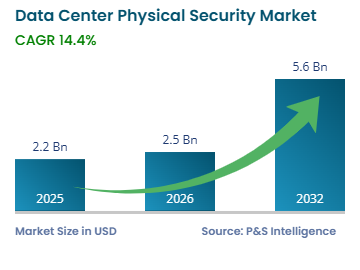
Market Size in 2025
USD 2.2 Billion
Market Size in 2026
USD 2.5 Billion
Market Size by 2032
USD 5.6 Billion
Projected CAGR
14.4%
Largest Region
North America
Fastest-Growing Region
Asia-Pacific
Market Structure
Fragmented
Market Size
Explore the market potential with our data-driven report
Data Center Physical Security Market Future Outlook
The data center physical security market size was USD 2.2 billion in 2025, and it will grow by 14.4% during 2026-2032 to reach USD 5.6 billion by 2032.
The data centre physical security market is expanding as digital infrastructure becomes increasingly critical for cloud computing, enterprise applications, financial transactions, artificial intelligence workloads, and connected services. Organisations are storing and processing larger volumes of sensitive information, making protection against unauthorised access, physical intrusion, vandalism, and operational disruption a key priority. Demand is rising across hyperscale, colocation, and edge data centres, where operators require advanced surveillance, access control, perimeter protection, and intrusion detection systems to secure high-value infrastructure. According to the International Telecommunication Union (ITU), approximately 5.5 billion people, representing 68% of the global population, used the internet in 2024. The continued growth in internet connectivity is accelerating demand for cloud-based services and data-centre infrastructure, thereby increasing the need for robust physical security solutions to protect critical facilities and digital assets.
Moreover, the market is benefiting from continued expansion in data-centre capacity and increasing dependence on digital services across industries. According to the International Energy Agency, global data centres consumed approximately 415 TWh of electricity in 2024, representing around 1.5% of total global electricity consumption. Operators are therefore placing greater emphasis on security frameworks that protect facilities from disruptions capable of affecting service availability, customer operations, and business continuity. To address these requirements, integrated security environments that combine access management, surveillance, threat detection, and real-time monitoring are becoming more common across both existing and newly developed facilities. Investment in these technologies is helping operators strengthen operational reliability, improve infrastructure protection, support compliance requirements, and maintain secure environments for increasingly complex digital workloads.
Key Market Insights
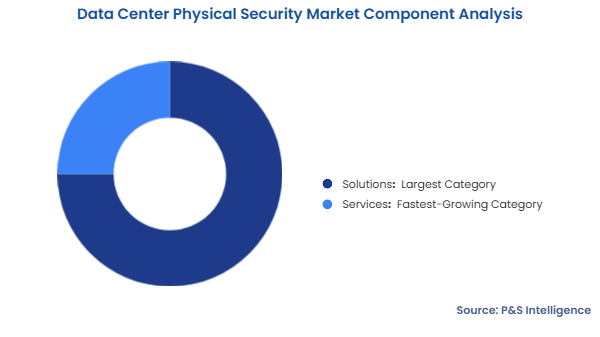
Solutions is the largest component, holding a market share of 75%, due to growing adoption of AI-powered surveillance and integrated physical security technologies.
Colocation Data Centers are the largest data-centre type, holding a market share of 40%, due to multi-tenant security requirements and increasing hyperscale customer deployments.
Healthcare is the fastest-growing end-user category, registering a CAGR of approximately 15.0%, driven by expanding digital health systems and rising protection requirements for sensitive healthcare data.
The U.S. holds the largest share, due to its large concentration of hyperscale, colocation, and enterprise data-centre facilities.
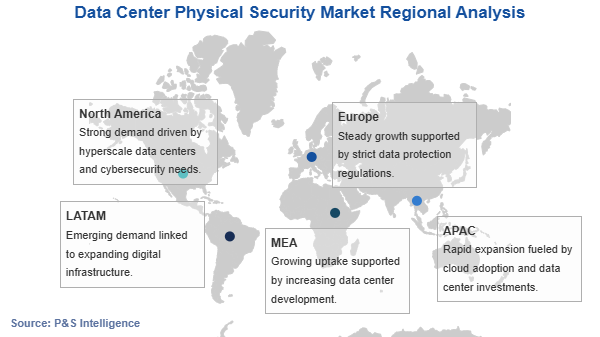
Asia-Pacific is the fastest-growing region, registering a CAGR of approximately 15.3%, driven by expanding cloud infrastructure and increasing high-capacity data-centre development.
Data Center Physical Security Market Trends and Drivers
AI-Enabled Integrated Security Platforms Are a Major Trend
The market is shifting towards unified physical security platforms that integrate video surveillance, biometric authentication, access control, intrusion detection, and environmental monitoring within a single management environment. Data-centre operators are replacing isolated security tools with connected platforms that provide centralised visibility across facilities and improve incident response capabilities. The growing use of artificial intelligence within security operations is also encouraging adoption of automated threat detection and real-time monitoring technologies. According to HID Global, 73% of security leaders prioritised software-driven unified security solutions in 2025, reflecting the growing adoption of integrated physical security platforms.
The shift towards integrated security management is also accelerating the adoption of hybrid deployment models. According to Genetec, 43% of end users identified hybrid deployments, combining on-premises and cloud-based physical security systems, as their preferred approach within the next five years. These developments are increasing demand for intelligent monitoring platforms that improve situational awareness, strengthen access management, support remote administration, and provide continuous protection across increasingly distributed data-centre environments.
Expansion of Hyperscale and Colocation Data Centre Infrastructure Drives Market
The market is growing as organisations become increasingly dependent on data-centre infrastructure to support cloud services, enterprise applications, artificial intelligence workloads, and digital communications. Expansion of hyperscale, colocation, and edge facilities is increasing the need for physical security systems capable of protecting high-value equipment, sensitive information, and critical operations. According to Synergy Research Group, the number of large hyperscale data centres worldwide reached 1,136 at the end of 2024, having doubled over the previous five years.
This rapid expansion is also reflected in increasing infrastructure utilisation. According to the International Energy Agency (IEA), global data-centre electricity demand increased by approximately 17% in 2025, highlighting the growing scale and operational intensity of data-centre facilities. The expansion of high-capacity data-centre operations is driving investment in surveillance, access control, perimeter protection, and integrated monitoring systems to safeguard critical infrastructure, ensure operational continuity, and support expanding digital service requirements across multiple locations.
High Capital Investment and Complex System Integration Limit Market Expansion
The adoption of advanced physical security solutions remains constrained by the significant investment required for deployment, integration, maintenance, and long-term management. Modern data centres often rely on multiple security layers, including surveillance systems, biometric authentication, monitoring platforms, and perimeter protection technologies that must operate within a unified environment. Integrating these systems can be technically complex, particularly in older facilities with legacy infrastructure, where compatibility issues, interoperability challenges, and system downtime during upgrades can increase implementation risks and project timelines. In addition, large-scale data centres require extensive hardware, software, networking infrastructure, and skilled personnel to deploy and manage integrated physical security platforms, significantly increasing total ownership costs.
Increasing implementation and ownership costs can delay modernisation projects, restrict security upgrades, and create challenges for operators managing multiple facilities. Budget constraints are particularly challenging for small and medium-sized colocation providers and operators upgrading legacy facilities, limiting the pace of physical security investments despite increasing security risks. These financial pressures are encouraging organisations to balance security requirements with budget constraints, often delaying upgrades to advanced physical security systems and phased infrastructure modernisation.
Growth of Edge Data Centres and Emerging Digital Infrastructure Creates Market Opportunities
The expansion of edge computing facilities is creating significant opportunities for physical security providers. Unlike centralised campuses, edge data centres operate across numerous distributed locations and require security solutions that support remote monitoring, centralised management, and consistent protection standards. Demand is increasing for intelligent surveillance systems, scalable access controls, and automated monitoring technologies capable of securing geographically dispersed assets. According to the International Telecommunication Union, global 5G coverage reached 51% of the world's population in 2024.
The continued expansion of 5G networks is accelerating the deployment of edge computing infrastructure, where geographically dispersed and often unmanned facilities require advanced physical security solutions to enable remote monitoring, rapid threat detection, and centralised security management. Security providers that offer integrated platforms capable of managing multiple facilities, supporting remote operations, and simplifying oversight across distributed locations are benefiting from growing investment in next-generation digital infrastructure.
Data Center Physical Security Market Segmentation Analysis
Component Analysis
Solutions is the largest category, holding a market share of 75%, driven by the widespread deployment of access control, surveillance, intrusion detection, and perimeter protection systems that form the foundation of physical security across modern data-centre facilities. Operators prioritise these systems to maintain operational continuity, protect critical assets, and support compliance requirements across increasingly complex facilities. According to Genetec, 37% of end users planned to implement AI-powered physical security features in 2025, reflecting the increasing adoption of intelligent and integrated physical security technologies. Growing adoption of intelligent security technologies is increasing demand for integrated solutions that provide real-time visibility, centralised management, automated threat detection, and stronger protection across colocation, on-premises, and high-availability data-centre environments.
Services are the fastest-growing category, registering a CAGR of approximately 14.7%, due to the increasing complexity of modern physical security environments and the growing need for specialised expertise. Data centre operators are seeking consulting, integration, deployment, and managed services to ensure effective implementation and ongoing optimisation of security systems. The growing deployment of AI-enabled surveillance, integrated security platforms, and multi-site data-centre operations is increasing demand for system integration, continuous monitoring, maintenance, and lifecycle management services. The expansion of multi-site operations and advanced security technologies is creating greater demand for professional support. Organisations increasingly rely on external specialists to improve system performance, maintain security standards, and manage evolving operational requirements efficiently.
Large Data Centers are the largest category, holding a market share of 60%, because these facilities house extensive computing infrastructure, high-value equipment, and substantial volumes of critical data that require comprehensive physical protection. Operators typically deploy multiple layers of security, including advanced surveillance, access control, and monitoring systems, to minimise operational risks. Large facilities also accommodate hyperscale cloud workloads, enterprise applications, and colocation services, resulting in greater security spending and wider adoption of sophisticated physical security technologies than in smaller data centre environments.
Medium Data Centers are the fastest-growing category, as organisations increasingly expand regional digital infrastructure to support cloud services, enterprise workloads, and distributed computing requirements. These facilities increasingly require scalable, cost-effective physical security solutions that can be deployed without the high capital investment associated with hyperscale facilities. Growth is further supported by rising demand for scalable security solutions that can adapt to changing business needs without the complexity associated with very large facilities. This trend is accelerating the adoption of integrated monitoring and access management technologies.
The data center sizes analysed in this report are:
Large Data Centers (Largest Category)
Medium Data Centers (Fastest-Growing Category)
Small Data Centers
Data Center Type Analysis
Colocation Data Centers are the largest category, holding a market share of 40%, because these facilities accommodate multiple customers and support diverse workloads within shared infrastructure environments. Operators must maintain strict access controls, continuous monitoring, and comprehensive perimeter protection to safeguard tenant assets and maintain service reliability. The presence of multiple tenants with varying security and compliance requirements increases demand for layered physical security systems capable of preventing unauthorised access while ensuring operational continuity. This growing concentration of high-value infrastructure is driving investment in advanced surveillance, access management, and facility protection technologies across colocation facilities.
Hyperscale Data Centers are the fastest-growing category, due to rapid expansion by cloud service providers, artificial intelligence infrastructure developers, and digital platform operators. These facilities require highly sophisticated security frameworks capable of protecting large campuses and supporting continuous operations. Their increasing scale, higher equipment density, and round-the-clock operations are driving demand for intelligent surveillance, biometric authentication, perimeter intrusion detection, and centralised security management systems. As hyperscale deployments expand into new regions, physical security requirements continue to grow alongside facility scale and operational complexity.
The data center types analysed in this report are:
Colocation Data Centers (Largest Category)
Hyperscale Data Centers (Fastest-Growing Category)
Enterprise Data Centers
Edge Data Centers
Others
End User Analysis
IT and Telecommunications is the largest category, holding a market share of 30%, because the sector operates a substantial share of global data centre infrastructure and relies heavily on uninterrupted digital services. Network operators, cloud providers, and technology companies require robust physical security measures to protect critical assets and maintain service continuity. The sector's ongoing investment in digital infrastructure, connectivity platforms, and large-scale computing facilities continues to drive demand for advanced access control, monitoring, and surveillance solutions designed for high-security operating environments.
Healthcare is the fastest-growing category, registering a CAGR of approximately 15.0%, due to increasing reliance on electronic health records, connected medical systems, digital platforms, and data-intensive healthcare applications. Healthcare organisations require secure infrastructure capable of protecting sensitive information and supporting uninterrupted operations. According to the World Health Organization (WHO) State of Digital Health Brief, 95% of participating countries used digital health systems to monitor population health in 2024. The rapid expansion of digital health services is increasing demand for secure data-centre infrastructure and driving investment in advanced physical security solutions, including access control, surveillance, and facility protection systems, to ensure data availability and operational continuity.
The end users analysed in this report are:
IT and Telecommunications (Largest Category)
Healthcare (Fastest-Growing Category)
BFSI
Government and Defense
Retail and E-commerce
Media and Entertainment
Manufacturing
Others
Deployment Type Analysis
On-Premises is the larger category, holding a market share of 75%, because organisations operating mission-critical workloads often prefer direct control over infrastructure, security policies, and facility access. Industries with strict compliance and operational requirements continue to maintain dedicated data-centre environments that require comprehensive physical protection. According to Synergy Research Group, on-premises enterprise data centres still accounted for approximately 37% of global data-centre capacity in 2024. Despite the ongoing shift toward cloud infrastructure, the continued reliance on internally managed infrastructure is sustaining demand for surveillance systems, advanced access management technologies, perimeter protection solutions, and monitoring platforms that support operational oversight and infrastructure security.
Cloud-Based is the faster-growing category, driven by the rapid expansion of cloud infrastructure and increasing adoption of remotely managed security platforms. Organisations are seeking greater flexibility, centralised visibility, and simplified management across distributed data centre environments. Cloud-enabled security solutions allow operators to monitor facilities, manage access permissions, and analyse security events from multiple locations through unified platforms. As digital infrastructure becomes more geographically dispersed, demand for scalable cloud-based security management capabilities continues to increase significantly.
The deployment types analysed in this report are:
On-Premises (Larger Category)
Cloud-Based (Faster-Growing Category)
Data Centre Tier Analysis
Tier III is the largest category, holding a market share of 45%, because these facilities offer a strong balance between reliability, operational resilience, and cost efficiency. They are widely adopted across enterprise, cloud, and colocation environments where continuous service availability is essential. Operators of Tier III facilities invest heavily in physical security to protect critical infrastructure and minimise operational risks. Their broad deployment across numerous industries contributes to substantial demand for surveillance, access control, and integrated monitoring solutions within this segment.
Tier IV is the fastest-growing category, because organisations increasingly require the highest levels of availability, redundancy, and operational continuity for critical workloads. Their fully fault-tolerant architecture, redundant power and cooling systems, and ability to maintain continuous operations during maintenance or unexpected failures are increasing demand for advanced surveillance, biometric access control, perimeter intrusion detection, and integrated security management systems to safeguard critical infrastructure. As investment in artificial intelligence, cloud computing, and high-performance computing continues to grow, demand for highly secure Tier IV facilities is accelerating.
The data center tiers analysed in this report are:
Tier III (Largest Category)
Tier IV (Fastest-Growing Category)
Tier I
Tier II
Drive strategic growth with comprehensive market analysis
Data Center Physical Security Market Regional Outlook
North America Data Center Physical Security Market Analysis
North America holds the largest share of 40% because the region hosts a highly concentrated base of hyperscale cloud operators, colocation providers, and enterprise data centre facilities that require advanced physical protection systems. The region benefits from the early adoption of integrated physical security technologies and strong investment in critical digital infrastructure. Data centre operators increasingly deploy multi-layered security architectures that combine biometric access control, intelligent surveillance, perimeter monitoring, and centralised security management. The presence of major cloud service providers, hyperscale operators, large colocation providers, and large-scale data centre campuses continues to support demand for sophisticated physical security solutions.
Additionally, Canada is experiencing growing demand for data-centre physical security solutions due to increasing investment in cloud infrastructure and colocation capacity across major metropolitan markets. Operators are expanding facility networks and strengthening security standards to protect distributed assets and maintain operational reliability. According to the Canada Energy Regulator, Canada had an estimated 239 operating data centres in 2024. The expanding and geographically dispersed data-centre network is encouraging adoption of integrated surveillance platforms, advanced access control technologies, remote monitoring systems, and centralised security management solutions that improve visibility and strengthen protection across multiple operating locations.
U.S. Data Center Physical Security Market Analysis
The U.S. represents a leading market for data-centre physical security solutions because it hosts a substantial concentration of hyperscale, colocation, and enterprise data-centre facilities supporting cloud computing, artificial intelligence, and digital services. Operators place strong emphasis on infrastructure resilience, operational continuity, and protection of high-value assets. According to Data Center Map, the United States hosts 4,497 listed data centres across all 50 states, the highest number of any country worldwide. The extensive data-centre footprint is driving investment in biometric access control, intelligent surveillance, centralised monitoring, and integrated security systems to protect critical infrastructure, ensure operational continuity, and safeguard high-value digital assets from physical threats and operational disruptions.
Asia-Pacific Data Center Physical Security Market Analysis
Asia-Pacific has the highest CAGR, of approximately 15.3%, because rapid digital infrastructure development, expanding cloud ecosystems, and increasing data localisation initiatives are driving new data centre construction across the region. Governments and private-sector investors are accelerating investments in digital connectivity, creating demand for advanced physical security systems from the planning and design stages of new facilities. The region is also experiencing strong growth in colocation and edge deployments, which require scalable monitoring and access management solutions. Additionally, Australia represents a major regional market due to its mature colocation sector, strong enterprise demand, and role as a strategic hub for international cloud providers. According to the Australian Trade and Investment Commission (Austrade), Microsoft announced an investment of AUD 5 billion to expand its hyperscale cloud computing and AI infrastructure in Australia over two years. The investment is expected to accelerate data-centre development and increase demand for advanced physical security solutions across new hyperscale facilities.
China Data Center Physical Security Market Analysis
China represents the largest market for data-centre physical security solutions in Asia-Pacific due to rapid expansion of hyperscale facilities, strong government support for digital infrastructure, and increasing deployment of cloud computing and artificial intelligence workloads. Large-scale data-centre construction under national digital initiatives is driving demand for advanced surveillance, biometric access control, perimeter protection, and integrated security management systems. According to China's National Data Administration, the country's Eastern Data, Western Computing project had installed approximately 1.95 million server racks by mid-2024, with more than 200 billion yuan invested across eight national computing hubs. The rapid expansion of large-scale computing infrastructure is increasing demand for comprehensive physical security solutions to protect critical facilities, ensure operational continuity, and support the country's growing digital economy.
Europe Data Center Physical Security Market Analysis
Europe remains an important market supported by stringent infrastructure protection requirements, increasing investments in cloud facilities, and the modernisation of existing data centre assets. Operators across the region are focusing on strengthening physical security frameworks to meet evolving operational and regulatory expectations. Demand is particularly strong for integrated security platforms that improve facility visibility and support centralised management across multiple locations. The U.K. serves as the leading market within the region due to its established colocation ecosystem, high concentration of enterprise workloads, and continued data center development activity. Spain is emerging as a fast-growing market as international operators expand capacity in the country, supported by favourable connectivity advantages, increasing cloud investments, and growing interest in southern European data center hubs. According to the Government of Spain, Microsoft announced a EURO 2.1 billion investment to expand cloud and artificial intelligence infrastructure in the country, accelerating data centre development and increasing demand for advanced physical security solutions across new facilities.
The regions and countries analysed in this report are:
North America (Largest Regional Market)
U.S. (Larger Country)
Canada (Faster-Growing Country)
Europe
Germany
U.K. (Largest Country)
France
Italy
Spain (Fastest-Growing Country)
Rest of Europe
Asia-Pacific (Fastest-Growing Regional Market)
China (Largest Country)
India (Fastest-Growing Country)
Japan
South Korea
Australia
Rest of APAC
Latin America
Brazil (Largest and Fastest-Growing Country)
Mexico
Rest of LATAM
Middle East and Africa
Saudi Arabia (Fastest-Growing Country)
South Africa
U.A.E. (Largest Country)
Rest of MEA
Data Center Physical Security Market Competitive Landscape
The market is fragmented, with numerous global physical security technology providers, access control specialists, video surveillance companies, systems integrators, and data centre infrastructure vendors competing across diverse end-user requirements. Demand varies across hyperscale, colocation, enterprise, and edge data centre environments, as well as according to security requirements, regulatory standards, and geographic regions, allowing multiple companies to compete through specialised offerings rather than a single standardised solution. Leading companies such as Honeywell International Inc., Johnson Controls International plc, Siemens AG, Bosch Security Systems, Axis Communications AB, and Genetec Inc. compete by expanding integrated physical security portfolios, strengthening strategic partnerships, and introducing intelligent security solutions tailored for data centre environments. As data centre operators increasingly seek tailored security architectures that align with facility size, operational complexity, and compliance requirements, opportunities remain available for both established companies and niche providers. This diversity of suppliers and solution approaches continues to support a fragmented competitive structure across the market.
Leading Companies in the Data Center Physical Security Market:
ABB Ltd.
Brivo Systems, LLC
Senstar Corporation
ASSA ABLOY AB
Johnson Controls International plc
Honeywell International Inc.
Schneider Electric SE
Siemens AG
Canon Inc.
Motorola Solutions, Inc.
Hangzhou Hikvision Digital Technology Co., Ltd.
Royal Boon Edam International B.V.
dormakaba Holding AG
Allegion plc
Robert Bosch GmbH
HID Global Corporation
Axis Communications AB
Genetec Inc.
Data Center Physical Security Market News
In March 2026, HID Global Corporation, through its Mercury business commercially launched its embedded application environment for access control controllers. The platform enables approved applications to run directly on Mercury controller hardware, providing access control software providers with a deployment path within existing enterprise security systems.
In March 2026, Johnson Controls International plc introduced next-generation access control and video security updates. The company launched new Illustra multisensor cameras and enhanced its exacqVision and Kantech EntraPass platforms to strengthen integration between video surveillance, access control, incident management, and partner solutions for commercial security environments.
In March 2026, Axis Communications AB introduced unified security products and made its latest access control readers available through distribution channels. The release included IP and OSDP reader additions for door security, alongside video, thermal, and analytics products. The access devices were presented as part of Axis' unified security portfolio.
Frequently Asked Questions About This Report
What does the data center physical security market include for organizations?+
It includes systems that protect data center facilities using surveillance, access control, perimeter protection, sensors, guards, and visitor management.
What factors are driving demand in the data center physical security market?+
Demand is driven by rising data center capacity, cloud workloads, critical infrastructure needs, compliance expectations, and facility risk.
Why are organizations adopting data center physical security solutions across operations?+
Operators adopt physical security solutions to prevent unauthorized entry, protect equipment, monitor incidents, and maintain service continuity.
How do data center physical security solutions improve decision making and efficiency?+
These solutions improve operations by combining access logs, video monitoring, alarms, and response processes for controlled facility protection.
What challenges affect adoption of data center physical security solutions today?+
Adoption is affected by site layout, integration with building systems, staffing, privacy rules, cost, and need for continuous monitoring.
Want a report tailored exactly to your business need?
Leading companies across industries trust us to deliver data-driven insights and innovative solutions for their most critical decisions. From data-driven strategies to actionable insights, we empower the decision-makers who shape industries and define the future. From Fortune 500 companies to innovative startups, we are proud to partner with organisations that drive progress in their industries.
Client Testimonials
Working with P&S Intelligence and their team was an absolute pleasure – their awareness of timelines and commitment to value greatly contributed to our project's success. Eagerly anticipating future collaborations.
McKinsey & Company
India
Unmatched Standards
Our insights into the minutest levels of the markets, including the latest trends and competitive landscape, give you all the answers you need to take your business to new heights
Complete Data Security
We take a cautious approach to protecting your personal and confidential information. Trust is the strongest bond that connects us and our clients, and trust we build by complying with all international and domestic data protection and privacy laws